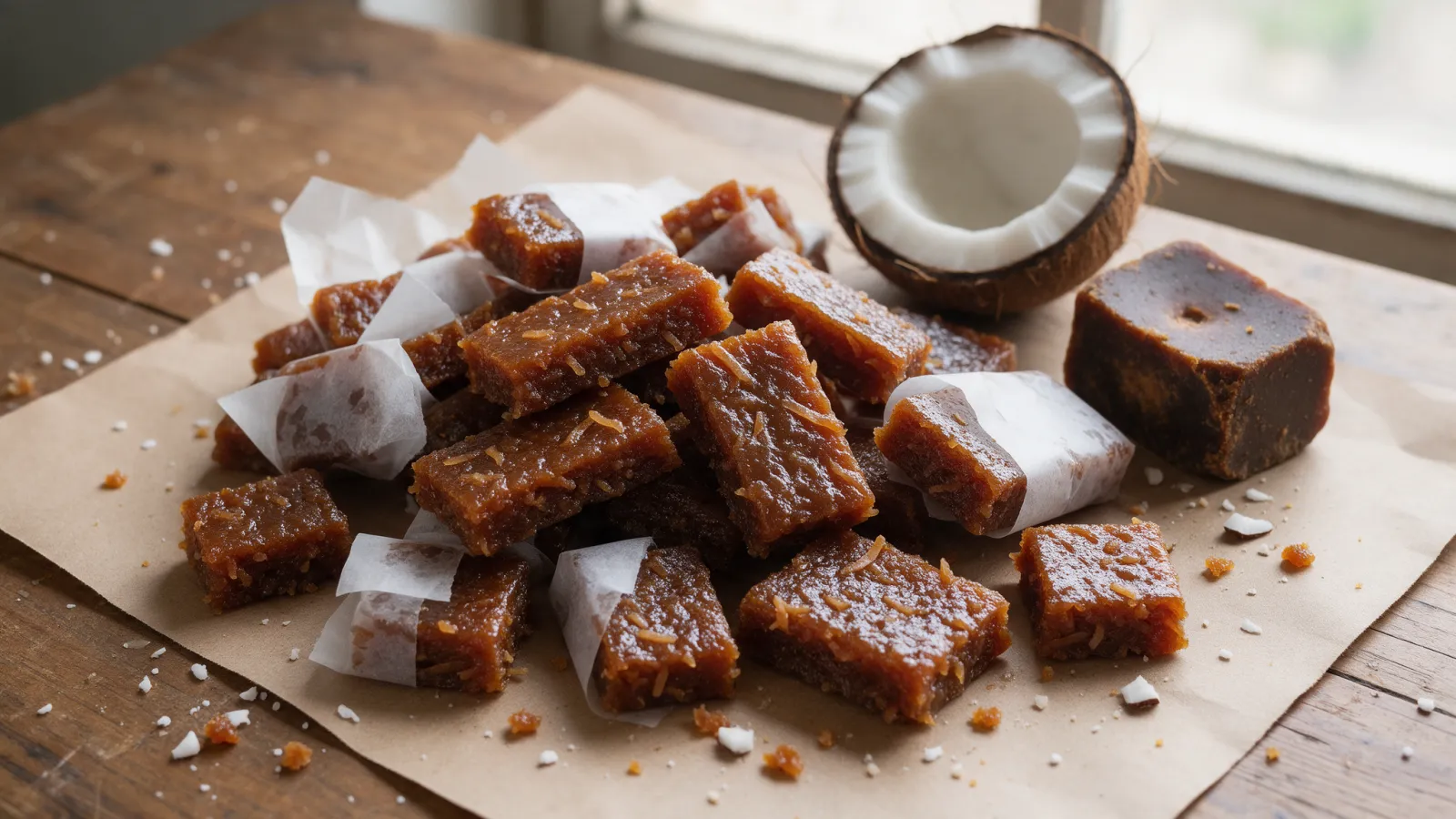

Conservas de coco are Venezuela’s wrapped coconut candy: fresh coconut grated fine and cooked with papelón, a dark unrefined cane sugar, until it turns into a glossy, chewy brown paste that you spread in a pan and cut into squares. Venezuelan bakeries sell them one by one in cellophane. If you know Jamaican coconut drops, this is the finer-grated cousin; if you grew up with British coconut ice, it is darker, chewier and made without condensed milk. This batch makes 25 squares of 1½ inches (4 cm), and the whole recipe hinges on one moment at the stove, which a candy thermometer reads as 234°F (112°C).
What are conservas de coco, and are they worth making?
How do you make Venezuelan coconut candy? Melt 14 oz (400 g) of papelón or piloncillo in 1 cup (250 ml) of water with grated ginger, add 17.6 oz (500 g) of finely grated fresh coconut and stir over medium-low heat for about 40 minutes, until the paste pulls away from the pot in one mass at 234-237°F (112-114°C). Spread it in an 8-inch (20 cm) square pan, cool, cut and wrap. 195 minutes for 25 servings.
They are worth it if you like deep, caramel-like sweets and have an afternoon free. Two main ingredients, no oven needed for the candy itself, and the result keeps for a week in a tin.
- Good for gift boxes, a dessert table, a lunchbox treat, or something sweet with black coffee.
- Not for anyone after a lightly sweet dessert: each piece carries about ½ oz (16 g) of cane sugar. Coconut allergies rule it out too.
- Naturally free of gluten, dairy and eggs, and vegan when made with papelón or brown sugar.
- Time: 195 minutes on the clock, about 100 of them hands-on. Forty of those go into cracking and grating the coconut, and 30 into stirring nonstop at the end.
- Difficulty: medium. Nothing about it is fancy, but the finish needs your full attention and a strong arm, and the paste spits.
One naming trap for anyone looking it up: in Venezuela, a “cocada” is a blended coconut drink, not this candy. The candy is always conserva de coco.
Ingredients and what to buy in the US and UK
Everything is weighed in the recipe card. The ratio that matters is coconut to sugar at 1.25 to 1 by weight, 17.6 oz (500 g) of coconut to 14 oz (400 g) of papelón. Published Venezuelan recipes range from equal weights to one and a half parts coconut; equal weights make a stickier, sweeter candy, and more coconut than this tends to stay jammy instead of setting firm.
Papelón and the closest supermarket swaps
Papelón is cane juice boiled down and set into blocks. It tastes of molasses and caramel, which plain sugar does not.
| What you find | Where | Amount for one batch | What changes |
|---|---|---|---|
| Papelón or panela | Latin grocers, Amazon | 14 oz (400 g) | nothing, it is the same product |
| Piloncillo cones | Mexican aisle, US | 14 oz (400 g), almost two 8-oz (225 g) cones | nothing; grate or chop it first |
| Dark muscovado | most UK supermarkets | 14 oz (400 g) | very close, and it dissolves faster |
| Dark brown sugar | any US or UK store | 14 oz (400 g), about 1¾ packed cups | a little lighter in color and flavor |
| White granulated sugar | anywhere | 14 oz (400 g) | the pale “white conservas”, a cleaner coconut taste |
Fresh, dried or sweetened coconut
Fresh coconut gives the classic result: juicy strands with real chew. Plan on 2 medium coconuts. The USDA counts about 14 oz (397 g) of meat in a medium coconut and Joy of Baking puts a whole one at about 1½ lb (680 g), so weigh the peeled meat rather than trusting the count.
Unsweetened desiccated coconut is the easy route. Fresh coconut is close to half water, so 9.5 oz (270 g) of desiccated coconut soaked for 20 minutes in 1 cup (250 ml) of hot water stands in for 17.6 oz (500 g) of fresh. Then cook it with the recipe’s own cup of water. The candy comes out a little finer and drier, and the coconut flavor is flatter. In the UK it is the standard desiccated coconut in the baking aisle; in the US, look for “unsweetened shredded coconut”.
Sweetened flaked coconut is a poor fit. It is 43% sugar by weight according to the USDA, so the candy ends up oversweet and soft. If it is all you can get, I use 10.5 oz (300 g) and cut the papelón to 8.8 oz (250 g).
Ginger, clove and salt
A 1½-inch (4 cm) knob of fresh ginger, about ½ oz (15 g) grated, gives a mild warmth that cuts the sweetness. Four whole cloves are the other traditional choice. A pinch of salt sharpens the cane flavor. Both spices are optional; lemon zest or a cinnamon stick also turn up in Venezuelan kitchens.
Equipment and workarounds
A heavy-bottomed 3-4 quart (3-4 L) pot is the one thing you should not improvise: a thin pot scorches the sugar before the center is ready. Beyond that, a long-handled wooden spoon, an 8-inch (20 cm) square pan, parchment, a big knife and a hammer. No square pan? Spread the paste into a square a scant ⅝ inch (15 mm) thick on a lined sheet pan, or drop it by the spoonful onto wax paper. No box grater patience? Pulse the coconut meat in a food processor.
How to crack a fresh coconut without a fight
Poke out two of the three “eyes” with a clean nail or screwdriver and drain the water through a sieve; keep it for the syrup. Bake the coconut 15 minutes at 350°F (175°C), the method the University of Florida’s extension service (UF/IFAS) recommends: the meat shrinks away from the shell. Tap it hard around the middle with a hammer until it splits, lever the meat out with a blunt knife and peel off the brown skin with a vegetable peeler. That skin darkens the candy and leaves tough flecks.
Make-ahead plan and cooking day
The day before, grate the coconut. UF/IFAS gives freshly grated coconut 3-4 days in the fridge and 8-12 months in the freezer. With the coconut ready, cooking day drops to about 155 minutes, most of it cooling.
On the day, line the pan with parchment that hangs over two sides, so the whole slab lifts out. Melt the sugar, add the coconut, and from there stay at the stove.
Scaling for 12, 25 or 50 pieces
- 10-12 pieces → half the recipe, spread in half the pan with the parchment folded up as a wall. With less paste it reaches the stage sooner, so start checking after 25 minutes with the coconut.
- 25 pieces → the recipe as written.
- 50 pieces → two batches back to back, not one double batch. Two pounds of coconut in one pot takes far longer to reduce and the bottom burns before the middle sets. I spread the first batch and start the second while it cools.
How to tell when it’s done, at 234°F (112°C)
The cook runs in three phases. For the first 10 minutes over medium heat, the coconut swims loose in syrup; stir every minute. Turn the heat to medium-low: around the 20-minute mark the bubbles turn thick and slow and the syrup stops running. The final stretch, roughly a quarter of an hour, decides everything.
Signs it’s ready
- The paste pulls away from the bottom and sides and turns as one mass with the spoon.
- A spoon dragged across the bottom leaves a clear trail for 2-3 seconds before it closes.
- The color shifts from light brown to a glossy mahogany.
- A candy thermometer reads 234-237°F (112-114°C), the start of the soft-ball stage on the Exploratorium’s sugar-stage chart, and the same 234°F the food.com coconut candy recipe uses. The probe reads unevenly in a paste this thick, so push it into the center without touching the bottom, and trust the spoon trail as well. A drop in cold water should squeeze into a soft ball, not dissolve.
Cutting and wrapping 25 neat squares
Scrape the hot paste into the pan and press it level to a scant ⅝ inch (15 mm); an oiled spoon works, a second sheet of parchment works better. After 30 minutes, when it is warm and the top is firm, score a 5 x 5 grid with an oiled knife. Wait until it is fully cold and it cracks instead of cutting.
An hour later, lift the slab out, dip the knife in hot water, wipe it dry and cut straight down along the scores in one push, no sawing. Wrap each square in a 4-inch (10 cm) square of wax paper or cellophane, tucking the ends underneath. Wrap them cold; warm squares sweat inside the paper and stick.
Why conservas burn, stay soft or turn hard
- Burnt bottom → thin pot or high heat. Cane sugar scorches in a minute or two. If you smell it, tip the candy into a clean pot without scraping the bottom.
- Too soft to cut → pulled before 230°F (110°C). Return it to the pot with 2 tablespoons of water and stir 5-10 minutes more, or dry the squares in the oven, 15 minutes at 300°F (150°C) and 30 minutes at 210°F (100°C), the fix the Cocina de Valen blog uses.
- Hard and cracking → past 245°F (118°C). No fix, but still good to eat in small pieces.
- Crumbly → desiccated coconut that was not soaked, or too much brown skin left on fresh coconut.
- Grainy → sugar crystals on the pot walls seeded the syrup. Brush the sides with a wet pastry brush while the papelón melts.
- Burns on skin → the paste is above 230°F (110°C) and spits. Long sleeves and a long spoon; kids watch from a distance.
Spice level: one out of five with ginger, none without. Kids love them; leave the ginger and clove out for little ones.
Conservas vs coconut drops, coconut ice and cocadas
- Jamaican coconut drops use diced dried coconut and lots of ginger, boiled with brown sugar and spooned out in rough clusters. Conservas are finely grated, use cane sugar and keep the ginger in the background.
- British coconut ice is desiccated coconut, condensed milk and sugar, often half pink, and much softer and milkier.
- Cocada covers many coconut sweets across Latin America and Spain, often with egg or milk and in many versions baked. In Colombia, a panela cocada is close to a conserva; in Venezuela, cocada is a drink.
Which version to make
- Short on time → desiccated coconut, soaked: about 175 minutes instead of 195, with no hammer.
- For a party table → white conservas with granulated sugar, with part of the batch tinted red or green.
- Creamier → some Venezuelan cooks add milk and condensed milk for a milky white version; it is no longer vegan.
- Spoonable → pull it before the set point, like thick jam, and keep it in a jar in the fridge.
What a batch costs in the US
Two fresh brown coconuts at $2.44 each and almost two 8-oz piloncillo cones at $1.28 from H-E-B bring a batch to $7.14, about 29 cents a square, before the ginger. The Bureau of Labor Statistics does not track average prices for coconuts or piloncillo, so this is one supermarket’s shelf price, not a national figure. The coconut is the expensive part; in Bogotá’s wholesale market it is 81% of the cost. I could not find a reliable UK price to quote.
Serving and storing
Serve them with black coffee or a glass of cold milk. Next to a glass of Venezuelan papelón con limón they are sugar on sugar; Colombian coconut lemonade balances them better. On a Venezuelan dessert table they sit beside majarete, the coconut and corn pudding, and green papaya in syrup. If you open coconuts and have meat to spare, Colombian coconut rice puts it to work. With papelón already in the pantry, Venezuelan catalinas turn it into soft spiced cookies for the same gift box.
At room temperature, wrapped and in a tin or airtight box somewhere cool, they keep up to 1 week, the window the food.com coconut candy recipe gives and the one I use with fresh coconut.
In the fridge, wrapped, about 2 weeks; they firm up, so give them 20 minutes on the counter before eating.
In the freezer, I keep them no longer than 2-3 months, wrapped and bagged. I found no official storage figure for this candy. Thaw 30 minutes in their paper.
Throw out any piece that smells rancid or shows mold: fresh coconut goes off long before the sugar does.
Conservas de coco FAQ
What does conserva de coco taste like? Deep cane sugar, almost like molasses toffee, with chewy coconut strands and a little warmth from ginger.
What temperature should coconut candy reach? 234-237°F (112-114°C), soft-ball stage. Past 245°F (118°C) it sets hard and cracks.
Can I use desiccated coconut instead of fresh? Yes, unsweetened: 9.5 oz (270 g) soaked 20 minutes in 1 cup (250 ml) of hot water replaces 17.6 oz (500 g) of fresh.
What can I use instead of papelón? Piloncillo or panela at the same weight, dark muscovado in the UK, or dark brown sugar.
Why didn’t my coconut candy set? It came off the heat too early. Cook it again with 2 tablespoons of water for 5-10 minutes, or dry the squares in a low oven.
How long does homemade coconut candy last? A week wrapped at room temperature, two weeks in the fridge, two to three months frozen.
Is it the same as a cocada? Close to the Colombian panela cocada. In Venezuela, cocada means a coconut drink.
Nutrition per square
Per serving (one 1½-inch square, 1/25 of the batch with ginger), calculated from USDA FoodData Central (SR Legacy) and the weights in this recipe. Papelón is not in that database, so brown sugar stands in:
- Calories: 132 kcal
- Protein: 1 g
- Carbohydrates: 19 g
- Sugars: 17 g
- Fat: 7 g, of which 6 g saturated
- Fiber: 2 g
- Sodium: 24 mg
Almost all of the fat is coconut fat, which is saturated. Two squares make a full dessert.
Back home in Venezuela nobody I knew made conservas; you bought them wrapped at the bakery, because grating coconut by hand took a whole afternoon. I learned in Colombia, where coconuts are cheap on the coast, and my first batch came off the stove too soon and had to be eaten with a spoon. Now I wait until I can see the bottom of the pot, and Dylan does the wrapping, one for the gift box and one for himself. Josnaisis.