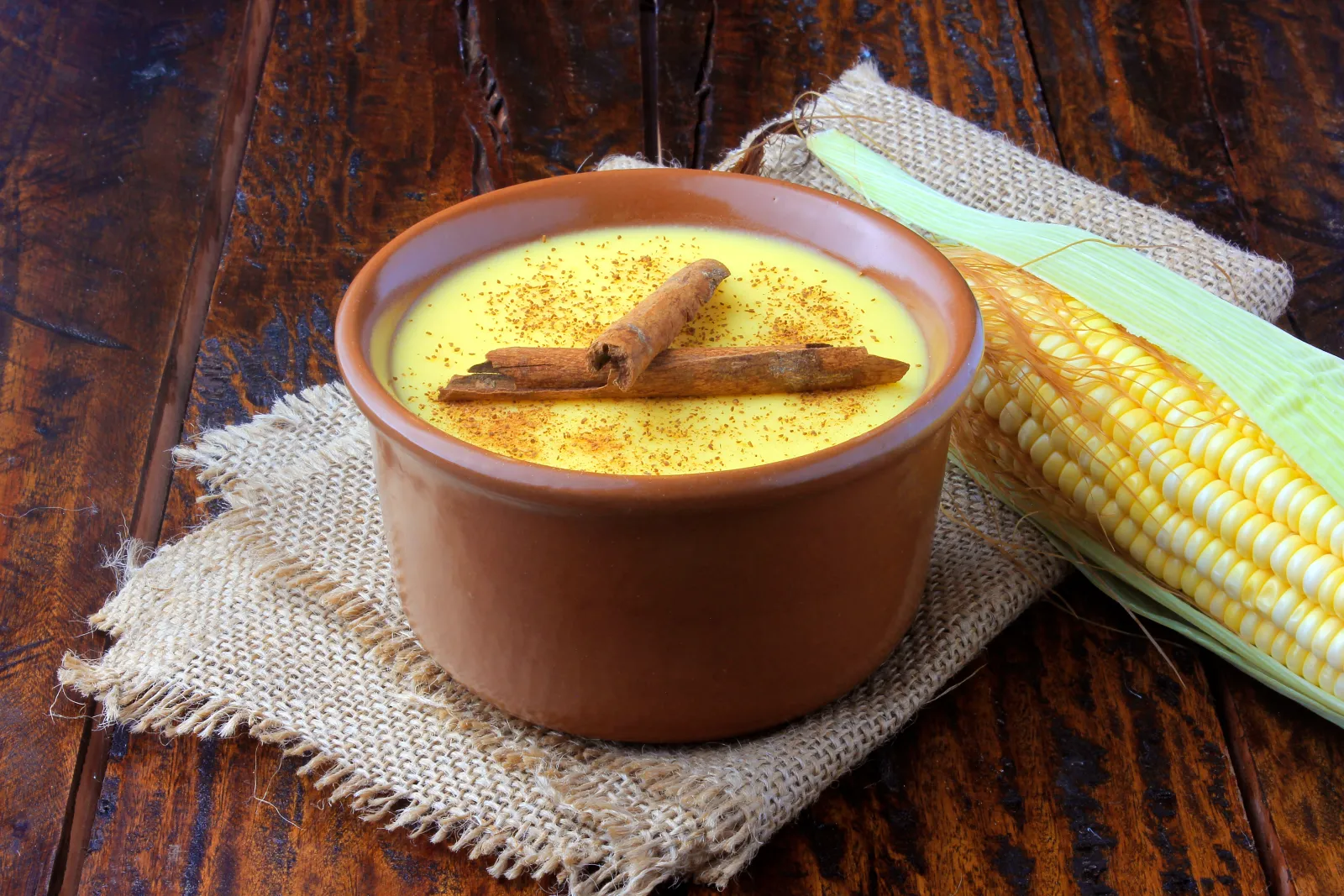

Majarete (mah-hah-REH-teh) is Venezuela’s coconut and corn pudding: corn flour cooked in coconut milk and whole milk with raw cane sugar, cinnamon and cloves, poured into a dish and chilled until it sets firm enough to cut into squares. No eggs, no oven. If you know Puerto Rican tembleque, picture that with corn in it and a darker, caramel-like sweetness. In Venezuela it’s an Easter-week sweet; the newspaper La Patilla listed it among the traditional desserts of Holy Week, next to sweet coconut rice.
What is majarete, and how do you make it?
How do you make Venezuelan majarete? Warm 800 ml (two cans) of coconut milk and 200 ml of milk with 250 g of papelón or dark brown sugar, cinnamon and cloves. Remove the spices, then whisk in 200 g of precooked corn flour that you’ve already dissolved in 500 ml of cold milk. Stir nonstop for 12 to 15 minutes until a line drawn through it closes slowly, pour into a dish and chill until set. 280 minutes for 10 servings.
The ratio is what makes or breaks it: 200 g of corn flour for 1.5 liters of liquid, about 133 g per liter, or roughly 1 cup of flour per quart. That gives squares that hold their shape and still wobble. Less and you get a spoonable cream; more and it turns stodgy and tastes of flour.
One name, several desserts. The Dominican majarete most English recipes describe is fresh or canned sweet corn blended with milk, strained and served soft in cups. Puerto Rico’s majarete is made with rice flour. The Venezuelan one is the coconut and corn version, and it’s the one on this page.
Is it worth making?
Yes, especially for a crowd. It’s about 30 minutes of hands-on work, the rest is fridge time, and it’s better made the day before. It needs no eggs, no oven and no special equipment.
When it shines. Easter, Christmas, a birthday, or any lunch for 8 to 12 people. It travels in its dish and is served cold, so it’s done long before guests arrive.
When to skip it. If you want something light: one square has 362 kcal and 16 g of saturated fat, almost all of it from the coconut milk. And if you’re after a silky egg custard, this is denser; a Venezuelan quesillo is the flan-style option.
Real timing. 280 minutes total, 40 at the stove, about 30 actually working.
What you need, with US and UK swaps
The corn flour, and the three it isn’t
The flour is precooked corn flour, the same one used for Colombian cheese arepas. Harina P.A.N. is the brand most US supermarkets carry in the Latin aisle; in the UK, look in Latin and international grocers or online. White or yellow both work; yellow gives a deeper color.
Three things are easy to grab by mistake:
- Masa harina (Maseca) is nixtamalized, treated with lime. It sets, but tastes of tortilla.
- Cornmeal or polenta is raw and gritty; it needs 40 minutes and never turns smooth.
- UK cornflour is cornstarch. It sets, but the corn flavor disappears and you’ve made a coconut custard.
Coconut milk, canned or homemade
Use full-fat canned coconut milk, unsweetened. It has about 21 g of fat per 100 g according to USDA data, and coconut fat firms up below about 75°F (24°C), which is why majarete made with canned milk slices so cleanly straight from the fridge.
| Coconut milk | What happens |
|---|---|
| Full-fat canned, 400 ml (13.5 fl oz) cans | the standard; firm, clean squares |
| Light canned | sets softer; fine if you add 20 g (2½ tbsp) extra corn flour |
| Homemade, 1 kg (2.2 lb) coconut blended with 800 ml (3⅓ cups) hot water and squeezed | lighter, more coconut aroma, softer set |
| Carton coconut “milk” drink | about 2 g fat per 100 g, a tenth of canned; it won’t set properly |
| Cream of coconut (Coco López) | sweetened for cocktails; far too sweet |
Papelón, and what to use instead
Papelón is unrefined whole cane sugar pressed into blocks, the same thing Colombians call panela and Mexicans call piloncillo. The same block sweetens Venezuelan catalinas, the soft spiced cookies sold in bakeries.
In a US supermarket, piloncillo cones are often in the Mexican aisle; grate them on a box grater or shave with a serrated knife. In the UK, dark muscovado is the closest supermarket match. White sugar works in a pinch, use 230 g (1 cup plus 2 tbsp) because it tastes sweeter, but the pudding comes out pale and one-note.
Equipment
A heavy 3-quart (3-liter) saucepan, a whisk, a wooden spoon or silicone spatula and a 9 x 13 inch (23 x 33 cm) or 8 x 12 inch (20 x 30 cm) dish. A thin pan works if you keep the heat lower and stir even more; the bottom catches within 30 seconds of neglect. No dish? Ten 6 oz (170 ml) ramekins or cups.
How to plan it
Make-ahead. Make it the afternoon before. Majarete is at its best on day two, once the coconut fat has fully set. Keep the plastic wrap pressed on the surface and cut just before serving.
How to tell each stage is right.
| Stage | What you should see |
|---|---|
| Sugar, 8-10 min | no hard bits when you scrape the bottom |
| Stirring, minute 5 | coats the back of the spoon with an opaque layer |
| Stirring, minute 10 | thick bubbles pop and spit; lower the heat if they jump |
| Done, minute 12-15 | a line across the bottom closes in 2-3 seconds; mixture pulls from the sides |
| Set, 4 hours | tilting the dish doesn’t make it slide; a knife comes out nearly clean |
Scaling for 4-6 or for 20
- 4 to 6 people → halve everything; use a 2-quart pan and an 8 x 8 inch (20 x 20 cm) dish. Stirring drops to 10-12 minutes.
- 20 people → double it in a 5- or 6-quart pot and use two 9 x 13 inch dishes. Twice the mass means 18-20 minutes of stirring; get someone to take turns. Don’t triple it in one pot, it scorches before it thickens.
Before you cook, the mistakes that matter
- Lumps → the flour went into hot milk dry. Fix it off the heat with an immersion blender, 30 seconds, then carry on.
- It didn’t set → pulled too early, or carton coconut drink. If it’s still soft after 4 hours, return it to the pan with 20 g (2½ tbsp) corn flour whisked into 100 ml (scant ½ cup) cold milk, and cook 5 minutes, stirring.
- Grainy, floury taste → too much flour (over 200 g per liter) or under 10 minutes on the heat.
- Burnt taste → the bottom scorched. Don’t scrape; pour the top into a clean pan and finish there.
- Skin or cracks → it cooled uncovered. Plastic wrap on the surface prevents both.
- Weeping on day 3 → normal for a starch pudding; pour off the liquid.
Spice level, 0 out of 5. The cloves are strong; for small children, use 2 instead of 4.
Kids? Usually a hit. With 28 g of sugars per square, cut theirs half-size.
Allergens. Contains milk. No eggs, no wheat; corn flour is naturally gluten-free, but buy a certified bag if you cook for someone with celiac disease. Some people are allergic to coconut, so mention it to guests.
Which version should you make?
- Short on time → this recipe, with precooked flour and canned coconut milk.
- With fresh corn → the older, slower way: swap the flour for 800-900 g (about 5 cups) of kernels from roughly 6 ears, blended with the 700 ml of milk and pressed through a fine sieve. Cook 25-30 minutes. Very young corn may need 30 g (¼ cup) cornstarch to set. It tastes far more of fresh corn, and the same ears could go into a Venezuelan corn cake.
- Dairy-free or vegan → 1.5 liters of coconut milk (three cans plus 300 ml / 1¼ cups water) instead of both milks. Richer and firmer.
- Lighter → one can of coconut milk plus 400 ml (1⅔ cups) more whole milk: about 313 kcal and 12 g of fat per square, with a softer set.
- For a party → the 20-person batch cut into 30 small squares, finger food.
Majarete next to tembleque, natilla and the Dominican version
Colombian natilla sets with 120 g of cornstarch per liter of milk and panela, so it’s the closest relative in method. Colombian mazamorra shares only the corn: whole hominy-style kernels simmered for 2 hours, eaten cold in their cooking liquid with milk and sugar on the side.
What it costs
At the US city average prices the Bureau of Labor Statistics published for August 2026, whole milk was $4.23 a gallon, so the 700 ml (scant 3 cups) here costs about $0.78. White sugar was $1.02 a pound. The BLS doesn’t track coconut milk, precooked corn flour or piloncillo, so I won’t guess at them, but the two cans of coconut milk are almost always the biggest line on the receipt. In Colombia, where I cook, the coconut was 74 % of the cost of the ingredients that the government’s wholesale price survey tracks.
Yield. 10 squares of about 170 g (6 oz) each, or 15 smaller ones after a big meal.
What to expect, serving and storage
Taste and texture. Smooth, dense and tender, with a wobble. Coconut and caramel first, corn underneath, cloves at the finish. Straight from the fridge it’s firm; after 20 minutes at room temperature it softens and tastes sweeter.
How to serve it. Cold, in squares, dusted with cinnamon. I serve it plain with black coffee. For a Venezuelan spread, add glasses of cold Venezuelan chicha, the rice drink, and at Christmas a bowl of green papaya in syrup or a plate of Venezuelan green mango paste cut into squares.
Fridge. Per USDA FSIS guidance for leftovers, refrigerate within 2 hours of cooking and keep it 3 to 4 days at 40°F (4°C) or below, covered.
Freezer. I don’t freeze it. Thawed, the starch releases water and the texture turns spongy.
Reheating. Don’t. Majarete is eaten cold or at room temperature; take it out 20 minutes early if you prefer it softer, and don’t leave it out more than 2 hours.
Frequently asked questions
What is majarete made of? In Venezuela, corn (precooked corn flour or fresh corn), coconut milk, milk, papelón, cinnamon and cloves. No eggs.
Is majarete the same as tembleque? No. Tembleque is Puerto Rican coconut pudding thickened with cornstarch and has no corn flavor. Majarete tastes of corn and coconut.
Can I use cornstarch instead of corn flour? It will set, at about 120 g per liter, but you lose the corn flavor and end up closer to tembleque or natilla.
Why didn’t my majarete set? It came off the heat too soon, or the coconut milk was a carton drink. You need 133 g of flour per liter and a spoon line that takes 2-3 seconds to close.
How do I keep it from getting lumpy? Whisk the corn flour into cold milk first and pour it into the hot pan in a stream while whisking.
How long does majarete last? 3 to 4 days in the fridge at 40°F (4°C) or below. It may weep a little by day 3.
Is majarete gluten-free? The ingredients are. Use a corn flour labeled gluten-free if you cook for someone with celiac disease.
Can I make it dairy-free? Yes: replace both milks with 1.5 liters of coconut milk (three cans plus 300 ml water).
Nutrition
Per square, about 170 g (6 oz), one of 10. Calculated from USDA FoodData Central (SR Legacy) with the quantities above, using canned coconut milk, whole milk, degermed white cornmeal as a stand-in for precooked corn flour, and brown sugar as a stand-in for papelón:
- Calories: 362 kcal
- Protein: 5 g
- Carbohydrates: 46 g
- Fat: 19 g, of which 16 g saturated
- Fiber: 1 g
- Sugars: 28 g
- Sodium: 107 mg
Coconut milk supplies 41 % of the calories and nearly all the saturated fat; the lighter version takes about 49 kcal and 7 g of fat off each square.
I learned majarete in Venezuela with whatever spoon was nearest, and lumps were part of the deal until I started whisking the flour into cold milk. Now I make it in Colombia with panela from the corner shop, and the stirring is still the only part that needs me. Fifteen minutes of patience, four hours of fridge, no lumps. Josnaisis.