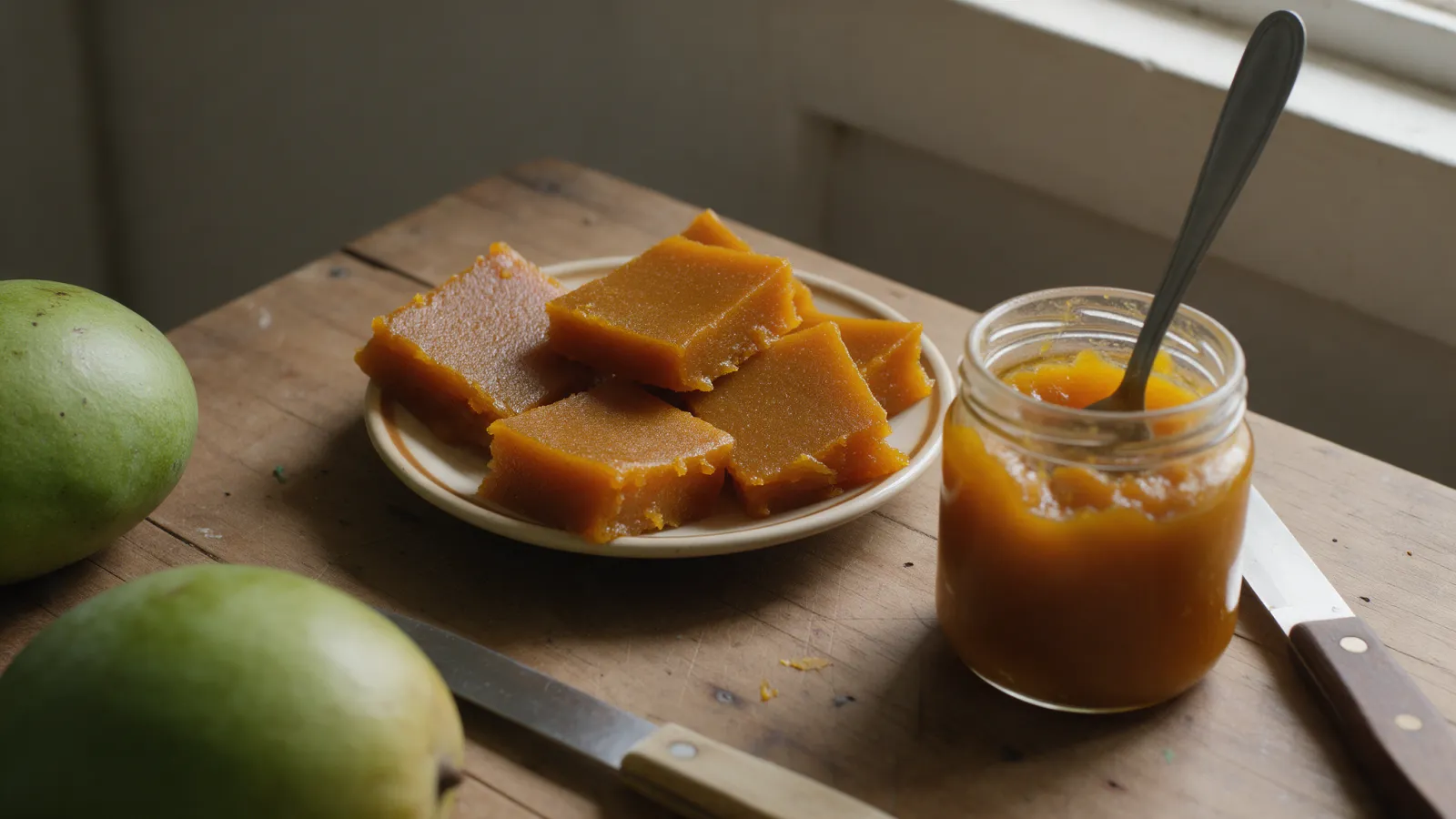

Jalea de mango (HAH-leh-ah deh MAHN-go) is not a clear jelly in the American sense. It is Venezuela’s mango paste: unripe mangoes boiled whole, their flesh scraped and sieved, then stirred with an equal weight of sugar until the purée turns amber and thick enough to cut into squares or spoon into jars. Think of it as a cousin of guava paste or Spanish membrillo, made at home from mangoes nobody wanted to wait for. Venezuelan cooks sell it at markets and roadside stands and give it away in jars, and it shows up around Easter, but you can make it whenever you can find hard green mangoes.
What is jalea de mango, and is it worth making?
How do you make Venezuelan jalea de mango? Simmer whole green or half-ripe mangoes for 35-40 minutes until the skins split, then scrape and sieve the flesh. Cook the pulp with its own weight in sugar, lime juice, cloves and cinnamon, stirring for 35-45 minutes, to 220°F (104°C) for a spoonable jar version or until it pulls away from the pot for firm squares. Ready in 130 minutes for 25 servings.
It is worth it if you like tart fruit sweets and have an afternoon. Three ingredients do the work, mango, sugar and acid, and no pectin, gelatin or cornstarch is needed because green mango brings its own acid. What it asks for is patience: 130 minutes in total, about 75 of them hands-on, and 45 of those are spent stirring a pot that spits.
Skip it if you want a quick dessert or a low-sugar one. The traditional ratio is one to one by weight, and cutting the sugar has costs explained below.
Green, half-ripe or ripe mango, which works best
Green or half-ripe. Unripe mango is far more acidic and less sugary than ripe. In a UC Davis study of Keitt mangoes, titratable acidity fell from 0.62% to 0.20% between green and ripe fruit, while soluble solids, mostly sugar, rose from about 9% to 17%. That is roughly three times the acid in green fruit.
Acid is what helps pectin form a gel. Penn State Extension puts it this way for fruit in general: slightly under-ripe fruit has the most pectin, the pectin drops as the fruit ripens, and soft over-ripe fruit is also less acidic. For mango specifically the pectin research is less consistent than the acidity data, so the acid is the number to trust.
If ripe mangoes are all you have, make the jar version, use 3 tablespoons of lime juice, and if you can, swap in a quarter of the fruit as green mangoes. That three-to-one mix of ripe and under-ripe fruit is what the National Center for Home Food Preservation (NCHFP) recommends for jellies made without added pectin.
Ingredients and how to shop for them in the US and UK
| Venezuelan ingredient | What it is | US and UK stand-in | What changes |
|---|---|---|---|
| Mango verde or pintón | hard green or half-ripe mango | green mango from Asian grocers; the hardest Tommy Atkins or Kent at the supermarket, used before it softens | supermarket mangoes are often half-ripe, so expect a sweeter, slightly softer set |
| Mango de hilacha | a stringy Venezuelan variety | any mango; sieve if fibrous | none, once sieved |
| Azúcar or papelón | white sugar or unrefined cane sugar | granulated sugar, or piloncillo (Mexican aisle, US), panela or dark muscovado (UK) | cane sugar makes it darker with a molasses note |
| Limón | small sour lime | lime, or half a lemon | none worth noticing |
How much sugar, and why it is one to one
1 kg (5 cups) of sugar for every 1 kg (2.2 lb) of sieved pulp. Three Venezuelan recipes I checked (Curadas, Notiapure and the Sucre state tourism site) use that ratio. Weigh the pulp, not the mangoes: depending on the variety and the stringiness, sieved pulp is 40-60% of the whole fruit’s weight.
You can go down to about 750 g (3¾ cups) per kilo of pulp for a less sweet jar, but it takes longer to thicken, sets softer, and, as the NCHFP notes for reduced-sugar spreads, keeps for less time in the fridge. Recipes with a fraction of the sugar plus cornstarch give a mango pudding that neither slices nor keeps.
Equipment
A wide, heavy-based pot of 4-5 litres (4-5 quarts), a long-handled wooden spoon, a mesh sieve, an 8x8-inch (20x20 cm) glass dish or five half-pint jars. A Dutch oven is ideal; a thin stockpot is where this scorches. A candy thermometer helps but a frozen plate does the same job.
The plan, start to finish
Make-ahead. Boil the mangoes and sieve the pulp the day before; covered in the fridge it is fine overnight. Squares are also easier with a day’s margin, since they set overnight and cut cleanly in the morning.
While things simmer. Sterilise jars or wet the dish while the mangoes boil. Weigh the sugar and squeeze the limes while they cool. After that it is the pot and the spoon until the end.
Scaling the batch
| You have | Sieved pulp | Sugar | Lime juice | Spices | Yield | Pulp cooking time |
|---|---|---|---|---|---|---|
| 1 kg (2.2 lb) whole mangoes | about 500 g (1.1 lb) | 500 g (2½ cups) | 1 tbsp (15 ml) | 2 cloves, ½ stick | 10 squares in an 8x4-inch (20x10 cm) dish, or 2-3 jars | 25-30 min |
| 2 kg (4.4 lb), this recipe | about 1 kg (2.2 lb) | 1 kg (5 cups) | 2 tbsp (30 ml) | 4 cloves, 1 stick | 25 squares, or 5 half-pints | 35-45 min |
| 4 kg (8.8 lb), gifts or a party | about 2 kg (4.4 lb) | 2 kg (10 cups) | 4 tbsp (60 ml) | 8 cloves, 2 sticks | 50 squares, or 10 half-pints | two pots, 35-45 min each |
For a double batch, use two pots. Twice the purée in one pot takes much longer to evaporate, catches on the bottom sooner, and is exhausting to stir.
How to tell when jalea de mango is set
At sea level, 220°F (104°C) for jars. The jelling point, according to the NCHFP, is 8°F above the boiling point of water, and it drops 2°F for every 1,000 feet of altitude. In Denver or anywhere high, boil a pan of water first, read the thermometer and add 8°F.
Without a thermometer:
- The frozen-plate test. Put a small plate in the freezer when you start. Drop a teaspoon of the mixture on it, freeze 2 minutes and push it with a finger. If it wrinkles and the line stays open, it is ready for jars. Take the pot off the heat while you test.
- The pull-away test, for squares. Curadas and Sucre’s tourism site describe the same sign: the paste comes away easily from the bottom and sides of the pot and drops from the spoon in one lump without running. In my kitchen that comes 5-10 minutes after the jar stage.
Keeping it from scorching, and from burning you
Sugar catches on the bottom long before the top shows it. Use a heavy pot, medium heat, then medium-low for the last 15 minutes, and keep the spoon moving into the corners. If you smell dark caramel or see black flecks, tip the jalea into a clean pot without scraping: the scorched layer will flavour everything.
At 220°F (104°C) it bubbles like lava and the splashes burn. I wear an oven glove on the stirring hand and never lean over the pot.
One more caution from the NCHFP: handling raw green mango can irritate the skin of some people the way poison ivy does, because the plants are related. If that has happened to you, peel with gloves and keep your hands away from your face.
Squares or jars, and other versions
- Squares → green mango, one-to-one sugar, cooked to the pull-away stage. Sliced like guava paste, with or without cheese.
- Jars → half-ripe mango, 220°F (104°C) or the plate test. A spread for toast and crackers.
- Short on time → boil the mangoes the day before and blend instead of sieving; about 55 minutes at the stove on the day.
- Only ripe mangoes → jars, 3 tbsp lime juice, a quarter green fruit if possible.
- With piloncillo or panela → same weight as the sugar. Darker, with a molasses edge, closer to market-stall jalea.
- Less sweet → down to 750 g (3¾ cups) sugar per kilo of pulp, jars only, fridge only.
Jalea de mango vs guava paste, ate and jam
They all start as fruit and sugar, and they are not interchangeable:
- Colombian bocadillo veleño is guava paste from Vélez in Santander, wrapped in bijao leaves and protected by a denomination of origin since 2017. It is the filling in a Colombian guava roll.
- Mexican ate is fruit cooked down with sugar, most often guava, quince or tejocote, sold in blocks and eaten sliced, often with cheese.
- Spanish membrillo is the quince version found in UK and US delis next to the Manchego.
- Jam is spreadable and often has fruit pieces. Jarred jalea de mango does the same job at breakfast, but it is smooth because the pulp is sieved.
Cut into squares, jalea de mango sits closest to ate and bocadillo, a little softer and made with mango.
Mistakes that ruin jalea de mango
- It never sets → not cooked long enough, too little sugar, or ripe fruit with no acid. Back on the heat for 5-10 minutes, with an extra tablespoon of lime if the mangoes were ripe.
- It sets like toffee → overcooked. Jars can be loosened with 3-4 tbsp hot water and a quick boil; squares cannot, but they are still edible.
- It tastes burnt → high heat or a thin pot. Change pots without scraping.
- Stringy mouthfeel → a fibrous mango blended rather than sieved.
- Squares stick to the knife → cut before 4 hours, or with a dry blade. Wet it between cuts.
What it costs in the US
With mangoes at the USDA AMS advertised average of $1.20 each (week of October 9, 2026), sugar at the BLS August 2026 average of $1.024 a pound and limes at the AMS average of $0.50 each, a 25-square batch costs about $9.26, or 37 cents a square, before the cloves and cinnamon, which have no official price series. Asian-grocer green mangoes may be priced by the pound and cost more or less than that.
Yield. About 1.6 kg (3½ lb) of jalea: 25 squares of 1½ in (4 cm), roughly 65 g (2.3 oz) each, or 5 half-pint jars.
Storing, sterilising jars and freezing
- Sterilised jars, refrigerated → up to 3 weeks. The NCHFP says anything processed for less than 10 minutes should go into sterilised jars: boil them 10 minutes at under 1,000 feet, plus 1 minute for every extra 1,000 feet. There is no USDA-tested canning process for jalea de mango, and the only mango product the NCHFP has tested for the pantry is a mango sauce with bottled lemon juice. So I keep it in the fridge, not the cupboard.
- After opening → the NCHFP gives opened regular cooked jams 1 month in the fridge at 40°F (4°C) or below; I count my 3 weeks from the day I make it.
- Squares → in a container with baking paper between layers, refrigerated, also 3 weeks. I do not leave them out for more than a day.
- Freezer → up to 1 year, the NCHFP’s limit for freezer jams. Freeze squares separated by baking paper and thaw in the fridge.
- Reduced-sugar batches → shorter. Use them within two weeks.
How to serve it
Cold or at room temperature, never reheated. A 1½-inch (4 cm) square goes on a dessert plate with a slice of fresh white cheese, about 30 g (1 oz), the way guava paste is served. From the jar it goes on toast, crackers or Colombian cheese arepas, or as a cake filling. It belongs on a Venezuelan sweets table with green papaya in syrup, majarete coconut pudding, figs in syrup and a slice of Venezuelan quesillo, with a glass of papelón con limón.
Jalea de mango FAQ
Can I use ripe mangoes? Yes, for a softer jar version. Add 3 tbsp lime juice and, if you can, replace a quarter of the fruit with green mangoes.
How much sugar for 1 kg (2.2 lb) of mangoes? That much whole fruit gives about 500 g (1.1 lb) of pulp, which takes 500 g (2½ cups) of sugar. The rule is equal weights of sieved pulp and sugar.
What temperature is jalea de mango done? 220°F (104°C) at sea level for jars, or 8°F (4°C) above your local boiling point. Squares cook a little past that, until the paste pulls away from the pot.
Why didn’t my mango paste set? It needed more cooking, more sugar or more acid. Return it to the pot for 5-10 minutes with a tablespoon of lime juice.
How long does it keep? Up to 3 weeks in sterilised jars in the fridge and a year in the freezer.
Can I can it for the pantry? There is no USDA-tested process for this product, so I refrigerate or freeze it.
Does it need pectin or gelatin? No. Green mango’s acid and the one-to-one sugar ratio set it.
Is it the same as guava paste? Same family, different fruit. Guava paste and ate are firm fruit pastes; jalea de mango in squares is the mango version, usually a little softer.
Is it gluten-free and dairy-free? Yes, as written. Some versions thicken with wheat flour, which adds gluten.
Nutrition per serving
Per square (1/25 of the batch, about 65 g / 2.3 oz), calculated from USDA FoodData Central (SR Legacy) with this recipe’s amounts: 1 kg pulp as raw mango, 1 kg sugar and 30 ml lime juice.
- Calories: 179 kcal
- Protein: 0 g
- Carbohydrates: 46 g
- Sugars: 45 g
- Fat: 0 g
- Fibre: 1 g
- Sodium: 1 mg
USDA only lists ripe mango. Green mango has less natural sugar, but 86% of the calories come from the added sugar, so the difference is small. Made with piloncillo, calculated as brown sugar, a square is 176 kcal.
Growing up in Venezuela, the green mangoes that fell before anyone wanted them ended up as jalea, and the trick I had to learn was the set. My first batch stayed soft enough to drink and my second turned into a slab. Now, in Colombia, the plate goes in the freezer before I even wash the mangoes, and Dylan is the one who shouts when the paste starts pulling away from the pot. Josnaisis.