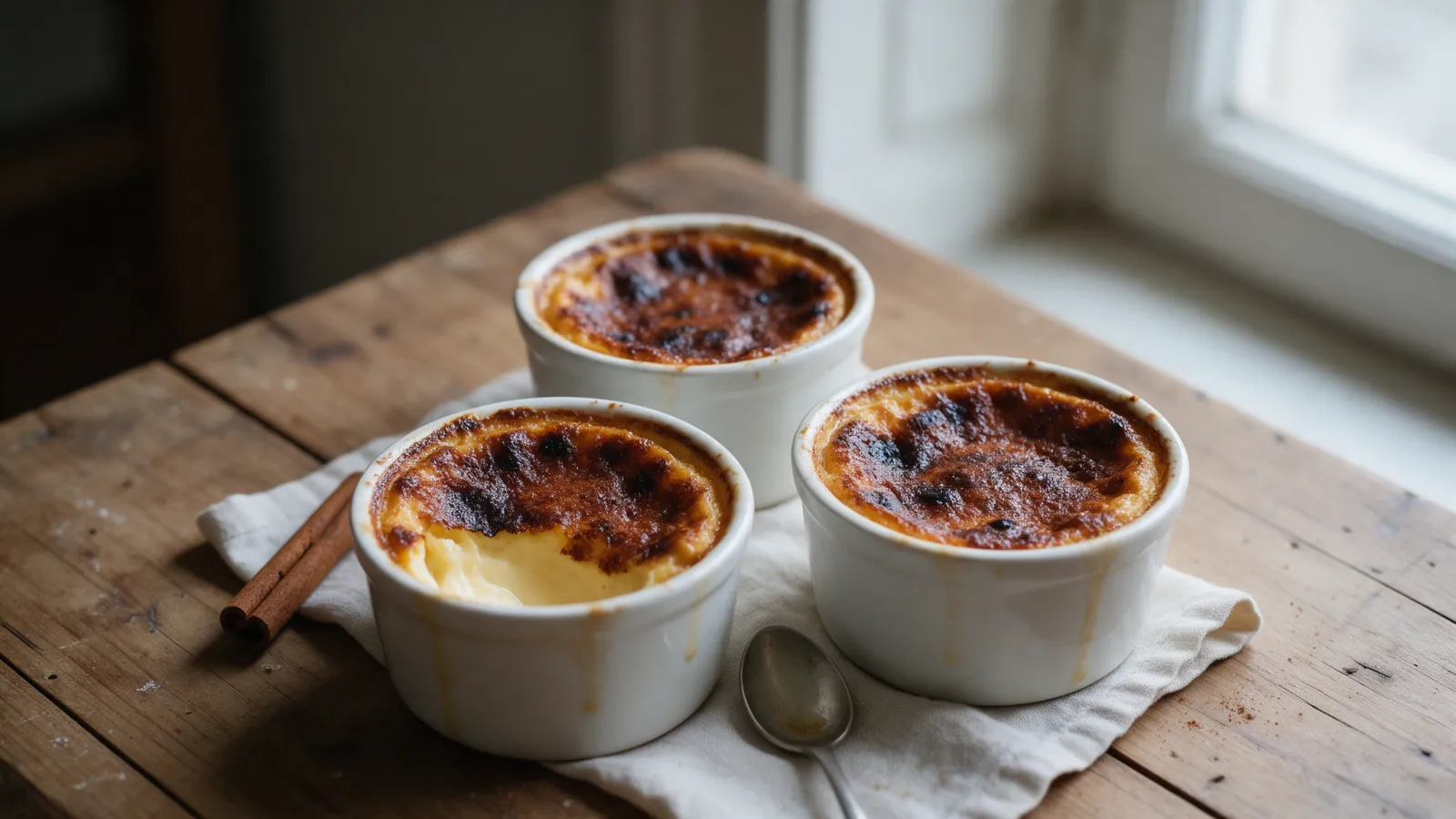

Jericalla (heh-ree-KAH-yah) is the custard of Guadalajara, in the Mexican state of Jalisco: whole milk steeped with a cinnamon stick, set with eggs, baked in small dishes and served cold under a thin, scorched skin. There is no caramel in it and no sugar sprinkled on top. That dark top is the custard itself, toasted, and it is the part people get wrong, because the heat that browns the surface will overcook the center if you leave it on long enough to do the job. I bake the body gently in a water bath and give the top two to seven minutes under the broiler, and below are the gram and cup measures, the center temperature to pull it at, and how it differs from flan and crème brûlée.
What jericalla is, and how it is made
How do you make jericalla? Steep whole milk with sugar and a cinnamon stick, whisk it warm into 3 eggs, 2 yolks and vanilla, strain, and bake in ramekins in a water bath at 350°F (180°C) for 30-35 minutes, to 170-175°F (77-79°C) in the center. Then broil 2-7 minutes until the tops are spotted dark brown and chill at least 2 hours. Ready in 210 minutes for 6 servings.
Think of it as a light, cinnamon-scented baked custard with a bittersweet lid. The body is milk rather than cream, so it eats lighter than crème brûlée, and the top is browned milk proteins and sugars rather than a sheet of caramel. In Guadalajara it comes in its own little dish and is eaten straight from it.
Where it came from is mostly legend. The story told in Mexican outlets such as Excélsior and Uno TV involves a nun at the Hospicio Cabañas orphanage who left a custard in the oven too long, and they present it as tradition, not record.
Is it worth making?
Yes, if you have a broiler and like desserts that are not very sweet. It is easier than flan: no caramel, no unmolding, and most of the 210 minutes is the fridge. Hands-on time is about 25 minutes. The one tricky moment is the broiler, where the gap between spotted brown and burnt is under a minute.
It is a good make-ahead dessert for a dinner party, and a light ending after something rich from the same region, like a beef birria. Skip it if you need it egg-free or dairy-free, or if you want a warm dessert.
Ingredients, with US and UK swaps
Everything is in a regular supermarket. Quantities are in the recipe card: 600 ml (2½ cups) milk, 90 g (scant ½ cup) sugar, 3 eggs and 2 yolks.
Why 3 eggs plus 2 yolks for 2½ cups of milk. The published recipes run from loose to almost flan-like: Olive Magazine uses 3 eggs for about 1½ cups (350 ml) of milk, Mama Maggie’s Kitchen 2 eggs and a yolk for about 2 cups (520 ml), and Directo al Paladar 4 yolks plus 30 g (¼ cup) cornstarch for 2 cups (480 ml). I sit in the middle. Whole eggs give the custard enough structure to hold up under the broiler, and the extra yolks keep it creamy.
- Cinnamon → the soft, flaky Ceylon stick, sold as canela or Mexican cinnamon in Latin grocery aisles and online. The hard, thick stick in most US supermarkets is cassia, which is hotter; if that is all you have, steep it only 10 minutes. In the UK, standard cinnamon sticks work.
- Milk → whole milk. Low-fat milk sets looser and browns less. For a richer custard, swap 160 ml (⅔ cup) of the milk for evaporated milk, as Olive Magazine and Mama Maggie’s Kitchen do.
- Sugar → granulated, or caster sugar in the UK. Ninety grams makes it gently sweet.
- Vanilla → pure extract. Imitation vanilla is obvious in something this plain. A split vanilla bean in the milk is even better.
- Eggs → large, at room temperature, so the custard does not start cold and take longer to set. Save the 2 leftover whites for meringue or an omelet.
Equipment, and what to use instead
Six 5-6 oz (150-180 ml) ceramic ramekins, a roasting pan deep enough for a water bath, a fine sieve and a jug. Oven-safe coffee cups or tempered glass jars of about 7 oz (200 ml) also work. An instant-read thermometer is the single most useful tool here. One larger dish of about 8 in (20 cm) works too; mine takes 45-50 minutes, and I check the center with the thermometer.
Water bath and doneness temperature
Always use a water bath, and start it with boiling water. All five recipes I compared use one. The water cannot climb past 212°F (100°C), which protects the sides and bottom of the ramekins while the center comes up to temperature. When America’s Test Kitchen compared baths started with cold water and with boiling water, the boiling ones cooked the custards fastest and gave the smoothest, most even texture. The towel under the ramekins keeps their bases off the hot metal.
Pull it at 170-175°F (77-79°C) in the center. That is the target in the Cook’s Illustrated custard recipe republished by ThermoWorks, and ThermoWorks puts the setting range of custards at about 160-180°F (71-82°C). The FDA asks for egg dishes to reach 160°F (71°C), so you are past the safety line. Push beyond 180°F (82°C) and the proteins tighten, squeeze out liquid and leave holes.
No thermometer? Nudge the pan with a towel. The edges should not move; a circle about 1 in (3 cm) across in the middle should wobble like gelatin. If it ripples like liquid, give it 5 more minutes. The toothpick test some recipes use comes out clean a little late.
Getting the scorched top
Broil at the end, 2-7 minutes. Olive Magazine uses a medium grill for 2 minutes, Mexican Made Meatless 3-4 minutes and Mama Maggie’s Kitchen 5-7 minutes. The range is that wide because home broilers vary that much, so the first time, check every minute. I broil with the ramekins still sitting in the water, which keeps protecting the sides; if your pan is so deep that the custard ends up closer than 4 in (10 cm) to the element, move them to a sheet pan.
What you are looking for is a top spotted dark brown to nearly black across most of the surface, with paler patches in between. A surface that is black all over will taste bitter.
No broiler? Do what Vitat does: bake at 400°F (200°C) in the water bath for about 40 minutes until the surface browns. The color is lighter and more even, and the center gets closer to overcooking, so use the thermometer.
Make-ahead plan and serving day
Jericalla is served cold, so the day before is the best day to make it. Mexican Made Meatless also bakes hers the day before and takes them out of the fridge about 10 minutes before dessert.
- The day before → steep, mix and bake (about 70 minutes, half of it hands-off), cool 15 minutes, cover and refrigerate.
- Up to 2 days ahead → you can steep and strain the milk and keep it chilled; warm it gently before whisking it into the eggs.
- Serving day → nothing to do but take them out of the fridge.
Scaling for 4, 12 or 20
| Guests | Milk | Sugar | Eggs | Ramekins |
|---|---|---|---|---|
| 3-4 | 300 ml (1¼ cups) | 45 g (3½ tbsp) | 1 egg + 2 yolks | 3 of 5-6 oz |
| 6 | 600 ml (2½ cups) | 90 g (scant ½ cup) | 3 eggs + 2 yolks | 6 of 5-6 oz |
| 12 | 1.2 liters (5 cups) | 180 g (scant 1 cup) | 6 eggs + 4 yolks | 12, two pans |
| 18-20 | 1.8 liters (7½ cups) | 270 g (1⅓ cups) | 9 eggs + 6 yolks | about 20 of 3½-4 oz |
Baking time depends on the size of the ramekin, not how many you bake. Small 3½-4 oz (100-120 ml) dishes set in 20-25 minutes. Broil one pan at a time.
Mistakes that ruin jericalla
- Bubbles and holes → the eggs were whisked into a foam, or the oven ran hot. Mix just until combined, strain, and skim the foam. ThermoWorks describes a finished custard as smooth with no bubbles on the surface.
- A watery puddle under the custard → it went past 180°F (82°C). Take it out while the center still wobbles.
- Bits of scrambled egg → the milk was too hot or went in all at once. Mama Maggie’s cools hers completely; I use it warm, after the 15-minute steep, and pour slowly.
- A bitter black lid → too long under the broiler. Spots are the goal, not full coverage.
- A pale top → the broiler is weak or the rack is too low. Move up a level.
- A cracked ramekin → cold ceramic straight under the broiler. The ramekins should already be hot from the oven.
Allergens and diets. Contains egg and milk. No flour, so it is naturally gluten-free. No heat at all from the cinnamon, and the kids in my house love it; just warn them the dishes stay hot well after broiling.
Which version should you make?
- Short on time → 3½ oz (100 ml) ramekins that set in 20-25 minutes, and 1 hour in the fridge, which is the minimum Mama Maggie’s gives.
- No oven → there is no real jericalla without one, because the top needs heat from above. A covered water bath on the stove gives a smooth, set custard like this stovetop flan, only without the scorched lid.
- Richer → evaporated milk for part of the milk, or the Directo al Paladar version with yolks and cornstarch.
- Less sweet → drop the sugar to 70 g (⅓ cup).
- Vegan → I would not. Mexican Made Meatless notes the eggs are very hard to replace, and without them it neither sets nor browns the same way.
Jericalla next to its relatives
A flan has caramel in the bottom of the mold and is turned out to serve; the flan napolitano is denser because of condensed milk and cream cheese, and the Venezuelan quesillo is the caramel cousin whose tiny holes are deliberate. A crème brûlée is cream and yolks with a sugar crust torched to order. Colombian natilla is a different dessert altogether, eggless and set with cornstarch; the Colombian natilla recipe explains it. If you love the cinnamon-milk flavor but do not want to bake, Colombian rice pudding uses the same steep.
What jericalla costs in the US
About $2.40 for six, or 40 cents a serving, using the BLS US city average prices for August 2026: eggs at $2.272 a dozen, whole milk at $4.229 a gallon and sugar at $1.024 a pound. The vanilla is McCormick pure extract at $6.84 for 2 fl oz on Walmart. The cinnamon stick is not counted.
The eggs are the biggest line, and teaspoon for teaspoon, pure vanilla is the most expensive thing in the recipe. I did not find official UK prices I could cite, so there is no figure in pounds.
Serving, storing and leftovers
Serve it cold, in the ramekin, so the scorched top shows. Mexican Made Meatless serves it plain, the traditional way; Directo al Paladar suggests fresh fruit or whipped cream. A cup of Mexican café de olla goes well with it.
Texture. Cold, it holds its shape when you dig in and is silky on the tongue, with a thin, bittersweet top. Directo al Paladar notes it turns denser as the days go by.
Fridge. 3-4 days, covered, which matches the FDA’s window for cooked egg dishes and what Mexican Made Meatless gives. Mama Maggie’s Kitchen says up to 3 days. After the second day the top softens a little.
Freezer. I do not freeze it, and Mama Maggie’s does not recommend it: the custard weeps when it thaws and the top goes soft.
Room temperature. No more than 2 hours out of the fridge, per the FDA.
Warm? It is meant cold, but you can eat it 20-30 minutes after broiling. Reheating a chilled one in the microwave curdles it.
Jericalla FAQ
What is jericalla? A traditional custard from Guadalajara, Jalisco, made with milk, eggs, sugar, cinnamon and vanilla, baked in individual dishes until the top scorches, and served cold.
What is the difference between jericalla and flan? Jericalla has no caramel and is not unmolded. It is served in its dish with the browned top showing, and it is flavored with cinnamon.
Is jericalla the same as crème brûlée? No. Crème brûlée is made with heavy cream and yolks and topped with sugar that is torched to a glassy crust. Jericalla uses milk and whole eggs, and its top is the custard itself, browned under the broiler.
How do you get the burnt top on jericalla? Bake it in a water bath at 350°F (180°C) to 170-175°F (77-79°C), then broil 2-7 minutes about 4-5 in (10-12 cm) from the element. Without a broiler, bake at 400°F (200°C) for about 40 minutes.
Do you need a water bath? Yes. The water never goes above 212°F (100°C), so the edges do not overcook before the center sets.
Why is my custard full of bubbles? The eggs were beaten to a foam or the custard overbaked. Whisk gently, strain, skim, and pull it while the center wobbles.
How long does jericalla keep? 3-4 days covered in the fridge. Do not leave it out for more than 2 hours.
Can you freeze jericalla? It is not a good idea. It weeps when thawed and the top loses its texture.
Nutrition per serving
Per serving (1/6 of the recipe, about 140 g or 5 oz), calculated from USDA FoodData Central (SR Legacy) and the quantities above:
- Calories: 177 kcal
- Protein: 7 g
- Carbohydrates: 20 g
- Sugars: 20 g
- Fat: 7 g, of which 3 g saturated
- Fiber: 0 g
- Sodium: 109 mg
About a third of the calories come from the added sugar; the rest is milk and egg. Spread over 8 small ramekins, it drops to about 133 kcal.
I grew up in Venezuela with quesillo, caramel and tiny holes and all, so my first jericalla felt almost bare. My first batch was worse: I left it in the oven hoping the top would brown by itself, and it came out watery, sitting in its own liquid. Now I pull it while it still wobbles and stand at the broiler counting minutes. That lid is worth the five minutes of attention. Josnaisis.