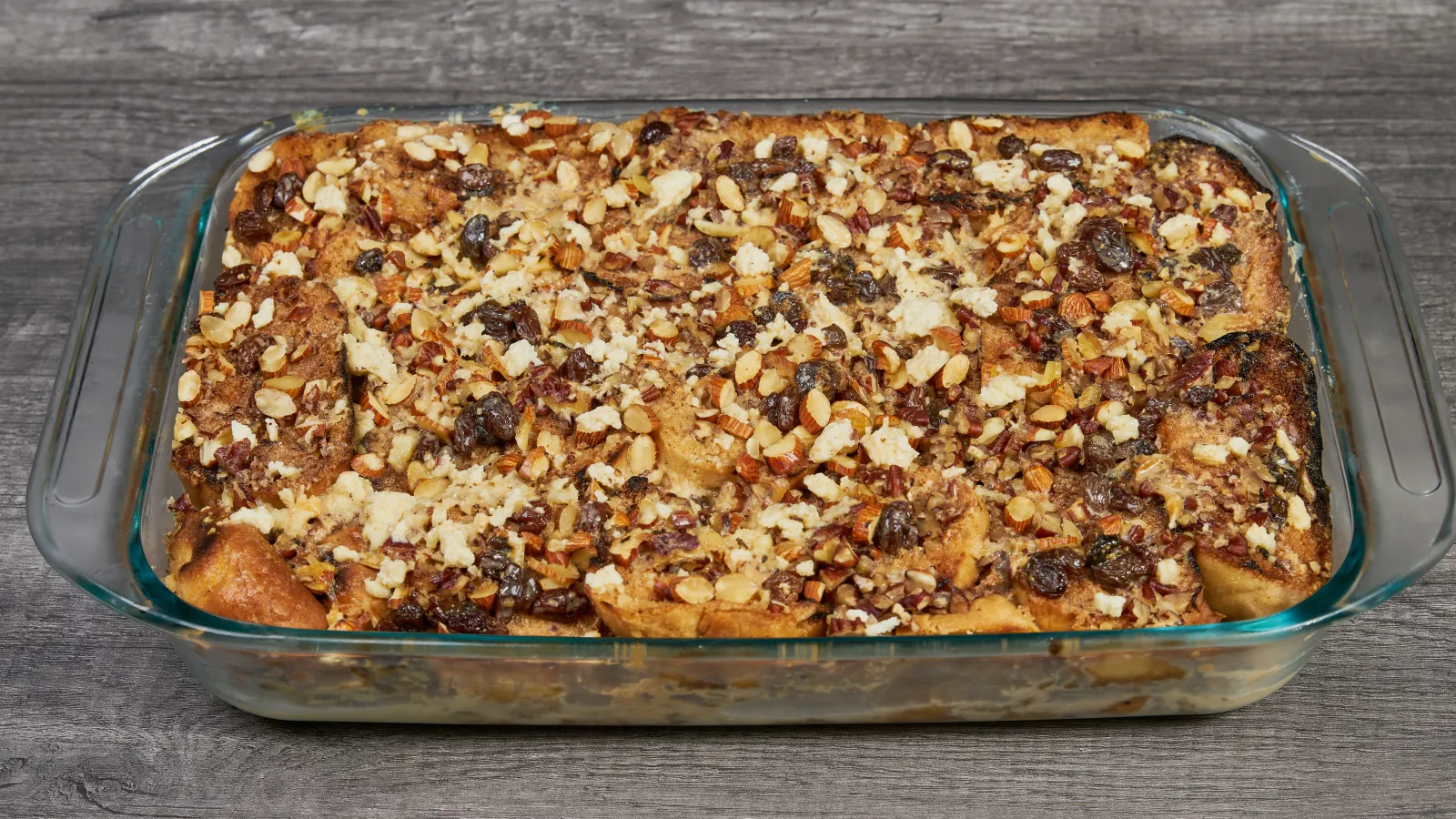

Capirotada (kah-pee-roh-TAH-dah) gets called Mexican bread pudding, but there is no custard in it. It is toasted day-old bread soaked in a dark syrup of piloncillo, an unrefined Mexican cane sugar, simmered with cinnamon and cloves, then layered with salty crumbled Cotija cheese, peanuts, raisins and fried plantain and baked until the top is golden. In Mexico it is the dessert of Lent and Good Friday. The part that decides whether it comes out dry or mushy is a single ratio, about 3¾ cups of syrup per pound of bread, and this recipe gives it in cups and liters, with the swaps you can find in a US or UK supermarket.
What is capirotada, and is it worth making?
How do you make capirotada? Simmer 1 lb (450 g) piloncillo in 5¼ cups (1.25 liters) water with cinnamon and cloves until it reduces to 1 liter, toast 1.1 lb (500 g) of sliced day-old bread with butter at 350°F (180°C), and layer it in a 9 x 13 in pan with fried plantain, peanuts, raisins and Cotija. Bake 30 minutes covered and 15 uncovered, then rest 20 minutes. 105 minutes for 12 servings.
Yes, if you like desserts that are sweet and salty at once. Each square is soft, dark bread that tastes of molasses and warm spice, with crunchy peanuts and a salty bite of cheese in every forkful. It is cheap, it uses up stale bread, and one 9 x 13 pan feeds 12.
Good for: Lent and Easter, potlucks, and any crowd you want to feed from a single dish that is just as good cold the next day.
Maybe not for: anyone with a peanut allergy (there is a swap below), anyone after a light dessert (47 g of sugar a square), or anyone expecting the creamy, eggy texture of an English or American bread pudding.
Time: 105 minutes start to finish, about 40 of them hands-on, if you slice the bread the night before.
Difficulty: easy. Nothing to knead, temper or whip. The only thing to get right is the amount of syrup.
The name is usually tied to the capirote, the tall pointed hood worn in Holy Week processions; Ricardo Muñoz Zurita’s encyclopedic dictionary of Mexican food, as cited by Milenio, lists it as a traditional dish in Colima, San Luis Potosí and Michoacán.
Capirotada vs bread pudding, the real difference
Bread pudding sets with a custard of eggs and milk. Classic capirotada has neither: the bread soaks in piloncillo syrup, and salty cheese goes between the layers. The result is denser and darker, it holds a clean square even straight from the fridge, and there is no egg to worry about.
Some recipes do lean toward pudding. Saveur adds 2 eggs to the syrup, and Isabel Eats’ family version from Zacatecas makes the syrup with milk. Both are real, but they are a different, softer dessert. The Lenten classic is syrup only.
Ingredients and the swaps that work in the US and UK
Quantities are in the recipe card: 1.1 lb (500 g) bread, 1 lb (450 g) piloncillo, 5¼ cups (1.25 liters) water, ½ cup raisins, ⅔ cup peanuts, 5.3 oz (150 g) cheese, a plantain and 5½ tbsp (80 g) butter.
The bread
Bolillos and teleras are Mexican white rolls with a crisp crust and an open crumb, close to a small French loaf. Use them a day or two old; fresh bread turns gluey in the syrup. In the US, Hispanic bakeries and many H-E-B and Walmart stores sell them. Otherwise a day-old French or Italian loaf, as Mely Martinez of Mexico in My Kitchen suggests, or a baguette, as Pati Jinich uses. In the UK, a day-old baguette or white bloomer. Brioche and challah also work (Jinich has a challah version), but they soak up more and the result is softer and richer.
Piloncillo, and what to use instead
Piloncillo is unrefined cane sugar pressed into cones, sold in the Hispanic aisle of most US supermarkets in 8 oz (227 g) cones. You need two. It is the same product as Colombian panela, which Latin American grocers and online shops in the UK carry. If you can’t find either, use dark brown sugar in the US or dark muscovado in the UK: Pati Jinich gives 2 packed cups for 1 lb of piloncillo. The syrup comes out a little lighter and less smoky.
Cotija, and why the salt matters
Cotija is a dry, salty Mexican cow’s-milk cheese that crumbles and doesn’t melt into strings. Cacique Cotija is in H-E-B, Kroger and Target. Its job is to cut the sweetness, so the swap has to be salty too: feta is the closest in the UK and in any US store without a Mexican section. Mild queso fresco works, but the dessert tastes flatter and sweeter.
How much syrup for the bread, so it is neither dry nor soggy
About 3¾ cups of reduced syrup per pound of toasted bread, which is 1 liter for 500 g, or 200 ml per 100 g. Measure the syrup after simmering, not the water you started with. Published recipes range from 2 cups of water for six rolls to 2 liters, and the difference is mostly how long they boil it down.
- Toasted bread → the full liter (4¼ cups). Toasting dries the bread so it drinks the syrup and still holds its shape.
- Fried bread → start with 3½ cups (850 ml). The oil seals the slices, so they take less. Keep the rest in the jug; if the top looks dry at the 30 minute mark, pour ½ cup (100 to 150 ml) over before pressing.
- Brioche or challah → in my experience about 3½ cups (850 ml) too, because the soft crumb collapses with more.
If the reduced syrup comes out short, top it up with hot water to the liter. If you have more, simmer it a few minutes longer.
Fried, oven-toasted or pan-toasted bread
All three are traditional. Milenio’s recipe fries the slices in 2 cups of corn oil, which gives the richest flavor and the most distinct layers, but you stand at the stove for four or five batches. Doña Ángela’s recipe on Uno TV toasts them on a dry griddle. I brush them with butter and toast them in the oven, two sheets at once, 15 to 18 minutes at 350°F (180°C), because for 12 people that is the least work and the most even result.
Make-ahead plan and timeline
The night before, you have two good options:
- Make the parts. Slice and toast the bread (keep it in a sealed bag once cool) and make the syrup (jar, fridge). On the day, brown the plantain, layer and bake: 65 minutes including the rest.
- Bake the whole thing. Isabel Eats says her favorite is capirotada that has spent a day in the fridge, and I agree: the layers settle and it slices neatly. Take it out 30 minutes before serving or reheat it.
Pati Jinich has said, answering a reader, that you can assemble it, refrigerate it and bake it the next day after it comes to room temperature. It works, but the bread spends the night in syrup and comes out softer.
Signs each step is on track:
- Syrup → after 20 to 25 minutes it has dropped from about 1.5 liters (6⅓ cups) to 1 liter and looks like strong coffee. It should still pour like water, not like a thick syrup.
- Toasted bread → dry to the touch and golden underneath, edges not burnt.
- Layering → each layer of bread is wet but not swimming. If there is already 3/8 in (1 cm) of liquid in the bottom before the top layer, hold back ½ cup for later.
- Minute 30 → when you lift the foil, the top bread is moist. Press with a spatula: syrup should rise around the edges.
- Done → cheese golden, and only a thin film of syrup bubbling in the corners. If liquid sloshes when you tilt the pan, give it 5 more minutes.
Scaling for 6, 12 and 24
| Servings | Bread | Piloncillo | Water | Reduced syrup | Pan |
|---|---|---|---|---|---|
| 6 | 250 g (9 oz) | 225 g (1 cone, 8 oz) | 650 ml (2¾ cups) | 500 ml (2 cups) | 8 x 8 in (20 x 20 cm) |
| 12 | 500 g (1.1 lb) | 450 g (2 cones, 1 lb) | 1.25 L (5¼ cups) | 1 L (4¼ cups) | 9 x 13 in (23 x 33 cm) |
| 24 | 1 kg (2.2 lb) | 900 g (4 cones, 2 lb) | 2.5 L (10½ cups) | 2 L (8½ cups) | two 9 x 13 in pans |
For 6, check after 25 minutes under foil. For 24, the syrup takes 30 to 35 minutes to reduce; bake both pans on the middle racks, swap them when you uncover, and add 5 to 10 minutes if the oven is crowded.
Oven temperature and timing
350°F (180°C), 30 minutes under foil and 15 uncovered. Every recipe I checked bakes between 350°F and 390°F (175 to 200°C); the time is what varies, from 20 minutes to an hour.
The foil keeps the syrup in the dish long enough to climb into the bread instead of steaming off. Uncovered, the cheese browns and the top firms up enough to slice. The UNAM recipe goes hotter and shorter, 20 minutes at 390°F (200°C), which browns the top before the syrup reaches the bottom layer.
Mistakes that ruin capirotada
- Dry on top → too little syrup or no foil. Use the full liter for toasted bread and cover the first 30 minutes. To rescue it, spoon ½ cup (120 ml) of hot syrup or water over, cover and rest.
- Soggy, pasty bottom → fresh bread or too much syrup. Day-old bread, and no more than 200 ml per 100 g (3¾ cups per pound).
- Liquid left in the pan → not pressed, or the oven runs cool. Press when you uncover and bake 5 minutes more.
- Burnt syrup in the corners → too hot, or a dark metal pan. In metal, bake at 340°F (170°C).
- Too sweet → a mild cheese or not enough of it. Stick with a salty one.
Variations
- Short on time → toast store-sliced bread without butter, 12 minutes at 350°F (180°C), then bake 30 minutes covered and 10 uncovered.
- No oven → the stovetop version from Excélsior: pan-toasted bread layered in a heavy pot, covered, over the lowest heat for 20 to 25 minutes, then 15 minutes’ rest. Softer, and no golden top.
- Nuevo León style → fried bread, piloncillo syrup, raisins, onion and fresh goat cheese, according to La Razón.
- With milk → Isabel Eats’ Zacatecas family recipe uses milk in the syrup. Creamier and milder; keep it refrigerated.
- With fruit → Pati Jinich’s version on The Splendid Table adds fried plantain and mango; MDZ’s adds coconut, pecans and pineapple.
- Lighter → toast the bread dry and halve the peanuts: about 60 kcal less a square.
- Vegan → oil instead of butter and no cheese. It works, but you lose the salt that balances the syrup.
What it costs in the US
The numbers: Cotija at H-E-B’s $4.99 for 10 oz, H-E-B piloncillo cones at $1.28, bread at the BLS August 2026 average for white bread ($1.823 a pound, as a stand-in for bolillos), butter at the BLS average ($4.021 a pound), and Walmart listings for Great Value raisins ($4.38 for 20 oz), Great Value peanuts ($2.58 for 16 oz) and a fresh plantain ($0.58). That is about $9.70 for 12, $0.81 a serving. If you can’t find H-E-B cones and buy Goya instead ($2.62 each in a case of 25), it comes to about $12.40.
What drives the cost is the cheese and the piloncillo, roughly half the total. The bread, the base of the dish, is close to free if it is yesterday’s.
Allergens, kids and spice level, 0 of 5
Contains peanuts, wheat (gluten) and milk (cheese and butter). No eggs. Add pecans or almonds and it also contains tree nuts. For a peanut-free version, swap in 3.5 oz (100 g) toasted pumpkin seeds.
Most kids like it, but at 47 g of sugar a square, half a square is plenty for small children, and whole peanuts are a choking hazard for children under 4, according to the American Academy of Pediatrics: chop them fine or leave them out. Spice level 0 of 5.
Serving and storing
Serve in squares, warm or cold, on its own or with a glass of cold milk. A cup of Mexican café de olla, which uses the same piloncillo and cinnamon, is the classic pairing. If you like piloncillo desserts, calabaza en tacha uses the same syrup on squash instead of bread, and Mexican buñuelos get a drizzle of it on crisp fried dough.
Fridge: 3 to 4 days at 40°F (4°C) or below, according to USDA FSIS, covered. Refrigerate within 2 hours of baking.
Freezer: 3 to 4 months for best quality, in wrapped portions (USDA FSIS). Thaw in the fridge overnight; the bread comes out a little softer.
Reheat covered with foil at 340°F (170°C), 15 to 20 minutes for the pan or 10 for a single square, to 165°F (74°C) in the center. In the microwave, sprinkle 1 tbsp water over a square and heat in 30 second bursts.
FAQ
What is capirotada made of? Day-old bread soaked in piloncillo syrup with cinnamon and cloves, layered with Cotija cheese, peanuts, raisins and often plantain or banana, then baked.
Is capirotada the same as bread pudding? No. Bread pudding sets with eggs and milk. Capirotada uses syrup and salty cheese, and has no eggs in the classic version.
What cheese goes in capirotada? Cotija or queso añejo. Feta is the best swap in the US and UK because it is salty and crumbly.
What can I use instead of piloncillo? Dark brown sugar (US) or dark muscovado (UK), the same weight, about 2 packed cups for 1 lb. Panela is the same product as piloncillo.
What bread is best for capirotada? Day-old bolillos or teleras. Outside Mexico, a day-old French loaf or baguette. Fresh bread turns to paste.
Can I make capirotada ahead? Yes. Bake it the day before and serve it cold or reheated, or toast the bread and make the syrup a day ahead and assemble on the day.
How long does capirotada last? 3 to 4 days in the fridge, covered, and 3 to 4 months frozen, per USDA FSIS.
Do you eat capirotada hot or cold? Both. Warm is juicier; cold slices more cleanly and tastes more of the syrup.
Why is it eaten during Lent? It is a meatless dessert made from leftover bread, which fits the Lenten fast days, and in Mexico it is especially tied to Holy Week and Good Friday.
Nutrition per serving
Per square (1/12 of the pan), calculated from USDA FoodData Central (SR Legacy) with the quantities in this recipe. Piloncillo isn’t in that database, so I counted it as brown sugar; the plantain is counted raw.
- Calories: 465 kcal
- Protein: 10 g
- Carbohydrates: 75 g
- Sugars: 47 g
- Fat: 16 g, including 7 g saturated
- Fiber: 2 g
- Sodium: 400 mg
The piloncillo supplies 143 kcal of each square and the bread 133. Frying the bread instead of toasting it adds fat that depends on how much oil it soaks up, which I can’t measure precisely, so these figures are for the toasted version. A glass of whole milk on the side adds 146 kcal.
Where I grew up in Venezuela, stale bread became a milk-and-egg bread cake, so my first capirotada came out halfway to a pudding because I poured syrup on it the way I would pour milk. Now the syrup goes into a measuring jug before it touches the bread, and I buy the saltiest cheese I can find. Leftover rolls from a batch of Mexican molletes are exactly the bread you want. Josnaisis.