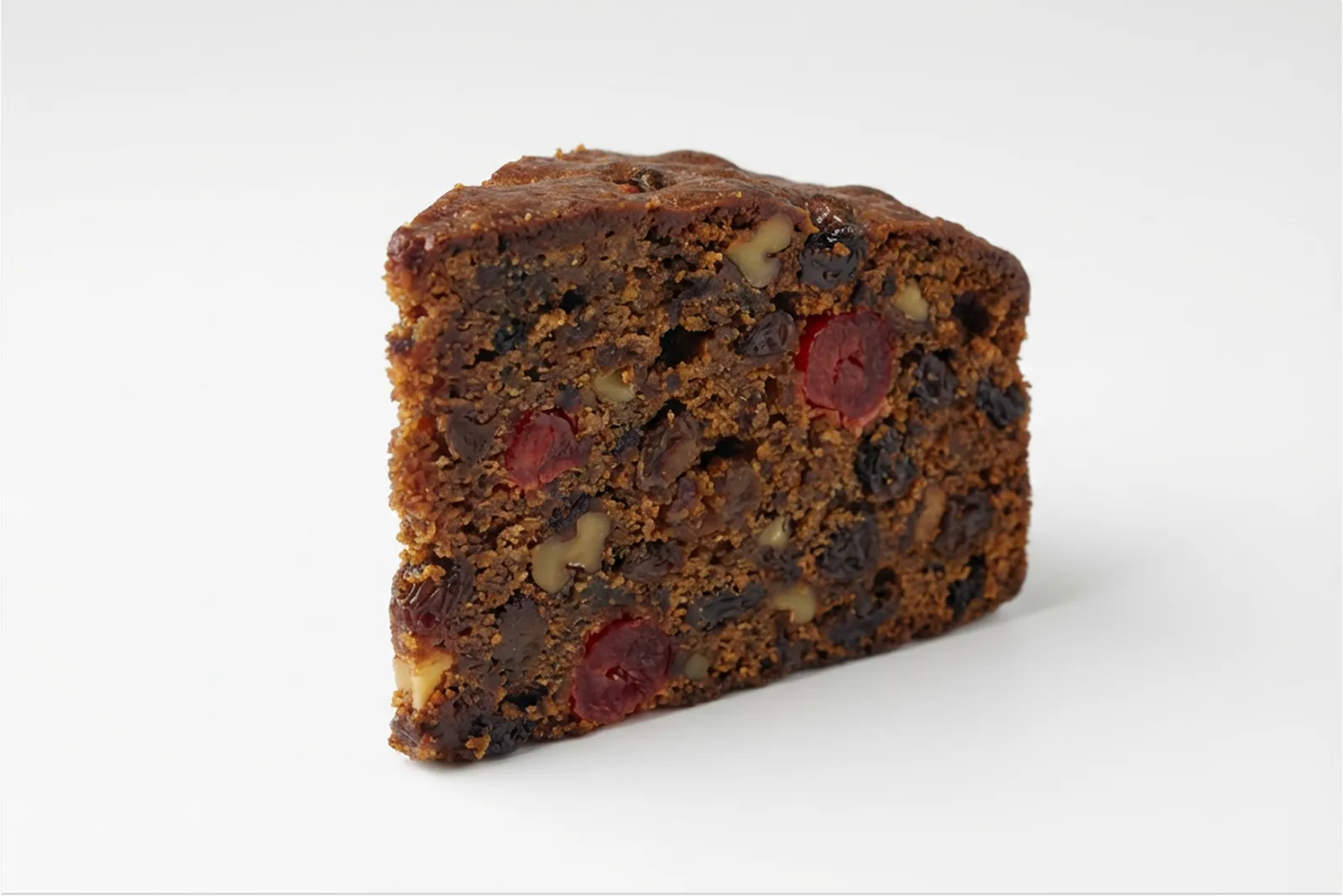

A Venezuelan Christmas table almost always has one dark, dense cake on the sideboard, sliced thin and wrapped in foil between visits: torta negra (TOR-tah NEH-grah), “black cake”. If you know British Christmas cake or American fruitcake, you know its family. If you’ve had Caribbean black cake, you’ve met a closer cousin. Torta negra sits between the two, with the fruit in pieces like a fruitcake and the near-black color of a Caribbean cake, which here comes from a caramel taken to 350°F (177°C) and from papelón, Venezuela’s unrefined cane sugar.
What is Venezuelan black cake, and is it worth making?
How do you make Venezuelan black cake (torta negra)? Soak 450 g (1 lb) of raisins, prunes and candied fruit in 200 ml of dark rum and 100 ml of sweet wine for at least 7 days. On baking day, cook a dark caramel to 347-356°F (175-180°C) and loosen it with hot water, cream butter with papelón or dark brown sugar, add eggs, the caramel, spiced flour and the drained fruit, and bake at 300°F (150°C) for about 105 minutes in a lined 9-inch pan. 150 minutes for 20 servings.
It’s a butter cake loaded with soaked fruit, dark from caramel, spiced with cinnamon, cloves and nutmeg, and kept moist for weeks by brushing it with rum. According to El Ucabista, the news site of Caracas’s Universidad Católica Andrés Bello, the cake isn’t Venezuelan in origin but adapted so well to local ingredients that it became one of the country’s best-known Christmas desserts.
Worth it? Yes, if you like fruitcake and you’re planning ahead. It’s the least stressful holiday dessert I know: you bake it three weeks before Christmas and on the day you only unwrap it.
Skip it if you need dessert tomorrow (the fruit needs a week in rum), if nobody at your table eats raisins, or if you’d rather avoid alcohol entirely, though there’s an orange-juice version below.
Real time. 150 minutes on baking day, about 35 of them hands-on. Before that, 5 minutes to fill a jar a week ahead; after, three feedings of 2 minutes each.
Honest difficulty, medium. Two things go wrong: caramel taken too far (bitter) and an oven that’s too hot (burnt crust, raw middle). The rest is a basic creamed butter cake.
Torta negra vs Caribbean black cake vs fruitcake
All three are dark Christmas cakes with dried fruit and liquor, and they get confused. The short version: Venezuelan torta negra has more batter than a fruitcake and less fruit puree than a Caribbean black cake.
Caribbean black cake, from Trinidad, Jamaica, Guyana and their neighbors, grinds the fruit to a paste, soaks it for weeks or months in rum and port or cherry brandy, gets its color from “browning”, a burnt-sugar syrup, and bakes low, around 275°F (135°C), as in Alica’s Pepperpot’s recipe. Wikipedia’s fruitcake entry describes the British Christmas cake as a round fruitcake covered in marzipan and royal icing, and notes that mass-produced American fruitcakes are usually alcohol-free. Torta negra keeps the fruit chopped, adds sweet wine, takes its color from a caramel you make yourself, and skips the icing.
Ingredients, and what to buy in a US or UK supermarket
You need 450 g (1 lb) of dried and candied fruit, 300 ml (1¼ cups) of liquor for soaking, 250 g (2¼ sticks) of butter, 250 g (2 cups) of flour, 4 eggs, 150 g (¾ cup) of papelón or dark brown sugar, and 100 g (½ cup) of sugar for the caramel. Nothing here needs a specialty store.
Papelón is Venezuela’s name for solid unrefined cane sugar: the same thing as Colombian panela and Mexican piloncillo. In the US, piloncillo cones are in the Latin aisle of most supermarkets; grate them on a box grater. Dark brown sugar, or dark muscovado in the UK, does almost the same job. White sugar gives a paler, flatter cake. The same papelón, cooked in oil to mahogany, is what blackens Venezuelan asado negro, an eye of round braised in caramel.
The soak, fruit to liquor ratio and how many days
I use 450 g (1 lb) of fruit to 300 ml (1¼ cups) of liquor, two parts dark rum to one part sweet wine. Seven days is my minimum; two to four weeks gives more rum and less dried-fruit flavor, and beyond a month I can’t taste a difference. Venezuelan cook Enri Lemoine asks for at least 5 days and ideally 10; El Ucabista mentions four months. After a week you’ll have about 100 ml (⅓ cup + 1 tbsp) of liquid left in the jar. Keep it, it’s what you feed the cake with.
The rum doesn’t need to be expensive; the long bake flattens fine aromas. A Venezuelan añejo is lovely if you find one, but any aged dark rum works.
The dark caramel, and the temperature where it turns bitter
The near-black color is caramel, not cocoa. I make it from white sugar rather than papelón for a practical reason: papelón starts out brown, so you can’t see when it’s burning. White sugar lets you watch it go from gold to amber to mahogany.
Vegan Baking’s sugar-stages chart puts dark caramel at 350°F (177°C), very dark and bittersweet at 375°F (191°C) and burned at 400°F (204°C). I pull mine at 347-356°F (175-180°C), with the first thin wisp of smoke. Without a thermometer, go by color: amber turns to mahogany in about 30 seconds, and mahogany to black in about as long again. Add the hot water straight away and at arm’s length. You’ll have about 150 ml (⅔ cup) of dark syrup, which must be cool before it meets the butter.
The pan, how to line it, and baking times by size
The full recipe makes about 1.9 kg (4.2 lb) of batter, which fills a 9-inch (22-23 cm) round pan, 3 inches (7.5 cm) deep, a little over halfway. Line the base with a circle of parchment and the sides with a double strip that stands 2 inches (5 cm) above the rim; that collar protects the crust during a long bake.
| Pan | Time at 300°F (150°C) | Servings | Good for |
|---|---|---|---|
| 9-inch (22-23 cm) round, 3 in deep | 100-110 min | 20 | one table of 12-20 |
| Two 9 x 5-inch (22 x 11 cm) loaf pans | 75-85 min | 10 each | one to keep, one to give |
| Six 4-inch (10 cm) foil pans | 45-55 min | 3 each | gifts |
| Half recipe, 6-inch (16 cm) round | 75-85 min | 10 | a table of 6 |
Depth sets the time, not weight: two loaves bake almost half an hour faster than one round cake.
Baking day, step by step and how to tell it’s done
Order of work. Line the pan while the oven heats. Make the caramel and let it cool while you drain the fruit and weigh the rest. Cream, add eggs, caramel, flour, fruit. Bake.
How to tell each stage is right.
| Stage | What you should see |
|---|---|
| Soak, day 7 | raisins plump and glossy, about 100 ml (⅓ cup) liquid left |
| Creaming, 4-5 min | butter and sugar go from brown to pale beige |
| Batter | thick; drops off the spatula in a lump, not a ribbon |
| 60 min in the oven | top dry and starting to crack in the center, which is normal |
| Done, 100-110 min | skewer shows moist crumbs, no wet batter; center at 205-210°F (96-99°C) |
The 205-210°F range is the one Kansas State University’s 4-H guide gives for layer and pound cakes, and it fits this one.
Make-ahead plan for Christmas, and how to feed the cake
Feeding means brushing liquor over the cooled cake every 5 to 7 days so it stays moist and keeps maturing. Start with 30 ml (2 tbsp) of the soaking liquid 30 minutes out of the oven, poured into skewer holes; then 15 ml (1 tbsp) of rum each time, three times. More doesn’t help, the top just turns pasty. Between feedings, wrap the cake in parchment and then foil, so the foil never touches it.
Countdown to December 24.
- November 26 → fill the soaking jar.
- December 3 → bake, and brush the first 30 ml (2 tbsp).
- December 8, 15 and 21 → feed 15 ml (1 tbsp) each time.
- December 22-23 → leave it alone so the top dries and slices cleanly.
- December 24 → unwrap, dust with powdered sugar if you like, slice ½ inch (1.5 cm) thick.
For New Year’s Eve, shift everything a week. Running late? Soak for 4 days, bake on December 21, feed once on the 22nd. Three days wrapped is the minimum before slicing; earlier, the crumb still tastes freshly baked and falls apart.
Mistakes that ruin a black cake
- Bitter cake → the caramel went past 375°F (190°C). There’s no fixing a baked cake; next time pull it at mahogany, not black.
- Burnt crust, raw center → oven too hot or pan unlined. 300°F (150°C), double parchment, foil over the top at 60 minutes.
- Fruit sank → it wasn’t floured, or the whole jar of liquid went into the batter. Drain, then toss in flour.
- Crumbles when sliced → cut too soon or unmolded hot. Cool in the pan and wait 3 days.
- Dry cake → overbaked or never fed. Brush 15 ml (1 tbsp) of rum, rewrap and wait 2 days.
- Mold → stored warm or damp with little liquor. If it molds, throw the whole cake out.
How much alcohol is left? Baking doesn’t remove it all: the USDA’s table of nutrient retention factors gives about 20 % of the alcohol remaining after 1½ hours of baking and 10 % after 2 hours. What you brush on afterward isn’t cooked at all. By my arithmetic a 3-ounce (85 g) slice ends up with roughly 2 ml of pure alcohol, against about 18 ml in a 1½-ounce shot of rum. Small, but not zero, so for children, pregnancy or anyone avoiding alcohol, make the orange-juice version.
Spice level, 0 out of 5. The spices are warm, not hot.
Allergens. Wheat (gluten), eggs, dairy (butter) and tree nuts, which you can leave out without losing anything essential. Maraschino and glacé cherries often contain red food coloring; check the label.
Which version should you make?
- Short on time → soak 4 days, bake 3 days ahead, feed once. More fruit, less rum flavor.
- Alcohol-free → soak the fruit in 300 ml (1¼ cups) of orange juice with 2 tablespoons of the caramel syrup, in the fridge, no more than 3 days, and feed with orange juice. Without alcohol I keep it refrigerated and finish it within a week.
- For 6 people → half the recipe in a 6-inch (16 cm) round pan, 75 to 85 minutes.
- For 30-40 → two 9-inch cakes, baked one after the other, rather than one huge cake: the middle would take so long that the edges dry out.
- For gifts → six 4-inch (10 cm) foil pans, 45 to 55 minutes, wrapped in cellophane with a tag that says it contains rum.
- Darker, less sweet → 120 g (½ cup + 1 tbsp) of sugar for the caramel and 120 g of papelón in the batter.
What it costs, and what makes it expensive
With US city-average prices from the Bureau of Labor Statistics for August 2026, the staples come to $3.51 for the whole cake: butter at $4.021 a pound makes the 250 g (2¼ sticks) $2.22, four eggs at $2.272 a dozen are $0.76, the flour $0.30 and the caramel sugar $0.23. The BLS doesn’t track rum, sweet wine, raisins, prunes, candied fruit or nuts, and those are most of the bill. In my own supermarket list in Colombia, the liquor plus the fruit and nuts came to nearly three quarters of the total.
Yield. One 9-inch cake of about 1.7 kg (3¾ lb) after baking, 20 slices of 85 g (3 oz). For 12 people that leaves slices for the 25th.
What drives the price. Liquor and candied fruit. The fruit is the easiest to trim: maraschino cherries, or more prunes with 2 tablespoons of bitter orange marmalade in the soak, do the same job.
Serving, storing and gifting
Taste and texture. Dense, moist and almost black, with a faint burnt-caramel bitterness underneath the sweetness of the papelón and rum-soaked fruit. It’s closer to a firm pudding than a sponge.
How it’s served. In thin slices at room temperature, plain or with powdered sugar. At a Venezuelan Christmas it comes after the hallacas, the roast pork pernil, the ham bread and the chicken and potato salad, and shares the dessert table with Venezuelan quesillo. For a drink, black coffee or a small glass of ponche crema, Venezuela’s rum eggnog.
Room temperature. Wrapped in parchment and foil, in a cool dark cupboard, up to 1 month, the figure Clemson University’s Home & Garden Information Center gives for wrapped fruit cakes; it adds that cakes soaked in alcohol keep longer. I don’t push it past a month out of the fridge.
Fridge. Up to 6 months wrapped, per Clemson. Take it out 1 hour before serving; cold butter dulls the flavor.
Freezer. Up to 12 months, per Clemson. Freeze in individually wrapped slices and thaw overnight in the fridge. Any mold or off smell, throw it out.
As a gift. Small 4-inch cakes travel well in their foil pans. Bake them at least 3 days before giving, label the rum, and tell people to keep them cool and wrapped.
Frequently asked questions
What is torta negra? Venezuela’s Christmas black cake: a butter cake with dried and candied fruit soaked in rum and sweet wine, colored dark by a homemade caramel and papelón, and brushed with rum for weeks.
Is Venezuelan black cake the same as Caribbean black cake? No. Caribbean black cake grinds the fruit to a paste, uses rum and port or cherry brandy and store-bought or homemade browning, and bakes around 275°F (135°C). Torta negra keeps the fruit in pieces and has more batter.
How long should the fruit soak? At least 7 days in rum and sweet wine, in a closed jar somewhere cool. Two to four weeks is better.
What temperature do you bake torta negra at? 300°F (150°C), for 100 to 110 minutes in a 9-inch round pan, until the center reads 205-210°F (96-99°C).
How often do you feed a black cake with rum? Every 5 to 7 days, 1 tablespoon (15 ml) at a time, three times, stopping 2 days before serving.
Why is my black cake bitter? The caramel went past about 375°F (190°C). Pull it when it’s mahogany, at 347-356°F (175-180°C).
Can I make it without alcohol? Yes. Soak the fruit in orange juice in the fridge for up to 3 days and feed with juice. Keep it refrigerated and eat it within a week.
How long does black cake last? Wrapped, up to 1 month in a cool pantry, 6 months in the fridge and 12 months in the freezer, according to Clemson University Extension.
Nutrition
Per slice, about 85 g (3 oz), one twentieth of the cake, calculated from USDA FoodData Central (SR Legacy) with the quantities above, counting all the rum and wine even though some evaporates in the oven:
- Calories: 323 kcal
- Protein: 4 g
- Carbohydrates: 41 g, of which 27 g sugars
- Fat: 13 g, of which 7 g saturated
- Fiber: 2 g
- Sodium: 74 mg
Most of the fat is the butter, about 10 g per slice. The rum and wine would add around 36 kcal per slice if none of the alcohol evaporated, so the real number is a little lower. Leave out the nuts and a slice drops to about 301 kcal.
The first torta negra I baked in Colombia came out brown, not black, because I was so scared of burning the caramel that I pulled it at amber. The second one I left until the kitchen smelled of smoke, and the whole cake tasted of it. The third time I watched the color instead of the clock, took it off the moment it turned mahogany, and it was my mother’s cake again. The cake should be black; the caramel never should. Josnaisis.