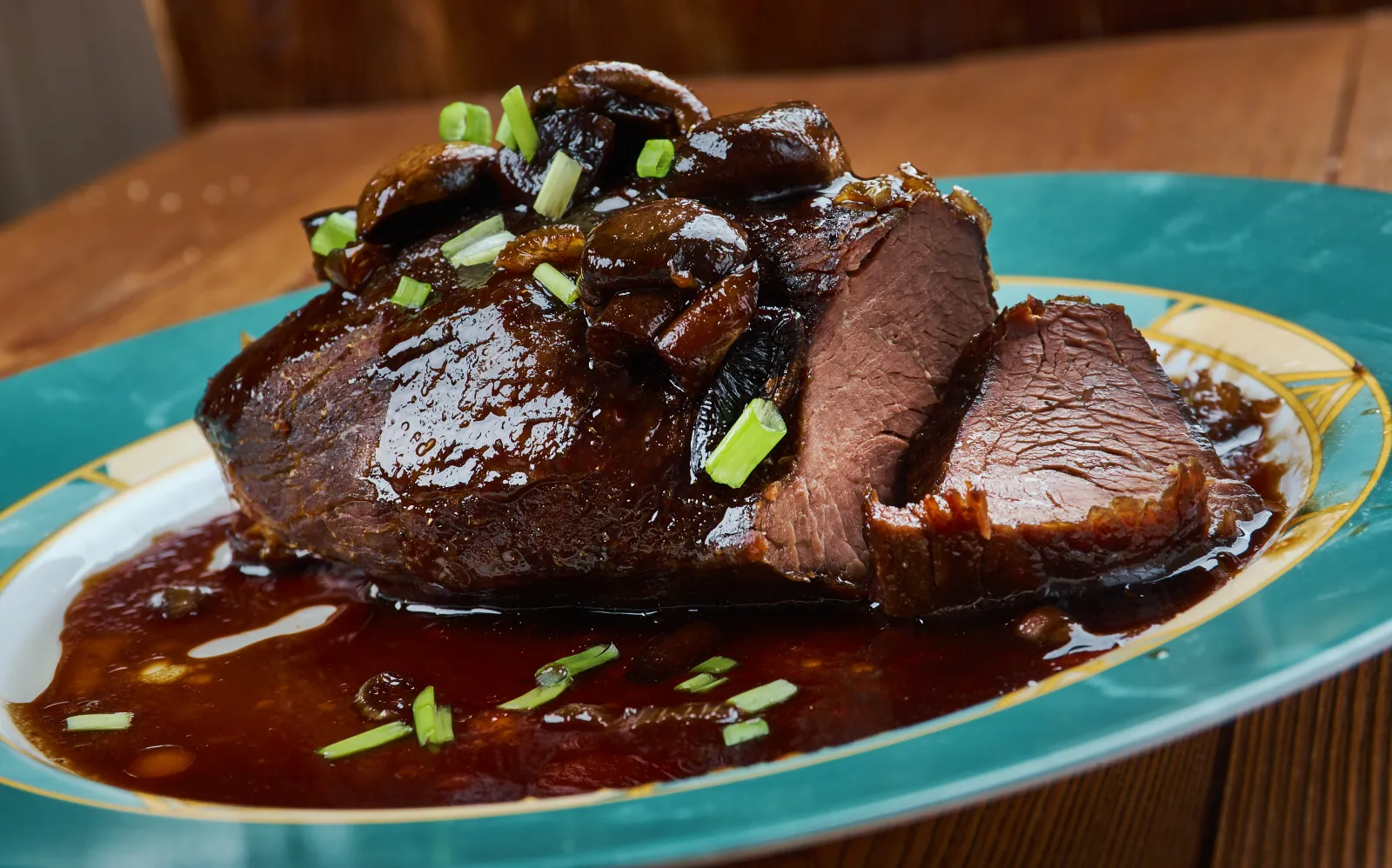

Asado negro (ah-SAH-doh NEH-groh) is Venezuela’s Sunday roast: a whole eye of round marinated overnight, blackened in a pan of caramelized raw cane sugar, then braised for close to three hours until the sauce is glossy and almost black. It’s sliced like pot roast, but it tastes like nothing in the American repertoire, sweet first, then salty from Worcestershire, with a faint bitter edge of dark caramel at the end. If you’ve never cooked with papelón, the one thing to learn is when to stop the sugar, and it’s earlier than you’d think.
How do you make Venezuelan asado negro?
How do you make asado negro? Marinate a whole 4.4 lb (2 kg) eye of round overnight with garlic, Worcestershire and vegetables. Next day, cook grated papelón or dark brown sugar in oil until mahogany, around 365°F (185°C), blacken the beef in it on all sides, add the marinade vegetables, red wine and water, and braise covered for 165 minutes. Rest, slice across the grain and serve in the blended, reduced sauce. 260 minutes for 8 servings, plus the overnight marinade.
It’s a two-day dish with about 95 minutes of actual work: 20 the night before and around 75 on the day, most of it at the start. The rest is a covered pot on a low burner.
Make it for a Sunday lunch, a birthday, or any meal where you want to be sitting with your guests rather than standing at the stove: made the day before, it only needs slicing and warming. Skip it if you want dinner tonight, or if sweetness with beef isn’t your thing; there are 23 g of sugar per serving and you can taste them.
Difficulty, medium. One step needs your full attention for about a minute, the caramel. The rest is patience.
What to buy, and what it’s called where you live
Eye of round, and why not chuck
The cut is eye of round, a long, lean, cylindrical muscle from the back leg. Venezuelans call it muchacho redondo. Because it’s lean and tightly grained, it braises into firm, clean slices instead of falling apart. Raw and trimmed to ⅛ inch of fat, it has 173 kcal and 21.7 g of protein per 100 g (3.5 oz), according to the USDA.
Buy it whole, 4 to 4.8 lb (1.8 to 2.2 kg), about 3½ inches (8-9 cm) thick, which is what the timings here assume. Ask the butcher to trim the fat cap and silverskin. Don’t use chuck roast. It turns tender sooner and that’s the problem: it shreds when you slice it, and you end up with shredded beef in black sauce, a different (good) dish.
Papelón, and the supermarket swaps
Papelón is unrefined cane sugar: cane juice boiled down and set in blocks. It’s the same product as Colombian panela and Mexican piloncillo, and in the US you’ll find it as piloncillo cones in the Hispanic aisle of many supermarkets and at Latin grocers. In the UK, look for panela or piloncillo from Latin American online shops, or jaggery in South Asian grocers, which is close.
| If you can’t find papelón | Use | What changes |
|---|---|---|
| Piloncillo or panela | 150 g (5.3 oz), grated | nothing, same product |
| Jaggery (UK) | 150 g, grated | very close; slightly different molasses note |
| Dark brown sugar | ¾ cup packed (150 g) | same color, a little less depth |
| White sugar | not recommended | caramelizes later and tastes flat |
Grate or shave it with a knife. A whole cone melts unevenly, and one side burns before the other has melted.
Papelón also browns faster than white sugar. It’s not pure sucrose: it carries molasses and some fructose, which starts browning around 230°F (110°C), while table sugar holds out until roughly 320°F (160°C). Stay at the stove.
The rest of the shopping list
- Ají dulce is a small, sweet, aromatic Caribbean pepper with no heat. Latin and Caribbean grocers sometimes have it frozen; otherwise add half a red bell pepper. You lose some perfume, not the dish.
- Red wine — any dry, unoaked bottle. For no alcohol, swap in a bottle of malta, the malt soft drink sold in Latin aisles; the sauce comes out a little sweeter.
- Worcestershire sauce is part of the flavor, not a garnish. Soy sauce brings salt but not the sour note.
Equipment. A heavy 5 to 6 quart (5-6 liter) Dutch oven with a lid, wide enough for the beef to lie flat. A thin-bottomed pot heats unevenly and burns the caramel in patches. Two wooden spoons to turn the meat, and a blender or stick blender for the sauce.
The caramel, the step that makes or breaks it
The caramel is made in oil, not dry: 3 tablespoons of oil and 150 g (5.3 oz) of papelón over medium-high heat. At 3 to 4 minutes it foams with big, pale bubbles. At 6 to 8 minutes the bubbles settle, the color deepens to mahogany, a reddish dark brown, and a thin white wisp of smoke rises. That’s around 365°F (185°C), and that’s the moment the beef goes in.
Wait longer and past roughly 375°F (190°C) it starts turning bitter, reaching black around 410°F (210°C). The smoke turns gray and acrid and the taste becomes dry and bitter. Nothing fixes that; not more sugar, not more braising. At 150 g of sugar against 4.4 lb of beef, starting over is the cheap option.
Forget the timer. Watch the color and smell: when the smell shifts from sweet to toasted, go. The cold beef drops the temperature instantly and the caramel stops where it is.
Signs the browning worked. The side that touched the pan comes up glossy and very dark brown. If it comes up gray, either the meat was wet or the caramel had cooled.
Stovetop, oven or Instant Pot
Dutch oven on the stovetop, 165 minutes on low, liquid halfway up the meat, turned every 30 minutes. This is the one I make: the slices are firm and the sauce reduces as it goes. It’s done when a fork slides into the center and drops out on its own. If it still resists, give it 20 to 30 more minutes.
Oven, 325°F (160°C) for 3 hours, covered, in the same pot. No turning needed, and the heat is gentler; good if you have to leave the house.
Pressure cooker or Instant Pot, 55 minutes on high plus a 15-minute natural release. Do the caramel, browning, vegetables and wine on sauté, then add water only a third of the way up. It saves almost 2 hours, but the edges of the slices can turn stringy and the sauce comes out thin, so reduce it uncovered on sauté for another 15 minutes.
Slicing, and why it’s better the next day
Rest the beef 20 minutes before cutting, or the juice ends up on the board. The grain runs the length of the roast, so slice across it: ⅜ inch (1 cm) slices while hot.
Better still, make it a day ahead. Cook it through, stop before slicing, cut the roast into 2 or 3 large chunks and chill them in their sauce in shallow containers, so they’re in the fridge within 2 hours, as the USDA Food Safety and Inspection Service advises. The next day the sauce has settled and tastes rounder, and the cold meat slices to ¼ inch (5 mm) without crumbling. Warm the slices in the sauce.
The sauce itself: remove the bay leaves, blend everything, then reduce uncovered 15 to 20 minutes until it coats a spoon and holds a line when you run a finger through it. Don’t thicken it with flour; the papelón already gives it body.
Cooking for 8 or for a crowd of 16
| Serves | Beef | Papelón | Wine | Pot |
|---|---|---|---|---|
| 8 | one 2 kg (4.4 lb) roast | 150 g (5.3 oz) | 250 ml (1 cup) | 5-6 quart Dutch oven |
| 16 | two 2 kg (4.4 lb) roasts | 300 g (10.6 oz), in two batches | 500 ml (2 cups) | 10-12 quart pot, or two Dutch ovens |
For 16, double everything except the water: add just enough to reach halfway up both roasts, about 750 ml (3 cups). The braising time stays the same, because it depends on how thick each roast is, not on the total weight. Make the caramel in two batches of 150 g, one per roast. A double batch in one pot browns unevenly, and by the time the middle reaches mahogany, the edges have burned.
Yield. 2 kg (4.4 lb) raw gives about 1.3 kg (2.9 lb) cooked, roughly 5.8 oz (165 g) per plate with sauce. On a buffet with other mains, one roast stretches to 12.
What goes wrong
- Bitter sauce → the sugar went black. Stop at mahogany. There’s no rescue afterwards.
- Gray outside → wet meat or cooled caramel. Dry it well and wait for the color.
- Dry meat → a hard boil, no lid, or sliced without resting. Low heat, lid on, 20-minute rest.
- Slices fall apart → cut with the grain, or the cut was chuck. Eye of round, across the grain, cold if possible.
- Thin sauce → not reduced enough. 15 to 20 minutes uncovered after blending.
- Too salty → all the salt went in at the start. Worcestershire and reduction concentrate it; keep ½ tsp for the end.
Heat level, 0 out of 5. Ají dulce isn’t hot. Alcohol: the USDA’s alcohol retention table puts the amount left after 2½ hours of simmering at about 5 %; use malta if cooking for small children. Allergens: Worcestershire sauce contains anchovies, and some brands (including UK ones) use malt vinegar, which contains gluten; the wine brings sulfites. No dairy, eggs or nuts.
What it costs
At the US city average prices the Bureau of Labor Statistics published for August 2026, a boneless USDA Choice round roast was $8.959 per pound, so 4.4 lb of beef costs about $39.51. Sugar and tomatoes add $1.91, for $41.42 in all, about $5.18 a serving, before onions, peppers, wine and Worcestershire, which the BLS doesn’t track. The beef is nearly the whole bill. Chuck roast was $9.448 per pound the same month, so the cut that works is also the cheaper one.
How it’s served, and storage
On a plate, in slices, with plenty of sauce. Alongside go white rice to soak it up, mashed potatoes, and tajadas, slices of very ripe plantain fried until caramel-edged. A tomato and onion salad cuts the sweetness. The rice is the same everyday pot as in Colombian white rice, and the Sunday table it belongs to also has pabellón criollo, where the beef is flank, shredded, rather than round in slices; that same shredded beef fills a patacon maracucho, the Venezuelan plantain sandwich. In December it turns up next to Venezuelan hallacas, pan de jamón and Venezuelan chicken salad, though it isn’t the traditional Christmas main.
Asado negro or posta negra? Colombia’s Caribbean coast makes posta negra, and the two are close relatives: same cut, and panela is the same sugar as papelón. In posta negra the panela melts on its own and the vegetables go into it; in asado negro the sugar cooks in oil and the beef is blackened inside the caramel. Asado negro braises in red wine and Worcestershire, posta in vinegar and dark sauce, often with cola, and posta is served with coconut rice.
Fridge. 3 to 4 days at 40°F (4°C) or below, in its sauce (FSIS).
Freezer. Slices in sauce, in flat bags or containers, keep their best quality for 2 to 3 months (FSIS). Thaw overnight in the fridge; the sauce may split a little and comes back together as it warms.
Reheating. Slices in the sauce, covered, over low heat until they reach 165°F (74°C) in the center, 10 to 15 minutes. Add 3 or 4 tablespoons of water if the sauce has thickened. High heat makes the sugary sauce catch and dries the meat.
Frequently asked questions
What cut of beef is asado negro? Eye of round, called muchacho redondo in Venezuela, salmon cut in the UK and redondo in Spain. Buy it whole, about 4.4 lb (2 kg).
What is papelón and what can I use instead? Unrefined cane sugar, the same as piloncillo and panela. Dark brown sugar is the best supermarket substitute, ¾ cup packed (150 g).
Why is it called asado negro? Negro means black: the caramelized papelón darkens the beef and, after nearly three hours, the sauce turns almost black.
Can I make asado negro in an Instant Pot? Yes. Brown on sauté, then 55 minutes on high pressure with a 15-minute natural release, and reduce the sauce 15 minutes afterwards.
Can I make it ahead? Yes, and it’s better. Chill it in its sauce, slice it cold and reheat the slices in the sauce.
Is asado negro sweet? Sweet first, then salty and slightly bitter. There are 23 g of sugar per serving; with 100 g (3.5 oz) of papelón instead of 150 g, it drops to about 17 g.
Can I make it without wine? Yes, with malta, the Latin malt soda, or with water and an extra tablespoon of Worcestershire.
Nutrition
Per serving, one eighth of the recipe (about 5.8 oz / 165 g cooked beef with sauce, no sides), calculated ingredient by ingredient from USDA SR Legacy data with the quantities above, using dark brown sugar for the papelón and counting the 5 % of the wine’s alcohol that remains after braising:
- Calories: 593 kcal
- Protein: 55 g
- Carbohydrates: 28 g
- Fat: 28 g, of which 9 g saturated
- Fiber: 2 g
- Sugars: 23 g
- Sodium: 814 mg
Papelón accounts for 18 of the 23 g of sugar. Most of the sodium is added salt and Worcestershire; without the salt, a serving would have about 232 mg.
Where I grew up in Venezuela, nobody measured the papelón with a thermometer; you watched for the smoke. It took me one ruined pot in Colombia to understand that the black in asado negro comes from time, not fire. Mahogany, beef in, lid on, and slice it tomorrow. Josnaisis.