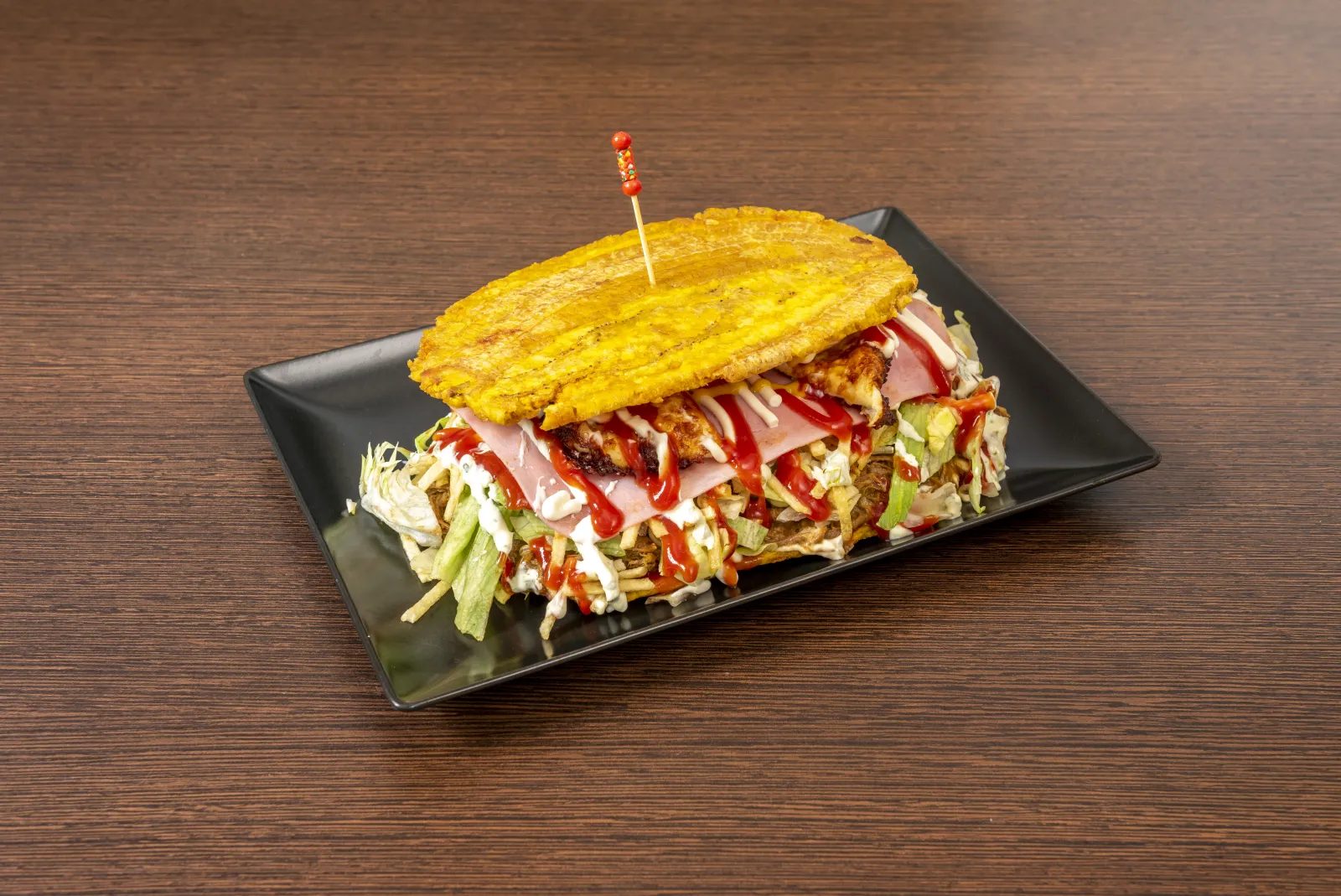

The Maracaibo street sandwich has no bread: its two slices are a green plantain cut in half, fried soft, pressed flat into a 6-inch (15 cm) round and fried again until it is stiff enough to hold beef, ham, cheese, salad and two sauces. If you have eaten Caribbean tostones, you already know the technique; the patacon maracucho scales it up from a bite-size round to a whole plantain and turns it into dinner.
What is a patacon maracucho?
How do you make a patacon maracucho? Halve green plantains crosswise and fry the halves at 320-330°F (160-165°C) for 8-10 minutes until soft to the center. Press each one flat while hot inside an oiled plastic bag to a ¼-inch (5-6 mm) shell, then fry again at 355°F (180°C) for 2-3 minutes a side. Fill two shells with garlic sauce, lettuce, tomato, shredded beef, ham, cheese and pink sauce. 60 minutes for 4 servings.
It is street food from Maracaibo, the city in western Venezuela whose people and things are called maracucho. Street stalls there sell it as two crisp pieces of flattened green plantain with a filling the customer picks, from plain cheese to chicken, pork or ham, with tomato, mayonnaise or mustard sauces, as described in Directo al Paladar’s guide to Maracaibo snacks. The city’s breakfast fritter, Venezuelan mandocas made with black-ripe plantain and papelón, uses the same fruit at the opposite end of ripeness.
In Colombia, a patacón is something smaller: a 1½-inch slice of plantain smashed flat and served as a side, like the Colombian patacones with hogao on this site. Same plantain, same two fries. The maracucho version is the one built like a sandwich.
Is it worth making at home, and who is it for?
Yes, if you already have a braise in the fridge. The plantain shells take 1 hour; the shredded beef, if you make it the same day, takes about 2 more (45 minutes in a pressure cooker).
Good for. A Friday dinner, a game night, a party where people build their own. One per person is a full meal; light eaters will leave half.
Not ideal for. A light lunch: a fully loaded one comes to about 1,245 kcal. Anyone who hates deep-frying at home, since it is two rounds of it.
Honest difficulty, medium. The only step that takes practice is pressing a hot half into a round shell. In my experience the first two come out lopsided and the third is fine.
The plantain decides everything
Buy large, straight, fully green plantains of about 14 oz (400 g) each, hard as a cucumber when you squeeze them. No yellow patches. A green plantain has 2.29 g of sugar per 100 g; a ripe one has 17.51 g, per the USDA, nearly eight times more. That sugar browns in the oil before the inside cooks, and a ripe half falls apart when pressed. Yellow plantains are for sweet fried plantains, not for this.
Size matters more than in regular tostones. Each half becomes one shell, so a small 9 oz (250 g) plantain gives a 4½-inch shell and the filling slides out the sides.
Where to buy them. In the US, green plantains sit in the tropical produce section of most large supermarkets and every Latin or Asian grocer. In the UK, look in Caribbean, African and Asian grocers and in some large supermarkets; they are often sold as green plantain or cooking plantain. Green bananas are not a substitute: they are smaller, wetter and won’t hold a shell.
Shopping list, with what to swap
- Shredded beef. The classic filling is carne mechada, beef braised until it pulls into threads, the same one used in Venezuelan pabellón criollo. The Colombian shredded beef recipe on this site works as is. You need 14 oz (400 g) cooked for 4 sandwiches, from about 1⅓ lb (615 g) raw flank or chuck, because beef loses about a third of its weight as it cooks. In the UK, brisket or braising steak.
- Ham and cheese. Both are standard in Maracaibo. Venezuelan cheese is a firm, salty white cheese (queso blanco duro or queso de mano). In the US, Latin-brand queso blanco or queso fresco. In the UK, halloumi is the closest in texture, a little saltier; a mild white cheddar is softer but fine.
- Two sauces. Garlic sauce is mayonnaise with grated garlic and a few drops of lime: ⅓ cup (80 g) mayo and 2 cloves for 4 sandwiches. Pink sauce is mayo and ketchup in equal parts, 3 tablespoons of each. For a third, Venezuelan guasacaca, the tangy avocado sauce, is excellent with pork.
- Equipment. An 11-inch (28 cm) deep skillet, a clip-on thermometer, a large zip-top freezer bag, a cutting board or a heavy flat-bottomed pot, and a wide spatula. Without a bag, two sheets of oiled parchment work, with more wrinkles.
The two fries, in °F and °C
The first fry cooks and the second one dries. At 320-330°F (160-165°C) the starch in the half cooks through in 8-10 minutes without the outside browning; it comes out pale and soft enough to press. At 355°F (180°C) the pressed shell loses water fast and turns rigid in 2-3 minutes a side. One temperature for both doesn’t work: hotter from the start seals a raw center, cooler throughout gives you a greasy shell.
Keep the oil about ¾ inch (2 cm) deep in an 11-inch skillet, which takes about 5 cups (1.2 L). That fits 4 halves for the first fry and 2 pressed shells for the second.
How to press a whole plantain half without cracking
This is the step that separates a sandwich from a pile of plantain crumbs, and I learned it the hard way.
- Cut the zip-top bag open down both sides so it opens like a book, and rub a few drops of oil inside. Plastic wrap tears; parchment wrinkles.
- Press within 1 minute of the half leaving the oil. Hot gelatinized starch is pliable; cool starch cracks. Press one at a time, not all at the end.
- Stand the half on its cut end and press with the board to about half its height. Turn the bag a quarter turn, press again, and once more if needed, to ¼ inch (5-6 mm) and about 6 inches (15 cm) across.
- Fix cracks while it is hot. A split at the edge closes if you pinch it through the plastic; the starch sticks to itself. A split through the middle means the first fry was too short.
Thinner than 5 mm and it shatters in the second fry, hard as a chip. Thicker than 7 mm and the middle stays starchy.
Game plan, make-ahead and party math
The hour works because two jobs overlap: the sauces get made while the oil heats, and you press the first batch while the second batch fries. The beef only needs warming in the last 10 minutes.
Make ahead. The beef keeps and improves overnight. Both sauces can be made the day before. The shells can be fried once, pressed, layered between parchment and refrigerated for 24 hours or frozen for 2 months; do the second fry straight from cold with 1 extra minute.
For 12 people: 12 plantains (about 11 lb / 5 kg in the peel), 2⅔ lb (1.2 kg) cooked shredded beef from about 4 lb (1.85 kg) raw, 12½ oz (360 g) ham, 1 lb (480 g) cheese, 1½ cups (360 g) mayo, ½ cup (120 g) ketchup, 1½ lb (720 g) tomatoes and 15 oz (420 g) lettuce.
For 20 people: 20 plantains (about 18 lb / 8.3 kg), 4½ lb (2 kg) cooked beef from about 7 lb (3.1 kg) raw, 1⅓ lb (600 g) ham, 1¾ lb (800 g) cheese, 2½ cups (600 g) mayo, ¾ cup (200 g) ketchup, 2⅔ lb (1.2 kg) tomatoes and 1½ lb (700 g) lettuce. With two skillets, the second fry is 40 shells, 2 at a time: about 50 minutes. Do the first fry and pressing the day before and set out a build-your-own bar.
Party-size option. Cut each plantain into 4 pieces instead of 2 for 3½-inch (8-9 cm) shells and make 2 mini sandwiches per plantain.
Before you start, mistakes, spice, kids and allergens
- Cracks in the middle → first fry too short. Two more minutes until a fork slides in.
- Broken edges → the half cooled before pressing. Thirty seconds back in the oil.
- Sticks to the bag → no oil on the plastic.
- Greasy shell → oil below 300°F (150°C), usually from crowding. Four halves, then two shells per batch.
- Hard as a cracker → pressed thinner than 5 mm or fried longer than 3 minutes a side.
- Falls apart when you bite → overfilled. About 3½ oz (100 g) of beef is the most a 6-inch shell holds.
Spice level, 0 out of 5. Nothing in it is hot; put hot sauce on the table if you like it.
Kids. They like it, but a whole one is too much. Half a sandwich or the mini size, and skip the raw garlic sauce.
Allergens. Egg in the mayonnaise, milk in the cheese, mustard if you add it. Plantain is gluten-free; check the ham and ketchup labels for a celiac guest. With guasacaca instead of the mayo sauces, it is egg-free.
Which version should you make?
- Short on time → shredded chicken instead of beef: breasts poached 18 minutes, pulled and tossed with the garlic sauce. Done in an hour from scratch.
- Leftover roast pork → the Venezuelan pernil shredded and warmed in its juices makes the best sandwich of the year after Christmas.
- Lighter → drop both mayo sauces, which add about 204 kcal and 22 g of fat per sandwich, and use guasacaca.
- Vegetarian → cheese only, doubled to 80 g (3 oz), with avocado slices.
- Air fryer → first cook 12 minutes at 350°F (180°C) with the halves brushed with oil, press hot, second cook 8 minutes at 400°F (200°C). Drier and paler, and the shells top out around 5 inches (12-13 cm) because they don’t fit bigger.
What it costs
Using US city average prices from the Bureau of Labor Statistics for August 2026, the beef, cheese, ham, tomatoes and lettuce for 4 sandwiches come to $17.84, about $4.46 a sandwich. The beef is 72 % of that. Plantains, mayonnaise and ketchup are not in the BLS series, so add whatever they cost where you shop.
In Colombia, at Bogotá wholesale prices from the DANE SIPSA bulletin for 12-18 September 2026, the same 4 sandwiches cost about 31,300 pesos, with the beef at 57 %. Shredded chicken instead of beef drops that by more than a quarter. I don’t have a reliable price source for Venezuela, so I won’t guess.
Serving, storing and reheating
How it eats. Crisp shells, a little tender inside and savory rather than sweet, around juicy beef, salty ham and cheese, cold lettuce and tomato. It drips. Serve it whole or cut in half, wrapped in paper, as soon as it is built. It needs no side dish.
Fridge. Don’t store a built sandwich; the bottom shell is soggy within 30 minutes. Keep the parts separate. Cooked meat keeps 3-4 days refrigerated if it goes in within 2 hours, per the USDA FSIS. I keep homemade garlic sauce no more than 3 days.
Freezer. Shredded beef freezes for 2-6 months. Shells freeze best after the first fry and pressing, for 2 months. Lettuce, tomato and sauces don’t freeze.
Reheating. Fully fried shells re-crisp in a 400°F (200°C) oven or air fryer for 5 minutes; a microwave makes them limp. Warm the beef in a skillet with a splash of water to 165°F (74°C).
Frequently asked questions
What is a patacon sandwich made of? Two shells of twice-fried, flattened green plantain in place of bread, filled with shredded beef, chicken or pork, ham, white cheese, lettuce, tomato, garlic sauce and pink sauce.
What is the difference between a patacon and a tostón? The technique is the same: green plantain fried, pressed and fried again. A tostón or Colombian patacón is a small 1½-inch round served as a side; the patacon maracucho uses half a plantain per shell to make a 6-inch sandwich.
Can I use yellow plantains? No. Ripe plantains carry nearly eight times the sugar of green ones; they brown before cooking through and fall apart when pressed.
Why do my plantains break when I flatten them? The half was undercooked in the center or it cooled down. Fry 8-10 minutes at 320-330°F (160-165°C) until a fork slides in, and press within a minute.
Can I make the plantain shells ahead? Yes. Fry once, press, and refrigerate for 24 hours or freeze for 2 months. Do the second fry at 355°F (180°C) just before serving, with 1 extra minute.
How many calories are in a patacon maracucho? About 1,245 kcal fully loaded. Without the two mayonnaise sauces it is about 1,040.
Can I make it in an air fryer? Yes, drier and smaller: 12 minutes at 350°F (180°C), press hot, then 8 minutes at 400°F (200°C).
Nutrition
Per sandwich (1 large plantain, 100 g / 3½ oz beef, 30 g ham, 40 g cheese, salad and 40 g of sauce), calculated ingredient by ingredient from USDA FoodData Central (SR Legacy) values and the nutrition of the shredded beef recipe on this site:
- Calories: 1245 kcal
- Protein: 44 g
- Carbohydrates: 113 g
- Fat: 69 g, of which 21 g saturated
- Fiber: 9 g
- Sugars: 15 g
- Sodium: 1975 mg
Half of the calories, about 620 kcal, are the fried plantain; the two mayo sauces add another 204. Sodium is spread across the salt on the shells, the beef, the ham and the cheese, so half a sandwich with a green salad cuts everything in two.
I grew up eating patacones bought from a stall and eaten standing up; making them at home only clicked once I lived in Colombia, where green plantains are everywhere and cheap. My shells cracked for weeks until I stopped rushing the first fry. Soft in the middle, hot into the bag, and the sandwich holds. Josnaisis.