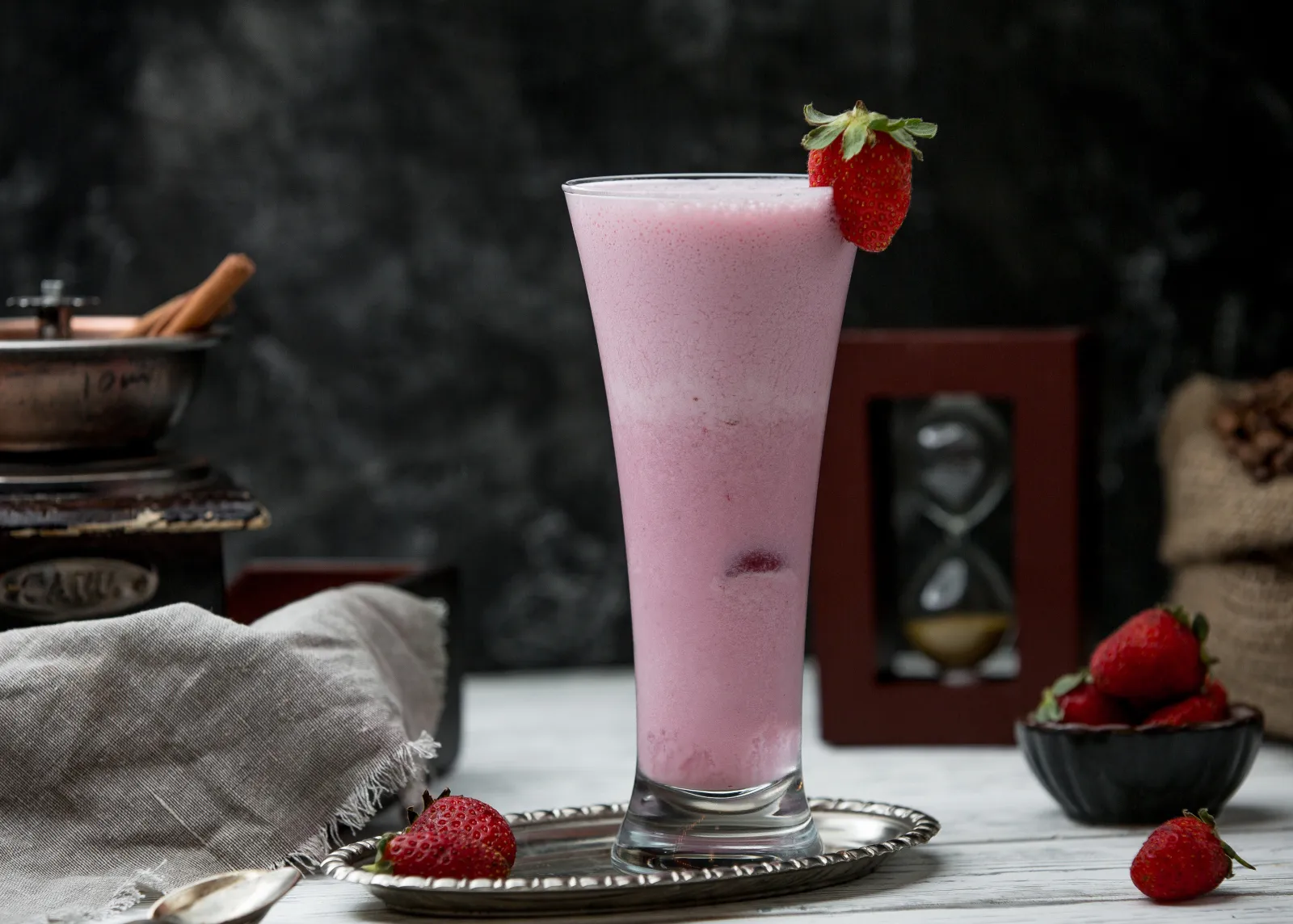

Ask for a merengada (meh-ren-GAH-dah) at a Venezuelan arepa shop and you get a tall, foamy glass of fruit blended with milk, sugar and ice, somewhere between a smoothie and a milkshake. Strawberry, papaya, banana and mango are the everyday flavors, and the vanilla ice cream version goes by merengada de mantecado. It takes 10 minutes and a blender. The only thing that goes wrong is the milk curdling, and that comes down to which fruit you use and the order it goes into the blender.
What is a merengada, and is it worth making?
How do you make a Venezuelan merengada? Blend 600 g (1⅓ lb) of ripe strawberries, papaya, mango or banana with 60 g (5 tbsp) sugar for 20 seconds, then add 720 ml (3 cups) of very cold whole milk and 300 g (10½ oz) of ice and blend 30 to 45 seconds more, until thick and foamy. Serve at once in tall glasses. Ready in 10 minutes for 4 servings.
The Diccionario de americanismos, published by the association of Spanish-language academies, defines merengada in Venezuela and Colombia as a shake of fruit, milk and sugar, and in Venezuela and Paraguay also as a drink of milk and ice cream. In Venezuela it is what you order alongside an arepa, at breakfast or mid-afternoon.
Worth it? Yes, if you have a blender and ripe fruit. Each glass carries 150 g (5⅓ oz) of fruit, nearly as much fruit as milk by weight, so it tastes of strawberry or papaya first and dairy second, and at about 221 kcal it is far lighter than an ice cream shake.
When it fits. A weekday breakfast with eggs or arepas, a kids’ snack, a hot afternoon, a brunch where you want something non-alcoholic that isn’t soda.
When it doesn’t. If you need to make drinks hours ahead: a merengada is drunk within minutes of blending. And if you avoid dairy, skip to the dairy-free swap below.
Time and difficulty. 10 minutes, 8 of them hands-on. Easy. The one skill is the blending order.
Merengada vs smoothie vs milkshake
A merengada is milk-based like a milkshake but fruit-led like a smoothie, and pourable rather than spoonable. Spanish leche merengada, which you’ll find in Spain and in some Spanish restaurants abroad, shares the name but is a different drink: milk with sugar, cinnamon and egg white, served so cold it is half frozen. The Venezuelan one has no egg.
Why some fruit curdles milk, and how to stop it
Milk sits at pH 6.4 to 6.8 on the FDA’s list of approximate food pH values, and casein, its main protein, clumps at pH 4.6. Strawberries (pH 3.0 to 3.9) and pineapple (3.2 to 4.0) are far more acidic; passion fruit pulp comes in around pH 3 in Brazilian (Embrapa) and Ecuadorian studies. In a merengada the milk outweighs the fruit and buffers the acid, which is why strawberry is safe. Push the acid up with passion fruit, too much fruit, or milk that has warmed, and it curdles.
Pineapple and papaya have a second problem. Fresh pineapple contains bromelain and papaya contains papain, enzymes that break down casein, so the drink turns bitter and grainy as it sits. Bromelain stops working above 176°F (80°C), according to Science Buddies’ write-up of this exact reaction, so canned or cooked pineapple is fine. Papain is concentrated in the green rind, according to a study in the Journal of Agriculture of the University of Puerto Rico: use fully ripe papaya with no peel, and drink it right away. Dominican Cooking’s papaya batida, the Dominican cousin of this drink, carries the same warning, that it turns bitter once it starts to warm.
The passion fruit method. Use 60 ml (¼ cup) strained pulp and 25 g (2 tbsp) sugar per glass. Blend pulp, sugar and ice first, add very cold milk last, blend only 15 seconds and serve immediately.
Ingredients, ratios and supermarket swaps
Per glass of about 400 ml (13.5 fl oz) my ratio is 150 g (5⅓ oz) fruit, 180 ml (¾ cup) whole milk, 75 g (2⅔ oz) ice and 15 g (1 tbsp) sugar. Multiply by the number of glasses; the recipe card is for 4.
Whole milk gives the body; with skim it comes out thin and the foam collapses within a minute. Ice thickens but melts into water, so I stop at 75 g a glass. Sugar depends on the fruit: ripe banana needs none, passion fruit needs the most.
| Spanish name | In US and UK stores | Per glass | Notes |
|---|---|---|---|
| Fresa | Strawberries | 150 g (5⅓ oz) | 15 g sugar; easiest flavor |
| Lechosa | Papaya (Maradol in the US) | 150 g (5⅓ oz) | Ripe, no peel, drink at once |
| Cambur | Banana | 1 medium, 120 g (4 oz) | No sugar; greys if it waits |
| Mango | Mango (Ataulfo or Kent) | 150 g (5⅓ oz) | 10 g sugar |
| Parchita | Passion fruit or frozen pulp | 60 ml (¼ cup) pulp | 25 g sugar; milk last |
| Mantecado | Vanilla ice cream | 100 g (3½ oz) | No sugar, 50 g ice |
Where to shop. In the US, Maradol papaya and frozen passion fruit, soursop and mango pulp (Goya and La Fe are the common brands) sit in Latin grocery stores and in the international aisle of many big supermarkets. In the UK, fresh passion fruit and papaya are in most large supermarkets; frozen pulp turns up in Latin American and Caribbean grocers.
Equipment. A blender of 6 to 8 cups (1.5 to 2 L). With only a stick blender, crush the ice first in a towel with a rolling pin, or use frozen fruit instead of ice.
Make-ahead, party amounts and how to tell it’s right
You can prep everything except the final blend. Hull and slice the fruit the day before and keep it covered in the fridge. Or freeze it days ahead, spread on a tray, then bagged: at 0°F (−18°C) food stays safe indefinitely, according to the USDA FSIS. Chill the milk at least 1 hour.
Party amounts, per guest 150 g fruit, 180 ml milk, 75 g ice and 15 g sugar:
- 8 glasses → 1.2 kg (2⅔ lb) fruit, 1.44 L (6 cups) milk, 600 g (1⅓ lb) ice, 120 g (a generous ½ cup) sugar, in 4 batches.
- 12 glasses → 1.8 kg (4 lb) fruit, 2.16 L (9 cups) milk, 900 g (2 lb) ice, 180 g (a scant 1 cup) sugar, in 6 batches.
Signs it’s going right. After 20 seconds the purée has no lumps and the sugar doesn’t crunch. The ice stops rattling. There’s ½ in (1-2 cm) of pale foam on top. The drink coats the back of a spoon and climbs a straw slowly. If you see white flecks or a thin clear liquid pooling at the bottom, it has curdled.
Mistakes, kids and allergens
- It curdled → acidic fruit plus warm milk or a long blend. Fruit first, fridge-cold milk last, no more than 45 seconds with the milk in.
- It’s watery → too much ice or skim milk. Cap ice at 75 g (2⅔ oz) a glass, or use frozen fruit.
- Gritty sugar → it went into the cold milk. Blend it with the fruit.
- Bland → underripe fruit or less than 150 g a glass. Strawberries red to the center, bananas with brown freckles.
- Bitter papaya or pineapple → enzymes at work. Ripe peeled papaya, canned pineapple, and no waiting.
- Grey banana → it oxidizes in minutes. In my kitchen ½ teaspoon of lime juice for 2 glasses slows it without curdling the milk.
Kids. It’s one of the easiest ways I know to get fruit into children; my son gets the banana one without sugar. Heat level zero.
Allergens. Milk, unless you use the dairy-free version. Some vanilla ice creams, especially French vanilla, contain egg yolk: check the label. If you want to try a Spanish-style version with raw egg white, the FDA advises using pasteurized eggs for anything made with raw egg.
Which merengada should you make?
- Fastest → banana: 1 ripe banana, 180 ml (¾ cup) milk and 75 g ice per glass, no sugar. 5 minutes for 2.
- Thick without ice cream → 150 g (5⅓ oz) frozen fruit per glass instead of the ice. Frozen banana comes out almost like soft-serve.
- Creamier, Venezuelan-style → 25 g (about 1¼ tbsp) sweetened condensed milk per glass instead of the sugar. Same sweetness, more body, about 243 kcal.
- Merengada de mantecado → 100 g (3½ oz) vanilla ice cream, 180 ml milk and 50 g ice per glass. About 322 kcal, the densest.
- Lactose-free → lactose-free whole milk (Lactaid in the US, Arla Lactofree in the UK). Same proteins, same result.
- Dairy-free → unsweetened almond milk, 180 ml a glass. Lighter, about 139 kcal with strawberry, with less foam; frozen fruit brings back the body.
Other Latin American fruit drinks. For fruit blended with water instead of milk, try Colombian soursop juice; for fruit you eat with a spoon, Colombian salpicón; for something dairy-free and fruit-free, Venezuelan papelón con limón; and for a thick cooked rice-and-milk drink, Venezuelan chicha. For a party punch with no dairy at all, Venezuelan tizana is diced fruit in orange juice and grenadine, eaten with a spoon.
What a merengada costs in the US
At BLS average US retail prices for August 2026, a 4-glass strawberry pitcher costs $5.49, or $1.37 a glass: $4.55 of strawberries at $2.578 per 12 oz, $0.80 of milk at $4.229 a gallon and $0.14 of sugar. Strawberries are 83% of it. The banana version is $1.49 a pitcher.
For UK readers I couldn’t find an official average-price series that matches these items, so I’m not putting a pound figure on it. The ratio holds anywhere: the fruit decides the bill.
Serving, storage and food safety
Taste and texture. Cold, thick but drinkable, fruit up front with the milk rounding off the acid. Papaya is mild and floral, mango sweeter, passion fruit the sharpest.
How it’s served. In a tall glass with a straw, no garnish. In my house it goes with a reina pepiada arepa at breakfast or with tequeños when people come over.
How long it can sit out. It’s milk and fruit, so the USDA FSIS limit for perishables applies: 2 hours at room temperature, 1 hour above 90°F (32°C).
Leftovers. It keeps in the fridge, covered, for the rest of the day, but the foam falls and the fruit settles. Re-blend 10 seconds with an ice cube. I pour real leftovers into ice-pop molds instead: 4 to 6 hours in the freezer and you have strawberry-milk ice pops.
Venezuelan merengada FAQ
What is a merengada in English? A Venezuelan fruit milkshake: fruit blended with milk, sugar and ice. The closest English words are milkshake or smoothie, but it has no ice cream (unless it’s the vanilla mantecado one) and no yogurt.
Is a merengada the same as a smoothie? No. A smoothie is usually yogurt or juice based; a merengada is whole milk, fruit, sugar and ice, lighter and foamier.
Does merengada have egg in it? The Venezuelan one doesn’t. Spanish leche merengada, a different drink, contains egg white.
Can you put pineapple in a milkshake? Canned or cooked pineapple, yes. Fresh pineapple contains bromelain, which breaks down milk protein and turns the drink bitter as it sits.
Why did my papaya milkshake turn bitter? Papain, an enzyme concentrated in the green rind. Use fully ripe papaya with no peel and drink it right away.
How do I make a milkshake thick without ice cream? Use 150 g (5⅓ oz) frozen fruit per glass instead of ice, with whole milk, and keep the milk at 180 ml (¾ cup) per glass.
How many calories are in a merengada? About 221 kcal for a 400 ml (13.5 fl oz) strawberry glass; 163 without sugar; about 322 for the ice cream version.
Can I make it ahead? Make the fruit purée up to an hour ahead and chill it with the milk; blend with ice just before serving.
Nutrition per glass
Per glass of about 400 ml (13.5 fl oz), with 150 g strawberries, 180 ml whole milk, 15 g sugar and 75 g ice, calculated ingredient by ingredient from USDA SR Legacy:
- Calories: 221 kcal
- Protein: 7 g
- Carbohydrates: 35 g
- Fat: 6 g, of which 3 g saturated
- Fiber: 3 g
- Sugars: 32 g (15 g added)
- Sodium: 80 mg
Every 5 g (1 tsp) less sugar per glass takes off about 19 kcal. With the same milk and ice, papaya comes to about 237 kcal, mango with 10 g sugar about 243, and unsweetened banana about 222.
Growing up in Venezuela, papaya merengada was the one we drank at home, because there was always a papaya ripening on the counter. When I moved to Colombia and tried it with passion fruit, it curdled every time until I changed the order: fruit first, cold milk last, straight into the glass. That small change is the whole recipe. Josnaisis.