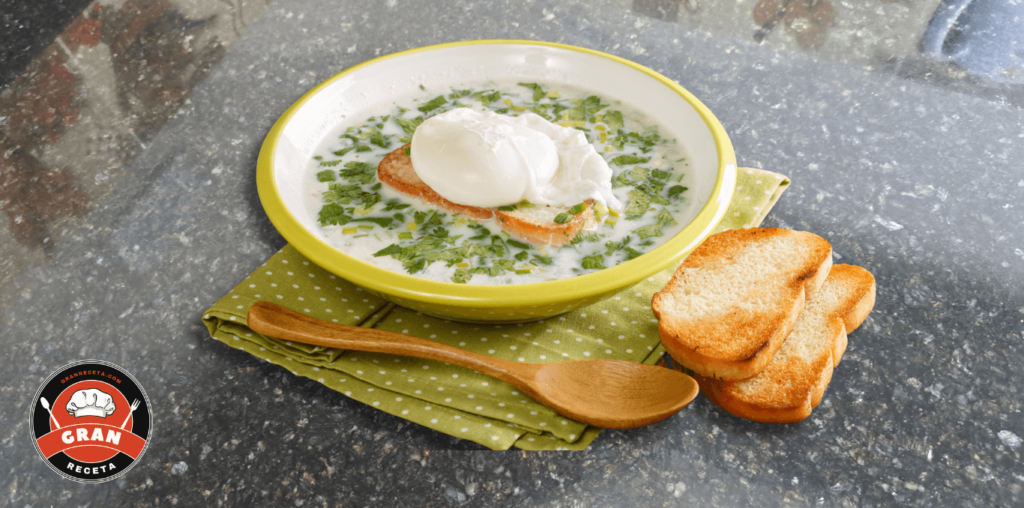
At 8,660 feet, soup for breakfast makes more sense than it sounds. Bogotá sits high on a cold plateau where mornings hover around 45 °F, and changua, an egg poached whole in milk, is what a household puts on the table before anyone leaves the house. It takes 15 minutes, costs almost nothing, and turns on one piece of kitchen physics: egg white sets at 144 °F and yolk at 158 °F, so the broth is kept below a boil and the egg comes out firm outside and liquid in the middle.
How do you make changua? Simmer water with chopped scallion for 6 minutes, add milk and bring it to a shiver without boiling, then slide in whole eggs and poach 3 minutes untouched. Off the heat, add cilantro. Put dry bread in the bowl and pour the broth over. 15 minutes for 2 servings.
What changua is
It is the standard breakfast of Bogotá and the Boyacá highlands: milk cut with water, scallion, cilantro, a whole poached egg and a piece of dry bread underneath. No cheese in the broth, no spice, nothing fried. Say it CHAN-gwa.
The bread matters more than it sounds. Colombians use calado, a twice-baked dry bread made for soups, which softens without turning to paste. Any day-old bread dried in a low oven for 5 minutes does the same job, and the point is the same: something with structure at the bottom of the bowl.
The temperature window
An egg does not set all at once. The white begins to firm around 144 °F and the yolk holds out until about 158 °F, and that 14-degree gap is what makes a poached egg possible. With the broth shivering around 185 °F, heat moves inward slowly enough that 3 minutes sets the white while the center of the yolk never gets there.
No thermometer is needed. The cue is the surface: a faint shiver, a thread of steam, no bubbles breaking. If big bubbles start rising, lower the heat and wait 20 seconds before the eggs go in.
Why the milk is cut with water
Half milk and half water is not economizing. Milk alone boils over easily, because the protein skin on the surface traps steam underneath, and it makes a heavy bowl for the morning.
The 50-50 mix gives a broth with body that you can drink in quantity, and it allows the first real step of the recipe: simmering the scallion in plain water for 6 minutes before the milk arrives. That way the broth takes on flavor without subjecting the milk to a boil it cannot survive.
The five parts and their moments
Each component has its own entry point: water and scallion at the start, milk next, the egg 3 minutes before the end, cilantro off the heat, bread in the bowl.
The egg technique is worth spelling out. Crack each one into a cup first and slide it in from the rim of the pot rather than dropping it from height, and if you are making four, use a wide pan instead of a tall one so the eggs do not touch each other.
How the 15 minutes break down
Everything before the eggs is forgiving. The scallion can simmer for five minutes or eight, and the milk can take its time coming up. From the moment the eggs go in, though, the pot is left alone, because a stir at minute one leaves you with milk full of white threads.
If you like the yolk firm, give it 5 minutes rather than 3, or spoon a little hot broth over the top as you serve.
Who this recipe is for
- If you like a firm yolk → 5 minutes instead of 3, or spoon hot broth over it at the table
- If you have no calado → any day-old bread dried 5 minutes in the oven does the same job
- If you use lactose-free milk → it behaves identically; lactose plays no part in the texture
- If you are cooking for 4 → double everything but use a wide pan, so the eggs have room not to stick together
- If you want it more substantial → a piece of fresh white cheese in the bowl, softened by the broth, about 80 calories more
Three highland breakfast soups
Spoon breakfasts make sense where mornings are cold, and Colombia’s highlands have three. Caldo de costilla is built on beef rib broth and asks 70 minutes; sopa de huevo from Santander sits on water and a tomato sofrito, with the egg beaten into threads on purpose.
Changua is the only one that uses milk as its broth and the only one where the egg arrives whole, which is also why it is the one that goes wrong most easily: the other two do not care whether you stir.
What goes wrong
Letting the milk boil. It climbs the pot, splits, and the yolk sets along with the white.
Stirring the egg. The white shreds into threads and the broth turns cloudy.
Bread in the pot. It dissolves in 2 minutes and the broth becomes porridge.
Boiling the cilantro. It loses its aroma in under a minute; it always goes in off the heat.
Reheating it. The egg finishes cooking. This is a 15-minute dish: make it and eat it.
Variations
With fresh cheese. A 2 oz piece in the bottom of the bowl, softened by the hot broth. Very much the Boyacá way.
With small potatoes. Two or three criolla potatoes boiled in the water before the milk, which thicken the broth slightly.
Water only. Some highland households make it without milk at all, lighter, with more scallion.
With beaten egg. That is a different soup, closer to the Santander sopa de huevo, where the egg is meant to shred.
What to serve with it
Changua is eaten on its own, in a deep bowl of about 14 oz, with the bread inside and sometimes a griddled Colombian cheese arepa or a pair of garullas alongside. At 305 calories it is a light breakfast, so households usually put bread on the table and Colombian hot chocolate after it for anyone who wants something sweet.
For the version with stock instead of milk and the egg beaten into ribbons, there is Colombian egg soup. If you want the heavier end of Colombian breakfast, Colombian calentado is beans and rice fried together and will hold you until dinner, cuchuco de trigo is the thick cracked-wheat soup the same households eat at midday, and the Colombian egg arepa is what the Caribbean coast eats instead, fried rather than poached.
Frequently asked questions
Why did my milk split? It boiled. The broth has to stay below a boil, shivering, for the whole time the egg is in it.
How long does the egg take? Three minutes for a set white and a liquid yolk, 5 minutes if you want the yolk firm.
What is calado? A dry, twice-baked bread used for soups in Bogotá. Day-old bread dried 5 minutes in the oven replaces it.
Can I make it with milk only? You can, but it boils over easily and eats heavy. Half and half is the traditional ratio.
Can I reheat it? Better not: the egg sets through. It takes 15 minutes, so it is made fresh.
Nutrition
Per bowl, half the pot with its egg and bread, calculated with the USDA database for the milk, egg and bread:
- Calories: 305 kcal
- Protein: 17 g
- Carbohydrates: 27 g
- Fat: 13 g, of which 6 g saturated
- Fiber: 1 g
- Sodium: 380 mg
- Sugars: 12 g, which is the lactose in the milk
It is one of the better-balanced breakfasts on this site: according to the USDA, egg brings 12.56 g of protein per 100 g and whole milk carries 3.25 g of fat per 100 ml. Cutting the milk with water is what keeps the bowl near three hundred calories rather than the four hundred and twenty it would run made with milk alone.
The first time someone offered me changua in Bogotá I thought milk soup with an egg floating in it was a strange thing to eat at seven in the morning, coming as I did from a warm-country breakfast. I drank it out of politeness and understood the invention by the third spoonful: the cold on that plateau explains the dish better than any cooking theory. Josnaisis.