
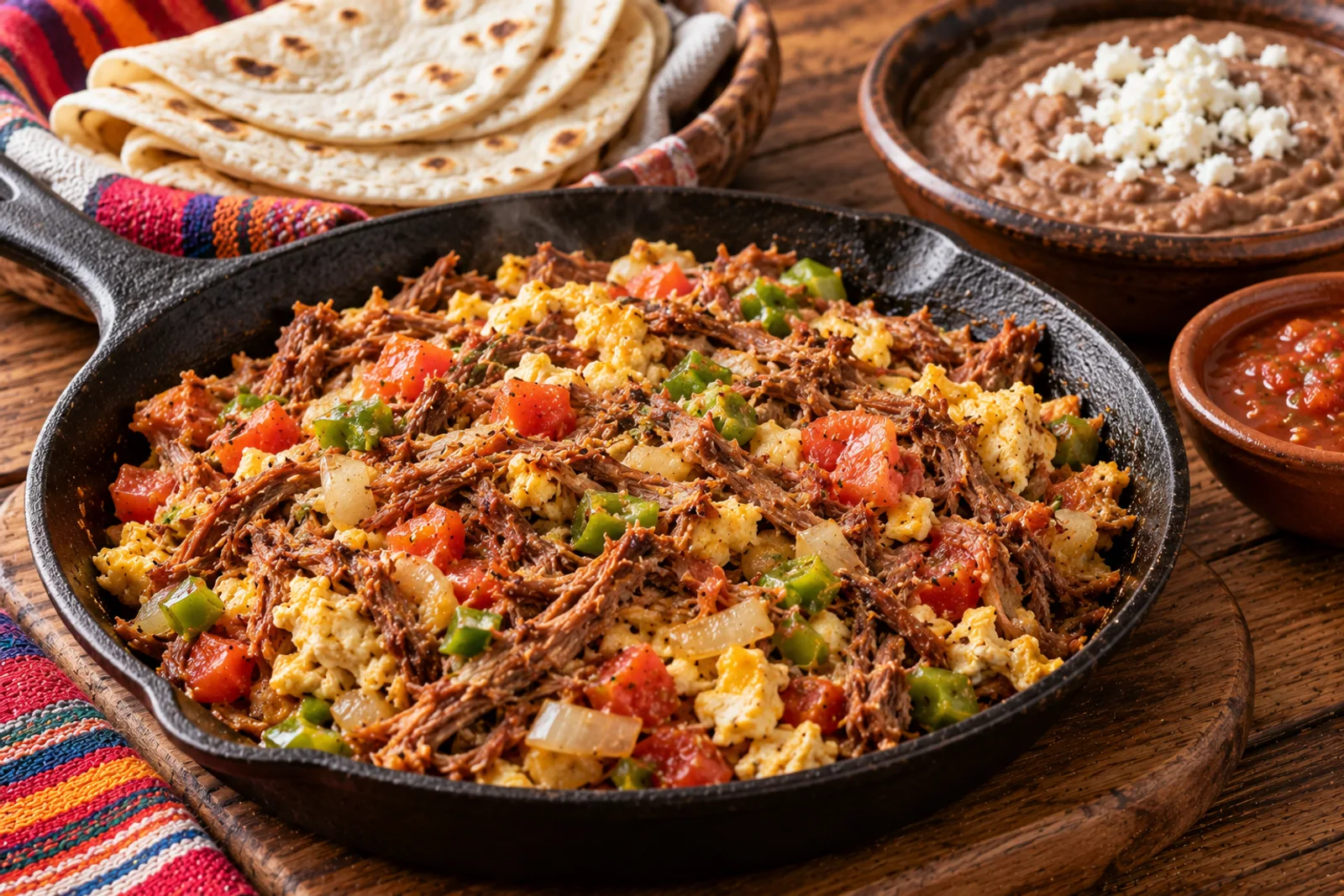

Machaca con huevo (mah-CHAH-kah kon WEH-voh) is a northern Mexican breakfast of scrambled eggs with machaca: beef that has been salted, dried and shredded into fine, fluffy threads. Think of a softer, savory cousin of beef jerky, cooked with tomato, onion and serrano chile, then folded through eggs and eaten with flour tortillas or rolled into a breakfast burrito. It’s quick and easy, but it goes wrong in two ways: the beef ends up tough, or the whole pan is too salty. Both are fixed at the stove, and below is how, plus where to find machaca in the US and what to use in the UK or anywhere it isn’t sold.
What is machaca con huevo?
How do you make machaca con huevo? Fry 5¼ oz (150 g) of machaca in 3 tbsp of oil or lard for 2 minutes, add onion, serrano and garlic for 4 minutes, then 7 oz (200 g) of diced tomato with its juice for 4 to 5 minutes, until the beef softens and the pan is dry. Scramble in 8 eggs over medium-low heat for about 2 minutes and taste before salting. 25 minutes for 4 servings.
It comes out as soft eggs full of toasty, slightly chewy beef, with a concentrated, salty, beefy flavor and medium heat. It’s eaten across northern Mexico and the American Southwest, usually with flour tortillas, beans and coffee.
Names you’ll see. Machaca con huevo in Sonora and Chihuahua, machacado con huevo in Nuevo León and Texas, and in Sonora and Arizona the beef itself is often sold as carne seca. Same dish.
How it differs from other Mexican egg breakfasts. Huevos a la mexicana use the same tomato, onion and chile base with no meat, and there the tomato is seeded so the eggs don’t go watery. Here the juice stays in, because the dried beef needs it. Chorizo and eggs start with fresh chorizo fried in its own fat.
Time. 25 minutes: 10 to chop, 15 at the stove. Easy.
Ingredients, in metric and US measures
| Ingredient | Metric | US | Notes |
|---|---|---|---|
| Machaca | 150 g | 5¼ oz | Up to 200 g (7 oz) for a meatier scramble, no salt |
| Large eggs | 8 (400 g) | 8 | 2 per person |
| Roma tomatoes | 200 g | 2 tomatoes | UK: plum tomatoes. Keep the seeds |
| White onion | 100 g | ½ onion | Yellow works |
| Serrano chiles | 12 g | 2 chiles | 1 jalapeño for milder; Anaheim for mild |
| Garlic | 3 g | 1 clove | |
| Oil or lard | 42 g | 3 tbsp | The beef soaks it up |
That’s about ⅔ oz (19 g) of machaca per egg, on the low side on purpose: machaca is salty.
Where to buy machaca, and what to use instead
In the US
Look in Mexican and Hispanic grocery stores, in sealed bags near the meat counter or by the dried chiles. It’s easy to find in Arizona, Texas and California, and sold online everywhere else. Unopened, it keeps in the pantry unless the label says to refrigerate. Brands vary a lot in salt and dryness, and some add chile or lime, which is why the recipe has no fixed salt. Once open, close it tightly and follow the label; I keep mine in a jar in the fridge.
In the UK
Machaca is rarely sold, so use one of the swaps below. I won’t give you a method for drying raw beef at home: doing it in the sun or a low oven without proper control isn’t safe.
The swaps, and what changes
- Cooked shredded beef, browned until dry. The most common stand-in. Use 10½ oz (300 g) of flank, brisket or any beef cooked until it shreds, like the filling for homemade burritos. Shred it very fine, pat it dry and brown it in the fat over medium heat, stirring, until it stops steaming and the tips crisp. Then follow the recipe. Taste first and add salt a little at a time, up to ½ tsp if the beef was cooked unsalted. Juicier and milder than machaca.
- Leftover carne asada. 10½ oz (300 g), chopped very fine. It’s already seasoned, so taste before salting. Grill flavor and small bits instead of threads. Leftovers from Mexican carne asada are ideal.
- Plain beef jerky. Only jerky with no flavorings or sugar. 5¼ oz (150 g), pulsed in a food processor. No salt. Chewier than machaca, and any sweetness shows in the eggs.
Equipment. An 11 in (28 cm) skillet, nonstick if you have one, a spatula and a bowl.
How to make it
Everything happens in one pan with no breaks, so chop before you turn on the heat.
Fry the machaca, 2 minutes only. Medium heat, stirring the whole time. At 2 minutes it smells toasty and the tips darken a little. Any longer, or with smoking fat, it turns black and bitter, and that can’t be undone.
Let the tomato soften it. The beef comes out of the fat stiff and dry. Onion and chile go in for 3 minutes, garlic for 1, then the tomatoes with all their juice. Over 4 to 5 minutes the beef drinks the juice and turns pliable while the pan dries out. You’re there when the shreds bend without snapping and a spoon leaves a dry trail across the pan. If the pan’s dry and the beef is still stiff, add 2 to 3 tbsp water and cover for 2 minutes. That’s my fix when a bag is very dry.
Cook the eggs gently. Medium-low heat, 20 seconds untouched, then slow passes from the edges to the center for about 2 minutes. Pull the pan off when there’s no liquid egg left but the curds still shine; the pan’s heat finishes them. If you’re cooking for anyone pregnant, very young or elderly, cook the eggs until fully firm, 160°F (71°C).
Salt last. With a typical machaca, the beef alone puts about 1,050 mg of sodium in each serving, nearly all of the dish’s total; drier brands carry more, so check the label. Beat the eggs without salt, taste at the end, and you’ll rarely need more than a pinch.
Troubleshooting tough, salty or watery machaca
- Too salty already? Beat 2 more eggs and stir them in, or add another diced tomato cooked down. Serve with unsalted beans and plain tortillas.
- Heat and kids. Two serranos give medium heat. With one seeded jalapeño, or no chile, most kids eat it happily, though the salt can be a lot for small children.
- Allergens. Eggs. Flour tortillas contain gluten; with corn tortillas the dish is gluten-free, but check the machaca label for additives.
Machaca breakfast burritos
In Sonora, machaca con huevo is the classic breakfast burrito filling, rolled in big, thin flour tortillas.
- Per 8 in (20 cm) tortilla, use ⅓ cup (about 2½ oz / 70 g) of machaca con huevo and 2 tbsp of Mexican refried beans. One batch fills about 10.
- Warm each tortilla 15 to 20 seconds per side in a hot dry skillet just before filling, or it cracks at the fold. Homemade flour tortillas are the most pliable.
- Keep the filling dry, with no tomato juice left in the pan, or the tortilla goes soggy.
- To freeze, cool the filling, roll the burritos, wrap each in plastic wrap (UK: cling film) and bag them. They keep 2 to 3 months; the eggs lose a little juiciness.
- To reheat from frozen, unwrap, wrap in a damp paper towel and microwave 1 minute, flip, then 1 to 3 minutes more, until the center reaches 165°F (74°C). Two minutes per side in a skillet crisps the tortilla.
Scaling it up, and other versions
- For a crowd. Allow 2 eggs and about ⅔ oz (19 g) of machaca per person. An 11 in (28 cm) skillet takes 8 eggs; for more, cook in 2 or 3 batches. Crowd the pan and the eggs steam and turn gray. The vegetables can be chopped the night before and kept covered in the fridge.
- With potatoes. Small cubes of potato fried in the fat until tender, before the machaca. Another common burrito filling up north.
- With roasted Anaheim chiles. Strips in place of the serranos: milder, with a roasted chile flavor.
- With salsa stirred in. 3 or 4 tbsp of Mexican red taco salsa with the tomatoes, for a juicier, hotter scramble.
Serving, storing and reheating
Serve with 2 warm flour tortillas per person, refried or whole beans, salsa and coffee, or as tacos with avocado.
Fridge. In a sealed container within 2 hours of cooking, it keeps 3 to 4 days.
Freezer. Best inside burritos, 2 to 3 months. Frozen on its own it dries out more.
Reheat in a covered skillet over medium-low with 1 tbsp water, stirring, until steaming and 165°F (74°C), or in the microwave at medium power in 30-second bursts. Reheated eggs are always a little drier than fresh.
Machaca con huevo FAQ
Is machaca the same as beef jerky? Both are dried beef, but machaca is shredded into fine threads and made to be cooked, usually with eggs, while jerky is a chewy snack in strips, often sweetened. Plain jerky pulsed in a processor works as a swap.
Do you soak machaca before cooking? I don’t. The tomato juice rehydrates it right in the skillet in about 5 minutes, and for a very dry bag a splash of water and a lid does the rest (amounts in the step above).
Can I make it the night before? The scramble itself dries out when reheated, so make it fresh. Chop the vegetables ahead, or roll burritos the night before and keep them in the fridge.
Does machaca need to be refrigerated? Not while the bag is sealed. Once open, follow the label; I keep it in a jar in the fridge.
Nutrition per serving
Per serving (a quarter of the recipe, no tortillas or beans, no added salt), worked out ingredient by ingredient from the amounts above:
- Calories: 314 kcal
- Protein: 25 g
- Carbohydrates: 6 g
- Fat: 21 g, of which 4 g saturated
- Fiber: 1 g
- Sugars: 4 g
- Sodium: 1,190 mg
The machaca itself is only about 57 kcal of each serving; the oil adds about 93 and the eggs about 143. Machaca varies a lot by brand, and drier ones carry more protein and sodium per ounce, so check your label. A flour tortilla of about 1¾ oz (50 g) adds about 145 kcal.
I always taste a shred straight from the bag before I start. If it stings my tongue, I add an extra egg that day and leave the salt alone. And when there’s no machaca to be had, I shred leftover beef from a pot of soup very fine and leave it in the pan until the tips crisp. It isn’t the same, but rolled in a flour tortilla with beans, it comes close. Josnaisis.