
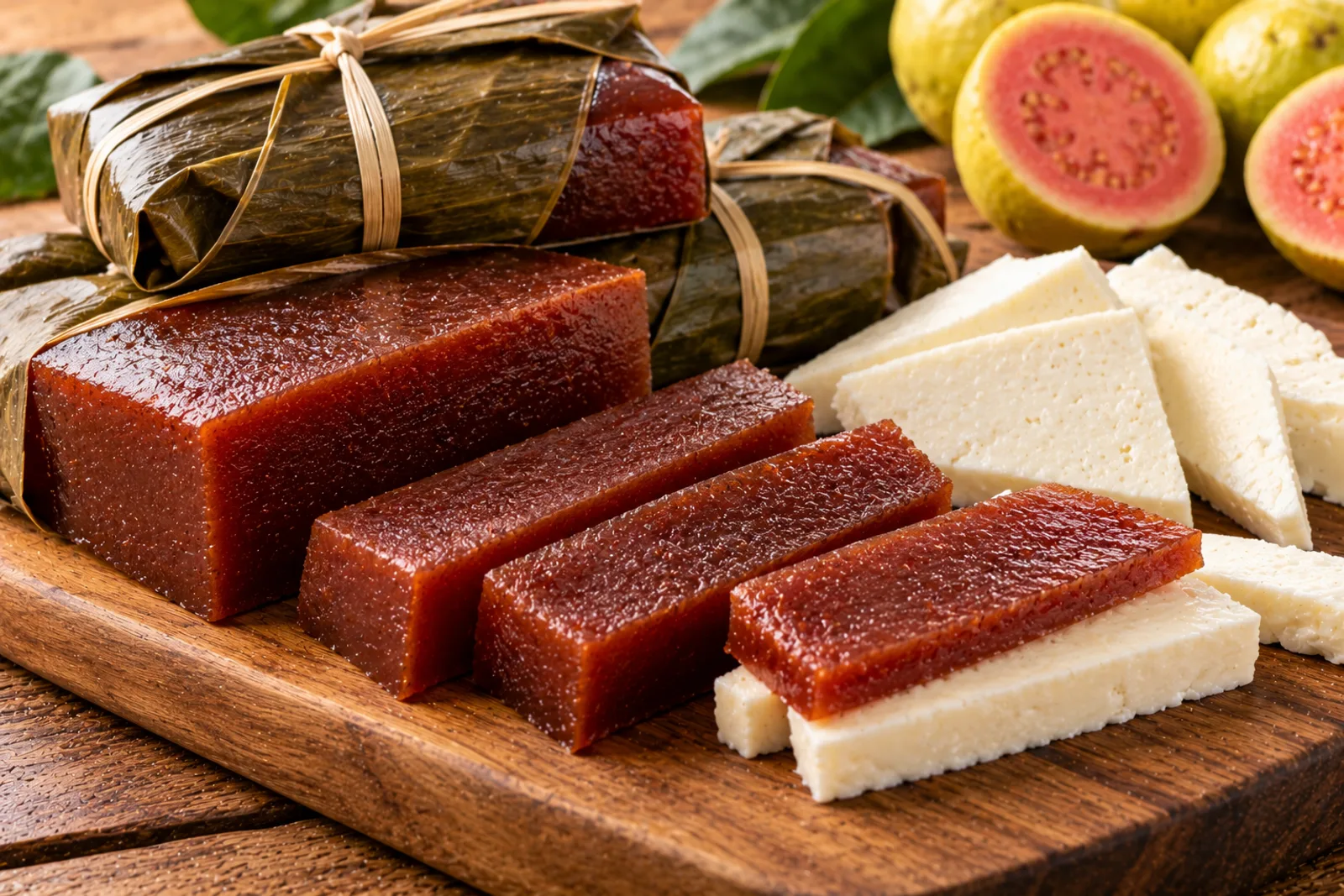

Guava paste is guava pulp cooked down with sugar to 226-230°F (108-110°C), the point where it sets into a firm, deep red block you slice with a knife. Colombians call it bocadillo (boh-kah-DEE-yoh) and eat a bar of it with a slice of salty fresh cheese; Cubans call it pasta de guayaba and bake it into pastries. If you know Spanish membrillo, the quince paste served with Manchego, it’s the same idea with a tropical, floral fruit. This recipe makes about 2.6 lb (1.2 kg), enough for 40 bars of 1 oz (30 g), from fresh guavas or from a bag of frozen pulp.
What guava paste is and how homemade compares
How do you make guava paste? Simmer 3¼ lb (1.5 kg) of quartered guavas in 1 cup (250 ml) of water, sieve out the seeds, and cook the pulp with 4 cups (800 g) of sugar per 2.2 lb (1 kg) and 2 tbsp of lemon juice, stirring, to 226-230°F (108-110°C), when it pulls away from the pan. Pour into an 8 in (20 cm) pan, let it set 12 to 24 hours and slice. 820 minutes for 40 servings: 100 at the stove and 12 hours to set.
The Colombian benchmark is bocadillo veleño, from the provinces of Vélez and Ricaurte in Santander and Boyacá, made with local white and red guavas and hand-wrapped in bijao leaves. It has had a protected designation of origin since 2017. The blocks you find in US supermarkets are the same sweet made on an industrial scale.
Homemade comes out a touch softer and less uniform than store-bought, with a fresher fruit taste and some tartness. It still slices cleanly and keeps for weeks.
100 minutes at the stove, plus at least 12 hours to set. Medium difficulty: nothing is tricky except the last 20 minutes, when you can’t leave the stove.
Ingredients, ratio and what to buy
The ratio is sugar at 80% of the pulp’s weight: 800 g (4 cups) per 1 kg (2.2 lb) of sieved pulp. Less sugar gives a softer paste with a shorter shelf life; more makes it sweeter and duller. It’s measured against the sieved pulp rather than the raw fruit because guavas vary in how much seed and water they carry, and the cooking water counts too. That’s why you start with 3¼ lb (1.5 kg) of fruit and weigh what comes through the sieve. A kitchen scale makes this much easier than cups.
Guavas are rich in pectin, mostly in the skin, so you don’t peel them and you don’t need packet pectin. The lemon adds the acidity that helps it set and balances the sugar.
Where to find guavas outside Latin America
| US | UK | What changes | |
|---|---|---|---|
| Fresh guavas | Latin and Caribbean markets, some Florida and California supermarkets in season | South Asian and Caribbean grocers | Pink flesh gives the classic dark red paste; white flesh gives an amber one |
| Frozen guava pulp | Freezer aisle of the Hispanic section, usually 14 oz (397 g) packs | Latin, Caribbean and Asian grocers, or online | Already sieved, so it skips the first 40 minutes. Thaw it overnight in the fridge |
| Canned guava shells or nectar | Hispanic aisle | World food aisles | Not suitable: nectar never sets, and canned fruit brings its own syrup, which throws the ratio off |
Check the frozen pulp label says only guava pulp (some add ascorbic acid, which is fine). If it’s sweetened, the 80% ratio no longer works. Fresh guavas should be fragrant and give slightly when pressed; green ones make a pale, bland paste.
Brown sugar or panela. You can swap the same weight of dark brown sugar, piloncillo or panela for the white sugar. The paste turns brown rather than red and tastes of molasses, and the color change at the set is harder to read, so rely on the other signs.
Equipment. A wide, heavy pan of 4 to 5 qt (4 to 5 L), about 10 to 11 in (26 to 28 cm) across; nonstick helps. A long-handled wooden spoon and an oven mitt, because thick paste spits and burns. A fine-mesh sieve. A candy thermometer that reads to at least 300°F (150°C) is useful but not essential. An 8 in (20 cm) square pan and parchment: the paste ends up about ¾ in (2 cm) thick.
How to make guava paste step by step
Cook and sieve the fruit
Quartered guavas simmer in the water, covered, for 15 to 20 minutes, until they collapse. Then pulse them in the blender in short bursts. Blending hard cracks the rock-hard seeds, the fragments pass through the sieve and you end up with gritty paste. A potato masher works too and avoids the problem altogether.
Push the purée through the sieve with a ladle, scraping the underside where the thickest pulp clings. Weigh the pulp: 1,200 g needs 960 g of sugar; 900 g needs 720 g.
Cook it down without scorching
Pulp, sugar and lemon go in together over medium heat until the sugar dissolves and it boils. Then turn it to medium-low, uncovered, and for about 40 minutes stir every 5 minutes, scraping the bottom and corners. It goes from pink to dark red and slowly thickens.
When the bubbles turn big, slow and start to spit, stir constantly, scraping the bottom, for another 15 to 20 minutes. This is the stretch that gets skipped, and it’s the one that matters: stop stirring now and the bottom catches, and the whole block tastes scorched.
How to tell guava paste is set
With a thermometer, the set is 226 to 230°F (108 to 110°C) at sea level. Hold the tip in the middle of the paste, off the bottom of the pan, which always reads hotter. At altitude water boils lower and every stage drops by the same amount: check what your water boils at and aim 15 to 18°F (8 to 10°C) above it. In Denver, where water boils at about 203°F, that’s roughly 217 to 221°F.
Without a thermometer, three signs arrive together:
- It leaves the pan. As you stir, the paste comes away from the bottom and sides and moves around as one heavy mass.
- The spoon track stays open. Drag the spoon across the bottom: you see a clean line of pan that doesn’t close. If it closes in about 2 seconds, you’re at the softer stage of a Colombian guava roll; if it closes straight away, keep going.
- The cold water test. Drop half a teaspoon into a glass of very cold water and wait a few seconds. If it dissolves or trails like a thread, it isn’t ready. If it holds as a firm ball you can lift out whole, it is.
Set, slice and wrap
Pour the paste into the pan immediately and smooth it with an oiled spatula; within minutes it starts setting in the pot. Leave it uncovered until it stops steaming, then cover with a clean cloth rather than plastic wrap, which drips condensation onto the surface. Let it set 12 to 24 hours somewhere cool, out of the sun.
Lift the block out by the parchment and cut it with a long knife dipped in hot water and wiped between cuts. An 8 in (20 cm) pan gives 40 bars of about 1½ x 1 in (4 x 2.5 cm), around 1 oz (30 g) each. If the cut faces feel tacky, I leave them on a rack for a few hours before wrapping.
In Vélez each bar is folded by hand into a bijao leaf. At home, wrap each one in a square of parchment or wax paper like a sweet. Plastic pressed against the paste makes it sweat.
Guava paste troubleshooting
- Soft, won’t slice. It didn’t reach the set. Scrape it back into the pan, melt it over low heat while stirring, cook 10 to 20 minutes more until the three signs return, and pour it again.
- Hard, dark and brittle. It went past 230°F (110°C) and there’s no going back. Don’t throw it out: melted with 2 or 3 tbsp of hot water it’s the filling for a Venezuelan brazo gitano cake roll.
- Gritty or seedy. Over-blended or a coarse sieve. No fix; pulse and use a fine mesh next time.
- Tastes scorched, with black flecks. It caught on the bottom in the last stretch, from a thin pan or from stopping stirring. No fix.
- Sugary crust or crystals. Sugar that never dissolved at the start, or crusts from the sides of the pan scraped in when pouring. Dissolve the sugar fully before it boils and don’t scrape the sides into the pan.
- Sweats or sticks to the paper in storage. It was wrapped in plastic or shut in a jar. Unwrap, air it for a few hours and rewrap in paper.
Allergens. No gluten, dairy, eggs or nuts, and no heat. Kids love it, but it’s almost all sugar: one 1 oz (30 g) bar is about 95 kcal.
Make ahead, storage and scaling up
- Room temperature, each bar wrapped in paper and kept in a tin or box somewhere cool and dry: 2 weeks.
- Fridge, wrapped and in a closed container: up to 3 months. It may sweat a little when it comes out, so leave it wrapped until it warms up.
- Freezer, wrapped in paper and bagged: up to 3 months. Thaw at room temperature; the texture holds.
If you see any mold, discard the whole block rather than cutting around it.
Lower sugar. You can drop to 600 g (3 cups) per 1 kg (2.2 lb) of pulp. It comes out tarter and softer, takes longer to set and won’t keep the same way at room temperature, so store it in the fridge from day one.
Bigger batches. One batch serves 20 people at 2 bars each. To double it, use two pans at once rather than one huge pot: twice the paste takes far longer to reduce and catches on the bottom sooner. The set point doesn’t change.
How to serve guava paste
With cheese. In Colombia, bocadillo con queso is a 1 oz (30 g) bar of guava paste with a same-size slice of fresh white cheese, stacked; the salty cheese cuts the sweetness. In the US, queso fresco, queso blanco or cream cheese all work. In the UK, a mild fresh cheese, or Manchego, the way Spain serves membrillo.
In baking. It’s the filling of the Colombian guava roscón sweet bread ring and of flaky Cuban guava pastries with cream cheese. Softened with a splash of hot water it fills an Argentinian pastafrola lattice tart, and in strips it melts inside baked sweet plantains with cheese and guava paste.
Guava paste FAQ
Is guava paste the same as guava jelly or jam? No. It’s the same fruit with more water cooked out. Jelly and jam stop around 219°F (104°C) and spread; guava paste goes to 226-230°F (108-110°C) and slices.
Does guava paste need to be refrigerated? Homemade keeps 2 weeks at cool room temperature, wrapped in paper. For longer, up to 3 months in the fridge. Once opened, a store-bought block follows the instructions on its label.
Why didn’t my guava paste set overnight? It stopped short of the set, often because it was taken off by the clock rather than by the signs. Put it back on the heat for 10 to 20 minutes.
Can I make it with frozen guava pulp? Yes, and outside Latin America it’s the easiest way. Use unsweetened pulp, thaw it in the fridge, and start at the sugar stage: about 60 minutes in all.
Guava paste nutrition
Per bar (1 of 40, about 1 oz / 30 g), worked out from 1 kg (2.2 lb) of pulp, 800 g (4 cups) of sugar and the lemon juice:
- Calories: 95 kcal
- Protein: 1 g
- Carbohydrates: 24 g
- Fat: 0 g
- Fiber: 1 g
- Sugars: 22 g
- Sodium: 1 mg
More than four-fifths of the calories come from sugar. Much of a guava’s fiber sits in the seeds, which get sieved out.
Make it when guavas are cheap and ripe, and make the full batch: whatever doesn’t go with cheese that week keeps for months in the fridge, ready for roscón and plantains. Even with a thermometer, don’t turn off the heat until the spoon track stays open. Josnaisis.