
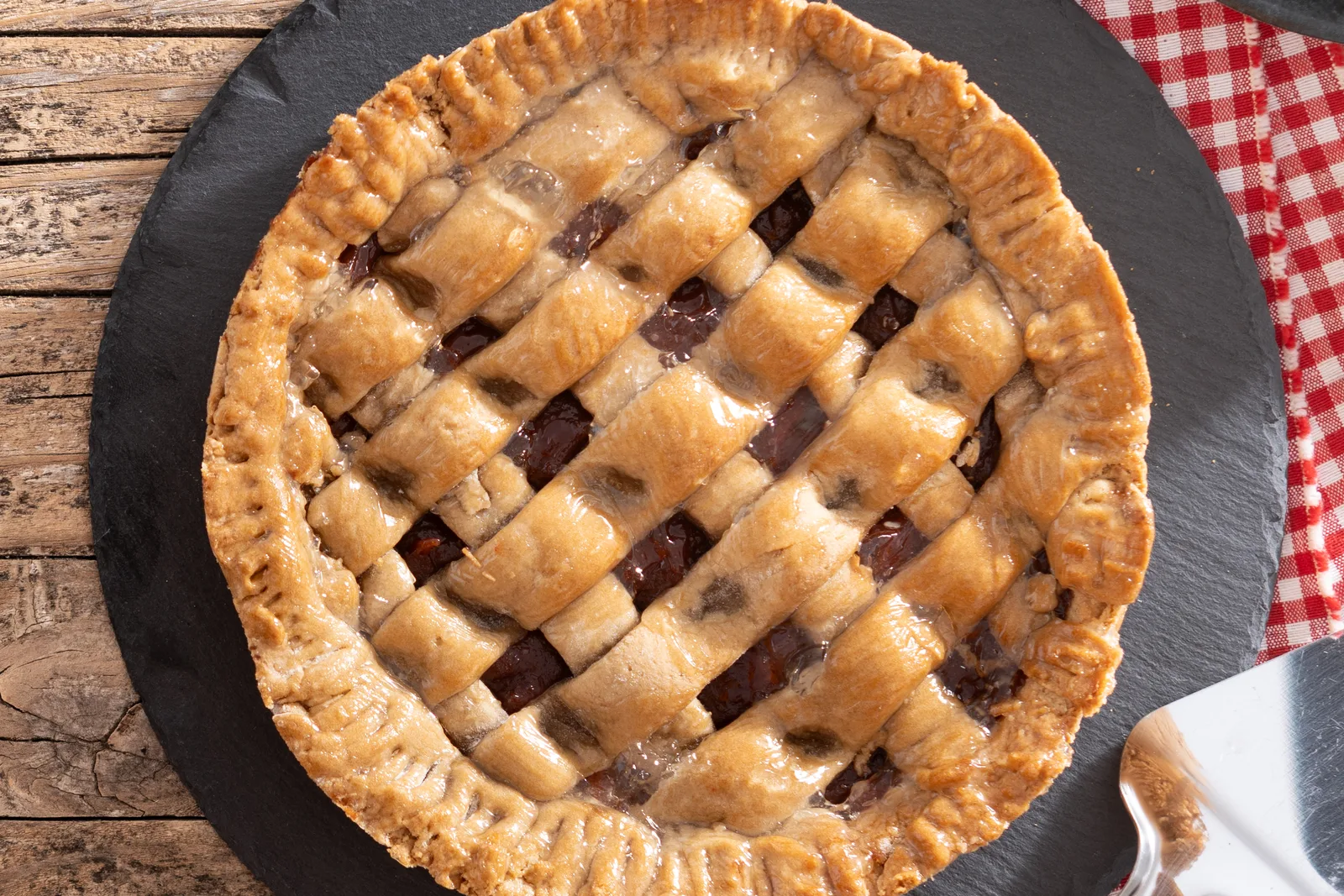

Pastafrola (pah-stah-FROH-lah) is the tart Argentinians cut into squares for the afternoon merienda: a sweet, sandy butter crust spread with quince paste and topped with a diamond lattice of the same dough. Pasta frolla is Italian for shortcrust pastry, and the tart is just as common in Uruguay and Paraguay. If you’ve had a Linzer torte it will look familiar, but there’s no nut flour or spice, and the filling is firmer and tarter than raspberry jam. What follows is weight-first, so the dough comes out the same every time.
What pastafrola is, and how long it takes
How do you make pastafrola? Rub 150 g (5⅓ oz) of cold butter into 300 g (2⅓ cups) flour, ¾ cup sugar and lemon zest, bind with 1 egg and 1 yolk without kneading, and chill 30 minutes. Line a 9½ in (24 cm) tart pan, fill with 1 lb (450 g) quince paste softened with ¼ cup water, add a lattice of ⅜ in strips and bake 35 to 40 minutes at 350°F (180°C). 235 minutes for 12 servings, including 2 hours of cooling.
Time. 1 hour 55 minutes until it comes out of the oven, about 40 of them hands-on. Then it needs 2 hours to cool before it will slice. Medium difficulty: nothing is technically hard, but the dough has to stay cold.
Quince paste, dulce de membrillo in Spanish, is quince fruit cooked down with sugar until it sets into a firm, sliceable block, deep amber to brick red. On its own it’s too stiff to spread, so for this tart it’s warmed with a little water into something like very thick jam.
What you need, with US and UK swaps
| Ingredient | Metric | US | UK and notes |
|---|---|---|---|
| All-purpose flour | 300 g | 2⅓ cups, spooned and leveled | Plain flour |
| Baking powder | 4 g | 1 tsp | Skip it with self-rising (UK self-raising) flour |
| Sugar | 150 g | ¾ cup | Caster sugar; powdered sugar gives a finer crumb |
| Unsalted butter, cold | 150 g | 1 stick plus 2½ tbsp | Block butter, straight from the fridge |
| Egg and yolk | 1 + 1 | 1 + 1 large | Large eggs |
| Quince paste | 450 g | 1 lb | Sold in small packs in the UK, so buy about four 120 g ones |
Weigh the flour if you can. Scooped straight from the bag, a cup holds noticeably more flour than a spooned one, and the dough comes out dry and crumbly in the wrong way, cracking instead of rolling.
Where to buy quince paste in the US and UK
- US. Look in the Hispanic or international aisle, at Latin grocers, or near the specialty cheeses as quince paste or membrillo. Argentine, Uruguayan and Spanish brands are all sold online. Any of them works here.
- UK. Waitrose, M&S and Morrisons sell membrillo in small 120 to 200 g packs, usually near the cheese counter. Ocado and Spanish delis such as Brindisa stock it too.
- Can’t find it? In the US, a block of guava paste from the Hispanic aisle is the easiest swap and softens the same way. See the fillings below.
Equipment. A 9½ in (24 cm) tart pan with a removable bottom (a 9 in pan works with a slightly thicker crust), two sheets of parchment, a rolling pin, a small saucepan and a long knife or pastry wheel. No loose-bottom pan? Line a fixed one with parchment, leaving the ends hanging out, and lift the cold tart out by them.
The make-ahead plan
You can split the work across two days. Make the dough and soften the quince the night before, both covered in the fridge, then let the dough sit out 10 minutes before rolling. The baked tart is better on day two anyway: the crust firms up and the slices come out clean.
How to make pastafrola, step by step
The dough, rubbed not kneaded. Rub the cold butter into the dry ingredients for 3 to 4 minutes, until the biggest bits are lentil-sized. Add the beaten egg, yolk and vanilla and bring it together with a fork, then one hand. Stop as soon as there are no dry patches. Keep working it and the gluten tightens, and you get a tough cookie instead of a crumbly crust. Divide into 480 g and 200 g and flatten into ¾ in (2 cm) disks, which chill faster than balls. 30 minutes in the fridge.
Softening the quince paste. 1 lb (450 g) diced, ¼ cup (60 ml) hot water, low heat, 5 to 7 minutes, mashing as you go. You want it spreadable with the back of a spoon but not runny. If you leave it loose, it boils in the oven and soaks the base. In a microwave, heat it with the water for 30 seconds, mash, then go in 15-second bursts. Cool it before it goes on the dough, or it melts the butter.
Rolling without cracks. Roll between two sheets of parchment rather than on a floured counter. The dough doesn’t stick, picks up no extra flour, and you can flip it without touching it. Aim for a scant ¼ in (5 mm), about 12 in (30 cm) across. Peel, flip into the pan, peel again, and press it into the corners rather than stretching it. Run the rolling pin over the rim to trim. Patch any tear with a scrap; it won’t show.
Making the lattice
Roll the small disk to the same thickness and freeze it flat for 10 to 15 minutes. Cold, it cuts cleanly and the strips don’t stretch when you lift them. Use a ruler and a long knife to cut ⅜ in (1 cm) strips, ten or a dozen of them, and chill the filled tart in the meantime while the oven heats.
Argentinians don’t weave the lattice. Lay half the strips in parallel, about ¾ in (2 cm) apart, then lay the rest across them at an angle so the gaps are diamonds. Press the ends into the rim, trim, and brush with beaten egg. A strip that breaks can go down in two pieces; they fuse in the oven.
Baking, and how to tell it’s done
350°F (180°C), conventional heat, on a rack in the lower third so the base cooks through before the lattice gets too dark. Allow 35 to 40 minutes.
It’s done when the edge and every strip are evenly golden, with no pale patches, and the crust has pulled away slightly from the side of the pan. The quince looks glossy and may bubble a little in the gaps. If the rim is browning fast at 25 minutes, cover it with a strip of foil. Don’t push it longer than it needs: overbaked quince forms a chewy skin and this sweet a dough scorches quickly.
Why wait 2 hours? Straight from the oven, the crust is soft and the filling is liquid again. Cut it now and the quince runs and the base breaks. As it cools, the crust crisps and the quince sets back up.
Troubleshooting
- Pale, underbaked bottom. The oven wasn’t fully hot or the tart sat too high. Preheat for 15 minutes and bake low.
- Filling bubbling over the rim. Too much filling, or the crust didn’t come ¾ in (2 cm) up the sides. One pound in a 9½ in pan gives a layer just under ⅜ in (1 cm) deep.
- Lattice sinking. The quince went on warm or too loose.
Allergens. Contains wheat (gluten), egg and milk (butter). No heat at all; it’s very sweet, which kids tend to like.
Other fillings
- Sweet potato paste (dulce de batata). The other Argentine classic. Soften it the same way, adding water a spoonful at a time until it spreads. Sweeter and milder than quince. Look for it in Argentine shops or online.
- Half and half. Soften quince and sweet potato separately and spread each over one half.
- Guava paste. 1 lb (450 g), softened like the quince. Sweeter and more floral. The usual US option is Goya’s 21 oz (595 g) block in the Hispanic aisle, the same paste that fills Cuban guava pastries and a Colombian guava roll.
- Dulce de leche. 1 lb (450 g) of the thick baker’s style (repostero), straight from the jar, no water. Regular dulce de leche bubbles up through the lattice. A homemade Colombian dulce de leche cooked until it holds a line on the bottom of the pan works too.
- Oil instead of butter. Some Argentine versions use 100 ml (7 tbsp) neutral oil, 2 eggs and 350 g (2¾ cups) flour. The crust is softer and moister, less sandy, and harder to roll; give it 10 extra minutes in the fridge.
- Mini tarts. In 4 to 4¾ in (10 to 12 cm) pans, same thickness, 20 to 30 minutes in the oven.
Scaling for an 8 or 11 inch pan
Scale by the area of the pan and keep the dough a scant ¼ in (5 mm) thick. The baking time barely changes for bigger pans of the same depth; go by the color.
Serving and storing
Serve at room temperature, in wedges or 2½ in (6 cm) squares, with coffee, tea or, in Argentina, mate. A spoon of desiccated coconut over the hot tart is an optional finish. For a full Argentine merienda, add medialunas, the small sweet croissants, and a plate of alfajores with dulce de leche. For a no-bake Argentine dessert, there’s chocotorta, layered from chocolate cookies and dulce de leche cream.
- Counter. Covered, 2 to 3 days somewhere cool. The crust is at its best this way.
- Fridge. Up to 1 week in an airtight container. The crust softens a little; take it out 30 minutes before eating.
- Freezer. Baked and well wrapped, up to 4 months; thaw overnight in the fridge. The crust loses some crispness, so if you’re planning ahead, freeze the raw dough disks instead, for up to 3 months, and move them to the fridge the night before.
Frequently asked questions
Is pastafrola the same as a Linzer torte? They look alike, but a Linzer torte has ground nuts and spice in the dough and usually a berry jam. Pastafrola is a plain lemon-and-vanilla butter crust with quince, sweet potato or guava paste.
Can I use quince jam or quince jelly instead of paste? Not as a straight swap. Jelly and most jams are too runny: they boil in the oven and soak the crust. If it’s all you have, use the thickest jam you can find, with no water, in a thinner layer.
Why did my lattice strips break? Warm dough. Butter softens within minutes in your hands, and soft strips stretch, thin out and tear. Cut them from a sheet that has just come out of the freezer and lift them with a spatula, not your fingers.
Does pastafrola need to be refrigerated? Only in hot weather or if you want it to last the week. In a cool kitchen, covered on the counter is better for the crust for the first 48 hours.
Nutrition
Per serving (1/12 of a 9½ in tart), calculated ingredient by ingredient from the amounts above:
- Calories: 345 kcal
- Protein: 4 g
- Carbohydrates: 58 g
- Fat: 11 g, of which 7 g saturated
- Fiber: 1 g
- Sugars: 31 g
- Sodium: 67 mg
The quince paste brings about 104 kcal a serving, the flour 91 and the butter 90. A smaller square, a sixteenth of the tart, is around 260 kcal.
Every time my pastafrola has come out tough, it’s because I kept working the dough after it had come together; every time it fell apart, I sliced it warm. I like it with quince only, because its tartness balances such a sweet crust, and I always bake it the day before. Cold dough, few hands, patience at the end. Josnaisis.