
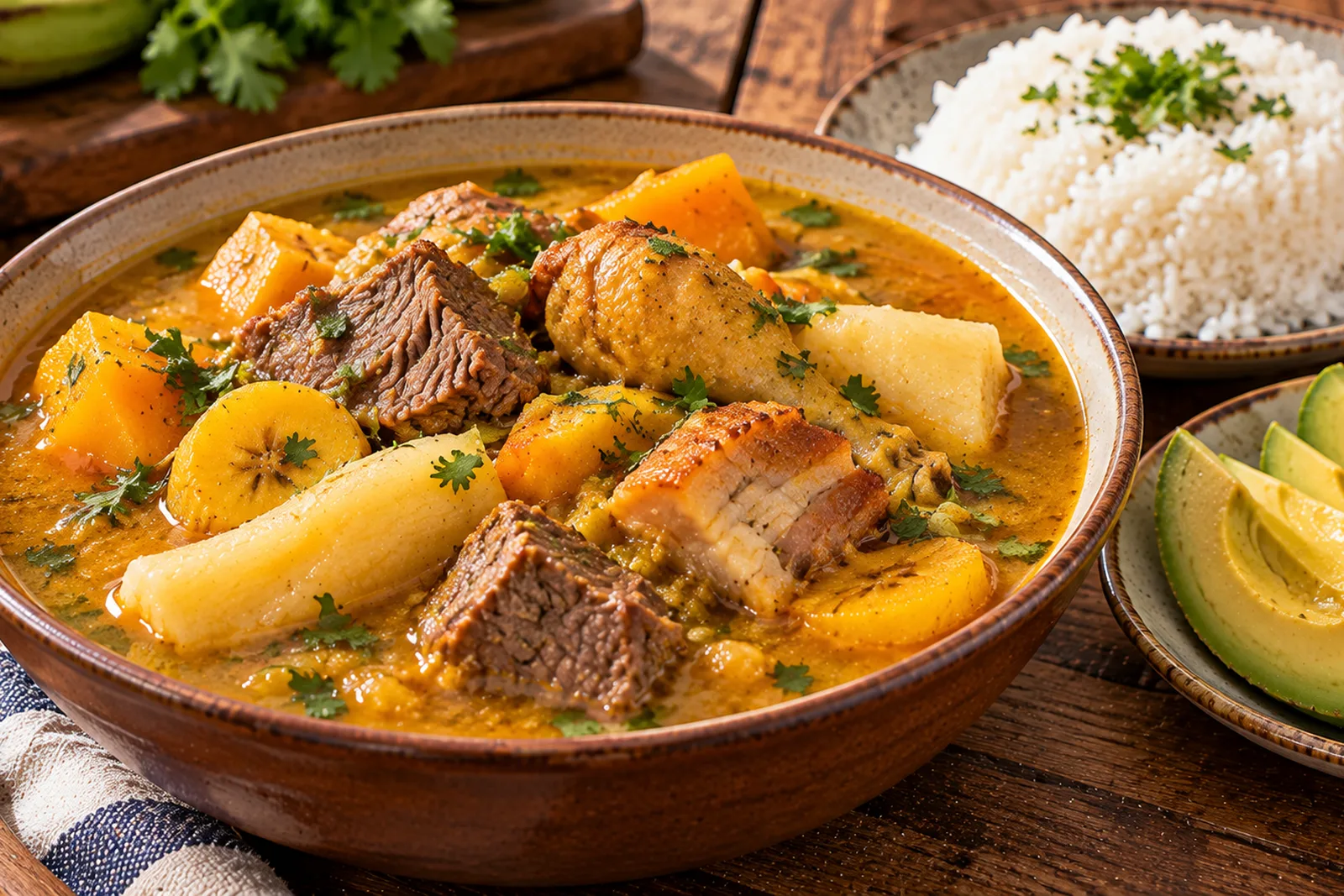

Dominican sancocho (sahn-KOH-cho) is the big-occasion stew of the Dominican Republic: several meats, starchy tropical roots, green plantain and Caribbean pumpkin, simmered until the broth turns thick, orange and almost gravy-like. The full party version is sancocho de siete carnes, seven-meat sancocho. It isn’t a pile-everything-in pot. The beef and pork get 50 minutes on their own, the chicken comes later, and the roots go in two rounds so the yuca and plantain hold their shape while the yautía and grated plantain dissolve and thicken everything. Below is a 10-serving version built on five meats you can buy at a US or UK supermarket, plus how to get to seven.
What Dominican sancocho is
How do you make Dominican sancocho? Marinate 6½ lb (2.9 kg) of mixed meats in lime, garlic and oregano, brown the beef and pork, then simmer them 50 minutes in 3 quarts of water with diced Caribbean pumpkin. Add chicken and corn, then yuca, ñame and green plantain 10 minutes later, and yautía with a grated plantain 15 minutes after that. Simmer 20 minutes, until the broth thickens and the chicken reaches 165°F (74°C), and serve with white rice and avocado. 160 minutes for 10 servings.
Think of it as a cross between a soup and a stew: you eat it from a deep bowl, with a spoon, and the broth coats the spoon. It tastes of browned pork and beef, lime and garlic, with sweetness from the pumpkin and corn. Rice is served alongside, avocado on top or on the side, and hot sauce or a sour-orange chili vinegar at the table. Dominican cooks leave out potatoes, noodles and tomato sauce.
The site also has two Colombian sancochos, and they work differently. The Colombian three-meat sancocho starts unbrowned meat in cold water, skims hard for a clear broth and adds potatoes. The Colombian hen sancocho is a lighter, one-meat soup. The Dominican pot browns marinated meat and wants a cloudy, thick broth.
Time: 160 minutes, 30 of prep, 15 of browning and the rest mostly simmering while you add things on schedule. Medium difficulty: no hard technique, but a long shopping list and an order you have to follow.
What to buy, and what it’s called at your store
This makes 10 deep bowls, with about 10 oz (290 g) of bone-in meat per person.
The meats
There is no fixed list of seven. The ones that come up most are beef, goat, pork, pork ribs, chicken, longaniza sausage and something smoked (pork chops, ribs or a ham bone). Families use what they have, and five already gives you a party-worthy pot. This recipe skips goat and the ham bone because they’re the hardest to find; see the variations if you can get them.
- Beef. Stew meat or chuck in the US, braising steak in the UK. It needs the longest cooking.
- Fresh pork spare ribs, cut between the bones. Your butcher will cut them for you.
- Smoked pork chops. In most US supermarket meat cases. In the UK, smoked gammon in chunks does the same job.
- Longaniza. Dominican longaniza is a fresh pork sausage, sold in Latin markets and bodegas in Dominican neighborhoods. Any fresh, unsmoked pork sausage works. Avoid Spanish paprika chorizo: it turns the broth red and makes it taste of a different dish.
- Chicken. Bone-in, skinless thighs and drumsticks. Breasts dry out and fall apart, and the skin only adds grease.
The roots, the pumpkin and the plantain
Yuca, green plantain and pumpkin are the must-haves. Ñame and yautía are almost always there; if you can’t find one, use more of the others by the same weight.
- Yuca (cassava). Fresh in Latin, Caribbean and many regular supermarkets in the US, and at African and Caribbean grocers in the UK. Frozen peeled yuca works just as well here.
- Ñame. A white-fleshed tropical yam with rough brown skin. The orange “yams” sold for Thanksgiving are sweet potatoes, and they would make the stew sweet and mushy. In the UK, look for white yam at African and Caribbean grocers.
- Yautía. Often labeled malanga or tannia in the US; in UK grocers, look for eddoes or cocoyam. It melts into the broth, which is the point.
- Auyama. Caribbean or West Indian pumpkin, sometimes sold as calabaza. Kabocha or butternut squash are the closest supermarket swaps.
- Green plantains. Fully green and hard. Once they start turning yellow, they taste sweet and the grated one won’t thicken the same way.
Marinade, finish and equipment
The marinade is lime or sour orange, garlic, oregano, salt and cilantro. Dominican oregano is stronger than the Mediterranean kind; with regular dried oregano, use a little more. Sour orange (naranja agria) is in Latin markets, often next to the limes. Without it, finish with lime juice: sharper and less perfumed.
Equipment. A heavy 12 liter (12 quart) stockpot at minimum, a ladle for skimming and a box grater. In a thin pot, the grated plantain sticks during the last 20 minutes.
Cooking it, step by step
Marinate, then brown
Drain the meat before it hits the oil: wet meat steams and turns gray. Brown it in 2 batches of 5 to 6 minutes, then the smoked pork and sausage for 3 minutes. The brown bits stuck to the pot dissolve once the water goes in and color the broth. The chicken isn’t browned; it goes straight into the broth later.
Why the meats go in at different times
Beef and pork ribs carry a lot of connective tissue that needs a long, gentle simmer to soften. Bone-in chicken is done in about 45 minutes, and if it simmers the full time with the beef it shreds into strings. So there are three moments: beef, pork, smoked pork and sausage as soon as the water boils; chicken 50 minutes later; and no new meat once the roots start going in.
At the 50-minute mark, pierce a piece of beef: it should be starting to give, even if it’s still firm. If it’s as tough as when it went in, give it 10 to 15 more minutes before adding the chicken. Not every cut of beef behaves the same.
Getting the thickness right
Plantain pieces, yuca and ñame go in together and cook 35 minutes, so they end up tender but whole. The yautía and grated plantain follow 15 minutes later and cook 20: the yautía half-dissolves and the plantain binds the broth. From then on, stir from the bottom every 5 minutes, because the grated plantain settles and sticks.
When it’s right, the broth coats the back of a spoon, it’s a toasted orange color, and a ladleful has whole chunks floating in a broth that is no longer see-through. For a thicker stew, mash some pumpkin and yautía against the side of the pot and simmer uncovered 5 to 10 minutes. Too thick? Add hot water from the reserve, ½ cup at a time.
How to tell it’s done
- Chicken at 165°F (74°C) next to the bone. Without a thermometer, the meat pulls away from the bone and nothing pink is left.
- Beef tender enough to cut with a spoon.
- Yuca with no hard center when you push a fork through.
- Salt last. The sausage and smoked pork salt the broth heavily, and it usually doesn’t need any more.
After the 10-minute rest, fat rises to the top: skim it off with the ladle. With two pork cuts and sausage, there’s a fair amount.
When it goes wrong
- Thin, watery broth. Too much water, not enough pumpkin or yautía, or the plantain wasn’t grated. Mash some roots against the pot and simmer uncovered 10 minutes. Next time, add only enough water to cover.
- Roots turned to mush. Everything went in at the start, or the pieces were small. Keep the two rounds and cut them 1½ in (4 cm).
- Tough beef, chicken already done. The beef didn’t get its 50 minutes, or the cut was very lean. Lift the chicken onto a plate, keep simmering until the beef gives, and return the chicken at the end.
- Scorched bottom. Thin pot, or no stirring after the plantain went in. Pour the stew into a clean pot without scraping: the burnt layer makes everything bitter if you stir it in.
- Too salty. Salt in the marinade and again at the end without tasting. Add hot water and an extra chunk of yuca or plantain, which soak up salt as they cook.
Heat and allergens. It isn’t spicy: cubanelle is a sweet pepper, and hot sauce goes on the table. Kids usually like it. There’s no gluten or dairy in the recipe, but some sausages and bouillon cubes contain them, so check labels.
Cost. The meat is what makes this pot expensive, longaniza and goat especially outside the Caribbean. The beef-and-chicken version is the cheapest, and the way to stretch the pot is more roots, not more meat.
Sancocho for a crowd
The recipe scales cleanly as long as you keep the ratios and the order. What changes is the pot size and how long it takes to come back to a boil:
- Time each round from when it boils again. In a 20 or 30 liter (5 to 8 gallon) pot, every addition cools the broth and takes longer to recover. The 50, 10, 15 and 20 minutes start once it bubbles again.
- Two pots beat one giant one on a home stove: a 30 liter pot takes a very long time to boil on a domestic burner, and the bottom scorches.
- The night before. Marinate the meat, covered in the fridge, up to 12 hours. Peel and cut the yuca, ñame and yautía and keep them in the fridge under water. Grate the plantain only at the last minute; it darkens.
- Half-cook it a day ahead. Go through step 4, with the beef and pork cooked, cool it in shallow containers and get it into the fridge within 2 hours. The next day, lift off the set fat, bring it back to a boil and carry on from the chicken.
- During the party. Leave the pot on the lowest heat, at 140°F (60°C) or higher, and stir in a splash of hot water now and then, because it keeps thickening. Anything left at room temperature longer than 2 hours goes in the trash.
Variations
- Beef and chicken only, the everyday version. Replace the pork, smoked pork and sausage with more beef and chicken: 3 lb (1.4 kg) beef and 3¼ lb (1.5 kg) chicken. Lighter, with a cleaner broth.
- The full seven meats. Add 1 lb (450 g) goat in chunks, marinated and browned with the beef, and a smoked ham bone from the start. Raise the water to 3.5 liters (3¾ quarts) and use a 15 liter (16 quart) pot.
- Pressure cooker, only for tough beef. With shank or very sinewy chuck, brown as above and pressure-cook the beef, pork, smoked pork, sausage, pumpkin, onion, pepper and 2 liters (2 quarts) water, no more than two-thirds full, for 30 minutes at high pressure with a 10-minute natural release. Open it, add 1 liter (1 quart) hot water and carry on uncovered from step 5. It doesn’t save much time, because the chicken and roots take the same, but the beef comes out reliably tender. A 6 quart electric pressure cooker holds half the recipe.
- Chicken only. Use 4 lb (1.8 kg) bone-in chicken and skip the beef hour: start at step 5 with all the water and the pumpkin. A quicker weeknight sancocho.
Serving, storing and reheating
Serve in deep bowls with fluffy white rice on the side for everyone to add as they like, sliced avocado, and hot sauce on the table. Allow ⅓ cup (about 65 g) uncooked rice per person. If you have green plantains left over, Dominican mangú is the breakfast for the next morning. For another thick Caribbean soup with the rice cooked right in it, try Puerto Rican asopao.
Fridge: in shallow covered containers, within 2 hours, for 3 to 4 days. It will be much thicker the next day.
Freezer: 2 to 3 months for best quality. The meat and broth freeze well; the yuca and ñame come back a little spongy and the yautía dissolves completely. Thaw overnight in the fridge.
Reheat in a pot over medium heat with ½ cup hot water per bowl, stirring from the bottom, until it boils. In the microwave, covered, in 2-minute bursts with a stir in between, until it steams in the center and the meat is piping hot inside (165°F/74°C on a thermometer).
Sancocho questions
Do you put potatoes in Dominican sancocho? No, and no noodles or tomato sauce either. The body and color come from the pumpkin, yautía and plantain. With potatoes, it drifts toward the Colombian style.
What if I can’t find yautía or ñame? Use more yuca and pumpkin by the same weight, 1 lb (450 g) for each missing root. The broth thickens a little less, so lean on the grated plantain and mash some pumpkin at the end.
Can I use frozen roots? Yes. Frozen peeled yuca and frozen “sancocho mix” bags work; add them straight from frozen at the same point, and count the time from when the pot boils again.
Nutrition
Per serving (1/10 of the recipe, without rice or avocado), worked out ingredient by ingredient from the quantities above:
- Calories: 790 kcal
- Protein: 51 g
- Carbohydrates: 72 g
- Fat: 34 g, of which 10 g saturated
- Fiber: 6 g
- Sugars: 7 g
- Sodium: 1305 mg
The sausage and spare ribs bring most of the fat, and the smoked pork and sausage most of the sodium. Skimming the broth after the rest takes some of the fat out of each bowl, and the beef-and-chicken version is the lightest. A cup of cooked white rice adds about 200 kcal.
My reference point is the Venezuelan hervido, where the broth stays clear and every root comes out whole, so the Dominican pot asked me to unlearn something: here the yautía and pumpkin are supposed to disappear. If you’re cooking it for the first time, trust the timer more than your instinct to rescue them, keep a kettle of hot water nearby for the end, and taste before any salt goes in. Josnaisis.