
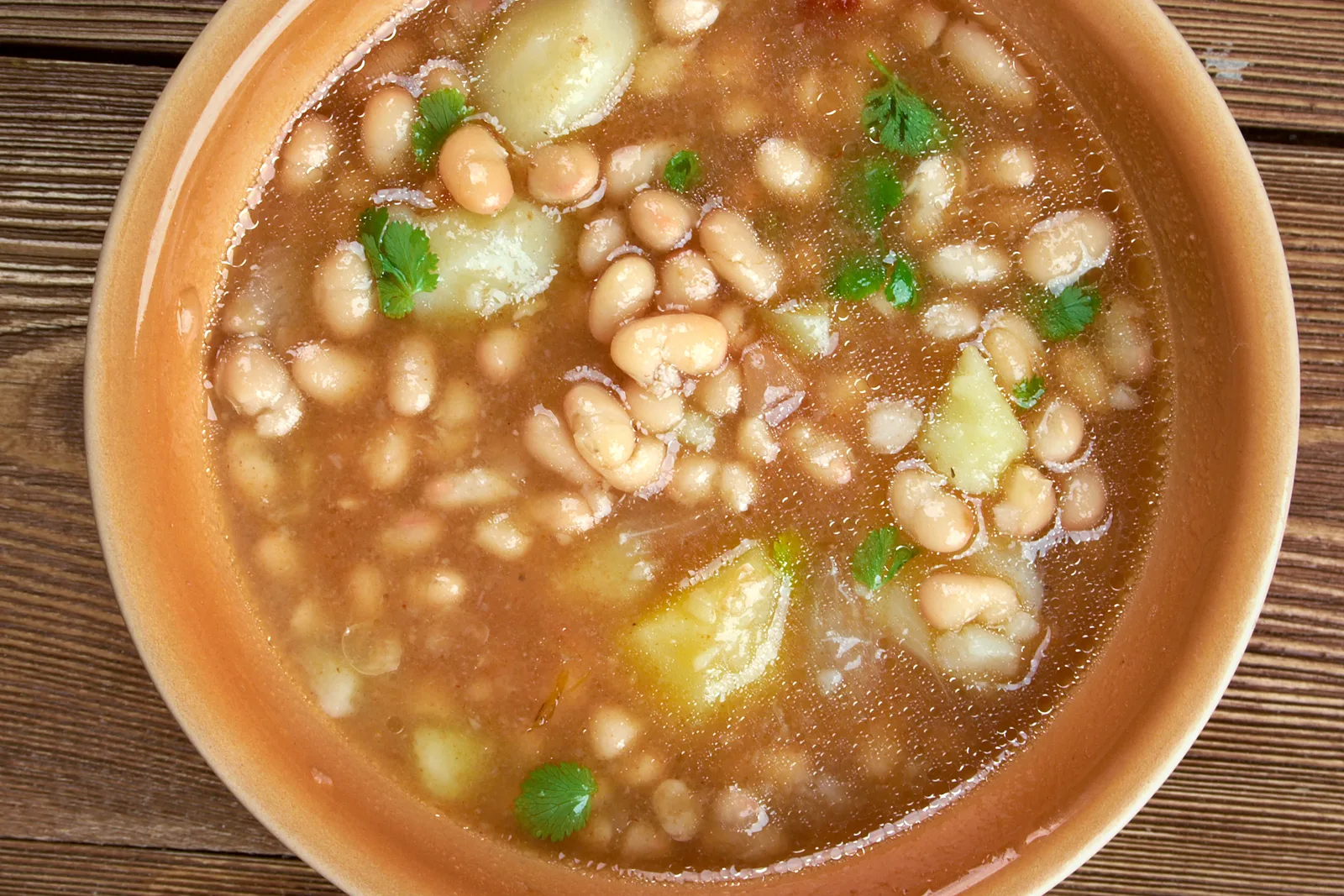

Porotos granados (poh-ROH-tohs grah-NAH-dohs) is Chile’s summer stew of fresh shelling beans, winter squash that melts into the broth, sweet corn and basil, colored red with paprika fried in oil. It’s naturally vegan, costs little, and comes in two styles: con mazamorra, with the corn blended into a paste that thickens everything, or con pilco, with whole kernels in a looser broth. This is the mazamorra version for 6 big bowls, made with the beans you can actually find in the US and UK.
What porotos granados is, and what to expect
How do you make porotos granados? Simmer 2.2 lb (1 kg) of fresh cranberry beans with 1.1 lb (500 g) of squash in 6⅓ cups (1.5 L) of water for 30 to 35 minutes, until creamy. Mash half the squash, stir in onion fried with sweet paprika, then add 4 ears of corn blended with basil and cook 10 to 12 minutes, stirring, until thick. 75 minutes for 6 servings.
Porotos is the Chilean word for beans, and granados means the pods were picked mature, with fully formed seeds, but before they dried. It’s a dish of central and southern Chile for late spring and summer, when fresh beans and corn come in together, and it’s usually served with a simple tomato and onion salad or a spoonful of pebre, Chile’s fresh salsa.
Expect a thick, spoonable yellow-orange stew, closer to a chowder than a soup: creamy beans, threads of squash in the broth, sweetness from the corn and a strong basil aroma. It isn’t spicy at all. If you know Argentina’s locro, the slow-cooked hominy, bean and squash stew, this is its lighter summer cousin: fresh beans instead of dried, no meat, and about an hour instead of four.
Time. 75 minutes: 20 to prep, 55 on the stove, and only the last 12 need you standing at the pot. Skill level, easy.
Mazamorra or pilco, the two ways to add the corn
Everything else in the pot is the same. The corn changes:
- Mazamorra. Corn kernels blended (or grated off the cob) with basil, added once the beans are tender. It cooks 10 to 12 minutes and thickens the whole pot into a creamy stew.
- Pilco. Whole kernels cut from the cob, also added at the end, for about 10 minutes, until tender but still with a bite. The broth stays thinner and lighter, and many families add cut green beans.
I chose mazamorra for the recipe card because blended corn hides the extra sweetness of US and UK supermarket corn better than whole kernels do. The pilco method is further down.
Shopping in the US and UK
Which beans to buy
The bean used in Chile is the same cream-and-red speckled bean sold as cranberry beans or Roman beans in the US and borlotti in the UK. Here’s how each form changes the recipe:
- Fresh, shelled. Farmers’ markets in late summer, often still in their pink-streaked pods. No soaking; they go straight in with the squash. This is what the recipe card uses.
- Frozen. Add them straight from the bag, no thawing, with the same water. They take a little longer; start tasting at 30 minutes.
- Dried. 400 g (14 oz) of dried cranberry or borlotti beans gives about 1 kg (2.2 lb) once cooked. Soak them 8 to 12 hours, then cook them separately in unsalted water until tender, between 45 minutes and 1½ hours depending on their age. After that, treat them as fresh but simmer only 20 minutes with the squash.
- Canned. Four 15.5 oz (439 g) cans of Roman beans (Goya makes them) or borlotti beans in the UK, drained and rinsed. Simmer the squash first for 20 minutes in 1 liter (4¼ cups) of water, then add the beans 10 minutes before the onion mixture. They come out softer and taste less like fresh beans, but they make this a weeknight dish.
Pinto beans work too if that’s all you have; they’re a different bean, so the stew is earthier and less creamy.
The squash
Chilean zapallo camote has dense, orange, slightly floury flesh, and that’s what breaks down and thickens the broth. Butternut or kabocha behave the same way. Watery squash keeps its shape and leaves the broth thin. Cut it in 2 cm (¾ in) cubes so some of it dissolves on its own and the rest holds up until you mash it.
The corn
Chilean corn is starchy and only mildly sweet, so the paste thickens on its own. US and UK sweet corn, fresh or frozen, is sweeter and wetter. With it, blend the kernels without the ½ cup of water, and if the broth is still loose at the end, mash a little more squash or a ladle of beans against the pot. Frozen corn goes into the blender straight from the bag. A large ear gives about 140 g (5 oz) of kernels.
Paprika and basil
Chileans use ají de color, which is ground sweet red pepper: plain sweet paprika is the right swap. Avoid smoked paprika; it takes over the whole pot. Use fresh Italian basil, the big-leaf supermarket kind. Dried basil doesn’t do the same job.
Salt. The 2 tsp are fine table salt. Kosher salt is less salty by the spoonful, so if that’s what you use, add it gradually and taste at the end.
Equipment. A 5-quart (5-liter) pot with a lid, a skillet, and a blender or stick blender. No blender? Grate the corn straight off the cob on the large holes of a box grater.
How to make porotos granados
Beans and squash, 30 to 35 minutes
Bring it to a boil, then straight down to medium-low with the lid ajar. A hard boil splits the skins before the centers soften. Start tasting at 30 minutes: a done bean is creamy all the way through when you press it against the roof of your mouth. If the middle is still chalky or firm, give it 5 more minutes.
The red onion base
Give the onion 8 to 10 minutes over medium heat, plus 1 more with the garlic, until soft and clear, not browned. The paprika goes in last, over the lowest heat, for 30 seconds, just until the oil turns brick red. Brown paprika is burned paprika: bitter, and it muddies the color.
The corn paste
Blend for about half a minute, 40 seconds at most, only until you have a thick paste with flecks of kernel. Blended completely smooth, it turns into cream of corn and you lose the little bits that make the texture.
Bringing it together, and when it’s done
Mash half the squash against the side of the pot, stir in the onion base, then pour in the corn paste. From here it’s low heat, lid off, and a stir every 2 minutes, scraping the bottom, because corn starch catches and scorches fast. Start checking at 10 minutes; it can take a couple more. It’s done when:
- The broth is yellow and thick enough to coat the spoon, and a ladleful settles in the bowl instead of running like soup.
- The corn no longer tastes raw or starchy.
- Most of the squash has dissolved into the broth.
It keeps thickening as it rests and even more overnight, so stop a little looser than you want to eat it.
Pilco version, with whole kernels
Same quantities and the same steps up to tender beans and the onion base. Then:
- Cut the kernels off the 4 cobs, standing each one on end, or use 600 g (1⅓ lb) frozen corn. Don’t blend them.
- Once the beans are tender, add the onion base, salt, pepper, corn kernels and 12 basil leaves, chopped. For green beans, add 200 g (7 oz), cut in 2 cm (¾ in) pieces, now.
- Simmer 10 minutes over medium-low, until the kernels are tender but still have some bite.
The broth is thinner. If you’d like more body without losing the whole kernels, mash all the squash instead of half.
Make ahead
- The day before. Shell the beans, peel and cube the squash and refrigerate them separately in sealed containers. Make the onion base and refrigerate it in a jar.
- Or cook it all the day before. It thickens and the flavor settles overnight. Reheat with water as below.
- Blend the corn just before cooking. It takes under 1 minute, and the fresh paste tastes cleaner.
Troubleshooting
- Beans still firm at the end. They needed more time before the corn went in. In a thick stew they barely soften, so always taste a bean before adding the corn.
- Scorched bottom. Low heat and a scrape every 2 minutes once the corn is in. If it does catch, pour the stew into a clean pot without scraping the burned layer.
- Bitter taste, brownish color. Burned paprika. Next time, 30 seconds over the lowest heat.
- Watery stew. Sweet corn or a watery squash. Mash more squash or some beans and cook 5 minutes more with the lid off.
- Too thick. Stir in hot water, 60 ml (¼ cup) at a time.
- Mushy kernels in the pilco. They went in at the start. Whole corn needs only 10 minutes.
Diet notes. The base recipe is vegan and gluten-free, with no dairy, meat or eggs; check your paprika label if you cook for someone with celiac disease. It isn’t spicy, and kids usually like it, especially the creamier mazamorra version.
Variations
- Creamier, with milk. Blend the corn with 120 ml (½ cup) whole milk instead of water. Softer and richer, no longer vegan.
- A red drizzle. Warm 2 tbsp oil (or lard, the farmhouse way), take it off the heat, stir in 1 tsp paprika and spoon a little over each bowl.
- With sausage. Brown 250 g (9 oz) of sliced Spanish-style chorizo or Chilean longaniza before the onion and cook the onion in its fat. Chicken or beef stock can replace the water.
- With tomato. One peeled, diced tomato, fried for 1 minute at the end of the onion base, adds a bit of acidity.
- For 12. Double everything and use a 10-quart (10-liter) pot. The corn paste takes a little longer to thicken and sticks more, so stir every minute for the last 5.
Out of season, fresh shelling beans are what make this pricey; dried beans bring the cost right down at the price of an overnight soak.
Serving, storing and reheating
Serve in deep bowls with torn basil. On the side, a tomato and thinly sliced onion salad, or the 10-minute Chilean pebre from the sopaipillas recipe. For a Chilean spread, start with baked empanadas de pino, and when corn is cheap, the next dish to make is pastel de choclo, the Chilean corn pie.
Fridge. Refrigerate within 2 hours in a sealed container; it keeps 3 to 4 days.
Freezer. 2 to 3 months, in portions. Thaw overnight in the fridge. The squash and corn turn slightly grainy, but they come back together once heated and stirred.
Reheat in a pot over medium-low with 60 to 120 ml (¼ to ½ cup) of water per 2 servings, stirring and scraping the bottom, until it simmers gently and reaches 165°F (74°C). In the microwave, cover and use medium power, stirring every minute.
FAQ
Do I need to soak porotos granados? Fresh and frozen beans, no. Only dried beans do, overnight or for at least 8 hours.
Can I use a pressure cooker or Instant Pot? For dried beans, yes, to cook them first: use your cooker’s timing for soaked beans, then finish on the stove as in the recipe. Don’t pressure-cook the corn paste; it scorches on the bottom.
Is it a soup or a stew? The mazamorra version is a thick stew you eat with a spoon. Pilco is looser and more soup-like.
What’s the difference between porotos granados and locro? Locro uses dried hominy and dried beans with several cuts of meat and cooks for hours. Porotos granados uses fresh beans and fresh corn, no meat, and takes about an hour.
Nutrition per serving
One of 6 servings, without bread or salad, calculated ingredient by ingredient from the recipe card:
- Calories: 429 kcal
- Protein: 20 g
- Carbohydrates: 73 g
- Fat: 9 g, of which 1 g saturated
- Fiber: 19 g
- Sodium: 798 mg
The beans supply more than half the calories and nearly all of the protein and fiber. With canned beans, which are already salted, start with 1 tsp salt and adjust at the end.
I make this with mazamorra and I like it best the next day, when the squash has fully melted and the broth is properly thick. Sweet paprika is a perfectly good stand-in for ají de color, but I don’t skip the fresh basil: without it, it’s just beans and corn. Josnaisis.