
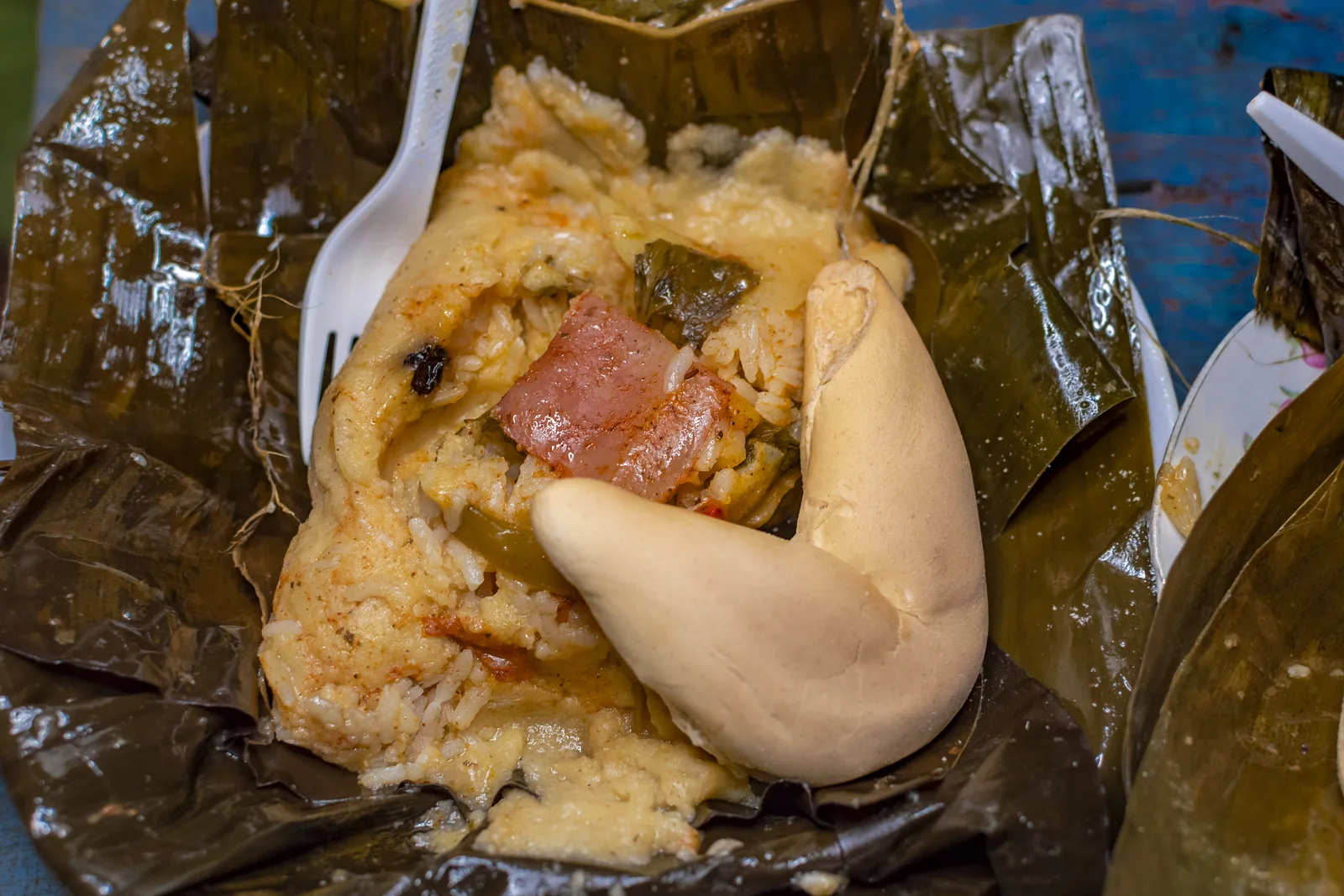

A nacatamal (nah-kah-tah-MAHL) is Nicaragua’s big Sunday tamale: a parcel of banana leaf about the size of a paperback, holding a soft corn dough made with lard, sour orange and achiote, and a filling that goes in raw. Marinated pork, rice, potato, tomato, bell pepper and a sprig of mint all cook inside the leaf for 4 hours, and the pork juices finish cooking the rice. One is a full meal. This recipe makes 16, with weights per nacatamal, a description of how the masa should feel, and clear signs for when they’re done.
What a nacatamal is, and how long it takes
How do you make Nicaraguan nacatamales? Marinate pork overnight in sour orange juice, garlic and achiote. Next day, beat 2.2 lb (1 kg) masa harina with 10½ oz (300 g) lard, sour orange and warm stock into a soft dough, then build each nacatamal on two crossed banana leaves with masa, raw pork, soaked rice, potato and vegetables. Tie them and simmer for 4 hours. 405 minutes on cooking day for 16 servings.
The name comes from the Nahuatl nacatl, meat. In Nicaragua nacatamales are eaten for weekend breakfast or supper and at family celebrations, with white bread or a tortilla and black coffee.
Time and difficulty. Fifteen minutes the night before to marinate the pork. On the day, about 2½ hours of hands-on work and 4¼ hours of simmering and resting. Medium difficulty: no single step is hard, but there are a lot of them, and assembling goes twice as fast with a helper.
How nacatamales compare with other tamales
If you’ve made Mexican tamales, the main difference is scale and the raw filling. A Mexican tamal is small, wrapped in a corn husk, filled with something already cooked and steamed for about an hour. A nacatamal is several times bigger and needs 4 hours because the pork, rice and potato start out raw.
On this site you’ll also find Mexican green chicken tamales in corn husks, Venezuelan hallacas with a three-meat stew, Puerto Rican pasteles made with green banana and taro and Colombian tamales from Tolima, with rice in the dough.
Ingredients, and what to buy in the US and UK
Exact amounts are in the recipe card. Each nacatamal gets about 6 oz (170 g) of masa, a generous ¾ cup, plus 2½ oz (75 g) of pork in two chunks and 1 tbsp of rice. It weighs about 13 oz (370 g) before cooking. For smaller ones, the same masa makes 20; the cooking time barely changes.
Masa harina, fresh masa, and the flour that won’t work
- Masa harina for tamales, as written. US supermarkets carry it in the baking or Hispanic aisle; in the UK it’s sold online and in Mexican and Latin shops. Masa harina for tortillas also works, with a slightly denser result.
- Fresh unprepared masa from a tortillería or Latin market: use 5½ lb (2.5 kg) instead of the masa harina. It already contains the water, so add only the lard, sour orange, achiote, salt and up to a scant 1 cup (200 ml) of stock.
- Prepared masa for tamales. It already has fat and salt in it: add just the sour orange, achiote and stock, and taste before salting.
- Cornmeal, polenta and pre-cooked arepa flour won’t work. None of them is nixtamalized (treated with lime), so the dough cracks and tastes wrong.
Sour orange, achiote and the other swaps
Sour orange gives the masa and the pork their sharp, slightly bitter edge, so don’t leave it out. It’s the same fruit as the Seville orange: in the UK they’re in shops for a short winter season, and the juice freezes well in ice cube trays. In the US look for fresh sour oranges in Latin and Caribbean stores, or bottled “naranja agria”. Bottled versions are often salted, so check the label and cut the masa salt to 2 tsp.
Achiote paste (annatto) gives the orange-yellow color; look in the Mexican or Latin aisle, or online. With ground annatto, use half as much. In Nicaragua the heat comes from chile congo, a tiny, very hot pepper; a piece of habanero does the same job. Mint here means spearmint, the common garden mint.
Banana leaves, where to buy them and how many
US Latin and Asian grocery stores, and the freezer aisle of many supermarkets, sell banana leaves frozen, usually in 1 lb packs. In the UK, look in Asian, Thai and Latin shops, frozen or occasionally fresh. For 16 nacatamales buy two packs, and a third the first time, since frozen leaves split as you unfold them.
Thaw them at room temperature without unfolding, wipe both sides with a damp cloth, and cut out the thick center rib.
Equipment. A stockpot of about 20 quarts (20 l), or two of 10 to 12 quarts, cotton kitchen twine, and foil if you’re not confident in your tying. A kitchen scale keeps every nacatamal the same size so they all finish together.
Make-ahead plan
The pork marinates the night before. Everything else happens on cooking day, and nearly all of the work is in the first 2½ hours.
Don’t leave assembled raw nacatamales at room temperature for more than 2 hours. If the pot isn’t ready, refrigerate them.
Step by step
Marinate the pork the night before. Shoulder with some fat, in 1½ in (4 cm) chunks: lean pork turns dry after 4 hours in the pot. Toss with the sour orange, garlic, achiote, salt and pepper and refrigerate for 12 to 24 hours. An hour works in a pinch, though the meat will taste less seasoned inside.
Make the masa. Mix the masa harina, salt and achiote, then rub in the lard with your fingertips until no lumps of fat remain. Add the sour orange juice, then the warm stock a little at a time, kneading by hand or beating with a stand mixer’s dough hook for 10 minutes.
How the masa should feel
It should be soft, glossy and a little firmer than mashed potatoes. It holds its shape on a spoon, spreads without cracking and doesn’t stick to wet hands. If a ball cracks at the edges when you press it, add stock; if it slumps through your fingers, add masa harina. Taste it raw: it should taste slightly salty and tangy, because the long cooking mutes it.
Some Nicaraguan cooks also cook the masa in a pot, stirring until it thickens and pulls away from the bottom. That gives a smoother dough, at the cost of half an hour or more at the stove; the beaten masa in this recipe spreads fine without it.
Soften the leaves. Pass each piece over a gas flame for 2 to 3 seconds per side, keeping it moving, or steam for 1 minute. They’re ready when they turn darker and glossy and fold without splitting. On an electric stove, dip them in boiling water for a minute and pat dry.
Assemble. Cross two leaf pieces, shiny side up. Put about 6 oz (170 g) of masa in the center and flatten it into a square of roughly 5 in (12 cm). On top, in this order: 2 chunks of pork with a little of the juice, 1 tbsp rice, 2 potato slices, a tomato slice, onion, pepper, mint, 2 olives, a few raisins and the chile.
Fold and tie. Bring up the sides of the bottom leaf, then the top one, into a square parcel without squashing it. Wrap in foil now if you’re using it. Tie like a parcel: twice lengthwise and twice across, finishing with a firm knot.
Into the pot. Line the bottom with leaf scraps so the bottom layer doesn’t scorch. Lay the nacatamales in, folded side down, cover with more leaves and add boiling water to halfway up the stack. Lid on, bring back to a boil and lower to medium-low: a gentle, steady simmer for 4 hours. Every 45 minutes, top up with boiling water. After 2 hours, move the top layer to the bottom so they cook evenly.
How to tell nacatamales are done
At 3½ hours, take one out and open it.
- The masa is firm and opaque and peels cleanly off the leaf.
- The rice is tender, with no hard center.
- A knife slides through the potato and the pork pulls apart with a fork.
If the masa sticks or the rice is chalky, retie it and give the whole pot 30 minutes more. After 4 hours at a simmer, the center is well past the 165°F (74°C) a pork filling needs; the masa is what sets the timing. Rest them 15 minutes out of the pot before serving, so the masa firms up.
Troubleshooting
- Masa still raw in the middle at 4 hours. Parcels too big, the pot packed too tight, or cold water added. Give them more time, and weigh the masa next time.
- Water inside the parcel. A split leaf or loose tie. Always use two leaves, check them against the light, and add foil if in doubt.
- Hard rice. Not soaked, or placed away from the pork juices. Soak for 30 minutes and put it right next to the meat.
- Dry, crumbly masa. Too little lard or stock. Do the texture check before assembling.
- Bland. The raw masa didn’t taste of much. It should taste slightly salty and tangy before it goes into the leaf.
Variations
- Chicken nacatamales. Use 2⅔ lb (1.2 kg) boneless chicken thighs in chunks, with the same marinade. The cooking time stays the same, since the masa sets it, and the chicken ends up well past 165°F (74°C).
- Instant Pot or pressure cooker. About 4 fit on the rack of a 6-quart pot with 2 cups (480 ml) of water: 50 to 60 minutes at high pressure with natural release. Check the same signs.
- Smaller or bigger. With 4¼ oz (120 g) of masa each you get about 22; with 9 oz (250 g), about 11, and they’re better with 5 hours.
- For 32. Double everything and use two pots; in one big pot the middle ones lag far behind.
Serving, storing and reheating
Serving. Unwrap on the plate and eat from the leaf with a spoon, with white bread or a tortilla and black coffee. For another Central American breakfast classic, gallo pinto fries yesterday’s rice with beans.
- Fridge. Cooled and in a sealed container within 2 hours, then 3 to 4 days at 40°F (4°C) or below.
- Freezer. Freeze them cooked, cooled and still in their leaves, inside a freezer bag: best quality for 2 to 3 months.
- Reheating. Thaw overnight in the fridge, then simmer or steam in the leaf for 20 to 30 minutes, until the center reaches 165°F (74°C). In the microwave, remove any foil and heat at medium power in 2-minute bursts, turning them; the masa dries more than in the pot.
Frequently asked questions
Can I use corn husks instead of banana leaves? They’re too small for a nacatamal. Foil alone works, but you lose the leaf’s aroma and the outside of the masa comes out wetter.
Why does the rice go in raw? It cooks in the pork juices and the fat from the masa over the 4 hours and ends up tender and full of flavor. Pre-cooked rice turns to mush.
How many nacatamales does 1 kg (2.2 lb) of masa harina make? About 16 at this size, each with 6 oz (170 g) of masa.
Are nacatamales spicy? Only where the chile sits, and it’s optional. Leave it out of some and tie those with a different knot so you can tell them apart.
Nutrition
Each of the 16 nacatamales provides, worked out ingredient by ingredient from the recipe card:
- Calories: 689 kcal
- Protein: 22 g
- Carbohydrates: 71 g
- Fat: 36 g, of which 13 g saturated
- Fiber: 6 g
- Sugars: 6 g
- Sodium: 776 mg
Roughly a third of the calories come from the masa harina, a quarter from the lard and a quarter from the pork. Using 250 g (9 oz) of lard instead of 300 g takes off about 28 kcal each, with a slightly less tender masa.
Nacatamal day looks a lot like hallaca day in a Venezuelan kitchen, with a table covered in leaves and everyone working in a line. The taste is its own thing, because sour orange and mint change everything. I weigh the masa for each one so they cook evenly, and I always open a test one before I turn off the heat. Josnaisis.