
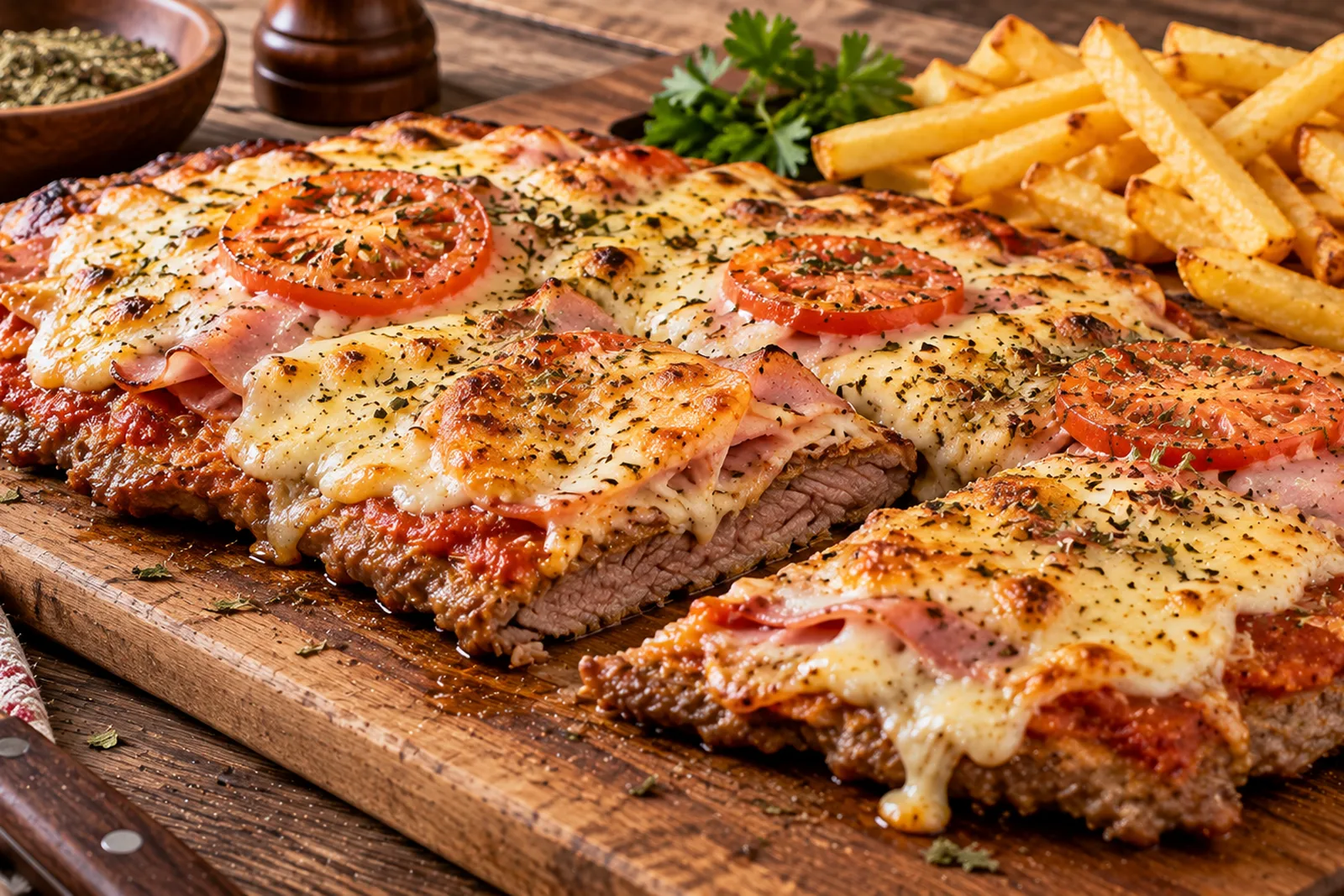

In Argentina, a thin sheet of beef called matambre plays the part of the pizza crust: it’s simmered for up to 2 hours until it’s tender enough to cut with a fork, then spread with tomato sauce, covered with ham and mozzarella and baked until the cheese bubbles. That’s matambre a la pizza, a Sunday-lunch and barbecue classic there and in Uruguay. Below is the full recipe for 6, what the cut is and what to buy in the US and UK, a faster flank steak version, the pork option and how to get it ready a day ahead.
What matambre a la pizza is
How do you make matambre a la pizza? Simmer a 1.5 kg (3⅓ lb) matambre, covered, in 1 liter (4¼ cups) milk and 1 liter water with bay leaves and garlic over the lowest heat for 1½ to 2 hours, until a fork slides in easily. Lay it fat side down in a pan, spread with tomato sauce and bake 10 minutes at 400°F (200°C), then add ham and mozzarella and bake 10 to 15 minutes more. 175 minutes for 6 servings.
Matambre is a thin, wide layer of beef that sits between the hide and the ribs. In Argentina it’s rolled and stuffed, grilled at a barbecue, or topped “pizza style”, which is this recipe. The name is usually explained as “hunger killer”, and it does fill you up.
Done right, the meat is moist and pulls apart in short strands, the thin layer of fat underneath turns soft, and the cheese browns in patches. It takes just under 3 hours, but only about 30 minutes of that is hands-on. It’s easy: the one thing to watch is the tenderness of the meat.
What to buy in the US and UK
Plan on 250 g (9 oz) of raw matambre per person: it shrinks in the pot and it’s a filling cut. A 1.5 kg (3⅓ lb) piece serves 6.
- Real matambre. Argentine and other Latin American butchers in the US sell it under its own name, and many will order it if you ask. In the UK it’s much harder to find; ask a butcher who can cut to order for the thin muscle between the skin and the ribs.
- Flank steak (UK: bavette or flank). The supermarket stand-in. It’s from a similar part of the animal but it’s a different muscle, thicker and leaner, and it needs the opposite treatment: 2 hours in a pot turns it into shreds. Cook it hot and fast instead (see the flank section below).
- Pork matambre (matambrito de cerdo). A thin pork cut sold at Latin butchers. It’s naturally tender and skips the simmer.
Sauce, cheese and ham
- Sauce. Crushed tomatoes cooked down for 15 minutes, much like the sauce in a homemade pizza. Jarred marinara works if it’s thick; a runny sauce soaks the meat and the cheese slides off.
- Mozzarella. Low-moisture, the block or the shredded bag, which melts without leaking water. Provolone gives a saltier, stronger flavor. Fresh mozzarella in water releases whey: slice it and blot it well if it’s all you have.
- Ham. Ordinary sliced deli ham. Prosciutto dries out in the oven.
- Common extras. Olives, strips of bell pepper, or fresh tomato slices after baking, and arugula with Parmesan on top.
Equipment. A wide lidded pot (or a deep roasting pan and foil), a sheet or roasting pan for baking, two wide spatulas and a long fork.
How to tenderize matambre
Matambre turns tender through long, gentle, moist cooking. Milk is the Argentine tradition and gives a mild flavor, but stock or water with bay leaves gets it just as tender; time is what matters. A hard boil tightens the meat before it ever softens.
On the stove, as in the recipe
Covered with liquid, lid on, lowest heat, 1½ to 2 hours for a 1.5 kg (3⅓ lb) beef matambre. Start testing at 1½ hours, in the thickest part:
- Not yet. The fork goes in with effort and the meat springs back.
- Ready. The fork slides in, and when you press with the back of a spoon the meat gives and the fibers start to separate.
- Overdone. It tears when you lift it with the fork. It’s still good: move it with two spatulas or slide it onto a tray.
The milk usually curdles as it cooks. That’s fine, it gets thrown away.
In the oven, covered
In a deep roasting pan, fat side up, covered with 1 liter (4¼ cups) milk (top up with water or stock if it doesn’t cover) and sealed tightly with foil, 2 to 2½ hours at 325-340°F (160-170°C). It ties up the oven longer, but you don’t have to watch a burner. Then drain it, turn it fat side down and carry on from the sauce step.
In a pressure cooker or Instant Pot
About 40 minutes at high pressure. Open it when it’s safe to do so and test: if it still resists, close it and give it 10 minutes more. In a pressure cooker I use water or stock with just a splash of milk, because milk under pressure catches on the bottom easily.
On the grill, without simmering
You can grill it raw, but it comes out firmer: you’ll need a knife, not a spoon. To get closer to the simmered texture, soak it in milk in the fridge for 6 to 12 hours and score the fat so it doesn’t curl. Over moderate coals, start meat side down for about 15 minutes to sear, flip so the fat faces the fire, spread the meat side with the sauce, ham and cheese, and cover with the grill lid or an upturned pan for about 20 minutes, until the cheese melts. Keep the heat low throughout: hot coals dry it out before it softens.
If the matambre is already simmered, the grill just browns it and melts the cheese: fat side down, topping on, covered, 10 to 15 minutes over medium coals.
The flank steak version
With flank steak, skip the pot. You can soak it in milk in the fridge for a couple of hours first if you like, then pat it dry. Season it with salt and pepper and cook it over high heat on a grill or in a large skillet, turning once. When the second side is down, spread the top with the sauce, add ham and mozzarella and cover with the lid (or slide the skillet into a 400°F/200°C oven) until the cheese melts and the thickest part reads 145°F (63°C). Rest it 3 minutes and slice it thin across the grain, which is what keeps flank from being chewy. Past medium it gets tough, so use a thermometer.
How to make matambre a la pizza, step by step
Stretch and top
Take it out of the liquid while it’s still warm: cold, it sets in the wrinkled shape of the pot, and very hot, it falls apart. Drain it well, because any liquid it carries ends up under the sauce. Lay it on the oiled pan fat side down, meat side up. The topping always goes on the meat.
Two rounds in the oven
First the sauce alone, 10 minutes at 400°F (200°C), so it sets and the surface dries a little and the cheese doesn’t slide. Then the ham, mozzarella and oregano for 10 to 15 minutes more, until the cheese bubbles with brown spots. For a deeper color, finish 2 or 3 minutes under the broiler (UK grill), watching, because cheese goes from golden to burnt very fast.
Rest and cut
5 minutes out of the oven, then onto the board. Cut it into rectangles, since matambre isn’t round. If it’s properly tender, a chef’s knife goes through with little pressure.
Why matambre turns out tough, and other fixes
- Tough or chewy. It wasn’t cooked long enough, the liquid boiled hard, or it went on the grill raw without a soak. If you catch it when testing, put it back in the pot and test every 20 minutes. If it’s already topped, cover it with foil, add a little stock to the pan and keep it at 325°F (160°C), testing every 20 minutes.
- Curled or shrunk. It cooled in a crumpled shape or had thick fat left on. Stretch it while warm and score the fat at the edges.
- Soggy base. It wasn’t drained or the sauce was thin. Drain it, and cook the sauce until no water seeps out at the edge.
- Burnt cheese, cold middle. It came straight from the fridge and the bake was short. See the make-ahead note below.
- Too salty. Ham, mozzarella and olives are already salty: don’t salt the topping.
Allergens. Contains milk (in the pot and the cheese). It’s gluten-free if your ham and stock are; check the labels. It isn’t spicy unless you add pepper flakes, and kids usually like it because it tastes like pizza.
Variations, pork, a crowd and a day ahead
- Pork matambre a la pizza. Tender enough to skip the simmer. Trim 1 kg (2¼ lb), season and bake 15 minutes at 350°F (180°C); top it and bake 20 minutes at 400°F (200°C). It must reach 145°F (63°C) in the thickest part, then rest 3 minutes. Serves 3 to 4.
- For 12 or 20. Allow 250 g (9 oz) raw per person: 3 kg (6⅔ lb) for 12 and 5 kg (11 lb) for 20. Simmer the pieces separately or in a stockpot and bake on two pans, swapping racks halfway. Scale the topping with the meat: for every 1.5 kg (3⅓ lb), 400 g (14 oz) tomatoes, 150 g (5 oz) ham and 350 g (12 oz) mozzarella.
- A day ahead. Simmer the matambre the day before, let it cool slightly and refrigerate it within 2 hours, covered and laid flat in the baking pan. Next day, sauce it and give it 15 minutes in the oven instead of 10 so the middle warms up before the cheese goes on.
- Other toppings. Roasted peppers, a fried egg on top, sautéed mushrooms, or blue cheese. The base doesn’t change.
What to serve with it, storage and reheating
In Argentina it comes with fries, roast potatoes or mashed potatoes, plus a lettuce and tomato salad. At a barbecue it follows the grilled provoleta and the choripán sausage sandwiches, and a jar of Argentinian chimichurri on the table never hurts. If you like tomato, ham and mozzarella on beef, the milanesa napolitana is the breaded, fried cousin.
Fridge. Refrigerate within 2 hours in a sealed container: it keeps 3 to 4 days.
Freezer. 2 to 3 months. It freezes best simmered, drained and untopped, well wrapped; baked mozzarella goes rubbery after thawing. Thaw it in the fridge overnight.
Reheating. In a 350°F (180°C) oven, covered with foil so the ham doesn’t dry out, until the center reaches 165°F (74°C); uncover at the end so the cheese melts again. In the microwave, use medium power and a cover.
Matambre a la pizza FAQs
Can I make it without milk? Yes. Stock, or water with bay leaves, garlic and peppercorns, for the same time over the lowest heat gets it just as tender. Milk gives a milder flavor, not the tenderness.
Which side of the matambre goes up? The topping goes on the meat side, so the fat faces down in the pan. On the grill, if it’s raw, sear the meat side first, then flip it to top it.
Is matambre the same as flank steak? No. Matambre is a thin muscle between the hide and the ribs; flank steak is a thicker, leaner cut from the belly. Flank is the usual substitute, but it’s cooked quickly to 145°F (63°C) and sliced thin, not simmered.
Can I use the cooking liquid? The milk curdles and turns greasy, so it’s no good as a sauce. If you simmered it in stock only, strain it, chill it, lift off the fat and use it as a soup base.
Matambre a la pizza nutrition
Per serving (one sixth, about 250 g/9 oz raw matambre with its topping, no potatoes), calculated from the recipe quantities with beef flank as the reference for the meat:
- Calories: 690 kcal
- Protein: 71 g
- Carbohydrates: 8 g
- Fat: 41 g, of which 18 g saturated
- Fiber: 2 g
- Sugars: 4 g
- Sodium: 1490 mg
The figure counts all the salt in the pot, though much of it stays in the liquid, and leaves out the milk, which is discarded. The mozzarella accounts for about 185 kcal per serving.
I always test it in the same spot, the thickest part in the middle, because the edges soften first and can fool you. And I take it out of the pot once the oven is already hot: a matambre left to cool in the pan keeps the shape of the pot. Josnaisis.