
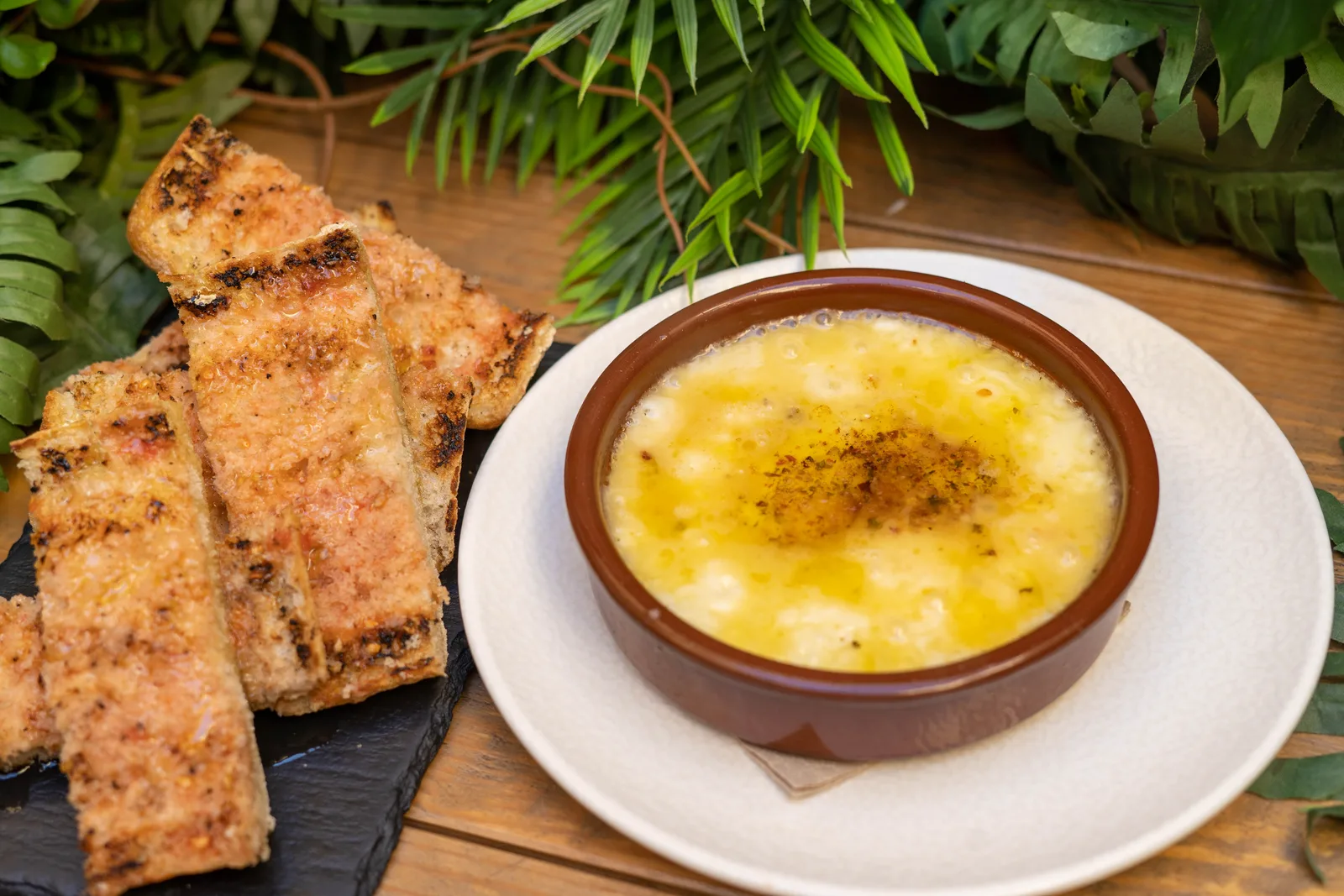

Provoleta (pro-vo-LEH-tah) is what Argentines put on the grill first at a cookout: a thick disc of provolone-style cheese seared until it has a browned, crackly crust on both sides and a soft, stretchy middle, finished with dried oregano and chile flakes and eaten on bread with chimichurri. It takes about 5 minutes over the heat. The part that decides whether it holds together or melts into the coals is the cheese, how thick you cut it and how dry it is, so that’s where this recipe starts, with what to buy in a US or UK store.
What provoleta is, and what you’re aiming for
How do you make provoleta? Air-dry a ¾-inch (2 cm) round of provoleta or aged provolone, about 8 oz (220 g), unwrapped in the fridge overnight. Lay it cold on a very hot grill or cast-iron skillet, leave it 2 to 3 minutes until the crust releases, flip, add oregano and red pepper flakes, and cook 2 to 3 minutes more. 15 minutes for 4 servings as a starter.
In Argentina, provoleta is both the cheese, a firm pulled-curd provolone sold in discs made for grilling, and the dish. Done right, it comes off the heat as a golden disc that still holds its shape; cut into it and the center pulls in strings instead of running across the board. It’s a starter, not a main: one round feeds four before the meat.
The cheese, what to buy and what to skip
This is the one decision that matters. Argentine provoleta is hard to find outside South America, and regular provolone stands in fine as long as it’s a whole piece, firm, and cut thick. The longer a provolone has aged, the firmer it is and the better it browns; mild provolone softens sooner, so cut it thicker and give it the full overnight dry.
| Where you are | Ask for | Avoid |
|---|---|---|
| US supermarket | A ¾ to 1 in (2 to 2.5 cm) slice cut from a provolone log at the deli counter, aged or sharp if they have it | Pre-sliced sandwich provolone |
| Latin grocery (US) | Argentine provoleta discs, when stocked | Soft melting cheeses sold for quesadillas |
| UK | Italian provolone from a cheese counter or Italian deli, cut 1 in (2.5 cm) thick | Pizza mozzarella, thin slices |
Thin sandwich slices and mozzarella simply melt and drop through the bars within a minute; they never build a crust.
Ingredients, with US and UK names
- The cheese, about 8 oz (220 g), from the section above. It’s already salty, so there’s no salt in this recipe.
- Dried oregano, 1 tsp. It goes on after the first side, because on direct heat it scorches.
- Crushed red pepper flakes, ¼ tsp. They’re the closest thing to Argentine ají molido and only add a faint warmth at this amount.
- Olive oil, 1 tsp, only for the skillet or oven. On a bare grill grate the cheese releases its own fat.
- Baguette or French bread, sliced ½ in (1 cm) thick, 2 slices per person.
- Chimichurri, about 1 tbsp per person. My Argentinian chimichurri with parsley, garlic and oregano can be made the day before.
Equipment. A grill with a clean grate, or a small 6 to 8 in (15 to 20 cm) cast-iron skillet, which in Argentina is sold as a provoletera. A wide, thin spatula, so you can get under the crust without tearing it.
How to grill provoleta
The night before, dry it out
Unwrap the cheese, set it on a plate or a wire rack and leave it uncovered in the fridge for 24 hours, flipping it once after a few hours. The surface dries and firms, and that dry skin is what turns into the crust. Cheese that goes straight from its plastic onto the fire weeps whey, sticks and falls apart. If you only have a few hours, uncovered for that long still helps.
Cold cheese, hot fire
Build a hot fire and get the grate clean and very hot. Take the cheese out of the fridge only when you’re ready to cook it. If your grate has wide gaps, put it in a small cast-iron skillet set right on the grate, or on a heavy-duty foil tray.
When to flip
Lay it down and leave it alone for the first couple of minutes (3 at most on a grill). It’s ready to flip when:
- the underside is golden and the bottom edge is starting to soften and slump slightly;
- a spatula slides underneath and the crust lets go by itself.
If it resists, wait another 30 seconds. Forcing it is how half the crust ends up on the grate.
Finish and serve
Flip in one confident move, scatter the oregano and pepper flakes over the browned side and cook 2 to 3 minutes more, until the second side is golden and the center gives under the spatula. Pull it while the middle is soft, not liquid; it keeps melting on the board.
Provoleta in a cast-iron skillet or the oven
Cast-iron skillet on the stove
Heat the skillet over medium-high for 3 to 5 minutes, until very hot, brush with the oil and add the cold cheese; after about 2 minutes it will release. Flip, add the oregano and pepper flakes, and give it another 2 or so, until the center gives. Serve it in the skillet on a board. This is the easiest version to control and the least likely to stick.
In the oven
Put the cast-iron skillet in the oven and heat it to 400°F (200°C) with the pan inside for 5 minutes. Take it out, brush it with the oil, add the cheese with the oregano and pepper flakes on top and bake 8 to 10 minutes, until it starts to melt, then slide it under the broiler (UK grill) for 1 to 2 minutes to brown the top. No flipping here, and the crust is softer than on a grill, but it’s hands-off.
Troubleshooting
- It melted through the grate. The slice was too thin, the cheese was sandwich provolone, or it was too young. Go to 1 in (2.5 cm) and use a skillet.
- It stuck and left its crust behind. It was moved too soon, it was still damp, or the grate wasn’t hot and clean.
- It turned into a puddle. Overcooked. Take it off when the center gives, not when it runs.
- Bitter, burnt oregano. It went on before the first side. Add it after flipping or when serving.
- Rubbery by the time it reached the table. It sat. Provoleta is eaten in the first few minutes.
Allergens. Dairy, plus gluten from the bread; the cheese itself is gluten-free, but check the label. Provolone is usually made with animal rennet and enzymes, so check the label if you’re cooking for strict vegetarians. Leave out the pepper flakes for kids.
When to serve it at a cookout
Provoleta comes off the grill first, while the beef is still cooking. It goes straight to the middle of the table, and everyone tears off a piece, puts it on toasted bread and spoons chimichurri over. Alongside it you’ll usually see Argentinian choripán, grilled chorizo in crusty bread.
No grill? The skillet version makes a good starter before a tray of Argentinian beef empanadas, or a light supper for two with bread and a tomato salad. For dessert, keep it Argentine with alfajores, dulce de leche sandwich cookies.
Variations
- With tomato. Half a tomato, diced or thinly sliced, on top when serving.
- With garlic. One clove, finely chopped, over the browned side after flipping.
- For a crowd. One 8 oz (220 g) round per 4 people, cooked in batches so each comes off the heat fresh.
- Stuffed. Two thinner rounds with cured ham, roasted peppers or onion in between. It’s harder to flip, so bake it in the skillet.
- Floured. Some cooks dust it with flour before grilling for a sturdier crust. With well-dried cheese, it isn’t needed.
Leftovers
It’s best eaten right away; reheated, it’s never quite the same. Get leftovers into a covered container in the fridge within 2 hours of cooking. They keep 3 to 4 days. To use them up, warm in a skillet over medium heat for a couple of minutes, or melt over toast.
Provoleta FAQ
Is provoleta the same as provolone? Nearly. Provoleta is an Argentine pulled-curd provolone sold in discs for grilling. Italian-style provolone works the same way if it’s firm and cut thicker.
Do I need to oil or flour the cheese? On a bare grill, no. In a skillet or the oven, a teaspoon of oil in the pan helps it release. Flour is optional.
Can I make it ahead for guests? Only the drying, the night before. The cooking has to happen when you serve it; after about 5 minutes off the heat it has firmed up.
Provoleta nutrition
Per serving (a quarter of the round, about 2 oz / 55 g of cheese with its oil, oregano and pepper, without bread or chimichurri), calculated from the recipe amounts:
- Calories: 204 kcal
- Protein: 14 g
- Carbohydrates: 1 g
- Fat: 16 g, of which 10 g saturated
- Fiber: 0 g
- Sugar: 0 g
- Sodium: 400 mg
Two slices of baguette add about 80 kcal, and a tablespoon of chimichurri about 63.
With provolone from outside Argentina I always cut it thicker than seems necessary. I’d rather give up a little molten center than watch half the cheese drip into the coals, and the overnight dry in the fridge matters more to me than anything I do at the grill. Josnaisis.