
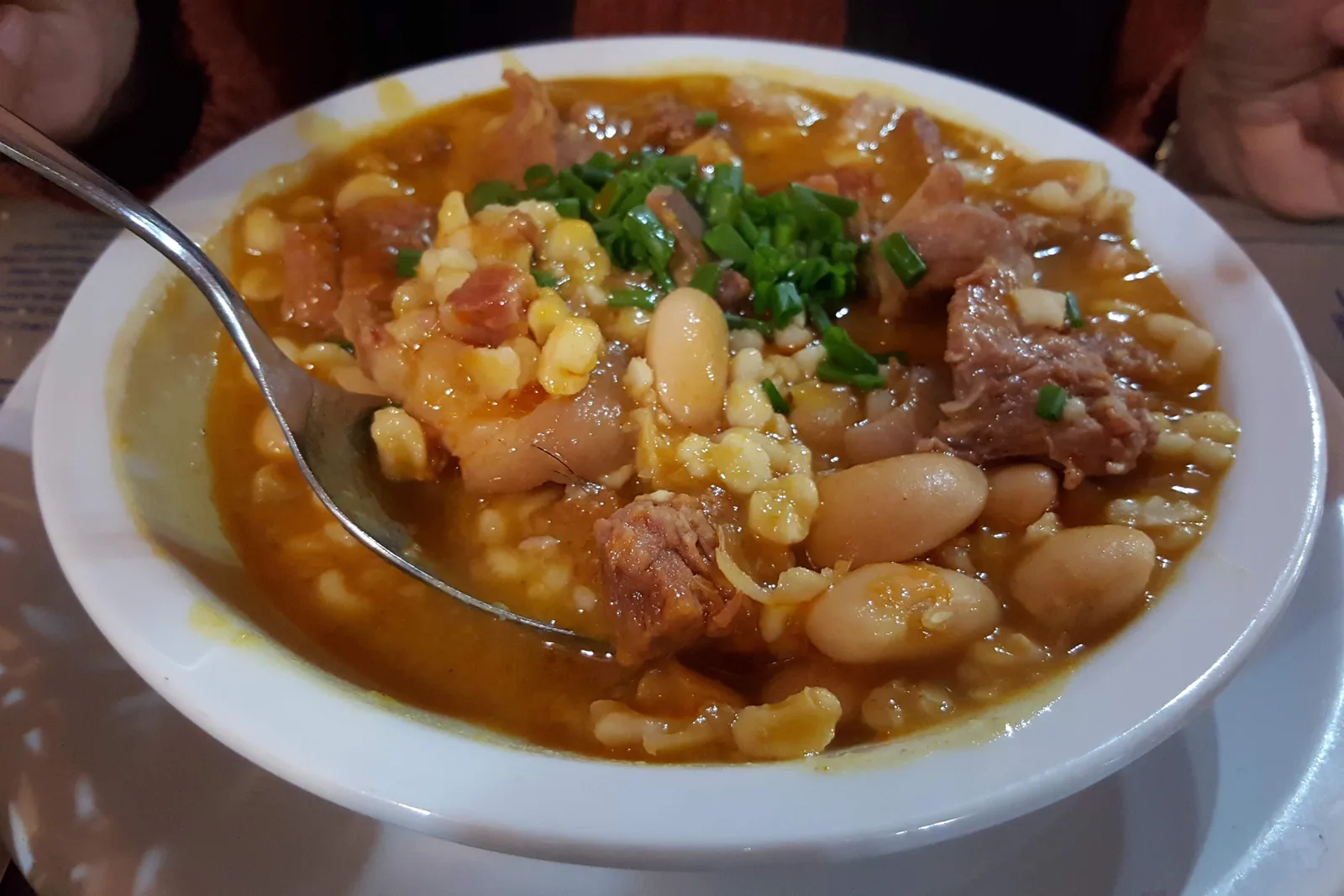

Locro (LOH-kroh) is Argentina’s big-pot stew: cracked white corn, white beans, squash and several cuts of pork and beef, simmered for hours on the lowest heat until the squash dissolves and the whole thing turns thick, golden and creamy. It’s served with quiquirimichi (kee-kee-ree-MEE-chee), a red oil of paprika and scallions spooned on top, and it’s what Argentinians cook for crowds on their national holidays, July 9 and May 25. This recipe makes 10 generous bowls, with a plan that starts the night before and the swaps you need in a US or UK store.
What locro is, and what to expect
How do you make Argentinian locro? Soak 1 lb 2 oz (500 g) of cracked white corn and 9 oz (250 g) of dried beans for 12 hours. Render 7 oz (200 g) of bacon, soften onion with cumin and paprika, add the corn, beans and 3¾ quarts (3.5 liters) of water and simmer 1 hour on the lowest heat. Add beef, pork ribs and cubed squash for 1 hour 30 minutes, then the chorizo, grated squash and salt until thick. 250 minutes for 10 servings, plus the soak.
Think of it as a cross between a bean stew and a porridge. It’s eaten with a spoon from a deep bowl, and it should be thick enough that a spoon dragged across the bottom of the pot leaves a trail. The corn stays slightly chewy, the beans collapse on your tongue and the meat shreds. The pot itself isn’t spicy at all; the heat is in the sauce.
If you know Mexican pozole, the corn will look familiar, but the dish is very different: pozole is a brothy soup with crunchy garnishes, while locro is dense and rich, with squash and beans thickening it. Ecuador also has a dish called locro de papa, a potato and cheese soup served with avocado. It has nothing in common with this one beyond the name.
Time. 20 minutes of chopping and about 4 hours on the stove, of which you’re busy for a little over an hour, plus the overnight soak. Medium difficulty: nothing tricky, but it needs patience and an eye on the bottom of the pot.
Ingredients, and what to buy in the US and UK
The quantities make 10 deep bowls, enough as the only main course at a party. With a starter and dessert, it stretches to 12.
The corn, and what changes with hominy
Argentinians use maíz blanco partido: dried white corn with the skin removed, cracked into pieces. During the long simmer it releases starch, and that’s half of what thickens the stew. Your options:
- Colombian maíz trillado. The closest match: hulled, cracked dried white corn. In the US it’s in the Latin aisle in 1-pound (454 g) bags, sometimes labeled maíz pelado or dried white hominy corn. Check that the kernels are cracked, not whole: whole kernels are usually the lime-treated kind below; in the UK, from Latin grocers and online Colombian shops. Use it exactly as written. It’s the same corn I use for Colombian mazamorra.
- Dried pozole corn (maíz pozolero, cacahuazintle). Sold in bags at Mexican grocers and online. This kind has been treated with lime, so the kernels stay whole, bloom open and taste faintly of corn tortillas, as in pozole blanco. The locro comes out less thick; grate an extra 7 oz (200 g) of squash to make up for it. Same soak, same timings.
- Canned hominy. Already cooked. Skip its soak, cook the beans alone for the first hour, and stir in the drained, rinsed hominy with the chorizo in the last half hour; it only needs to heat through and take on flavor. You need about 2¾ lb (1.3 kg) drained, which is several cans, so buy extra. It thickens less, so grate more squash here too.
The beans
White beans or large lima beans (butter beans in the UK), which are bigger and creamier. Great northern, navy, cannellini or UK haricot beans all work, with the same soak. With canned beans, drain them and add them with the chorizo.
The meat, essential and optional
Each cut does a job. The bacon gives the fat for the base and a smoky note; the beef and pork ribs give meat that shreds and gelatin from the bones; the fresh chorizo is mild; and the red chorizo, colored with paprika, tints the stew.
- US. Bone-in beef short ribs or beef plate for the beef, pork spareribs, slab bacon. Argentinian-style chorizo is sold at Latin butchers; otherwise use mild fresh pork sausage. For the red chorizo, Spanish-style cooking chorizo. Don’t use fresh Mexican chorizo: it’s loose ground meat with chile and falls apart in the pot.
- UK. Beef short ribs or brisket, pork ribs, smoked bacon lardons or pancetta, and Spanish cooking chorizo for the red one, which most supermarkets stock. Any good fresh pork sausage stands in for the Argentinian kind.
- Optional. Tripe (honeycomb tripe), pig’s feet (trotters in the UK) and pork rind. Add them at the start with the corn so they get the full 3 hours. They add gelatin and make a heavier locro.
The squash
Butternut squash is the easiest to find and breaks down well; any orange-fleshed winter squash works. Half goes in as cubes halfway through and melts into the broth; the other half is grated and added at the end to thicken.
Equipment. An 8 to 10 quart (8 to 10 liter) heavy pot and a long wooden spoon. A thin pot scorches even on low; if that’s what you have, set a heat diffuser or a cast-iron skillet under it.
The plan, from the night before
- The night before. Soak the corn and beans. To get further ahead, cut the meat and keep it covered in the fridge.
- On the day. Start 4½ hours before you want to eat. The work is in the first 40 minutes and the last 30; in between you only stir the bottom every 15 minutes.
- A day ahead. Locro is better the next day and thickens further. Cool it in shallow containers and get it into the fridge within 2 hours; loosen it with hot water when you reheat.
How to make locro, step by step
Soak for 12 hours
Corn and beans in separate bowls, covered by 2 in (5 cm) of water. Soaking cuts hours off the cooking and gets the kernels cooking evenly. Without it, the corn can still be hard after 4 hours.
The base and the first hour
The bacon renders in 8 minutes over medium heat, and the onion and scallion whites then soften in that fat until translucent, which takes about as long again. Paprika scorches in seconds and turns bitter, so it goes in last, for 30 seconds, and the water goes straight in after it.
Bring it to a boil, skim, then lowest heat: slow bubbles, never a rolling boil. Lid ajar, and stir every 15 minutes.
Meat and squash
After an hour, the corn and beans have softened on the outside. In go the beef, pork ribs and cubed squash for another 1½ hours on the lowest heat. If the liquid drops below the meat, top up with hot water; cold water stalls the cooking.
The chorizo is boiled separately for 10 minutes and the water thrown away, taking a good part of the fat with it. Added raw, it makes the locro greasier.
How to tell locro is done
The last half hour, with the chorizo and grated squash in, is when it changes fastest. It’s ready when:
- The corn is tender to the bite with no hard center, and plenty of kernels have split open.
- The beans crush against the roof of your mouth and are creamy inside.
- The squash cubes have disappeared into a golden broth.
- The texture is a thick stew: a wooden spoon drawn across the bottom leaves a trail that closes slowly.
If it’s thick but the corn is still hard, add hot water and keep going on low in 20-minute rounds. If the corn is done and it’s still soupy, cook uncovered for 15 minutes, stirring, or grate in a little more squash.
Quiquirimichi, the red sauce for locro
Quiquirimichi is oil or lard with scallions, paprika and dried chile. A spoonful goes on each bowl and everyone sets their own heat.
- Warm ½ cup (120 ml) oil or lard over low heat.
- Cook 4 chopped scallions for 3 to 4 minutes, until soft but not browned.
- Off the heat, stir in 1 tbsp sweet paprika, 1 to 2 tsp crushed red pepper flakes and ¼ tsp salt, until the oil turns deep red.
The paprika goes in off the heat because hot oil burns it and makes it bitter. Some cooks add a little chopped red bell pepper with the scallions, or loosen the paprika in a splash of water first. In Argentina the chile is ají molido, a coarse dried red pepper; US crushed red pepper flakes are the nearest thing. One teaspoon is gentle, two is properly hot, and if no one at the table likes heat, make it with paprika alone.
Why locro goes wrong
- It caught and tastes burnt. Heat above the lowest setting, or a thin pot. Don’t scrape the bottom: ladle the locro from the top into a clean pot and leave the burnt layer behind.
- Corn still hard after 4 hours. Short soak or old corn. Hot water and more time; turning the heat up won’t fix it.
- Watery. Too much water, or squash that didn’t break down. Cook uncovered while stirring, and grate in more squash.
- Too salty. The bacon and chorizo bring salt, which is why the salt goes in during the last half hour, tasting first.
- A layer of fat on top. Raw chorizo or very fatty bacon. Skim it with a wide ladle, or chill the locro and lift off the set fat.
- Squash added at the start. It dissolves too early and sticks to the bottom for hours. Cubes halfway, grated at the end.
Who it suits. With no chile in the pot, kids usually like it; the sauce stays on the side. Allergens: no gluten, dairy or egg in the recipe, but some sausages and bacon contain additives with gluten or milk, so check labels if it matters.
Ways to make locro
- Pressure cooker. Same base, then the corn, beans and water: 30 minutes, counted from when the cooker reaches pressure, on low heat. Let the pressure drop, open, add the meat and cubed squash: another 30 minutes. Finish uncovered with the chorizo and grated squash for about 20 minutes, stirring, until it shows the doneness signs above; if the corn is still hard, add hot water and keep simmering on the lowest heat. Don’t fill the pot more than halfway, because corn and beans foam.
- On a budget. The meat is what makes locro expensive, especially the red chorizo and bacon. Use more of a cheap bony beef cut such as shank, add pig’s feet for gelatin, and cut back on the chorizo.
- Faster. Canned hominy and canned beans save the soak and about 2 hours, at the cost of a thinner stew with firmer corn: base, meat and squash for 1 hour 30 minutes, then the hominy, beans and chorizo in the last half hour.
- For 20. Double everything and use a 16 to 20 quart stockpot, or two 10 quart pots. An overfilled pot scorches sooner and is hard to stir; two pots are easier to manage. Timings stay the same.
- Meatless. Swap the meat for browned mushrooms and extra beans, and cook the base in oil with smoked paprika. It’s a lighter, different dish without the bacon flavor, but the quiquirimichi gives it backbone.
Serving, storing and reheating
Serving. Piping hot in deep bowls or clay dishes, with a spoonful of quiquirimichi and chopped scallion greens. For a full Argentinian table, start with Argentinian beef empanadas and finish with alfajores filled with dulce de leche and coffee.
Fridge. Divide into shallow containers within 2 hours: a big pot of hot stew takes a long time to cool in the middle. It keeps 3 to 4 days at 40°F (4°C) or below.
Freezer. Freezes well in portions for 2 to 3 months. The corn and meat hold up; the beans can turn a little mealy. Thaw overnight in the fridge.
Reheating. In a pot over medium-low heat with a splash of hot water, since it sets thick when cold, stirring until it bubbles and reaches 165°F (74°C). In the microwave, covered, stirring every 2 minutes. Keep the quiquirimichi separately in a sealed jar in the fridge and warm it briefly before serving.
Frequently asked questions
What’s the difference between locro and pozole? Both are white corn and pork, but Mexican pozole is a broth with whole lime-treated kernels, served with lettuce, radish and lime. Locro is thick, with beans and melted squash, and comes with a paprika sauce. Pozole rojo is the version made red with dried chiles.
How much locro do I need for 20 people? Double the recipe: 2¼ lb (1 kg) of corn and 1 lb 2 oz (500 g) of beans makes about 20 deep bowls. If there’s plenty of other food, 1½ times the recipe feeds 15 to 18.
Can I make locro the day before? Yes, and it’s better for it. Cool it quickly in shallow containers, refrigerate, and reheat with hot water, stirring from the bottom.
Nutrition
Per serving (1 of 10, with a spoonful of quiquirimichi), worked out ingredient by ingredient from the quantities above:
- Calories: 830 kcal
- Protein: 33 g
- Carbohydrates: 69 g
- Fat: 48 g, of which 14 g saturated
- Sodium: 1010 mg
It’s a hearty bowl. The corn accounts for about 180 kcal a serving and the meat and sausages about 400. The quiquirimichi adds about 100 kcal per bowl, so go lighter with it if that matters. Most of the sodium comes from the bacon, chorizo and salt.
At home I make locro with maíz trillado, the corn I already buy for mazamorra, because it’s the one I find without hunting. I start it early, leave it on the lowest flame while I do other things and come back every 15 minutes with the wooden spoon. The quiquirimichi goes in a bowl in the middle of the table, and everyone takes as much as they like. Josnaisis.