
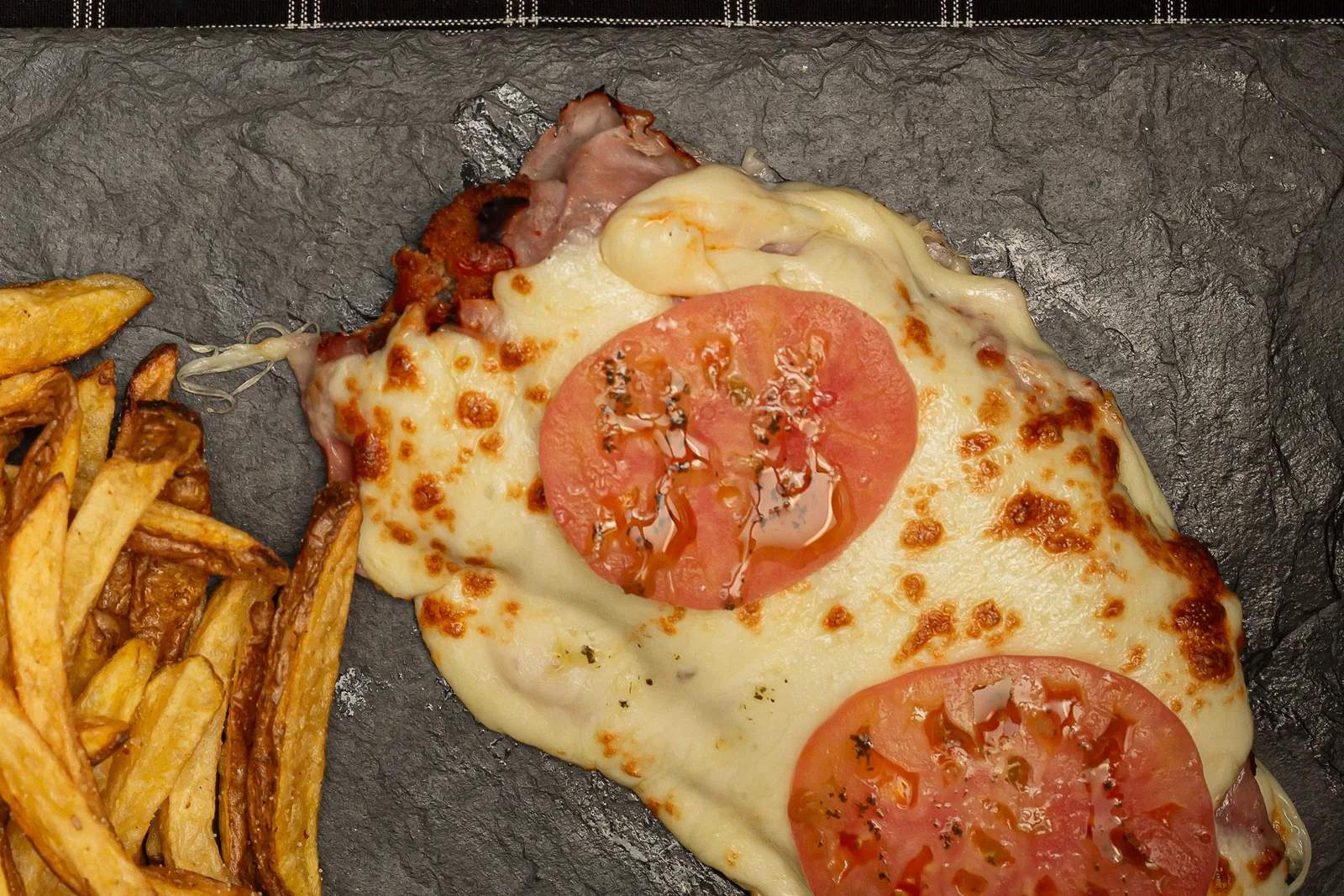

Milanesa napolitana is Argentina’s version of a breaded cutlet: thin beef marinated in egg with garlic and parsley, coated in breadcrumbs, fried until golden, then topped with tomato sauce, a slice of ham and mozzarella and run under the heat until the cheese bubbles. If you know chicken parmesan, you already know half of it. The other half is keeping the crust crisp under all that topping, and that comes down to a thick sauce, a bare edge and a short trip to the oven.
What milanesa napolitana is
How do you make milanesa napolitana? Pound 600 g (1⅓ lb) top round to 5 mm (a scant ¼ inch), marinate it 20 minutes in egg with garlic and parsley, coat it in breadcrumbs and fry at 340-355°F (170-180°C) for 2 to 3 minutes per side. Top with thick tomato sauce, ham and mozzarella and bake 8 to 10 minutes at 400°F (200°C). 95 minutes for 4 servings.
A milanesa is the everyday breaded cutlet of Argentina and Uruguay, made with beef, chicken or pork. The napolitana version adds the topping, and in Buenos Aires it almost always comes with a pile of fries. The name doesn’t mean it came from Naples: the most widely told story places it at a Buenos Aires restaurant called Nápoli in the 1940s.
How it compares. A Wiener schnitzel is veal with no topping. American chicken or veal parmesan usually has no ham, adds parmesan to the mozzarella and often comes with pasta. Milanesa napolitana is thin beef, ham, mozzarella and fries.
Time and difficulty. 95 minutes, of which 40 are hands-off fridge time, with the sauce made while the beef marinates. It’s medium difficulty only because you are juggling three things: the cutlets, the sauce and the final bake. The timeline below keeps them in order.
Which beef to buy in the US and UK
Ask for thin steaks for breading from a lean cut of the back leg, sliced against the grain. Plan on 150 g (5 oz) per person.
- In the US. Many Latin butchers and supermarkets sell packs labeled “milanesa”, usually thin-sliced top round, sometimes bottom round. If you only find thick round steaks, buy top round and pound it yourself.
- In the UK. Topside is the closest to the Argentine nalga, and silverside to cuadrada. Thin “minute steaks” cut from topside work without pounding. The peceto, eye of round, is sold as salmon cut, from the silverside.
- Skip stewing cuts like chuck with a lot of connective tissue: five minutes in a skillet leaves them chewy.
The rest of the shopping list
- Breadcrumbs. Plain, fine and dry. Panko makes a thicker, craggier crust that soaks up a little more oil; fine if that’s what you have, but it’s further from the classic.
- No flour. The Argentine method goes straight from egg to crumbs. The garlicky egg is both marinade and glue.
- Ham. Ordinary deli or sandwich ham, thinly sliced. Prosciutto is saltier and dries out in the oven.
- Mozzarella. Use low-moisture mozzarella, the firm block or the shredded bag. Fresh mozzarella in water leaks whey onto the crust; if it’s all you have, slice it, blot it well with paper towels and expect a softer result.
- Sauce. Crushed tomatoes cooked down with garlic and oregano. A jarred marinara works if it’s thick; if it’s runny, reduce it in a skillet for 5 minutes first.
Equipment. A meat mallet with a flat face (or a heavy skillet), an 11-inch (28 cm) skillet, tongs, a wire rack and a sheet pan. A thermometer settles any doubt about the oil.
How to make it, step by step
Pound to an even 5 mm
If your steaks are already thin, don’t pound them, just even out the edges. Thicker ones go between plastic wrap and get firm taps with the flat side of the mallet until they are 5 mm (a scant ¼ inch) all over, never more than 8 mm (5/16 inch). The spiked side shreds the meat. Uneven steaks dry out in the thin spots before the thick spots cook.
The garlic and parsley egg
The marinade is just the 3 eggs whisked with 2 minced garlic cloves, the parsley, salt and pepper. The steaks sit in it, covered, in the fridge for 20 minutes, or up to 2 hours if you want a stronger garlic flavor. It’s raw meat in raw egg, so it stays cold.
Bread and chill
Let each steak drip for a few seconds, then press it into the crumbs with an open palm on both sides until no meat shows. Chill them 20 minutes in a single layer. The crumbs absorb some of the egg and set, so the coating doesn’t come away in sheets in the pan.
Make the sauce while the beef marinates
While the steaks are in the egg, cook the third garlic clove gently in the olive oil for 1 minute, add the tomatoes, a pinch of salt and half the oregano, and simmer 15 minutes. It’s ready when a spoon dragged across the bottom leaves a trail that closes slowly. Watery sauce is what makes a soggy napolitana.
Fry at 340-355°F (170-180°C)
With 300 ml (1¼ cups) of oil in an 11-inch skillet you get about 5 mm of oil, enough for a thin cutlet you turn once. Fry one at a time, 2 to 3 minutes per side. Skim out loose crumbs between cutlets so they don’t burn, and give the oil a minute to recover. Drain on a rack; on paper towels the underside steams.
Top and bake
Top the cutlets only when the oven is ready: 3 tbsp sauce, keeping a 1 cm (⅜ inch) border clear, one slice of ham, 50 g (1¾ oz) mozzarella and a pinch of oregano. Bake 8 to 10 minutes at 400°F (200°C) or broil 3 to 4 minutes, until the cheese bubbles and has brown spots. Longer doesn’t help: the beef dries and the crust toughens underneath.
If it goes wrong
| What happened | Why | Next time |
|---|---|---|
| Soggy crust | Thin sauce, too much of it, or topped too early | Reduce the sauce, top at the last minute, leave the border bare |
| Coating falls off | Egg not drained, crumbs not pressed, no chill, flipped twice | Drip, press, chill 20 minutes, turn once |
| Greasy | Oil too cool or pan crowded | Wait until a pinch of crumbs sizzles at once; one at a time |
| Dark outside | Oil above 355°F (180°C) | Lower the heat and wait a minute |
| Tough | Thick or uneven steak, or a stewing cut | Pound to an even 5 mm |
| Too salty | Ham and cheese already carry salt | Only ½ tsp salt for all 4 steaks |
Allergens. Gluten (breadcrumbs), egg and dairy. For a gluten-free version, use gluten-free crumbs and check the ham label. There’s no heat at all, so it’s an easy sell with kids.
Baked, air fryer and chicken versions
- Baked, no frying. Heat the oven to 400°F (200°C) with an oiled sheet pan inside. Lay the breaded cutlets on the hot pan, spray or drizzle with a little oil and bake about 15 minutes per side, turning once, until golden; check very thin ones at 10. They come out less crisp and a little drier than fried. Then top and bake as above.
- Air fryer. Breaded the same way and sprayed with oil on both sides, 8 to 10 minutes at 400°F (200°C), flipping halfway. Add the topping and give them 2 or 3 more minutes in the air fryer or oven. A little paler and drier than fried.
- Chicken. Split each breast into two cutlets and pound to 5 mm. Same coating, about 3 minutes per side, until the center reads 165°F (74°C).
- A caballo. With a fried egg on top of the finished napolitana. A different dish that shares the thin beef, ham, mozzarella and egg, but seared instead of breaded and stacked in a bun with bacon, lettuce and tomato, is the Uruguayan chivito sandwich.
- For 8 or more. Double everything and fry in two skillets. Hold finished cutlets uncovered on a rack in a 195°F (90°C) oven for no more than 20 minutes, then top and bake them all together.
For the plain, untopped cutlet with a flour coating, the Mexican beef milanesa covers that method, and the Colombian breaded chicken is the chicken breast version.
What it costs. The beef is the biggest line, then the cheese. Bottom round brings the price down without changing the dish much, and block mozzarella is cheaper than fresh and works better here.
Fries and other sides
Fries are the Argentine default. For 4, cut 1 kg (2¼ lb) of potatoes into 1 cm (⅜ inch) sticks, soak them 30 minutes in cold water and dry them very well. First fry in plenty of oil at 300-320°F (150-160°C) for 5 to 7 minutes, without browning; drain and let them rest while the cutlets bake. Second fry at 355-375°F (180-190°C) for 2 to 3 minutes until golden, then salt. Both finish at the same time.
Other good sides: Latin-style mashed potatoes, a lettuce, tomato and onion salad, or plain rice. For a full Argentine meal, start with Argentinian beef empanadas and finish with alfajores with dulce de leche. A bowl of hand-chopped chimichurri on the table suits anyone eating their cutlet plain.
Make ahead, freeze and reheat
The cutlets freeze raw and breaded, without the topping. Freeze them on a tray in a single layer for 2 hours, then bag them with plastic wrap between each one so they come apart easily. They keep up to 3 months; thaw overnight on a rack in the fridge and fry as usual. Raw and breaded in the fridge, up to 1 day, covered, in one layer.
- Fried, untopped. Into the fridge within 2 hours, in a sealed container, 3 to 4 days; frozen, 2 to 3 months, with paper between them.
- Already topped and baked. 3 to 4 days in the fridge. I don’t freeze them: the sauce soaks the crust as they thaw.
- The sauce. Make it the day before; it keeps 3 to 4 days covered in the fridge.
Reheating. Best untopped: oven at 350°F (180°C) for 10 to 15 minutes on a rack, or air fryer at 350°F (175-180°C) for 5 to 8 minutes, until the center reaches 165°F (74°C); then add the topping and a few minutes under the broiler. Topped ones go in the oven the same way. The microwave melts the cheese but leaves the crust soft.
Milanesa napolitana FAQ
Is milanesa napolitana Italian? No. Despite both names, it’s an Argentine dish, and the most widely told story ties “napolitana” to the Nápoli restaurant in Buenos Aires, not to Naples.
Can I use store-bought breaded cutlets? Yes. Cook them as the package says and pick up from the topping: 3 tbsp sauce, ham, 50 g (1¾ oz) mozzarella and the bake. Thin ones dry out faster, so watch the cheese rather than the clock.
Can I skip the ham? Yes, and plenty of Argentine homes do. It’s milder and less salty without it.
How many calories are in milanesa napolitana? About 655 kcal per cutlet without fries, with 54 g protein, 21 g carbs, 39 g fat (14 g saturated), 3 g fiber, 6 g sugars and 1360 mg sodium. I calculated it from the raw beef, the crumbs and egg that stick, and about 6 g of absorbed oil per cutlet, which is my estimate for a thin cutlet shallow-fried. Nearly a third of the calories come from the ham and cheese.
I get the best napolitana when the sauce simmers while the beef sits in the egg, not at the end in a rush: it has time to thicken and nobody waits at the table. I always bread a few extra and freeze them raw, which turns a weeknight napolitana into half an hour of frying and baking. The one thing I never skip is the bare border, because it’s why the last bite still crunches. Josnaisis.