
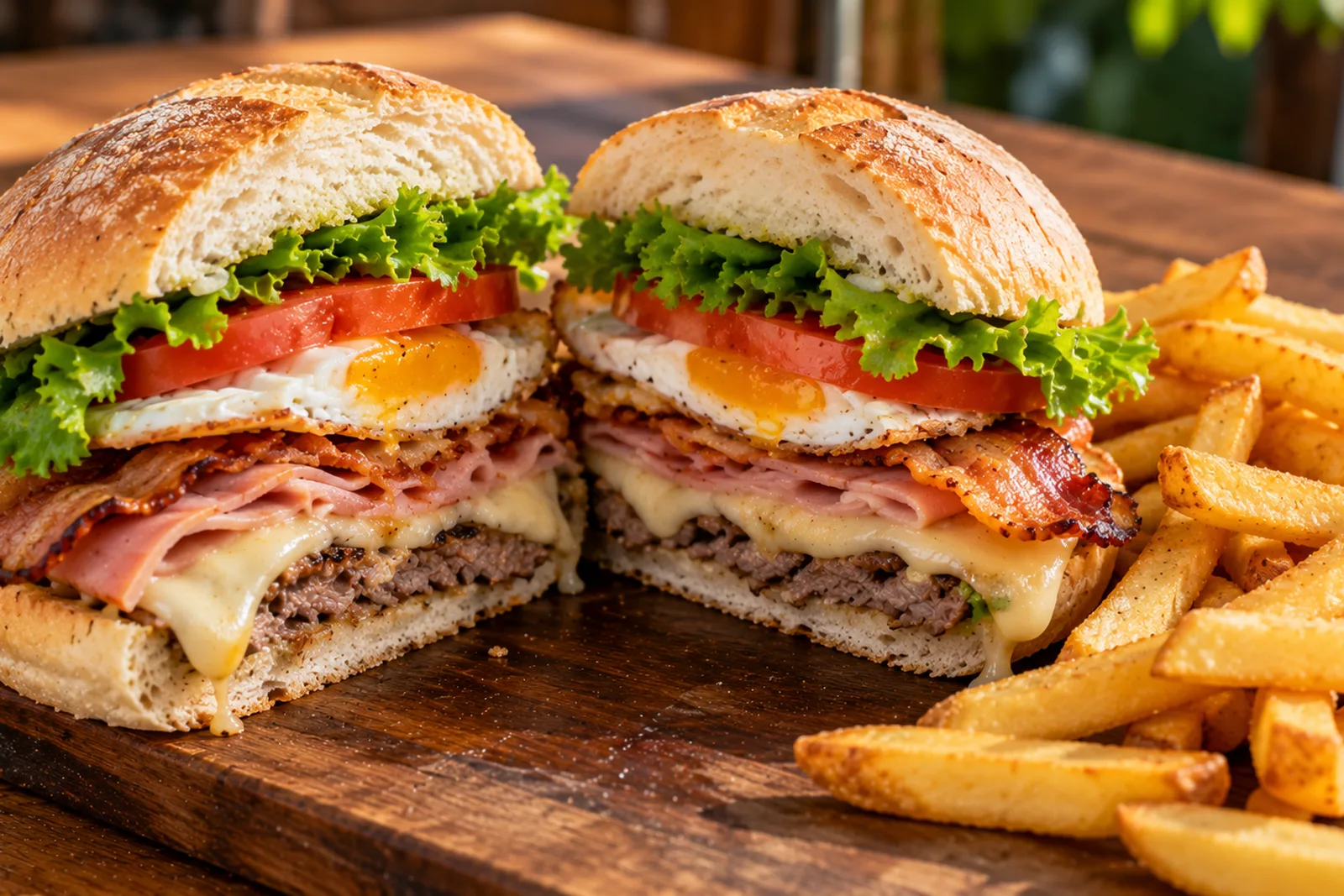

The chivito (chee-VEE-toh) is the sandwich Uruguay is proudest of, and despite the name there is no goat in it. Chivito means baby goat; what you get is a thin slice of beef tenderloin seared hard and fast, crowned in the pan with ham and melting mozzarella, then stacked into a soft bun with bacon, a fried egg, lettuce, tomato, red pepper, olives and plenty of mayonnaise. It is big, a knife-and-fork sandwich in many places, and it comes with fries.
How to make a chivito at home
How do you make a Uruguayan chivito? Pound four 120 g (4.2 oz) slices of beef tenderloin to 1/4 inch (6 mm), sear them over high heat for 1½-2 minutes, flip, and melt ham and mozzarella on top under a lid for another 1½-2 minutes. Stack in toasted buns with mayo, lettuce, tomato, bacon, a fried egg, red pepper and olives. Ready in 40 minutes for 4 servings.
The story most often told puts its birth at El Mejillón, a bar in the beach town of Punta del Este, in the 1940s. A customer from Argentina asked for chivito, the owner had none, and he sent out a beef sandwich with ham and cheese instead. The name stuck to the sandwich.
Two things decide whether yours works. The steak has to be thin enough to cook in the time the cheese takes to melt, and the layers have to go in an order that lets you bite through without the whole stack sliding out the back.
Time and effort. 40 minutes, half of it slicing and pounding, half at the stove. Easy, as long as you don’t wander off while the steak is in the pan.
The beef, and what to ask for
Uruguayans use lomo, which is tenderloin. You need 120 g (4.2 oz) raw per sandwich, and once pounded it covers the whole bun.
Why pound it so thin
A 3/8-inch (1 cm) steak browns outside before the middle is done, and in the bun it slips around and drags everything with it. At 1/4 inch (6 mm) it cooks evenly in 3-4 minutes and bites cleanly. Pounding also breaks up fibers, which is why a cheaper sirloin or strip steak can stand in when it is thin enough.
- US. Beef tenderloin or filet mignon. Many butchers will slice and pound it for you.
- UK. Beef fillet. Sirloin is the budget swap.
- Budget. Sirloin, strip or ribeye sliced thin: beefier, a little chewier.
- Pork tenderloin. Milder and cheaper. Cook it through to 145°F (63°C); slices this thin get there in the same 3-4 minutes.
Ingredient swaps for a US or UK supermarket
| In Uruguay | What to buy | What changes |
|---|---|---|
| Muzzarella for melting | Low-moisture mozzarella from a block | Same melt. Avoid fresh mozzarella in water, which leaks onto the bread, and pre-shredded, which is coated in anti-caking starch and melts less smoothly |
| Panceta | Smoked streaky bacon | Same role. Without it you have the basic chivito |
| Jamón cocido | Deli cooked ham, thinly sliced | Same |
| Pan de chivito | Large soft hamburger bun or kaiser roll, about 80 g (2.8 oz) | Closest match. A short ciabatta holds juices better but is harder to bite through |
| Morrón | Red bell pepper, raw or jarred roasted | Roasted is softer and sweeter |
| Other melting cheese | Havarti or Monterey Jack slices | Both melt cleanly; Jack is a little tangier |
Skip sandwich bread: hot steak and tomato turn it to paste.
Equipment. A large heavy skillet or griddle with a lid (cast iron is ideal), a second pan for the eggs, and a meat mallet, rolling pin or heavy saucepan for pounding.
The cooking, step by step
Slice and pound
Fifteen minutes in the freezer firms the tenderloin so it slices into even 3/8-inch (1 cm) steaks. Cut across the grain. Pound between plastic wrap from the middle outward; hitting the same spot over and over tears it. Salt goes on at the last moment, because salted early the meat weeps and won’t brown.
Bacon, then buns
All 8 bacon slices go over medium heat for 4-6 minutes, until golden but still bendable. Shatter-crisp bacon breaks into bits that fall out of the sandwich. Pour off most of the fat, keeping 1 tablespoon for the eggs, and toast the buns cut side down for 1-2 minutes.
Steak with ham and cheese
High heat, the pan barely smoking. Two steaks at a time in a 11-inch (28 cm) skillet, and don’t touch them for 1½-2 minutes; they release on their own when browned. Flip, add 2 slices of ham and 1 of mozzarella to each, cover, and give it 1½-2 minutes more, until the cheese runs down the sides.
That lid is what holds a chivito together: the cheese glues the ham to the steak and the three come out as one piece. At 1/4 inch the steak ends up cooked through, which is how it is eaten in Uruguay; for a pinker center, take 30 seconds off the first side, except for small children, pregnant women and older people, who should get it cooked through with no pink in the middle.
Eggs
In the second pan with 1 tablespoon of bacon fat, over medium heat, 2-3 minutes. For eating by hand, flip for 1 minute so the yolk sets; a runny one ends up on your shirt. For older people, pregnant women and small children, always cook the yolk firm.
Stacking it
Cut the slippery things small: olives in rings, pepper in thin strips. Press the closed sandwich for 10 seconds before slicing it on the diagonal with a serrated knife. A long toothpick through the middle keeps it upright on the way to the table.
What goes wrong with a chivito
- Tough, dry steak. Too thick, or cooked too long. Pound to 1/4 inch (6 mm) and stop at 4 minutes total.
- Gray steak sitting in liquid. The pan wasn’t hot enough or it was crowded. Two at a time, high heat.
- The filling slides out. Ham and cheese weren’t melted onto the steak, or the olives went in whole.
- Soggy bun. Untoasted, no mayo, or wet lettuce. Dry the leaves and keep them at the bottom, away from the hot steak, which wilts and darkens them.
- Bacon in crumbs. Cooked too crisp. Pull it while it still bends.
Allergens and heat. Contains gluten (bun), egg (egg and mayonnaise) and milk (mozzarella). It isn’t spicy at all; for kids, serve the pepper and olives on the side.
Chivito al plato, canadiense and other versions
- Chivito canadiense. In Uruguay, the name for the full version with bacon.
- Basic chivito. No bacon, no egg: steak, ham, cheese, lettuce, tomato and mayo. The quickest one.
- Chivito al plato. No bun. The steak with ham and cheese goes on the plate topped with bacon and a fried egg, with fries and Latin-style ensalada rusa, the potato, carrot and pea salad that is its classic partner, plus lettuce and tomato. Some places add red pepper and onion caramelized on the griddle.
- With hard-boiled egg. One sliced hard-boiled egg on the lettuce instead of a fried one. It shifts around less.
- Lighter. No bacon and 1 tsp of mayo per bun saves about 175 kcal per sandwich.
- For a crowd. Count 1 chivito per adult. Pound the steaks the day before and set up a line: one person at the stove, one building.
Cost. Tenderloin is what makes a chivito expensive. Pork tenderloin or thin-cut sirloin brings it down a lot, and bacon is the next biggest item.
Serving, make-ahead and leftovers
Serve with fries next to or under the sandwich. Frozen oven fries, cooked as the bag says, are done in the time it takes to make the steaks. A spoonful of Argentinian chimichurri on the steak isn’t standard, but it suits it.
The day before. Pounded steaks, separated with plastic wrap, keep up to 2 days in the fridge. Sliced tomato and pepper, covered, too. Store washed, dried lettuce in a container lined with paper towels.
Leftovers. A built chivito doesn’t keep; the bun goes soggy. Refrigerate cooked steak within 2 hours: it keeps 3-4 days in the fridge and 2-3 months in the freezer. Reheat it in a hot skillet for 1 minute per side until steaming, with the ham and cheese on top under the lid. Microwaved, thin steak turns rubbery.
Chivito questions
Is there goat in a chivito? No. It is beef, usually tenderloin. It is called that because of the customer in Punta del Este who asked for chivito, baby goat, and was served beef.
How is it different from a Philly cheesesteak? A cheesesteak is shaved beef chopped on the griddle in a long roll. A chivito is one whole pounded slice of tenderloin with ham, bacon, egg and salad, in a round bun.
Can I use a breaded cutlet? Then it becomes a milanesa sandwich, which is a different thing. The chivito steak is seared bare. If you want the breaded version, a Mexican beef milanesa starts from the same 1/4-inch (6 mm) pounded steak, and the Argentinian milanesa napolitana covers it with ham, tomato sauce and broiled cheese.
What other Latin sandwiches are like this? Street sandwiches built around meat: the choripán is a grilled chorizo in crusty bread with chimichurri, the Cuban sandwich is roast pork and ham pressed hot, and the Venezuelan pepito uses marinated steak strips with potato sticks on top.
Nutrition per chivito
Per full sandwich (120 g / 4.2 oz raw tenderloin, with bacon, egg and mayo, fries not included), calculated ingredient by ingredient from the recipe amounts:
- Calories: 1020 kcal
- Protein: 58 g
- Carbohydrates: 48 g
- Fat: 66 g, including 23 g saturated
- Fiber: 4 g
- Sugars: 10 g
- Sodium: 1660 mg
The steak is about 295 kcal, the bun about 225, and bacon, egg and mayo together about 290. Most of the sodium comes from ham, bacon, mozzarella, olives and the bun.
What I care about most here is the thickness. At 1/4 inch the steak is done exactly when the cheese has melted, and you never have to choose between the two. I also dry the lettuce leaf by leaf, because it is the lettuce that decides whether the bun makes it to the last bite. Josnaisis.