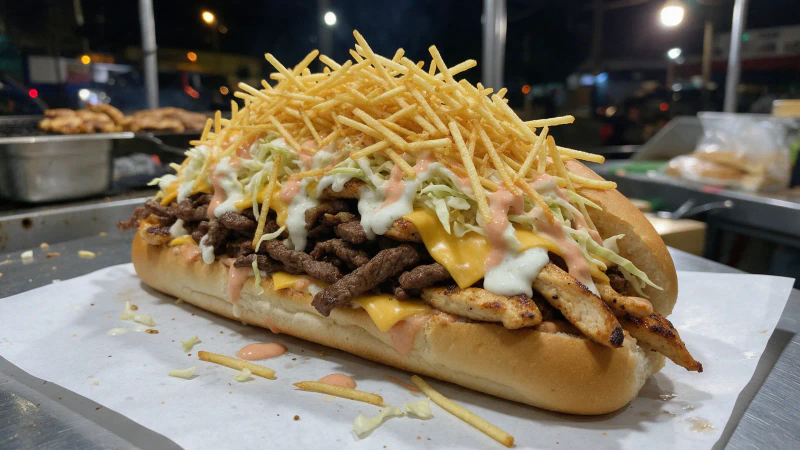
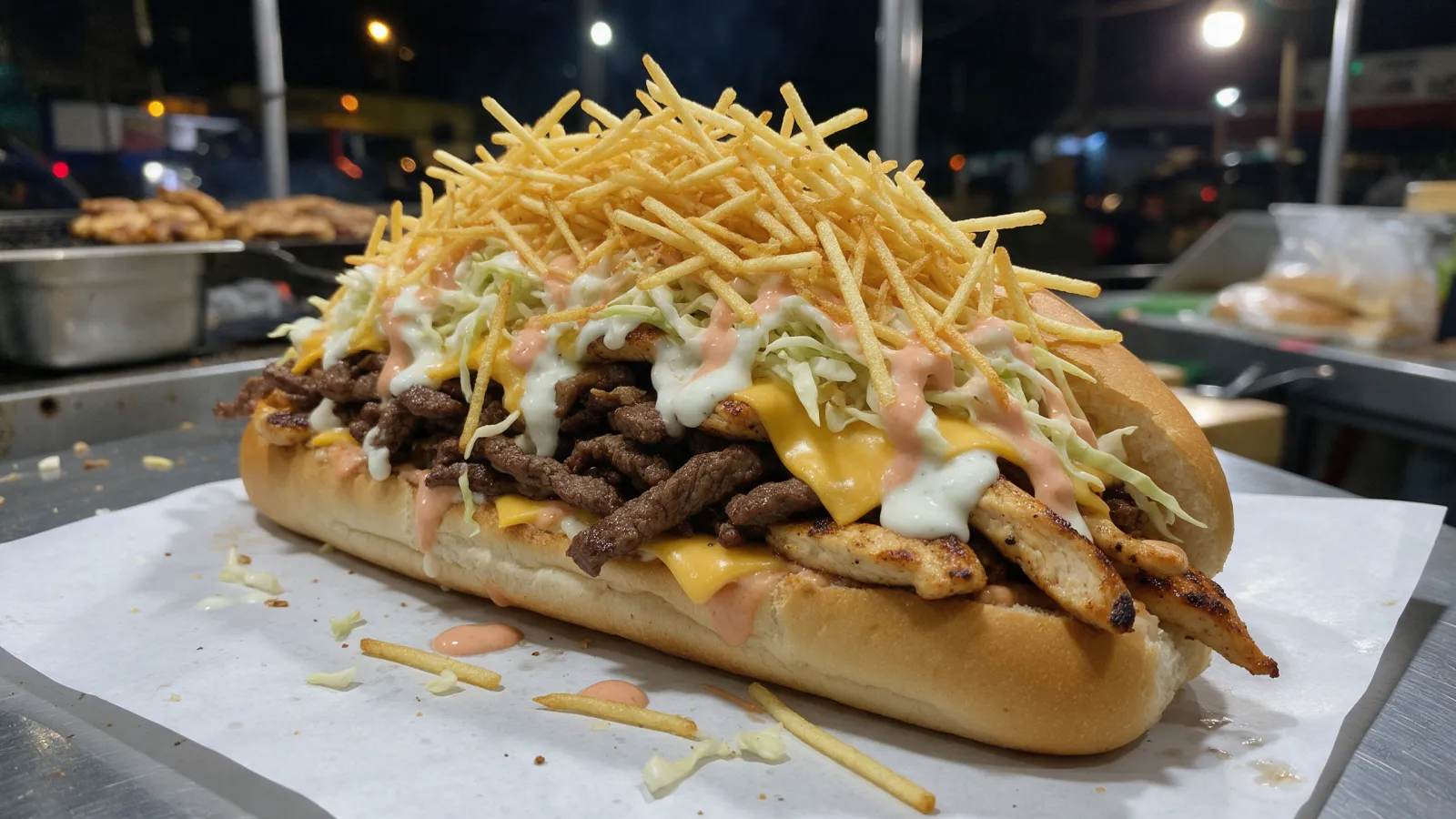

Picture a Philly cheesesteak that took a detour through a Caracas street cart: a long toasted roll stuffed with soy-and-Worcestershire marinated steak and chicken, a blanket of yellow cheese, shredded cabbage, a ribbon of garlic mayo and a fistful of crunchy potato sticks on top. That’s a pepito (peh-PEE-toh), the late-night sandwich of Venezuela, and the version with both meats is called a pepito mixto. The trick most home cooks miss is that the meat itself, not the sauce, is what turns the bread to mush.
What is a Venezuelan pepito, and who is it for?
How do you make a Venezuelan pepito? Slice steak and chicken into ⅜-inch (1 cm) strips, marinate 30 minutes in Worcestershire, soy, garlic and cumin, then sear in a single layer over high heat with bacon and onion. Pile onto a toasted roll over sliced cheese, add cabbage, garlic and pink sauce, and finish with potato sticks. 70 minutes for 6 servings.
In Venezuela the pepito is street food, sold from carts where you choose your meat and squeeze on as many sauces as you like. It’s most closely tied to the city of Barquisimeto. The name also exists in Spain, but there a pepito is a much simpler thing: a thin grilled beef steak in a bread roll.
Make it if you want a big, messy, build-your-own dinner for a game night or a crowd. It’s generous: one pepito is a full meal at about 978 calories.
Skip it if you’re after something light, or something to pack for lunch tomorrow. Assembled, it has a shelf life of minutes.
Time, honestly. 70 minutes start to finish, but 30 of those are the meat sitting in the fridge while you make the sauces and cut the potatoes. With sauces made ahead and canned potato sticks, you’re looking at about 30 minutes at the stove.
Difficulty. Moderate, only because two pans and a pot of oil run at once. Nothing here needs a technique you don’t already have.
Shopping for a pepito in a US or UK supermarket
You don’t need a Latin grocery for this one. Everything has a close match in a regular store.
The bread. You want long, soft inside and thin-crusted: a hoagie or sub roll in the US, a soft sub roll or a soft baguette in the UK. A crackly artisan baguette fights back when you bite and pushes the filling out the sides.
The beef. Venezuelan carts often sell pepito de lomito, made with tenderloin. At home I use a cheaper cut and slice it thin. Top sirloin is the easy choice in the US; flank and skirt have more flavor but long fibers, so they must be sliced across the grain. In the UK, sirloin or rump. Twenty minutes in the freezer firms the meat so the strips come out even.
The chicken. Breast is classic. Boneless thighs stay juicier and need 1 to 2 extra minutes.
The cheese. Venezuelans call it queso amarillo, “yellow cheese,” a mild, sliceable cheese that softens without turning to liquid. Mild cheddar, gouda, muenster or Edam slices all behave the same way. Skip aged cheddar: too sharp, and it gets greasy.
The potato sticks. These thin fried potato threads are the signature crunch. In the US, canned shoestring potato sticks sit in the chip aisle (4 oz and 9 oz cans are common); you need about 4.2 oz (120 g). In the UK they’re harder to find, so make them: one large potato is enough for six sandwiches, and the method is in the recipe card. Crushed crisps work in a pinch, though they go soft faster.
The sauces. Garlic sauce is the one every cart has. Mine is a small batch of my Venezuelan garlic sauce with the garlic-to-mayo ratio: mayonnaise blended with fresh garlic, milk and lime. Pink sauce is 2 parts mayo to 1 part ketchup; there’s more on keeping and scaling it in my salsa rosada recipe. Want something green? A drizzle of guasacaca, the Venezuelan avocado and vinegar sauce, goes on after the garlic sauce.
How to slice and marinate the meat
Strips 1 cm (⅜ in) thick and about 6 cm (2½ in) long. Thicker strips need longer in the pan, and that’s when the marinade has time to pool. Look at the lines running through the steak and cut perpendicular to them; cut along them and even sirloin turns chewy.
The marinade. 2 tbsp each of Worcestershire and soy sauce, 3 crushed garlic cloves and ½ tsp cumin for 800 g (1¾ lb) of meat. Split it into two bowls before the meat goes in, so raw chicken and raw beef never share. Whatever marinade the raw meat sat in gets thrown away, not poured into the pan as a sauce.
How long. I give it at least 30 minutes in the fridge and no more than 24 hours. Longer than that, the soy over-salts the surface of the chicken. It always marinates in the fridge, never on the counter.
Searing without steaming, and the build order
Why the meat goes in one layer
Here’s where pepitos go wrong. Dump 14 oz (400 g) of wet, marinated steak into an 11-inch (28 cm) skillet and the pan temperature crashes. The marinade can’t evaporate, so the meat simmers in it, turns gray and leaves a puddle that ends up in your bread. Drain the strips in a sieve first, get the pan very hot, and lay them out in one layer: the liquid flashes off and the steak is browned in about 3½ minutes, 4 at most. Small skillet? Two batches. Chicken goes in after the beef, 5 to 6 minutes.
The build order that keeps the roll crisp
- Toasted roll, cut side down until the crumb looks dry. A dry crumb soaks slower.
- Cheese slices straight onto the bread. They’re the waterproof layer.
- Hot meat on the cheese, which softens it without a trip under the broiler.
- Cabbage over the meat.
- Sauces drizzled on the cabbage, never on the bare bread: garlic first, then pink.
- Potato sticks last, so they’re still crunchy at the first bite.
Built like this, a pepito holds for about 5 minutes. Serving kids, or carrying plates to another room? Put the potato sticks in a bowl on the table.
How to tell each step is right.
- Steak → sizzles hard on contact, browned edges within 2 minutes. If you hear bubbling, the pan is crowded.
- Chicken → white all the way through the thickest strip, juices clear.
- Potato sticks → pale gold and crisp once cool. Pale and limp means the oil was too cool or the batch too big.
- Bacon → snaps when cool.
- Bread → dry, lightly golden crumb.
Temperatures, mistakes, kids and allergens
Doneness. Chicken needs to hit 165°F (74°C) in the thickest strip, which takes 5 to 6 minutes at high heat. Beef steak is safe at 145°F (63°C), and thin strips get past that in 3 to 4 minutes. Use a clean plate for the cooked meat, not the one that held raw chicken.
Mistakes that ruin a pepito.
- Gray, tough steak → crowded pan or low heat. One layer, high heat, batches.
- Soggy bread → wet meat. Drain it before and after cooking, and cheese goes down first.
- Too salty → long marinade or extra salt. Taste before salting: soy and bacon already did the work.
- Chewy beef → sliced with the grain.
- Greasy potato sticks → oil below 350°F (175°C) or wet threads.
- Sandwich falls apart → crusty bread or overfilling. About 3½ oz (100 g) of cooked meat per roll is what fits.
Heat level. Zero. Put hot sauce on the table for anyone who wants it.
For kids. The chicken version is a hit. Give little ones half a sandwich, skip the raw garlic sauce, and serve the potato sticks on the side.
Allergens. Wheat/gluten (bread, and usually soy sauce and Worcestershire), egg (mayo), milk (cheese and the milk in the garlic sauce), soy, and in many Worcestershire sauces, fish (anchovy). Check labels if you’re cooking for someone with an allergy.
Which pepito to make
- Steak only → 800 g (1¾ lb) beef. Juicier and pricier, about 1,032 calories.
- Chicken only → 800 g breast or thighs. Cheapest, kid-friendly, about 924 calories.
- Mixto → half and half, this recipe.
- Minimalist → meat, cheese and one sauce on a toasted roll. Some cooks from Barquisimeto make it that way.
- With sweet corn or guasacaca → a small can of drained corn tossed with the meat for the last minute, or a guasacaca drizzle with the sauces.
- Lighter → no bacon, no pink sauce, half the potato sticks: about 769 calories per sandwich.
- In tortillas instead of a roll → steak and bacon under melted cheese, with peppers and onion, is basically Mexican alambre tacos.
- Weeknight shortcut → canned potato sticks, sauces from the fridge, and a 30-minute marinade while you prep. About 30 minutes of cooking for six.
Pepitos for a crowd, 10 to 20 sandwiches
How many. I plan 1 per adult when there’s other food, half for kids. They’re big.
Shopping for 20 (the recipe times 3⅓): 1.35 kg (3 lb) each of steak and chicken, the marinade times 3⅓ (100 ml / 7 tbsp each of Worcestershire and soy, 10 garlic cloves, 1½ tsp cumin), 500 g (1.1 lb) bacon, 500 g (1.1 lb) onions, 600 g (1.3 lb) sliced cheese, 650 g (1.4 lb) cabbage, 400 g (14 oz) potato sticks or 1 kg (2.2 lb) potatoes, 20 rolls, garlic sauce from 400 g (1¾ cups) mayo and 20 g garlic, and pink sauce from 300 g (1⅓ cups) mayo plus 150 g (a generous ½ cup) ketchup. For 10, halve it.
The night before. Sauces into squeeze bottles, cabbage shredded and stored with a paper towel, meat sliced and marinating in the fridge.
On the day. Sear the meat in batches of about 14 oz (400 g), one layer each time: that’s 7 batches for 6 lb. Move each batch into a covered dish in a low oven and keep it at 140°F (60°C) or above. Out of the heat, 2 hours is the limit, 1 hour above 90°F (32°C). Toast rolls 6 at a time as people come, and set up a station in build order: bread, cheese, meat, cabbage, sauces, potato sticks.
What a pepito costs in the US
At average US prices for August 2026, six pepitos mixtos come to about $25.77, or $4.29 a sandwich, before the cabbage and the Worcestershire, soy and cumin.
What drives the price. The sirloin, which is half the bill at about $14.36/lb. Round steak brings the six to about $21.66 ($3.61 each), and going all chicken drops it to about $16.79 ($2.80 each). The cheese and bread figures use cheddar and white sliced bread as stand-ins, and the potato sticks use the average for potato chips, so treat those three as estimates. I don’t have reliable current prices for the UK, so I won’t guess.
Yield. Six large sandwiches of about 11 oz (320 g). One per adult is dinner.
Serving, storing and reheating
What it tastes like. Salty and smoky from the soy and bacon, garlic at the finish, cabbage for freshness, and crunch in every bite.
How to serve it. Wrapped in paper or a napkin, cut in half if the roll is long, with the sauces in squeeze bottles on the table. Hands only. On a street-food night it sits well next to Venezuelan tequeños, a Colombian hot dog with pineapple sauce or a basket of Colombian salchipapa. If you like the idea but want to swap the bread for fried green plantain, that’s a Venezuelan patacón maracucho.
Make-ahead and leftovers. An assembled pepito doesn’t keep. Store the parts instead:
- Cooked meat → covered in the fridge 3 to 4 days, or frozen without sauce for 2 to 3 months.
- Sauces → in their jars in the fridge: the pink sauce keeps 3 to 5 days, the garlic sauce 4 with store-bought mayo. Neither freezes.
- Potato sticks → airtight at room temperature.
- Rolls → freeze well on their own.
Reheating. Meat in a hot skillet 2 to 3 minutes, stirring, until steaming and 165°F (74°C); the microwave makes it rubbery. Re-toast the bread 1 minute. Sauces and potato sticks go on cold, at the end.
Venezuelan pepito FAQ
What is a pepito sandwich? A Venezuelan street sandwich: a long toasted roll filled with grilled strips of steak, chicken or both, cheese, cabbage or lettuce, sauces such as garlic sauce and pink sauce, and crunchy potato sticks on top.
What’s the best cut of beef for a pepito? Tenderloin is the classic. Top sirloin is the best value; flank and skirt work if you slice them ⅜ inch (1 cm) thick across the grain and cook them fast.
What are the potato sticks on a pepito? Thin fried potato threads. In the US, buy canned shoestring potato sticks; in the UK, fry your own from one large potato at 350°F (175°C).
What does pepito mixto mean? A pepito with both steak and chicken. This recipe uses 14 oz (400 g) of each for six.
How do I keep the bread from getting soggy? Drain the meat, sear it in one layer, toast the roll, put the cheese down first, drizzle sauces on the cabbage and add potato sticks last. Eat within 5 minutes.
Is a Venezuelan pepito the same as a Spanish pepito? No. In Spain a pepito is a thin grilled beef steak in a roll. The Venezuelan one adds marinated strips, cheese, vegetables, several sauces and potato sticks.
How many pepitos do I need for a party of 20? Twenty, one per adult, using about 3 lb (1.35 kg) each of steak and chicken. Cook the meat in batches and hold it covered at 140°F (60°C) or hotter.
Nutrition per pepito
Per pepito mixto (about 320 g / 11 oz, with bacon, cheese, cabbage, potato sticks and both sauces), worked out ingredient by ingredient from the recipe weights. The whole marinade is counted even though some stays in the bowl, so sodium is a ceiling:
- Calories: 978 kcal
- Protein: 49 g
- Carbohydrates: 54 g
- Fat: 62 g, of which 18 g saturated
- Fiber: 3 g
- Sugars: 10 g
- Sodium: 1,605 mg
Leave out the bacon and you save roughly 47 calories per sandwich. The lighter version above lands near 769 calories, with 1,210 mg sodium.
The first time I made pepitos for friends in Colombia, I tipped all the steak into the pan at once to save time and served six gray, dripping sandwiches. Batches feel slower. They aren’t, because you never have to apologize for the bread. Josnaisis.