
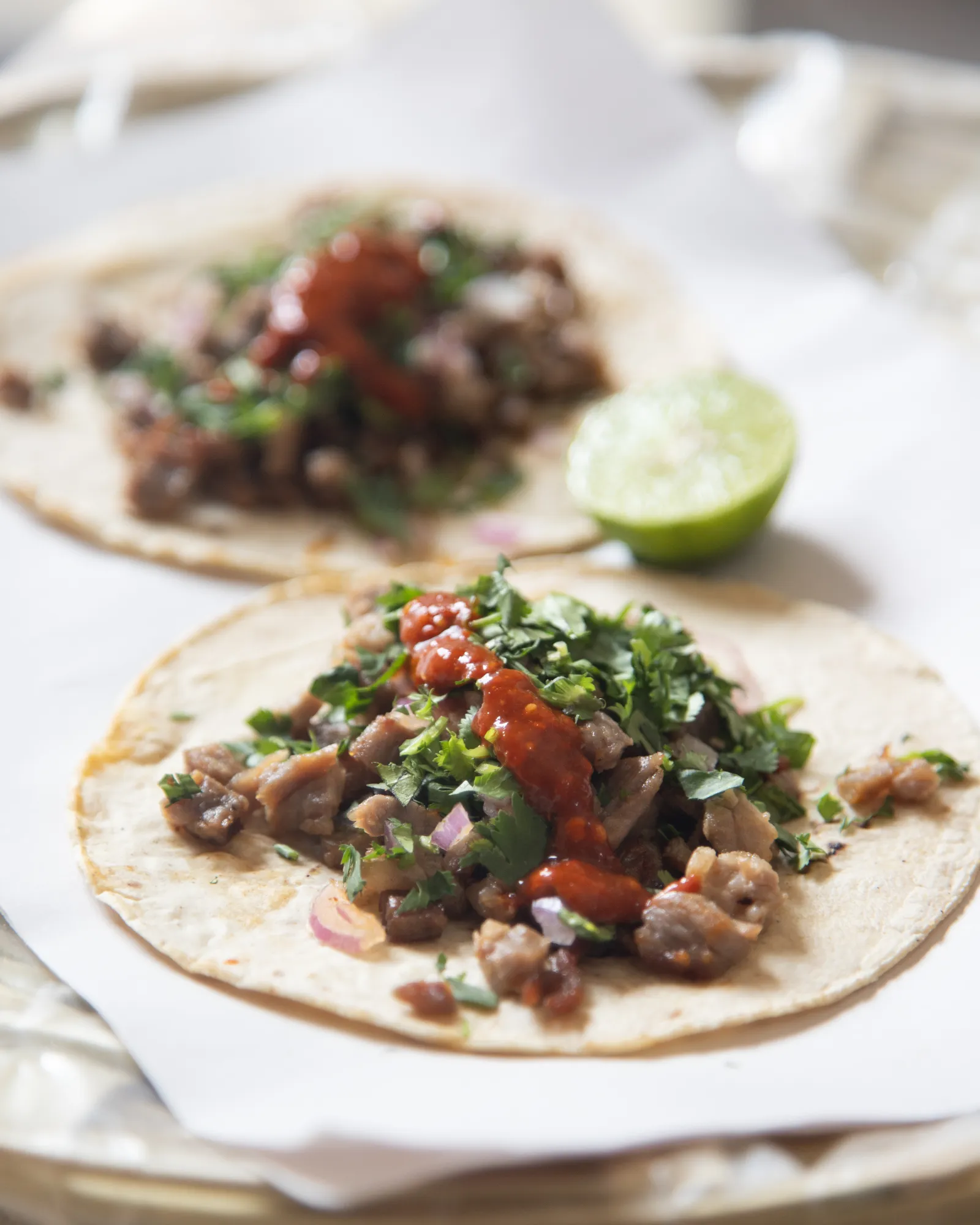

Suadero (swah-DEH-roh) is one of the classic Mexico City street tacos: thin beef simmered for hours in a ring of bubbling lard, then chopped and pushed up onto a hot steel dome to toast for a minute before it goes into a tortilla. The taquero’s pan is called a choricera, and you don’t need one. A wide pot with 500 g of lard and 2 cups of water does the slow part, and a skillet does the crisping, because the water keeps the fat at a gentle 212°F (100°C) until the beef turns soft.
What is suadero, and who are these tacos for?
How do you make suadero tacos? Cut 1 kg (2.2 lb) of suadero or brisket into 3-4 inch pieces, salt them and cook uncovered in a wide pot with 500 g of lard, 2 cups of water, garlic and bay over the lowest heat for 2½ hours, until a fork slides in. Chop the beef finely, crisp it for 2-4 minutes in a skillet with a little of its fat and serve in corn tortillas with onion, cilantro, salsa and lime. 200 minutes for 6 servings.
Suadero is a thin beef cut with layers of meat and fat, from the lower part of the animal around the belly. Butchers don’t agree on exactly where it starts and stops (some place it toward the leg, others toward the chest), and in practice every taquería uses whatever its butcher sells under that name. What matters is the texture you’re after: beef soft enough to fall apart, with just a little toasting at the edges.
Good for: a Friday dinner, game day, a taco bar. The confit can be done the day before, so on the day you only chop and crisp.
Not ideal for: a quick weeknight unless you use a pressure cooker, or anyone after a lean meal. It’s a fatty cut cooked in fat.
Time, honestly: 200 minutes, about 50 of them hands-on. The 2½ hours on the stove only need a turn every half hour.
Difficulty: medium. Nothing is hard, but the heat has to stay truly low, and you need to recognize the moment the beef is tender.
Suadero vs carnitas vs al pastor
All three are Mexico City taquería staples, and they could hardly be more different. Carnitas are pork cooked in fat and browned until crunchy. Tacos al pastor are thin slices of pork in a red chile and achiote marinade, seared. Suadero is beef, unmarinated, and served soft and juicy with only a light toast. If you like carnitas, the method will feel familiar; the result is gentler.
What cut is suadero, and what to ask the butcher for
In the US, ask for suadero at a Mexican carnicería; some of them cut it. If they don’t, ask a butcher for beef navel (part of the plate), which is the cut suadero is most often said to come from. The easy option is brisket, flat or point, with its fat cap left on: it’s sold almost everywhere and it’s what most US cooks use for these tacos. Some taquerías in the US use boneless chuck.
In the UK, brisket is the practical choice. Buy it as one piece with its fat, not rolled and netted, so you can cut it into 3-4 inch pieces yourself.
| If the recipe says | You can use | What changes |
|---|---|---|
| Suadero | Brisket with its fat cap, same weight | Very close; a slightly coarser grain, which disappears once chopped |
| Suadero | Beef navel | The closest, but usually needs ordering |
| Pork lard | Beef tallow, same weight | Works perfectly and tastes beefier |
| Pork lard | Neutral oil, same volume | Cooks the same; you lose the taquería flavor |
Lard, water and why the pot never goes above 212°F
At a taquería the beef sits in a pool of fat all day. At home, 500 g (about 2½ cups) of lard for 1 kg (2.2 lb) of beef in a 24-26 cm (9½-10 in) pot almost covers the pieces, and the meat adds its own fat as it cooks.
The 2 cups of water are the safety net. While there is water in the pot, the mixture can’t rise above 212°F (100°C), so the beef cooks slowly and its collagen has time to soften. Once the water is gone, the fat climbs quickly and the beef starts to fry. If it’s still tough at that point, it stays tough. That’s why, if the pot dries out early, you add a cup of hot water and keep going.
Which fat. Pork lard is the classic; beef tallow is just as good. In the US, the freshly rendered lard at Mexican butchers tastes far more of pork than the hydrogenated blocks on the supermarket shelf. In the UK, block lard is sold in most supermarkets. A neutral oil will confit the beef just as well but won’t taste like the street version.
No choricera? The choricera does two jobs at once: the beef confits in the outer ring and gets pushed up the dome to toast. At home you split that into a pot and a skillet. If your pot is wider, 28-30 cm (11-12 in), add 250 g (about 1¼ cups) more lard so the beef stays covered.
Timeline and make-ahead plan
While the beef cooks, make the salsa: a taqueria-style red salsa with chiles de árbol or a tomatillo salsa verde. If you’re making homemade corn tortillas with masa harina, they can be pressed and cooked ahead and rewarmed on the griddle.
The day before. Do the whole confit, let the beef cool in its fat (no more than 2 hours out of the fridge) and refrigerate it covered. On the day, melt the fat over low heat, lift out the beef, chop and crisp.
How to tell it’s on track:
- 10 minutes: the lard has melted and the water bubbles gently around the beef.
- During the confit: small, slow bubbles. A rolling boil means the heat is too high.
- Around 2 hours: test the thickest piece. If the fork meets resistance in the middle, give it 30 more minutes.
- Done: the fork goes in and out without lifting the piece, and the meat separates when pressed with a spoon.
- Water gone too early: the bubbling turns fine, fast and loud. If the beef isn’t tender, add 1 cup hot water.
The final crisp. Mexico City suadero is soft and juicy with only a light toast, not crunchy like carnitas. Chop first, then give it 2-4 minutes in a very hot skillet with 2 tbsp of its fat, in two batches so it toasts rather than steams.
Mistakes, spice level, kids and allergens
- Tough beef: the water ran out before the meat was tender, or the heat was too high. Add hot water, turn the heat down and give it another 30 minutes.
- Dry and stringy: it was crisped too long, or the cut came without its fat. Ask for the fat and crisp for 2-4 minutes only.
- Tastes boiled, not like a taquería: it skipped the final crisp. Those last minutes in the skillet are where the toasty flavor comes from.
- Spattering: wet beef went into hot fat, or cold water was added. Pat the beef dry and always add hot water.
Spice level: 0 out of 5. The beef has no chile; the salsa brings the heat, and the red one linked above, with 12 chiles de árbol, is properly hot.
Kids: they usually love it, since it’s tender, mild beef. Chop it finer and keep the salsa on the side.
Allergens: no gluten, dairy, eggs, nuts or soy. Corn tortillas are naturally gluten-free, but check the label on store-bought ones.
Pressure cooker, low-fat and taco-bar versions
Pressure cooker or Instant Pot. The beef with 2 cups of water, the garlic, bay and salt, 35-45 minutes at high pressure with a natural release. Drain, chop and crisp in a skillet with 3 tbsp of lard. It’s tender but tastes more of boiled beef; all the lard flavor comes from the crisping. Never pressure-cook the beef in a pot of fat.
Less fat. Simmer the beef covered in water with garlic and salt for an hour or more, until very soft, then uncover, let the liquid boil off and crisp it with 3 tbsp of lard. Firmer, and less like the street version.
Juicier tacos. Swipe each tortilla through the strained fat before warming it on the griddle, the way street stands do.
Suadero for a crowd
Plan on 3 tacos per person with about 40 g (1.4 oz) of cooked beef each. Brisket keeps around 72 % of its raw weight when braised (a pound of raw brisket gives about 329 g, or 11.6 oz, cooked), so that’s roughly 165 g (6 oz) of raw beef per guest.
| Guests | Raw beef | Lard | Water | Tortillas | Onions / cilantro | Limes |
|---|---|---|---|---|---|---|
| 6 | 1 kg (2.2 lb) | 500 g (2½ cups) | 500 ml (2 cups) | 18 + 4 spare | 1 / 1 bunch | 3 |
| 12 | 2 kg (4.4 lb) | 1 kg (5 cups) | 1 liter (4 cups) | 36 + 8 | 2 / 2 bunches | 6 |
| 20 | 3.3 kg (7.3 lb) | 1.65 kg (8 cups) | 1.65 liters (7 cups) | 60 + 15 | 3 / 3 bunches | 10 |
For 20, split everything between two pots; in one, the pieces pile up and the fat can’t cover them. Confit the day before, store the beef in its fat, then chop and crisp in batches. Keep the suadero covered over the lowest heat or in a low oven at 140°F (60°C) or above while people help themselves.
What suadero tacos cost in the US
At the September 2026 US average for boneless stew beef, $8.53 a pound (there is no separate average for brisket), the 2.2 lb of beef costs about $18.81. Limes, cilantro, onion and garlic add about $3.24, for a total of $22.05, or $3.68 a serving. For 20 guests, 7.3 lb of beef runs to about $62. I leave the lard out of the cost because it’s strained and reused.
Serving, storing, reheating and saving the lard
Pile the chopped beef onto warm corn tortillas with white onion, cilantro, lime and salsa. An avocado and tomatillo salsa is lovely against the richness of the beef, and a pan of refried beans made with a spoonful of the strained fat uses up what’s left in the pot.
Fridge. Cooked suadero keeps 3-4 days at 40°F (4°C) or below, and shouldn’t sit out longer than 2 hours. Store it with a spoonful of fat on top so it doesn’t dry out.
Freezer. Freeze the chopped beef flat in bags with a little fat and use it within 3-4 months for best quality. Thaw in the fridge.
Reheating. In a skillet with a spoonful of fat over medium heat, 3-4 minutes, until it reaches 165°F (74°C) in the center. If it looks dry, add 2 tbsp water, cover for a minute, then uncover to crisp.
Saving the lard. Strain it while warm into a glass jar and let it settle. A layer of jellied meat juices sinks to the bottom: lift the fat off it, because that layer is what spoils first. The clean fat, covered in the fridge, does the next batch of suadero, a pan of beans or the tortillas. I throw it out if it smells rancid.
Suadero tacos FAQ
What is suadero meat? A thin, fatty beef cut from the lower part of the animal, around the belly. In Mexico City it’s confited in lard and served chopped in tacos.
What is suadero called in English? There’s no standard English name. It’s most often linked to the beef navel (part of the plate), and brisket is the usual substitute.
Can I use brisket for suadero? Yes. Brisket with its fat cap, either the flat or the point, gives a very similar result once chopped.
How long does suadero take to cook? About 2½ hours over the lowest heat for 1 kg (2.2 lb) in 3-4 inch pieces, or 35-45 minutes at high pressure, plus 2-4 minutes of crisping.
Is suadero beef or pork? At a taquería it’s beef. Some butchers also sell a pork suadero from a similar part of the animal.
What’s the difference between suadero and carnitas? Suadero is beef served soft with a light toast; carnitas are pork browned until crisp.
Nutrition per serving
Per serving of three tacos with onion and cilantro (salsa and lime not included), worked out ingredient by ingredient from the amounts above. The beef is counted as braised brisket at its 72 % cooked yield, plus the 2 tbsp of lard used for crisping; the confit lard stays in the pot and isn’t counted, though the beef soaks up a little, so the real fat may be slightly higher:
- Calories: 607 kcal
- Protein: 36 g
- Carbohydrates: 35 g (mostly tortillas)
- Fat: 36 g, including 13 g saturated
- Fiber: 5 g
- Sugars: 2 g
- Sodium: 888 mg
The beef accounts for about 400 kcal and 30 g of fat per serving, the tortillas about 157 kcal. Most of the sodium, about 775 mg a serving, comes from the salt. Dipping the tortillas in fat adds more.
In Venezuela the cut we call falda went into the pot for shredded beef, and in Colombia I learned sobrebarriga as a long-simmered braise. Cooking that kind of beef in lard sounded to me like a recipe for shoe leather until I tried it with water in the pot, which keeps the fat from ever getting too hot. Now I strain the lard every time and keep it in a jar, because the second batch always tastes better than the first. Josnaisis.