
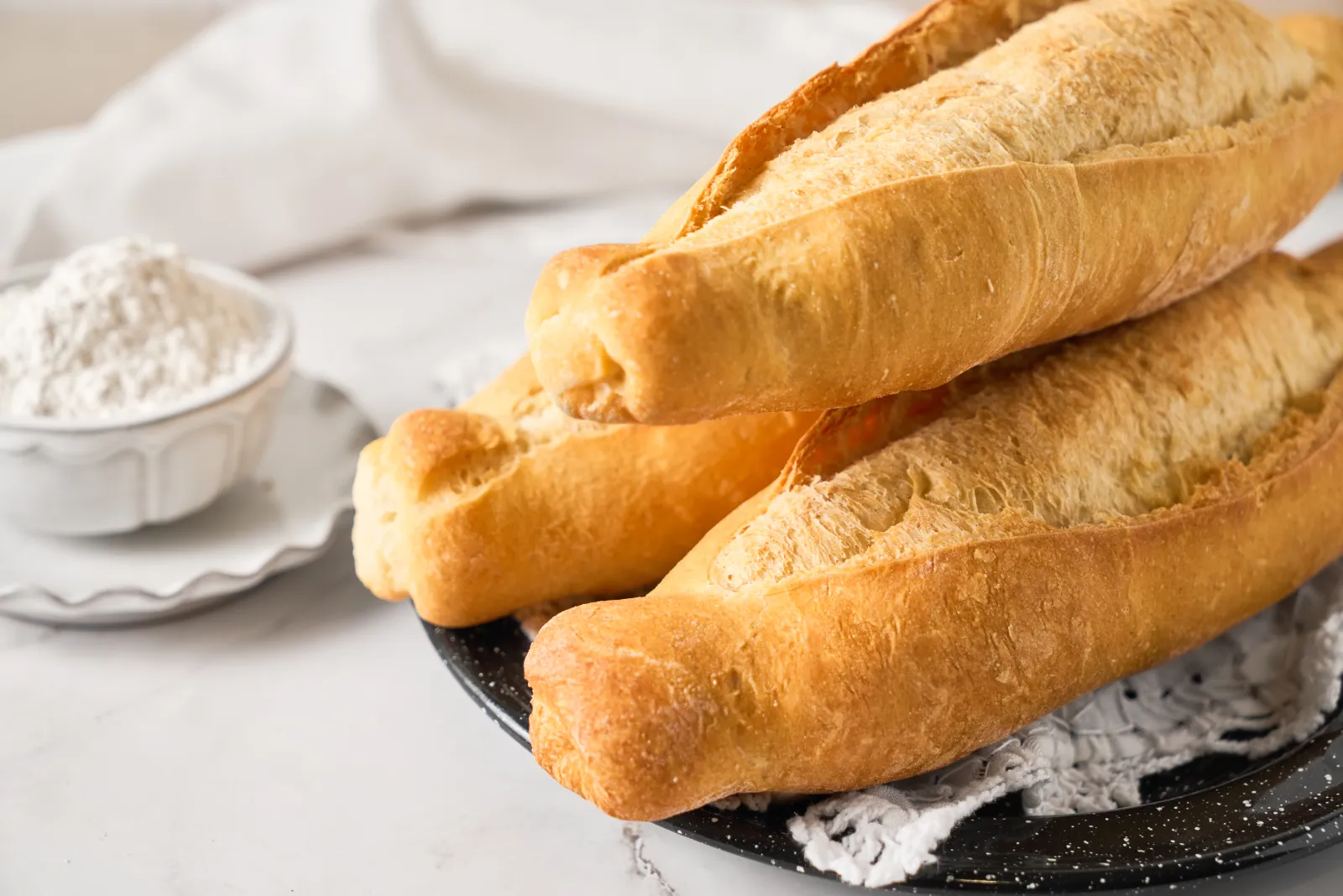

The roll in the middle of a Mexican torta is a bolillo (boh-LEE-yoh): about the length of your hand, pointed at both ends, split down the top by a single cut, with a crust thin enough to crackle and a soft white crumb that can take beans, avocado and hot fillings without falling apart. Mexico buys them warm from the corner bakery. In the US the supermarket version is usually soft, and in the UK you will rarely find one, which is why they are worth baking. This batch makes 8 rolls from 500 g (about 4 cups) of flour, and the one thing that decides the result is the steam you create in a home oven in the first minutes of baking.
What is a bolillo, and who is it for?
How do you make bolillo rolls at home? Knead 500 g (4 cups) bread flour with 325 ml (1⅓ cups) lukewarm water, instant yeast, salt, sugar and a spoonful of lard until the dough passes the windowpane test. Let it double, shape 8 pointed ovals, proof again, slash each one and bake at 450°F (230°C) over a pan of boiling water for about 20 minutes. Ready in 185 minutes for 8 servings.
A bolillo is a lean white roll, close in spirit to a mini baguette but softer inside and a little richer, thanks to a small amount of lard or butter. It is the default bread for tortas, molletes and dunking into stews in Mexico.
Bake them if you want proper torta rolls, you have no Mexican bakery nearby, or you like having a bag of good rolls in the freezer. Skip them if you need bread within the hour, since two rises take most of 3 hours, or if your oven cannot hold 450°F (230°C), because the crust will not crisp below that.
Time. 185 minutes start to finish, about 30 of them hands-on. Difficulty, medium. The dough is simple; shaping the points and pouring the steam water quickly take a batch or two to get right.
Bolillo ingredients, with US and UK swaps
Full quantities are in the recipe card. As baker’s percentages: 65% water, 2% salt, 2% sugar, 1.4% instant yeast and 4% fat against the flour. The sugar is there for browning, not sweetness.
Flour. Bread flour in the US or strong white bread flour in the UK gives the tallest rolls. American all-purpose is fine if the label shows at least 11 g protein per 100 g; hold back 2 tablespoons of the water and add it only if the dough feels stiff. British plain flour is too soft for this, and so is cake flour anywhere.
Yeast. The recipe uses 7 g instant yeast (fast-action in the UK), mixed straight into the flour. For active dry, use 9-10 g (about 2¾ tsp) and dissolve it in the water first. For fresh yeast, three times the instant weight: 21 g (0.75 oz).
Fat. Lard is the traditional choice and gives the softest crumb; in the UK, block lard is sold next to the butter. Vegetable shortening (Crisco in the US, Trex or Cookeen in the UK) or unsalted butter work just as well, and 2 tablespoons of vegetable oil will do in a pinch.
Equipment. A baking sheet, parchment, an old metal roasting pan or cast-iron skillet for steam (never Pyrex, which can crack when boiling water hits it hot), a razor blade or very sharp serrated knife, and a scale. An instant-read thermometer is helpful, not essential.
Making steam in a home oven
Bakery ovens inject steam. At home, three things do the job:
- A metal pan on the lowest rack, preheated with the oven for at least 20 minutes at 450°F (230°C).
- A good misting of water over the rolls right after you slash them.
- 1 cup (240 ml) of boiling water poured into that hot pan as soon as the rolls go in. Lay a towel over the oven-door glass while you pour, then pull it out and close the door fast.
The steam keeps the surface of the dough soft while the roll is still expanding, so the slash opens into a ridge and the crust sets thin and shiny. Without it the skin dries in minutes, the rolls rise less and the crust comes out pale and leathery. Do not open the door during the first 10 minutes. No suitable pan? Cover the misted rolls with an upturned disposable foil roasting pan for the first minutes of baking, then lift it off: it traps the moisture coming off the dough.
Step by step, from windowpane to hollow thump
Kneading and the windowpane test
After about 10 minutes of kneading the dough stops sticking, looks satiny and springs back when poked. Pinch off a walnut-sized piece and stretch it slowly between your fingers. If it thins into a membrane you can see light through, the gluten is ready to hold gas. If it rips, knead 2 more minutes and try again. A 65% dough is a little tacky at first; adding flour every time it sticks is what makes rolls dense.
Shaping and scoring
Pat each ball into an oval, fold the top third down to the middle, fold again to the bottom edge and seal the seam with the heel of your hand, so the surface is pulled taut. Then roll it under your palms, pressing harder at the ends: the middle stays plump and the tips come to points.
The single slash is called the greña in Mexico. Make it just before baking, ½ inch (1 cm) deep with the blade at 45 degrees, in one confident stroke along the length, stopping short of the tips. A timid cut lets the roll burst out the side instead.
How to tell they are done
At 20-22 minutes the crust is deep golden, darker along the ridge of the cut, and the roll feels light for its size. Tap the bottom: it should sound hollow. With a thermometer, the center reads at least 200°F (93°C). I let them cool on a rack for 30 minutes before cutting, because a hot crumb is still setting and turns gummy if you slice it.
Make-ahead and freezer plan
- Dough the night before. Knead in the evening and refrigerate the covered dough for up to 24 hours. In the morning give it 1 to 2 hours on the counter to warm up, then shape, proof and bake. The cold rest adds a little flavor.
- Rolls shaped the night before. Shape and slash in the evening, cover the sheet and refrigerate up to 24 hours. Next morning, leave them out about 30 minutes while the oven and steam pan heat, then bake.
- Freezer. Cool completely, wrap each roll and bag them; they keep good quality for up to 3 months. At 0°F (-18°C) bread stays safe indefinitely; texture is what fades.
- Reviving. Thaw wrapped at room temperature, mist with water and warm 5 minutes at 350°F (180°C). Eat them soon after; a revived roll goes stale faster than a fresh one.
Why bolillos come out hard, flat or pale
- Pale, thick, hard crust → no steam or an oven running cool. Check 450°F (230°C) with an oven thermometer if you can, and use the boiling-water pan.
- Flat and wide → over-proofed or loosely shaped. Bake when a fingertip dent springs back slowly; if it stays, they have gone too far. Roll the log tight.
- Small and dense → under-kneaded or floured too heavily. Trust the windowpane, not the clock.
- Cut that barely opens → too shallow, or made after the skin dried. Score 1 cm deep right before the oven.
- Hard the next day → stored in the fridge. Cold speeds up the staling of the starch; keep rolls in a paper bag for 2-3 days or freeze them.
Heat, 0 out of 5. Kids? Yes, it is soft white bread, and children enjoy rolling the points. Allergens. Wheat gluten, plus dairy if you use butter. Lard makes them unsuitable for vegetarians; with shortening or oil the rolls are vegan.
Which version to make
- Short on time → there is no good bolillo in under about 2½ hours, but you can split the work with the overnight dough above.
- Torta rolls → the recipe as written, 8 rolls of 109 g (3.8 oz) dough.
- Smaller rolls for molletes → divide the same dough into 12 pieces of about 72 g (2.5 oz) and bake a few minutes less, judging by color and the hollow sound.
- Telera → the same dough flattened and pressed with two parallel lines instead of the slash. Flatter and softer, also used for tortas.
- By hand → 10 minutes of kneading; no mixer needed.
How many rolls, and what they cost
1 kg (2.2 lb) of flour makes 16 rolls of this size. For 4 people, halve the recipe; for 20, bake 2½ times the recipe, 1,250 g (2.75 lb) of flour, in three batches. I stick to 500 g batches: a home stand mixer struggles with more than 2 kg (4.4 lb) of dough, and 8 rolls fill one sheet.
At US city-average prices for August 2026, with butter as the fat, a batch costs about $0.80, roughly 10 cents a roll, leaving out yeast and salt. Flour is three quarters of it. The real expense is running the oven at 450°F (230°C) for an hour, so baking two batches back to back and freezing one is the efficient move.
Serving bolillos, tortas and storage
Split the roll lengthwise, pull out a little of the crumb and toast the cut side in a dry skillet: that is the start of every torta. A chorizo and egg torta with smeared refried beans, avocado and fresh cheese is the quickest breakfast you can make with a roll from this batch. For molletes, open-faced rolls with beans and melted cheese, the bolillo is toasted with butter first. Pambazos dipped in guajillo sauce traditionally use a softer bread; a bolillo works if it gets 4 to 5 seconds per side in the sauce instead of 2 to 3. For Guadalajara’s tortas ahogadas, a crusty bolillo stands in for the local birote if you toast it 6 minutes at 400°F (200°C) before drowning it in sauce. Rolls that have gone hard past saving are exactly what capirotada, Mexico’s Lenten bread pudding, is made from. For a quicker breakfast bread with no rising at all, Mexican bisquets with butter and jam go from bowl to table in 85 minutes.
At room temperature, keep them in a paper bag or bread box for 2-3 days; plastic turns the crust leathery. Day one they crackle; from day two, toast them.
Frequently asked questions
Why are my bolillos hard? Usually no steam, which sets a thick pale crust, too much bench flour, which makes a dense crumb, or storing them in the fridge. Bake at 450°F (230°C) over a pan of boiling water and keep them in paper or the freezer.
Do I need bread flour for bolillos? It gives the best rise, as does UK strong white flour. US all-purpose with at least 11% protein works; UK plain flour makes flat rolls.
What is the difference between a bolillo and a telera? Same dough, near enough. The bolillo is an oval with pointed tips and one slash; the telera is flatter, softer and marked with two lines.
Can I use active dry yeast instead of instant? Yes. Use 9-10 g instead of 7 g and dissolve it in the lukewarm water before mixing.
What internal temperature are bolillos done at? At least 200°F (93°C) in the center, after 20-22 minutes at 450°F (230°C).
Can you freeze bolillos? Yes, baked and fully cooled, wrapped individually, for up to 3 months. Mist and warm 5 minutes at 350°F (180°C).
Can I make bolillos without a stand mixer? Yes. Knead by hand for about 10 minutes, until the dough passes the windowpane test.
Nutrition
Per roll (1/8 of the batch), calculated ingredient by ingredient with bread flour and lard:
- Calories: 256 kcal
- Protein: 8 g
- Carbohydrates: 47 g
- Fat: 4 g, of which 1 g saturated
- Fiber: 2 g
- Sugars: 1 g
- Sodium: 486 mg
Flour supplies 88% of the calories and the salt nearly all of the sodium; cutting the salt to 7 g brings each roll to about 340 mg.
I grew up on Venezuelan pan canilla and learned bread again in Colombia with pan francés, so bolillos came into my kitchen through molletes and tortas. My first trays came out pale and spread, and the dough was not to blame: I was splashing cold water into a pan I had never heated. Now the pan goes in with the oven, the water goes in boiling, and my son Dylan fights me for the darkest tip. Josnaisis.