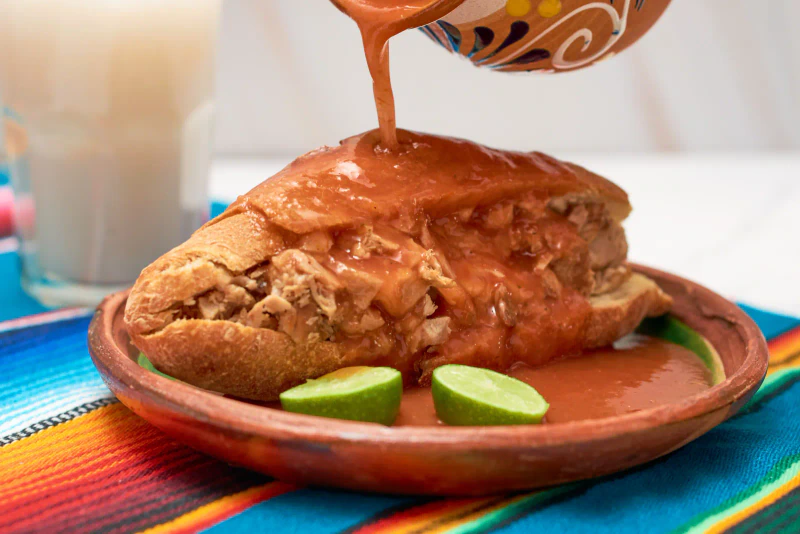
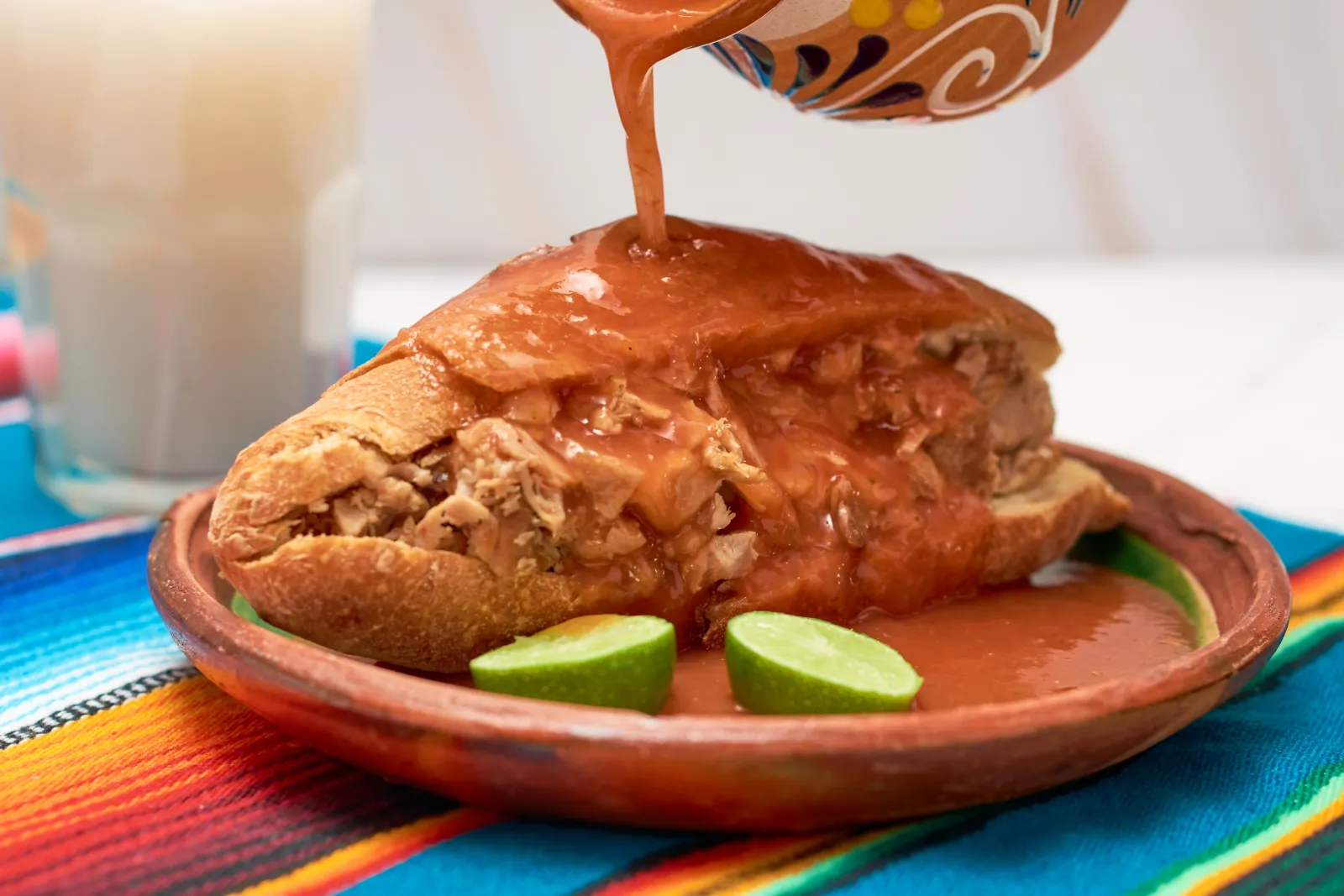

In Guadalajara you eat a torta ahogada (TOR-tah ah-oh-GAH-dah) with a spoon. The name means “drowned sandwich”, and that is exactly what it is: a crusty, salty roll from that city in the Mexican state of Jalisco, stuffed with carnitas and sitting in a bowl of thin tomato sauce, with a much hotter chile de arbol sauce spooned on top and lime-cured red onion to finish. It is the city’s signature street food, and it is surprisingly easy at home once you solve one problem, the bread.
What you need to know before you start
How do you make tortas ahogadas? Fill a hard-crusted roll with 100 g (3.5 oz) of carnitas, set it in a bowl and pour over a thin, mild sauce of boiled tomatoes blended with garlic, clove, cumin and oregano. Spoon on a vinegar-sharp chile de arbol sauce to taste and top with red onion cured in lime. Ready in 60 minutes for 6 servings, with the carnitas already made.
Three things decide whether this works:
- The bread has to have a hard, thick crust, or it falls apart in the sauce. In Guadalajara that bread is the birote salado, a salty sourdough roll you will not find outside Jalisco. A day-old baguette is the best stand-in.
- There are two sauces, not one. The tomato sauce does the drowning and has no heat at all. The chile de arbol sauce is the fire, and it is served separately.
- The carnitas are made ahead. I use the same pork from my carnitas tacos, and you need 600 g (1⅓ lb) cooked for 6 sandwiches.
Is it worth making? If you like carnitas and you like heat, yes. It’s a great weekend lunch and the best use I know for leftover carnitas. It is not a sandwich for eating on the go: a fully drowned one needs a bowl, a spoon and a stack of napkins.
Real time. 60 minutes with the carnitas done, about 40 of them hands-on. Making the carnitas from scratch adds about 2½ hours, so do that the day before.
Difficulty, easy. The only two ways to fail are soft bread and burnt chiles.
Where exactly the dish was born is disputed, with different Guadalajara street vendors from the early 20th century credited depending on who tells it. Everyone agrees it belongs to Guadalajara and that it depends on the birote.
The best bread for tortas ahogadas if you can’t get birote
Birote salado has a thick, hard crust and a dense crumb, so it can sit in hot sauce and still be in one piece when you lift it. That is the whole trick. Most supermarket rolls are made soft on purpose, which is the opposite of what you want.
- In the US → a bakery baguette bought the day before, or bolillos from a Mexican bakery, always crisped in the oven for 6 minutes at 400°F (200°C). Skip soft sub rolls and anything labelled “hoagie”.
- In the UK → a supermarket bake-at-home baguette, baked and then left out overnight, works better than a fresh soft one. A crusty sourdough bloomer cut into thick slabs also holds up.
- The test → squeeze it. If the crust crackles and doesn’t give, it’s ready for sauce.
If you have soft rolls only, toast them hard and go half-drowned: wet only the base and spoon the sauce over at the table.
The two sauces, and how hot to go
The tomato sauce (the drowning one). 1 kg (2.2 lb) tomatoes boiled for 10 minutes and blended with 500 ml (2 cups) of their cooking water, onion, garlic, 2 whole cloves, cumin and oregano, then simmered 10 minutes. It makes about 1.4 litres (6 cups), enough to drown 6 sandwiches. It must stay thin. If it thickens like an enchilada sauce, it sits on top of the bread instead of soaking in. Out of season, use a 794 g (28 oz) can of whole peeled tomatoes plus 300 ml (1¼ cups) water and skip the boiling.
The chile de arbol sauce (the hot one). 25 g (1 oz) dried chiles de arbol, toasted for under a minute, simmered 5 minutes, then blended with 120 ml (½ cup) white vinegar, water and garlic. It makes about 400 ml (1⅔ cups) and it is very hot. It’s a close cousin of the Mexican red taco salsa, sharper because of the vinegar and with no tomato.
Ingredient swaps for a US or UK kitchen.
| If the recipe says | Use this | What changes |
|---|---|---|
| Chiles de arbol | Dried Thai bird chiles, or dried “chillies” from the spice aisle | Usually hotter and less toasty; start with half and taste |
| Chiles de arbol | Cayenne powder | Not recommended; the sauce turns gritty |
| Mexican oregano | Regular dried oregano | Milder and more minty, still fine |
| Birote salado | Day-old baguette | The closest crust; a little less salty |
| Mexican limes | Persian limes (US), regular limes (UK) | No real difference |
| Carnitas | Slow-roasted pork shoulder, pulled | Loses the crisp edges but works |
In the US, chiles de arbol are sold in bags in the Hispanic aisle of most large supermarkets and in every Latin grocery. In the UK, look in Mexican specialist shops online.
How hot should you make it? That depends on how many spoonfuls you add, from 0 for kids to 6 or more for the full Guadalajara burn. Half-drowned (media ahogada) means only the bottom gets soaked and the chile sauce goes on lightly, so the top stays crisp. Fully drowned (bien ahogada) means the whole sandwich sits in tomato sauce with plenty of chile sauce on top. Vendors draw the line in slightly different places, but that’s the idea.
How to plan it and make it ahead
Everything except toasting the bread and assembling can be made a day ahead. That is how I do it for guests.
Make-ahead plan.
- Up to 2 days before → the carnitas, refrigerated in their fat.
- The day before → both sauces and the lime-cured onion. The onion actually improves overnight and turns a deeper pink.
- On the day, 25 minutes → reheat the tomato sauce until it simmers, crisp the carnitas in a skillet with a splash of water, toast the bread, assemble.
Signs each step is right.
- Tomatoes split their skins after 10 minutes of boiling.
- Chiles darken and smell toasty within 30-60 seconds. If they smoke hard or blacken, start over; the bitterness won’t cook out.
- Tomato sauce runs off the spoon in a thin stream.
- Carnitas sizzle and brown at the edges after 8-10 minutes.
- Bread crackles when squeezed.
Scaling it for a crowd of 10 to 20
Set it up as a build-your-own bar: toasted rolls, hot carnitas, the tomato sauce in a pot over the lowest heat, and the chile sauce and onions in bowls. If you’d rather have everything ready before guests arrive, basket tacos steamed in a cooler hold hot for the whole party.
| Guests | Rolls | Cooked carnitas | Raw pork shoulder | Tomatoes | Chiles de arbol |
|---|---|---|---|---|---|
| 6 | 6 | 600 g (1⅓ lb) | 1 kg (2.2 lb) | 1 kg (2.2 lb) | 25 g (1 oz) |
| 12 | 12 | 1.2 kg (2⅔ lb) | 2 kg (4.4 lb) | 2 kg (4.4 lb) | 40 g (1½ oz) |
| 20 | 20 | 2 kg (4.4 lb) | 3.3 kg (7¼ lb) | 3.5 kg (7¾ lb) | 50 g (1¾ oz) |
The chile sauce doesn’t scale like the rest: not everyone takes it, and 50 g (1¾ oz) of chiles is plenty for 20.
Common mistakes, heat level and allergens
- Soggy sandwich → the bread was too soft or too fresh. Use day-old bread, crisp it, and assemble only when people are ready to eat.
- Bitter chile sauce → the chiles burned. Medium heat, keep them moving, pull them as soon as they darken.
- Thick sauce that won’t soak in → too little liquid. Thin it with the tomato water, 50 ml (3 tablespoons) at a time.
- Raw-tasting tomato sauce → it skipped the 10-minute simmer in oil.
- Everything too hot for some guests → the chile sauce went into the tomato pot. Keep them separate.
Heat. From 0 to 5 out of 5, entirely your choice. The tomato sauce alone has no heat, so kids usually like a tomato-only torta.
Allergens. Wheat (gluten) from the bread; the carnitas are cooked in pork lard. Some Jalisco-style bottled chile sauces include toasted sesame seeds; this one does not, but check labels if you buy a ready-made sauce. No dairy, egg or nuts.
Variations
- Short on time → store-bought carnitas, a tomato sauce that is just blended and heated without the 10-minute simmer (a bit sharper), and onion that sits in lime for only 15 minutes. About 30 minutes.
- No carnitas → pulled roast pork shoulder or sliced pork loin.
- Lighter → half-drowned, with 70 g (2½ oz) of meat instead of 100 g: about 95 kcal and roughly 450 mg sodium less per sandwich.
- Vegetarian → spread the bread with refried beans and fill with boiled potato and onion. Both sauces are already meat-free. With refried beans cooked in oil instead of lard, it’s vegan.
- Drowned tacos → in Guadalajara the same sauces also go over crisp fried tacos. It’s a good use for leftover sauce.
What it costs to make
At US average prices, 6 tortas ahogadas come to about $18.66, or $3.11 a sandwich. The pork is 44 % of the bill.
Pork shoulder is priced at the US August 2026 average for “all other pork” ($3.737/lb), tomatoes at the US average ($1.977/lb), bread at the white bread average ($1.823/lb) and onions and limes at supermarket averages for 9 October 2026 ($1.22/lb and $0.50 each). A bakery baguette costs more than plain white bread, so expect the real bill to be a dollar or two higher. Chiles, garlic, oil and salt aren’t counted; a bag of chiles de arbol covers several batches.
Yield. 6 sandwiches of about 100 g (3.5 oz) bread and 100 g meat each. One is a full meal; big eaters manage two.
Serving, storing and reheating
How to serve. In a shallow bowl, with a spoon, lime wedges and napkins. A michelada is the natural drink, and guacamole with chips is a good starter. If you get hooked on Jalisco food, beef birria is the region’s other famous dish, and pozole rojo is the pot that sits next to it at every big celebration.
Storing. An assembled torta can’t be stored; the bread collapses. Store the parts separately. Carnitas and tomato sauce keep 3-4 days in the fridge at 40°F (4°C) or below, like any leftovers, as long as they go in within 2 hours. The vinegar-based chile sauce I use within a week. The onion is best within 3-4 days.
Freezing. Carnitas and tomato sauce freeze well for 2-3 months, like any cooked meat. Don’t freeze the bread or the onion.
Reheating. Bring the tomato sauce back to a simmer. Reheat the carnitas in a skillet until they reach 165°F (74°C) in the centre, the safe temperature for reheated leftovers, and always crisp the bread fresh.
Tortas ahogadas FAQ
What does torta ahogada mean? “Drowned sandwich” in Spanish. The roll is soaked in tomato sauce, and a hot chile de arbol sauce goes on top.
What is the sauce on tortas ahogadas? There are two: a thin, mild tomato sauce seasoned with garlic, clove, cumin and oregano, and a very hot chile de arbol sauce with vinegar, added to taste.
What bread can I use instead of birote? A day-old baguette in 20 cm (8 in) lengths, or crusty bolillos, crisped for 6 minutes at 400°F (200°C). Avoid soft rolls.
How spicy are tortas ahogadas? As spicy as you make them. The tomato sauce has no heat; the chile de arbol sauce is very hot and goes on by the spoonful.
Can I make tortas ahogadas ahead of time? The carnitas, both sauces and the onion, yes, up to a day ahead. Toast the bread and assemble only when serving.
Is a torta ahogada the same as a pambazo? No. A torta ahogada sits in sauce in a bowl; a pambazo is a soft roll dipped in guajillo sauce and griddled, then eaten by hand.
Nutrition per sandwich
Per torta (100 g bread, 100 g carnitas, a sixth of the tomato sauce and onion, and 2 tablespoons chile sauce), calculated ingredient by ingredient from the recipe amounts, counting the carnitas as braised pork shoulder with its share of lard and salt:
- Calories: 670 kcal
- Protein: 38 g
- Carbohydrates: 66 g
- Fat: 28 g, of which 9 g saturated
- Fiber: 6 g
- Sugars: 11 g
- Sodium: 2130 mg
That sodium is high: about 600 mg from the bread, 550 from the carnitas and 600 from the tomato sauce. Half-drowned cuts roughly 300 mg, and salting the tomato sauce with 1 teaspoon instead of 1½ cuts a bit more.
I grew up in Venezuela, where you protect a sandwich from sauce rather than pour it on, so the first torta ahogada I ever made went into a soft roll and turned into porridge in the bowl. The second time I bought the baguette a day early and left it on the counter on purpose. A good torta ahogada is a fight between crust and sauce that the crust should only just lose. Josnaisis.