
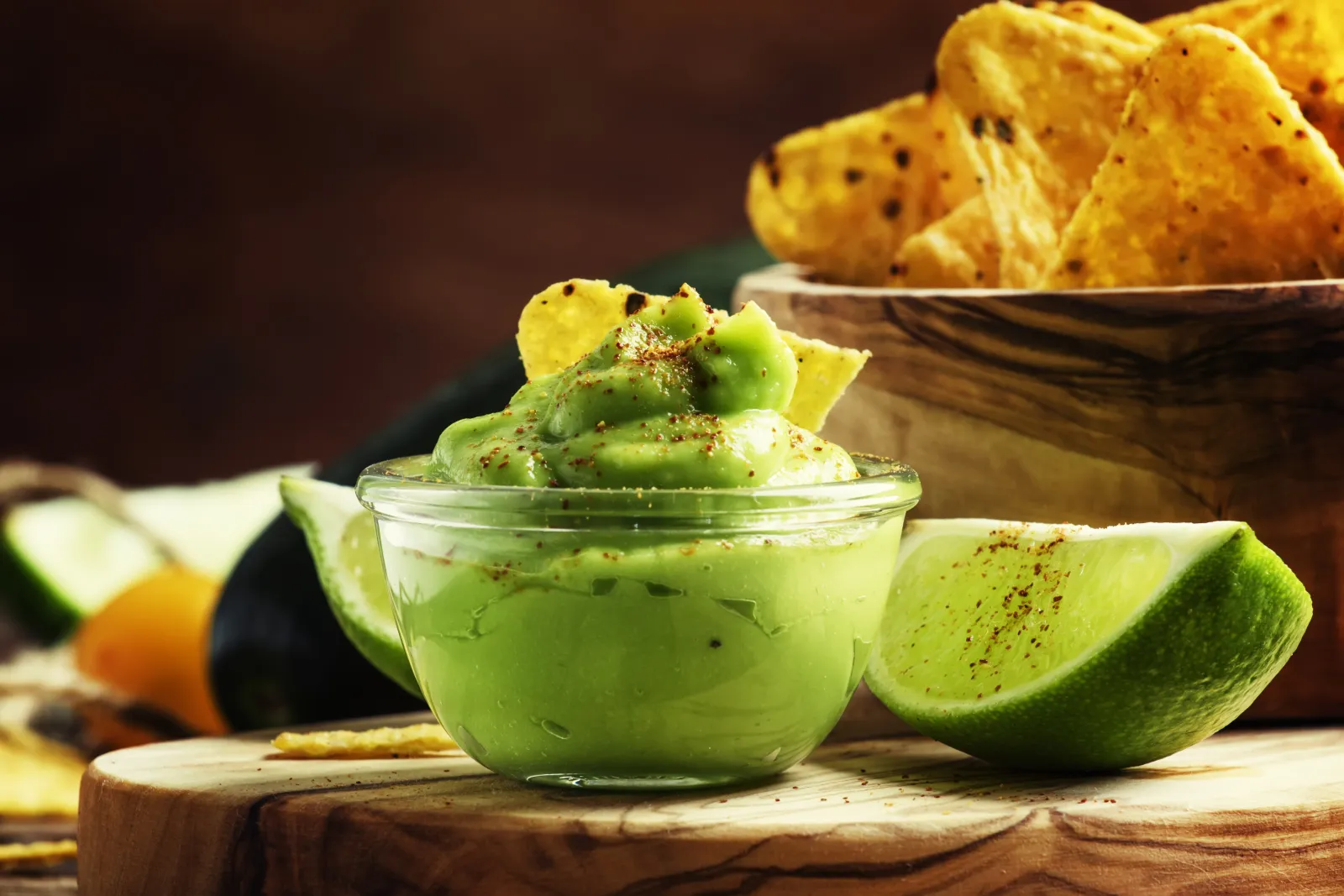

Taqueria avocado salsa takes ½ cup (120 ml) of water, and that water, plus a few tomatillos, is what separates it from guacamole. Blend ripe Hass avocado with raw tomatillo, serrano, cilantro, garlic and enough water to make it pour, and you get the pale green, spoonable sauce that sits next to the red one at many taco stands in Mexico. It is tangier and far thinner than guacamole, and it goes on the taco rather than on a chip. Below is the raw version, the cooked one, what to do in a UK kitchen without fresh tomatillos, and how to keep it green past the first hour.
What is taqueria avocado salsa, and who is it for?
How do you make taqueria avocado salsa? Blend 250 g (9 oz) of raw tomatillos with 2 serranos, onion, garlic, cilantro, lime juice, salt and ½ cup (120 ml) of water for 30 to 40 seconds. Add the flesh of 2 Hass avocados and pulse just 3 or 4 times, until smooth. Store it in a full jar with plastic wrap pressed on the surface. Ready in 15 minutes for 12 servings.
In Spanish it is salsa de aguacate (sahl-sah deh ah-gwah-KAH-teh), and some people call it guacamole taquero, taqueria guacamole, even though it is blended smooth. It is a table salsa: you spoon a tablespoon or so over tacos al pastor, carnitas, carne asada or anything fried.
Good for: taco night, a taco bar for a party, grilled meat. One batch covers about 36 tacos, and it needs no stove.
Maybe not for: anyone who wants a thick dip for chips (make guacamole), or anyone who needs to make it three days ahead with the avocado in. The base keeps that long; the finished salsa does not.
Time: 15 minutes, all hands-on, mostly husking and washing tomatillos. The cooked version takes about 35 minutes because the tomatillos have to cool before the avocado goes in.
Difficulty: easy. The only skill is stopping the blender early.
Avocado salsa vs guacamole, salsa verde and the red salsas
- Guacamole is mashed avocado with onion, chile, lime and cilantro, left chunky, for chips. No tomatillos, no water.
- Salsa verde is the same tomatillo, serrano and cilantro base without avocado. Sharper, thinner, and it keeps 3 to 4 days. Add avocado and you have this salsa.
- Venezuelan guasacaca is avocado blended with vinegar, oil, parsley and sweet peppers. Tangy from vinegar, no chile, made for grilled meat and arepas.
- Red taco salsa, chile de árbol salsa and salsa macha are dried-chile salsas, red to dark brown and much hotter. At a taqueria the red and the avocado salsa often sit side by side: one for heat, one to cool things down.
What you need, including swaps for US and UK kitchens
The full list for 12 servings of ¼ cup (60 ml) is in the recipe card. To scale it, think in weights: for every 100 g (3½ oz) of tomatillos, about 110 g (4 oz) of avocado flesh and 50 ml (3½ tbsp) of water. Chile to taste, two serranos per 250 g (9 oz) for medium heat.
Tomatillos, fresh or tinned
Tomatillos look like small green tomatoes wrapped in a papery husk, but they are sour, firm and slightly sticky under the husk. In the US they are in most produce sections next to the chiles. Pick firm ones that fill their husks; a medium tomatillo weighs about 34 g (1.2 oz), so you need about 7. Wash off the sticky film, which can taste bitter.
In the UK fresh tomatillos are rare. Use a 794 g (28 oz) tin of whole tomatillos: drained, it gives about 550 g (1¼ lb), so half a tin is enough here. Tinned tomatillos are already cooked and salted, so the salsa turns out like the cooked version below. Start with half the salt. Physalis, the orange cape gooseberry sold in UK supermarkets, has the same husk but is sweet: it does not work.
Avocados
Hass, the pebbly one that turns almost black when ripe, has the fat that makes the salsa creamy. One of about 200 g (7 oz) gives roughly 136 g (4¾ oz) of flesh. It should give slightly when pressed with your palm, with no black patches inside. The large smooth green-skinned kind (Florida avocados in the US) is wetter and milder: use 1 for every 2 Hass and start with half the water.
Serranos, or what to use instead
Serranos are slim green chiles with a clean, sharp heat. In US stores they are usually next to the jalapeños. A jalapeño is milder: one jalapeño is roughly half a serrano in heat, so swap 2 serranos for about 4 jalapeños, seeded if you want it gentler. In the UK, fresh jalapeños or green finger chillies both work; taste the chilli first, because heat varies from batch to batch.
Water, for the texture you want
Water is the dial. For the batch in the recipe card:
| Water | Texture | Best for |
|---|---|---|
| 60 ml (¼ cup) | Thick, like sour cream | Tostadas, sandwiches, spreading |
| 120 ml (½ cup) | Falls off a spoon in a thick ribbon | Tacos, the taqueria style |
| 180 ml (¾ cup) | Thin enough for a squeeze bottle | A taco bar, serving many |
At 180 ml (¾ cup) the flavour thins out, so add a pinch of salt and a squeeze of lime. It also thickens in the fridge overnight: loosen it with a spoonful or two of water.
Equipment
A jar blender and a container the salsa fills to the brim, plus plastic wrap. An immersion blender in a tall jug works too: base first, then avocado in short bursts. A food processor makes it slightly grainier but works.
How to plan it, from 15 minutes to a taco party for 20
For 4 to 6 people, one batch made the same day is plenty, with leftovers for tomorrow. Make the base first, add the avocado last, and you are done in 15 minutes.
Signs each step is right
- Tomatillos are clean when they no longer feel tacky and the skin looks glossy.
- The base is ready after 30 to 40 seconds of blending, when it is evenly pale green with no bits of chile or onion.
- The avocado is in after 3 or 4 short pulses: smooth and green, not grey-green. More blending gains nothing.
- Seasoning is right when it tastes good on a chip or tortilla. Tasted from a spoon, it seems saltier than it will on a taco.
What to make ahead
- The base, up to 3 or 4 days ahead, blended and sealed in a jar in the fridge. On the day, pulse in the avocado.
- The finished salsa, a few hours ahead at most, in a full container with wrap pressed on top.
- The avocados, bought hard 3 to 6 days before and ripened at room temperature, then moved to the fridge once they give.
Avocado salsa for 20 people
I allow about 50 ml (3½ tbsp) per person when there is also a red salsa, and about 70 ml (4½ tbsp) when it is the only one. Twenty guests means one and a half batches, or two.
| Ingredient | 1 batch (12 servings) | 1½ batches (20, with another salsa) | 2 batches (20, only salsa) |
|---|---|---|---|
| Tomatillos | 250 g (9 oz) | 375 g (13 oz) | 500 g (1 lb 2 oz) |
| Hass avocados | 2 | 3 | 4 |
| Serranos | 2 | 3 | 4 |
| White onion | 20 g (2 tbsp) | 30 g (3 tbsp) | 40 g (¼ cup) |
| Garlic | 1 clove | 1 large clove | 2 cloves |
| Cilantro | 10 g (⅔ cup) | 15 g (1 cup) | 20 g (1⅓ cups) |
| Lime juice | 15 ml (1 tbsp) | 22 ml (1½ tbsp) | 30 ml (2 tbsp) |
| Fine salt | ¾ tsp | 1⅛ tsp | 1½ tsp |
| Water | 120 ml (½ cup) | 180 ml (¾ cup) | 240 ml (1 cup) |
| Yield | about 720 ml (3 cups) | about 1.1 litres (4½ cups) | about 1.4 litres (6 cups) |
Blend in separate batches rather than one overfilled jar, where the avocado can’t be pulsed briefly. Make the base the night before, add the avocado in the last hour, and put out small bowls, topping them up from the fridge. A bowl set over ice stays cold; without ice, anything out for more than 2 hours goes in the bin.
What to know first, browning, heat level and allergens
Avocado salsa turns brown because of air. An enzyme in avocado flesh darkens it when it meets oxygen. The acid in tomatillos and lime slows that down, which is why this salsa stays green longer than unlimed guacamole, but it does not stop it. What works:
- Avocado last, in 2 to 3 second pulses. A blender beats in air and warms the salsa.
- A full jar with wrap pressed onto the surface, so there is almost no air above it. If the top darkens, stir it in or skim it off; underneath it is green.
- Cold tomatillos in the cooked version. Blend avocado with warm tomatillos and it turns murky and tastes flat.
- The pit in the jar does nothing except protect the patch it touches.
Common mistakes:
- Grey from the start: the avocado was blended too long or with warm tomatillos.
- Bitter: tomatillos not washed, or very underripe. Rub off the sticky film and choose ones turning slightly yellow.
- Too thick the next day: normal, it firms up when cold. Add water a spoonful at a time.
- Watery and bland: too much water, or a green-skinned avocado. Add avocado or salt before more lime.
- Stale, off taste: one avocado had black patches. Check each one before it goes in.
Heat level: with 2 serranos, about 2 out of 5, softened by the avocado. One deseeded serrano is mild; four is properly hot. Serranos run 10,000 to 23,000 Scoville units, jalapeños 2,500 to 5,000.
Kids: many like it, since it tastes mostly of avocado. Blend the base without chile, take out their share with some avocado, then blend the chile into the rest.
Allergens: none of the major ones: no gluten, dairy, egg or nuts, and it is vegan. People with a latex allergy can also react to avocado, so ask if you are cooking for someone with that allergy.
Which version to make, raw, cooked, tinned or no tomatillos
- Raw, the recipe card version: 15 minutes, bright green, tangy and fresh. It is the one for fatty pork, like tacos al pastor or carnitas tacos.
- Cooked: simmer the 250 g (9 oz) tomatillos with the serranos in 1 litre (1 quart) of water for 8 to 10 minutes, until they turn from bright to olive green without bursting. Drain, spread them on a plate and wait until cold to the touch, about 15 minutes, then blend as in the card. Milder, less sharp and smoother, with a duller green. About 35 minutes in all.
- Tinned tomatillos: half a 794 g (28 oz) tin, drained, about 250 g (9 oz). It behaves like the cooked version; halve the salt.
- No tomatillos: 2 avocados, ½ cup (120 ml) water, the juice of a whole lime, 1 serrano, garlic, cilantro and salt. Thicker, paler and tasting mostly of avocado, in 10 minutes.
- Creamier and milder: blend in 4 tbsp of Mexican crema or sour cream with the avocado. It keeps the same 2 days but does not freeze.
- The courgette version: some taquerias make their creamy green salsa with no avocado at all, blending courgette (zucchini), tomatillo, chile and oil. It never browns and costs less, but it is a different salsa.
What it costs, about $4.36 a batch
In a US supermarket a 12-serving batch comes to about $4.36, or $0.36 a serving, using average advertised prices for 9 October 2026. The two avocados are half of it, and the cilantro bunch another fifth.
Prices used: Hass avocados $1.09 each, tomatillos $0.99/lb, white onion $1.22/lb, garlic $5.99/lb, cilantro $0.97 a bunch, limes $0.50 each, and serranos priced as jalapeños at $1.45/lb. The whole cilantro bunch and the whole lime are counted, since that is what you pay for. In the UK, a 794 g (28 oz) tin of tomatillos was selling for about £3.95 at an online grocer in October 2026, and half of it goes into one batch.
Yield: about 720 ml (3 cups), 12 servings of ¼ cup, enough for about 36 tacos.
What drives the cost: avocados. The courgette version is cheaper for exactly that reason.
What to expect, and how long it keeps
Taste and texture: sour tomatillo first, then the serrano, then the soft richness of avocado rounding it off. Smooth, glossy and pale green, thicker than salsa verde and far thinner than guacamole.
Serving: cold or at room temperature, spooned over tacos, quesadillas, taquitos or grilled meat, or set out in a squeeze bottle next to a red salsa.
Fridge: with avocado, in a full jar with wrap pressed on top at 40°F (4°C) or below, it is best on day one and keeps 2 days at most. By day two it darkens slightly and weeps a little liquid; stir and serve. The base without avocado keeps 3 to 4 days.
Freezer: the avocado-free base freezes well for 3 to 4 months, in ½-cup portions or ice-cube trays. Thaw it in the fridge and pulse in fresh avocado; it tastes freshly made. With the avocado in, it can be frozen for up to 1 month, but it thaws watery, a little separated and duller in colour, so I only use it that way for cooking. With crema, don’t freeze it.
Reheating: don’t. It is a raw salsa and heat turns it brown. If it is very cold from the fridge, let it sit out 15 to 20 minutes, within the 2-hour limit.
Avocado salsa FAQ
How do you make avocado salsa for tacos? Blend 250 g (9 oz) raw tomatillos with 2 serranos, onion, garlic, cilantro, lime, salt and ½ cup (120 ml) water, then pulse in 2 Hass avocados 3 or 4 times.
Is the tomatillo raw or cooked in avocado salsa? Both are made. Raw is sharper, greener and faster; cooked is milder and smoother, but the tomatillos must be cold before the avocado goes in.
How do I keep avocado salsa from turning brown? Pulse the avocado in last, store the salsa in a full jar with plastic wrap pressed on the surface, and keep it cold. Lime and tomatillo slow browning; cutting out air is what stops it.
How long does avocado salsa last in the fridge? Two days at most with the avocado in, best on the first day. The base without avocado lasts 3 to 4 days.
Can you freeze avocado salsa? Freeze the base without avocado, for 3 to 4 months, and add fresh avocado after thawing. With avocado it keeps up to a month frozen but thaws watery and dull.
How do I make avocado salsa thinner or thicker? Change the water. Per batch, a quarter cup makes it thick, half a cup gives the taqueria texture and three quarters of a cup makes it pourable.
Can I make avocado salsa without tomatillos? Yes: avocado, water, a whole lime’s juice, serrano, garlic, cilantro and salt. Thicker and more avocado-forward. Tinned tomatillos also work.
What is the difference between avocado salsa and guacamole? Guacamole is mashed and chunky, with no water or tomatillos, for dipping. Avocado salsa is blended smooth with tomatillos and water, for spooning over tacos.
How much avocado salsa do I need for 20 people? About 1 to 1.4 litres (4½ to 6 cups): 1½ batches if there is another salsa, 2 if it is the only one. The larger amount takes four avocados.
Nutrition per serving
Per ¼ cup (60 ml), worked out ingredient by ingredient from the quantities in this recipe:
- Calories: 47 kcal
- Protein: 1 g
- Carbohydrates: 4 g
- Fat: 4 g, of which 1 g saturated
- Fibre: 2 g
- Sugars: 1 g
- Sodium: 148 mg
About 38 of the 47 calories come from the avocado, along with nearly all the fat. The sodium is the salt: with ½ tsp instead of ¾, it drops to about 100 mg a serving. Tinned tomatillos push it up, since they are already salted.
Where I live in Colombia, tomatillos show up only now and then, so I keep cubes of frozen base in the freezer and wait for good avocados instead. Taco night then comes down to one trip for avocados and ten seconds of pulsing, and those ten seconds decide the colour. Dylan gets his share before the serrano goes in. Josnaisis.