
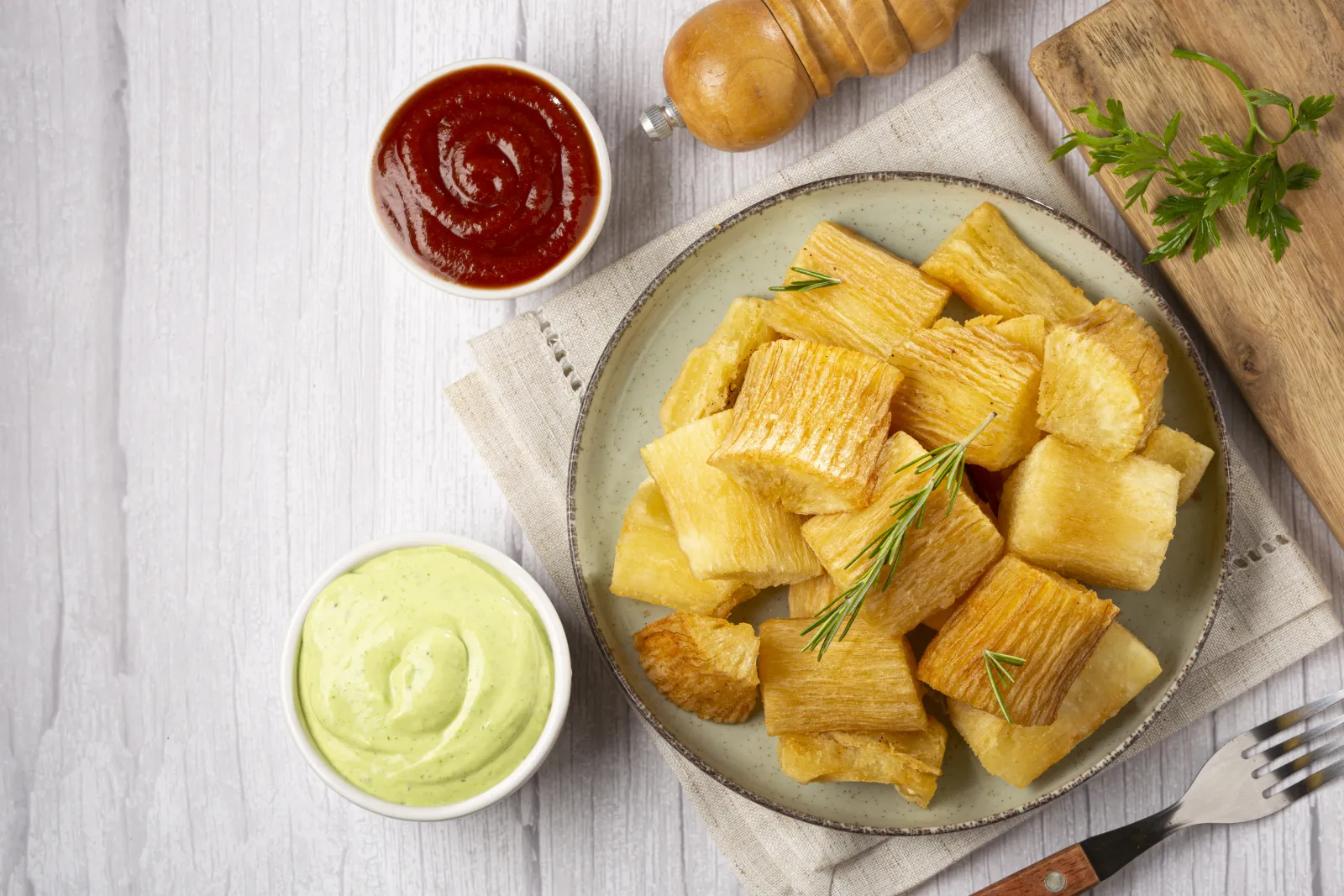

A 2 cm (¾ in) stick of yuca looks like a steak fry, but you can’t treat it like a potato. Drop raw yuca into 350°F (175°C) oil and the outside browns in about 6 minutes while the center stays hard and chalky, because cassava starch needs far longer than that to soften. So in Colombia and Venezuela, where yuca frita sits next to grilled meat and fried pork, it is cooked twice: boiled in salted water until it starts to split, then fried until the crust crackles. Below is how to pick a good root (or skip it and buy frozen), how to peel it, the doneness cue for the boil, the oil temperature, air fryer and oven versions, and a make-ahead plan for a crowd.
What is fried yuca, and who is it for?
How do you make crispy yuca fries? Peel the yuca, boil it in salted water about 25 minutes from the boil, until a knife slides in and the pieces split at the edges. Pull out the woody core, cut into ¾-inch (2 cm) sticks, dry them, and fry in batches at 350-355°F (175-180°C) for 5-7 minutes. Ready in 90 minutes for 6 servings.
Yuca (YOO-kah) is the starchy root that English speakers also call cassava or manioc. It has nothing to do with yucca, the ornamental desert plant, despite the near-identical spelling. Fried, it is one of the standard sides of Colombian and Venezuelan cooking: part of a Colombian fritanga, on the coast with tangy fermented cream, and in my Venezuelan family next to the grill with guasacaca.
Who will love it. Anyone who likes fries and wants something heartier: the crust is thicker and crunchier than a potato’s and the inside is dense and creamy. It’s naturally gluten-free.
Who might not. If you want a fast weeknight side, the boil adds almost 40 minutes, so do it the day before. And deep-fried, it’s about 414 calories per serving; the air fryer version is closer to 307.
Real time. 90 minutes, about 40 of them hands-on. With yuca boiled ahead and waiting in the fridge, 35 minutes on the day.
Difficulty. Easy. The two things that matter are the boil and the oil temperature.
Yuca, cassava, manioc, buying fresh or frozen
You’ll find two forms in a US or UK store, and both make good fries.
Fresh root. Long, tapered, with bark-like brown skin, in the produce section of many US supermarkets labeled yuca or cassava. In the UK, look in Caribbean, African, Asian and Latin grocers. It is usually coated in wax to slow spoilage, which is normal; the wax comes off with the peel. What isn’t normal is what’s inside: cassava starts to deteriorate within 24 hours of harvest and in 2-3 days shows blue-black streaks in the flesh. Streaky yuca never softens properly. Choose roots that feel hard and heavy for their size with no soft or moldy spots, and if the store has cut one open, check that the flesh is evenly white or cream.
Frozen pieces. Already peeled and cut, sold in 24 oz (680 g) and 5 lb bags in the Latin freezer aisle in the US, and in African and Caribbean shops in the UK. They go straight into boiling salted water without thawing, for 20-30 minutes. They still contain the woody core, so you’ll pull that out after boiling just like with fresh.
My honest pick for a first try: frozen. No peeling, no gamble on streaky flesh, and it costs about the same per pound of yuca you actually eat.
Is yuca safe to eat?
Yes, peeled and fully cooked. Raw cassava contains compounds that release hydrogen cyanide, which is why it is never eaten raw. The yuca sold for cooking in supermarkets is the sweet kind, low in those compounds, and it is made safe by peeling off all the skin, including the pink layer, and cooking it through. The boiling water is drained and discarded. Bitter cassava needs long soaking and fermenting that a home kitchen doesn’t do, and it isn’t what you buy as fresh yuca.
How to peel it
Cut off both ends, then cut the root into 6-7 cm (2½-3 in) sections so you can stand each one on the board. Make one shallow lengthwise cut through the brown bark until you see white, then work the tip of a paring knife under the edge: the bark and the thick pink-and-white layer under it should lift off in one sheet. A vegetable peeler leaves the pink layer behind, so I use a knife.
Ingredients and equipment for 6 servings
For 6 side servings: 1.25 kg (2¾ lb) of fresh yuca, which peels down to about 1 kg (2.2 lb), or 1 kg of frozen. Plus 2 tsp of salt for the water, 1 liter (4 cups) of neutral oil and a little fine salt to finish.
- Oil. Canola, vegetable, sunflower or peanut, anything neutral that handles heat. Strain and keep it covered afterwards; it’s good for another fry.
- Pot. A heavy pot about 20 cm (8 in) wide with oil at least 4 cm (1½ in) deep. A deep skillet with 2 cm (¾ in) of oil also works if you turn the sticks halfway.
- Thermometer. A clip-on or instant-read one. It’s the difference between crisp and greasy.
- A wire rack for draining, so the bottom of the fries doesn’t steam.
Boil until it splits, then fry
The boil and the doneness cue
I start the yuca in cold salted water and bring it up together, so it cooks evenly and the salt goes in from the start. From the moment it boils, count about 25 minutes for 6-7 cm pieces; very fresh yuca is faster, older roots slower. It’s ready when:
- a knife slides into the center with no resistance, and
- the pieces begin to split open along the edges, as if they’re cracking lengthwise.
Don’t wait until it falls apart. Overcooked yuca breaks when you cut it and soaks up oil.
Core out, dry, chill
Every piece has a tough fibrous string through the middle. Once boiled and warm, it pulls right out when you split the piece lengthwise. Cut into ¾-inch (2 cm) sticks and dry them for 10 minutes on a rack. Wet yuca spits in the oil and won’t brown. Better still, chill the sticks for at least 1 hour: the starch firms up, they break less, and the crust comes out crunchier. That’s why I boil the day before whenever I have guests.
Frying
Heat the oil to 350-355°F (175-180°C) and fry about a third of the batch at a time for 5-7 minutes, turning, until deep golden with darker edges where the yuca split. The crust should feel hard when you tap it with the spoon. Salt the fries the second they come out, while the surface is still hot enough for the salt to stick.
Even crispier. Fry twice: a first pass until barely colored, a few minutes’ rest, then back into hot oil until golden.
Air fryer and oven yuca fries
Both start the same way: boiled, cored, cut and dried.
- Air fryer. Toss 1 kg (2.2 lb) of sticks with 2 tbsp of oil and cook at 400°F (200°C) for 15-20 minutes in a single layer, shaking the basket a couple of times. For 1 kg you’ll need 2 batches.
- Oven. Toss with 3 tbsp of oil, spread on a sheet pan and bake at 425°F (220°C) for 30-35 minutes, flipping halfway.
Common mistakes
- Frying it raw. Brown outside, hard inside. Always boil first.
- Boiling it to mush. It breaks and drinks oil. Stop when the edges split.
- Frying it wet. Spatters and stays pale.
- Cold oil or crowded batches. Below about 340°F (170°C) the fries turn greasy and soft.
- Leaving in the core. It’s the first thing anyone notices.
- Buying streaky yuca. It won’t soften however long you boil it.
Heat, kids and allergens. No heat at all; the spice comes from the ají, if you serve it. Kids tend to treat it like fries, especially with salsa rosada. Yuca is free of gluten and the major allergens; if your oil fried something breaded first, it isn’t gluten-free anymore. The sauces bring the allergens: the garlic sauce has milk and egg (mayonnaise), and salsa rosada has egg.
Make-ahead, freezing and a party plan for 20
The day before. Boil, core and cut the yuca, cool it, and keep it covered in the fridge at 40°F (4°C) or below. It holds 3-4 days.
Weeks ahead. Freeze boiled, cored sticks on a tray so they don’t touch, then bag them. They keep for 3 months and fry straight from frozen; brush off any ice first, and give them a little longer in the oil.
For 20 people you need about 4.1 kg (9 lb) of fresh yuca, or 3.3 kg (7¼ lb) frozen. For 12, 2.5 kg (5½ lb) fresh or 2 kg (4.4 lb) frozen. For 2, 415 g (15 oz) fresh in a single batch.
What fried yuca costs in the US
About $5.18 in yuca for 6 servings, $0.86 each. In October 2026 fresh yuca was around $1.88 a pound at big US grocery chains, so 2¾ lb costs about $5.18. Frozen was about $2.48 a pound in a 5 lb bag, so 2.2 lb costs about $5.47, roughly the same once you account for the peel you throw away with fresh.
The oil isn’t in that figure: only about 100 g (½ cup) of the liter ends up in the fries, and the rest can be strained and reused for the next fry. In Colombia, for comparison, a kilo of yuca at a Bogotá wholesale market cost about 2,500 pesos in September 2026.
How it’s served, and the sauces
Pile the fries in a basket or on a platter with one or two sauces on the side:
- Venezuelan garlic sauce, the mayo-based dip that goes with everything fried in Venezuela.
- Venezuelan guasacaca, an avocado and herb sauce with vinegar, my favorite with yuca and grilled meat.
- Colombian ají, a fresh, sharp chile and cilantro salsa for anyone who wants heat.
- Salsa rosada, mayo and ketchup, the one kids reach for.
On Colombia’s Caribbean coast it is also eaten with suero costeño, a tangy fermented cream; outside Colombia I use sour cream thinned with a little buttermilk. As part of a full Colombian fritanga platter, the boiled yuca goes into the oil second to last, for 6 minutes.
The same boiled yuca leads to other dishes worth knowing: mashed and steamed in corn husks it becomes bollo de yuca, and shaped around a meat filling it becomes carimañolas. Colombian cassava bread is a different thing again, made with cassava starch instead of the fresh root.
Storing and reheating
Fried yuca is best within minutes; as it sits, steam from the center softens the crust. Leftovers keep 3-4 days in the fridge, but never leave them out more than 2 hours. Reheat in the air fryer or a hot oven until crisp again and heated through to 165°F (74°C). The microwave turns them chewy.
Fried yuca FAQ
Do you have to boil yuca before frying? Yes. Raw yuca browns outside long before the center softens. Boil about 25 minutes from the boil, until it splits at the edges, then fry.
How long do you boil yuca for fries? About 25 minutes from the boil for 6-7 cm (2½-3 in) pieces, 20-30 minutes for frozen. A knife should slide in with no resistance.
Why are my yuca fries hard? The yuca was underboiled, old and streaky, or the oil was too cold. Check the flesh when you buy and fry at 350-355°F (175-180°C).
Can you fry frozen yuca without boiling it? Not raw frozen pieces: boil them first, from frozen, for 20-30 minutes. Yuca that was boiled before freezing can go straight into the oil.
Are yuca fries healthier than french fries? Not really. Yuca is denser in starch than potato, and deep-fried both soak up oil. The air fryer version, at about 307 calories per serving, is the lighter choice.
Is cassava the same as yuca? Yes. Yuca, cassava and manioc are the same root. Yucca, with two c’s, is an unrelated ornamental plant.
What do you dip yuca fries in? Garlic sauce, guasacaca, ají or salsa rosada. On Colombia’s coast, tangy fermented cream.
Can you make yuca fries in the air fryer? Yes. Boil, core and dry them, toss with 2 tbsp of oil per 1 kg (2.2 lb), and cook at 400°F (200°C) for 15-20 minutes.
Nutrition per serving
Per serving (⅙ of the recipe, about 165 g / 5.8 oz of peeled raw yuca), deep-fried, without sauce. Calculated from the recipe’s weights plus an estimated 100 g of oil absorbed per kilo of yuca; the real figure changes with stick thickness and oil temperature. Salt from the boiling water isn’t counted, since it’s drained.
- Calories: 414 kcal
- Protein: 2 g
- Carbohydrates: 63 g
- Fat: 17 g
- Saturated fat: 3 g
- Fiber: 3 g
- Sugar: 3 g
- Sodium: 217 mg
Air-fried with 2 tbsp of oil, about 307 calories and 5 g of fat per serving.
Growing up in Venezuela, I ate yuca boiled far more often than fried; the fried kind was for Sunday grills. The trick of boiling it the night before I picked up in Colombia, and now a tray of cold, cored sticks in my fridge means the fries are twenty-five minutes away. Get the boil right and the oil does the rest. Josnaisis.