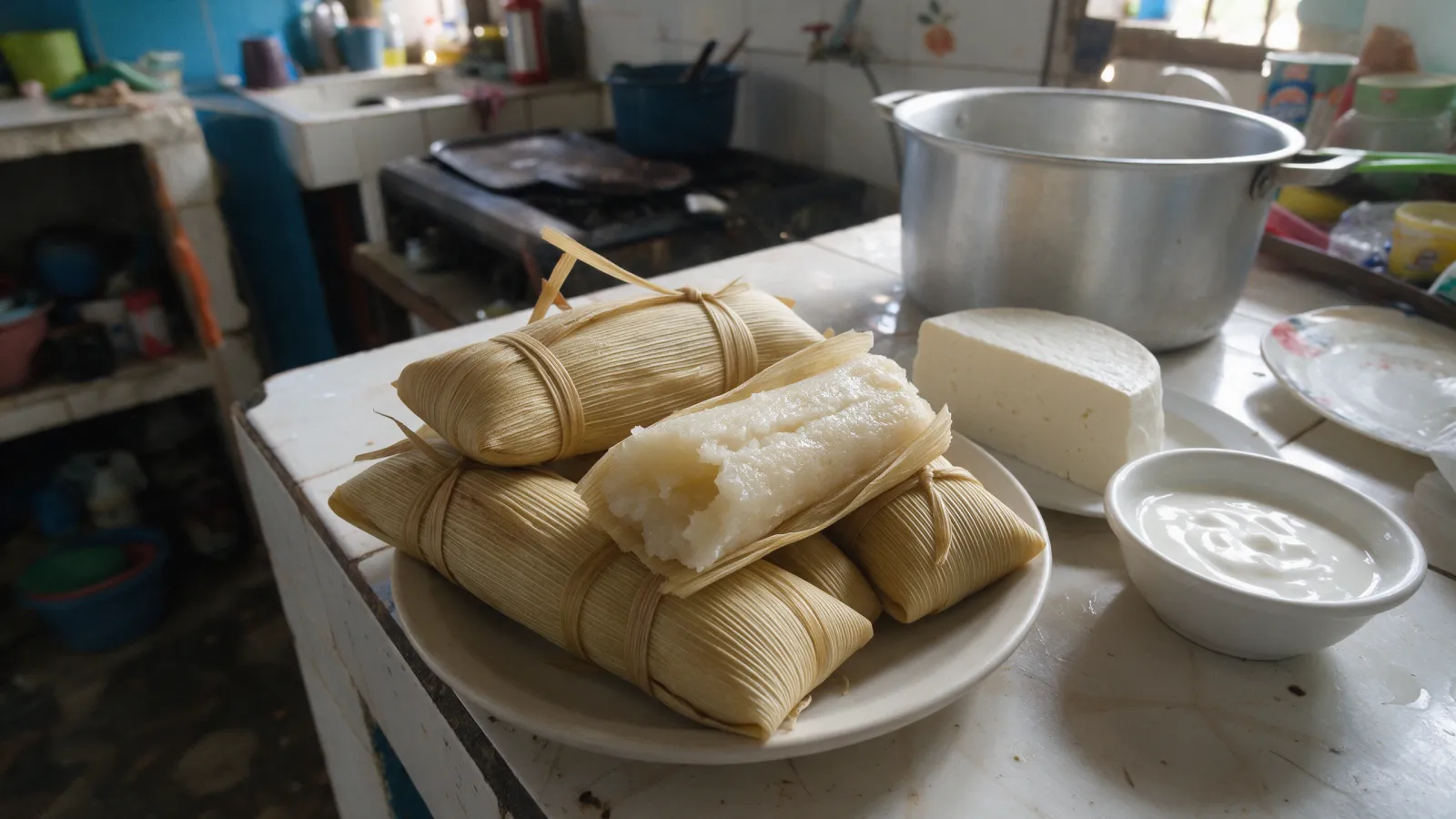

On Colombia’s Caribbean coast, the bread on the breakfast table is often a bollo de yuca (BOH-yoh deh YOO-kah): cassava boiled until tender, ground while hot into a smooth dough, rolled into a log, tied up in corn husks and simmered again until it sets firm. You unwrap it at the table and eat it with crumbly salty cheese, a spoonful of tangy suero, and sausage if there is any. One kilo (2.2 lb) of peeled yuca makes 8 rolls of 125 g (4½ oz), and nothing goes into them but salt.
What a bollo de yuca is, and whether it’s worth making
How do you make bollo de yuca? Boil 1 kg (2.2 lb) of peeled yuca for 20 minutes, pull out the woody core and grind it hot with 1 teaspoon of salt. Shape 8 logs of 125 g (4½ oz), roll each in two corn husks, tie the ends and simmer them covered in boiling water for 45 minutes until firm. Ready in 115 minutes for 8 servings.
It’s a plain starch, closer to a dense steamed dumpling than to bread: no crust, no browning, a slightly springy bite and the mild, faintly sweet taste of the root. It belongs with other leaf-wrapped doughs like the Venezuelan hallaquita and the Brazilian pamonha, minus any filling. The appeal is what goes next to it.
Worth it if you cook Colombian food at home, already love yuca fries or boiled yuca, or want a gluten-free bread substitute you can freeze. It takes 115 minutes, 40 of them hands-on, and a batch of 8 reheats all week.
Skip it if you want something crisp or golden, or breakfast in 20 minutes on the day. Make them the day before instead.
Difficulty: easy. The one skill is tying the husks tightly enough that water stays out. Expect the first two to look lopsided.
Two ways to make it on the coast
There is a cooked version and a raw version. The more common one boils the yuca first, grinds it, then cooks the wrapped rolls for anywhere from half an hour to an hour. The other grates the yuca raw and boils the rolls for anywhere from 40 minutes to 1¾ or 2 hours, and the result is somewhat rubbery. I make the cooked version at home because it’s predictable: the yuca is fully cooked before it ever goes into a husk, and the second boil only has to set it.
Is yuca safe to eat?
Yes, cooked. Raw cassava contains cyanogenic compounds that release hydrogen cyanide. The sweet cassava sold for cooking in supermarkets and Latin markets, fresh or frozen, is low in them and becomes safe once it’s peeled completely and cooked through. Bitter varieties need long soaking and fermenting that no home recipe includes.
What that means in the kitchen:
- Peel off all of the bark and the pink layer under it.
- Cook it to the center. Here the yuca boils 20 minutes and then cooks another 45 inside the roll. The safe routine is to cut it into pieces, soak it and cook it thoroughly in boiling water.
- Pour off the first cooking water. That’s my habit; with sweet cassava it isn’t strictly needed.
- For the raw-grated version, use only store-bought yuca sold for cooking, since the long boil inside the husk is all the cooking it gets.
Shopping list for a US or UK kitchen
You need 1.25 kg (2¾ lb) of fresh yuca roots to end up with 1 kg (2.2 lb) peeled. I lose about 20% to bark and ends on medium roots.
Fresh yuca or frozen
Fresh yuca is sold as yuca or cassava in many US supermarkets, and in UK Caribbean, African and Asian grocers. Pick firm roots with no soft spots or mold at the ends. Cut one open in the store if they let you: the flesh should be evenly white or cream. If you see black or blue-gray streaks, it’s been out of the ground too long, and I don’t buy it.
Frozen yuca (Goya is the brand most US stores carry, in 24 oz and 80 oz bags) is already peeled and works just as well. The package directions say to boil it from frozen in salted water until tender, about 20 to 30 minutes. It still has the woody core, so pull it out.
Corn husks, fresh, dried or something else
- Dried tamale husks are the realistic choice outside Colombia: Mexican and Latin aisles sell them year-round. Soak them 30 to 60 minutes in warm water until they bend without cracking, and use 3 per roll because they’re smaller.
- Fresh husks come off 5 or 6 ears of corn in summer.
- Banana leaf, sold frozen in Asian and Latin shops, needs 5-10 seconds per side over a gas flame until it turns matte and pliable. The roll picks up a greener, grassier smell.
- Foil, in 25 cm (10 in) squares twisted shut at the ends, also works. Same 45 minutes, no husk aroma, and a wetter surface, because foil holds the steam in.
Tools
A 5-liter (5-quart) pot with a lid, tongs, and something to grind with. On the coast that’s a hand-crank corn mill; a meat grinder does the same job. A food processor works in two batches if you only pulse: run it continuously and hot yuca turns stretchy and gluey, hard to shape. A potato masher leaves lumps and a more rustic roll that still sets. A blender won’t work without adding liquid.
Step by step, with the timing
115 minutes on the clock, about 40 of them hands-on. Start the second pot of water while the yuca boils, so it’s at a rolling boil by the time the last roll is tied.
Why the dough is ground hot
Hot boiled yuca grinds into a dough that sticks to itself. As it cools, the starch reorganizes and the dough goes from pliable to crumbly; the logs crack, water gets in through the cracks during the 45-minute simmer, and the roll comes out soggy on the outside. The same rule applies to the yuca dough for Colombian carimañolas, which is kneaded hot for the same reason.
How to tell each stage is right
- Boiled yuca → a fork goes in with no push, some edges split, but the chunk keeps its shape. If it falls apart, it has taken on water and the dough will be soft.
- The core → a tough string down the middle of each chunk, easy to see once the hot yuca is split.
- The dough → smooth, holds together, comes off damp hands cleanly.
- Cooked roll → firm when squeezed with tongs; unwrapped, evenly colored, with no water between dough and husk.
Who this recipe is for
- If you’ve never handled corn husks → buy more than you need; torn ones can be doubled up.
- If you’re feeding a crowd → see the quantities below, and cook the rolls standing upright, tied together in fours so they don’t fall over.
- If you’re gluten-free → the rolls are yuca, salt and water, nothing else.
Make ahead, freeze and reheat
This is where bollos earn their place. Cook a batch, cool them in their husks, and they keep 3 to 4 days in the fridge at 40°F (4°C) or below. Get them into the fridge within 2 hours.
Freezer: in their husks, wrapped in plastic, 3 to 4 months for best quality. No need to thaw.
Reheating: in their husks in boiling water or over steam, 10 to 15 minutes from the fridge and about 25 from frozen, until the center reaches 165°F (74°C). In the microwave, unwrap, cover with a damp towel and heat in 1-minute bursts; they toughen if overdone. A day-old bollo sliced into rounds and browned in a buttered pan is my favorite way to finish the last one.
I don’t make the dough ahead. Cold, unwrapped dough stiffens and cracks when you try to shape it.
Quantities for 4, 8 and 20 rolls
| Rolls | Fresh yuca with skin | Dough salt | Husks | Pot |
|---|---|---|---|---|
| 4 | 625 g (1⅓ lb) | ½ tsp | 8 | 3 L (3 qt) |
| 8 | 1.25 kg (2¾ lb) | 1 tsp | 16 | 5 L (5 qt) |
| 20 | 3.1 kg (6¾ lb) | 2½ tsp | 40 | 10 L (10 qt), or two 5 L |
The 45-minute simmer doesn’t change with batch size as long as the water covers the rolls and comes back to a boil.
Mistakes that ruin bollo de yuca
- Soggy, slimy surface → water got in through a loose tie during the 45-minute simmer, or the yuca was overboiled. Tie both ends firmly and pull the yuca as soon as a fork slides in.
- Cracks or crumbles when unwrapped → the dough was ground cold. Grind it hot.
- Hard strings in the roll → the woody core wasn’t removed.
- Bland → only the salt in the dough seasons it; the salt in the boiling water doesn’t get through the husk. Taste the dough before wrapping.
- Stuck to the husk → dried husks that weren’t soaked long enough.
Versions worth knowing
- Anise and coconut → 1 teaspoon of ground anise seed and ¼ cup (about 20 g) of unsweetened grated coconut per kilo of yuca, mixed into the dough. Fragrant and slightly sweet without sugar.
- With cheese → some cooks tuck pieces of queso costeño inside. I push a 15 g (½ oz) stick of salty white cheese into the center of each log before wrapping. Outside Colombia I’d use a firm, salty white cheese: Cotija in the US, feta in the UK. It softens but doesn’t fully melt.
- Sweet → ½ tablespoon of sugar and 25 g of grated coconut per kilo, or just 1 tablespoon of sugar.
- Steamed → on a rack over boiling water, covered, for 60 minutes. Mine come out a little drier on the surface, and there’s no risk of water getting in.
- Raw-grated → grate 1 kg (2.2 lb) of peeled yuca on the fine side of a box grater, squeeze the liquid out through a cloth, let the starch settle 10 to 15 minutes, pour off the water and stir the starch back in. Season, wrap and boil. Depending on the cook, it boils anywhere from 40 minutes to 2 hours; I never take them out before 1 hour, and I cut one open to check that the center is firm and translucent, with no chalky white middle.
Not to be confused with Venezuelan bollitos pelones, which are corn dough balls stuffed with beef and cooked in tomato sauce, no husk involved, or Dominican bollitos de yuca, which are fried.
What bollo de yuca costs
US cassava prices vary too much by store to give one figure here. In Colombia, the 1.25 kg (2¾ lb) of yuca for this batch cost 3,441 pesos at Barranquilla’s Barranquillita wholesale market in the week of 12-18 September 2026 (2,753 pesos per kg), about 430 pesos a roll. The 200 g of queso costeño to go with them cost 5,267 pesos at the same market: on the coast, the cheese costs more than the bread. Outside Colombia, the yuca and the husks are what you pay for; the rest is salt.
What to serve with bollo de yuca
Unwrapped, with about 25 g (1 oz) of grated or sliced salty cheese per roll and suero costeño, a tangy fermented cream; sour cream thinned with a little yogurt gets you partway there. Add chorizo or butifarras, the small sausages from Soledad, near Barranquilla. For breakfast, a plate of huevos pericos is the natural partner. In Barranquilla it’s also eaten with Colombian mullet rice, and it does the bread job next to a bowl of mote de queso, the coast’s yam and cheese soup. If you liked working with husks, Colombian corn envueltos use the same wrap with fresh corn.
Bollo de yuca FAQ
What does bollo de yuca taste like? Mild and faintly sweet, like boiled yuca, with a dense, smooth, slightly springy texture. The cheese and suero on the side supply the salt and tang.
Is bollo de yuca the same as cassava bread? No. Bollo is boiled in husks and has no crust. Colombian pandeyuca is a baked cheese roll made with cassava starch, and Caribbean casabe is a flat, crisp cassava bread.
Can I use frozen yuca? Yes, and it saves the peeling: 1½ bags of 24 oz (680 g) replace the fresh roots. Boil it straight from the freezer until tender, pull out the core and grind it hot.
What can I use instead of corn husks? Soaked dried tamale husks, 3 per roll, are the closest. Banana leaves softened over a flame and foil also work; foil cooks in the same 45 minutes but the roll loses the husk aroma.
Can you eat yuca raw? No. Cassava has to be peeled and cooked through to break down its cyanogenic compounds.
How long does bollo de yuca keep? In the husk, they keep 3 to 4 days at 40°F (4°C) or below, and 3 to 4 months frozen. Reheat to 165°F (74°C).
Is bollo de yuca gluten-free? Yes, the basic recipe is yuca and salt. Check any cheese or sausage you serve with it.
How many calories are in a bollo de yuca? About 200 kcal for a 125 g (4½ oz) roll, almost all carbohydrate.
Nutrition per roll
Per roll of about 125 g (4½ oz), without cheese or suero, calculated for 1 kg (2.2 lb) of raw peeled cassava plus the teaspoon of salt in the dough. The salt in the boiling water isn’t counted because the water is discarded.
- Calories: 200 kcal
- Protein: 2 g
- Carbohydrates: 48 g
- Fat: 0 g (0.3 g)
- Fiber: 2 g
- Sugars: 2 g
- Sodium: 308 mg
It’s a starch, full stop: protein and fat come from whatever you put beside it, and 25 g (1 oz) of salty cheese per roll changes the sodium more than anything else on the plate.
I grew up calling something completely different a bollito, the little corn balls my family cooked in tomato sauce in Venezuela, so the first bollo de yuca I ate in Colombia seemed like plain boiled yuca in a husk. It made sense only with cheese and suero on the same forkful. These days I tie eight on a Saturday and freeze whatever’s left in the husk. Josnaisis.