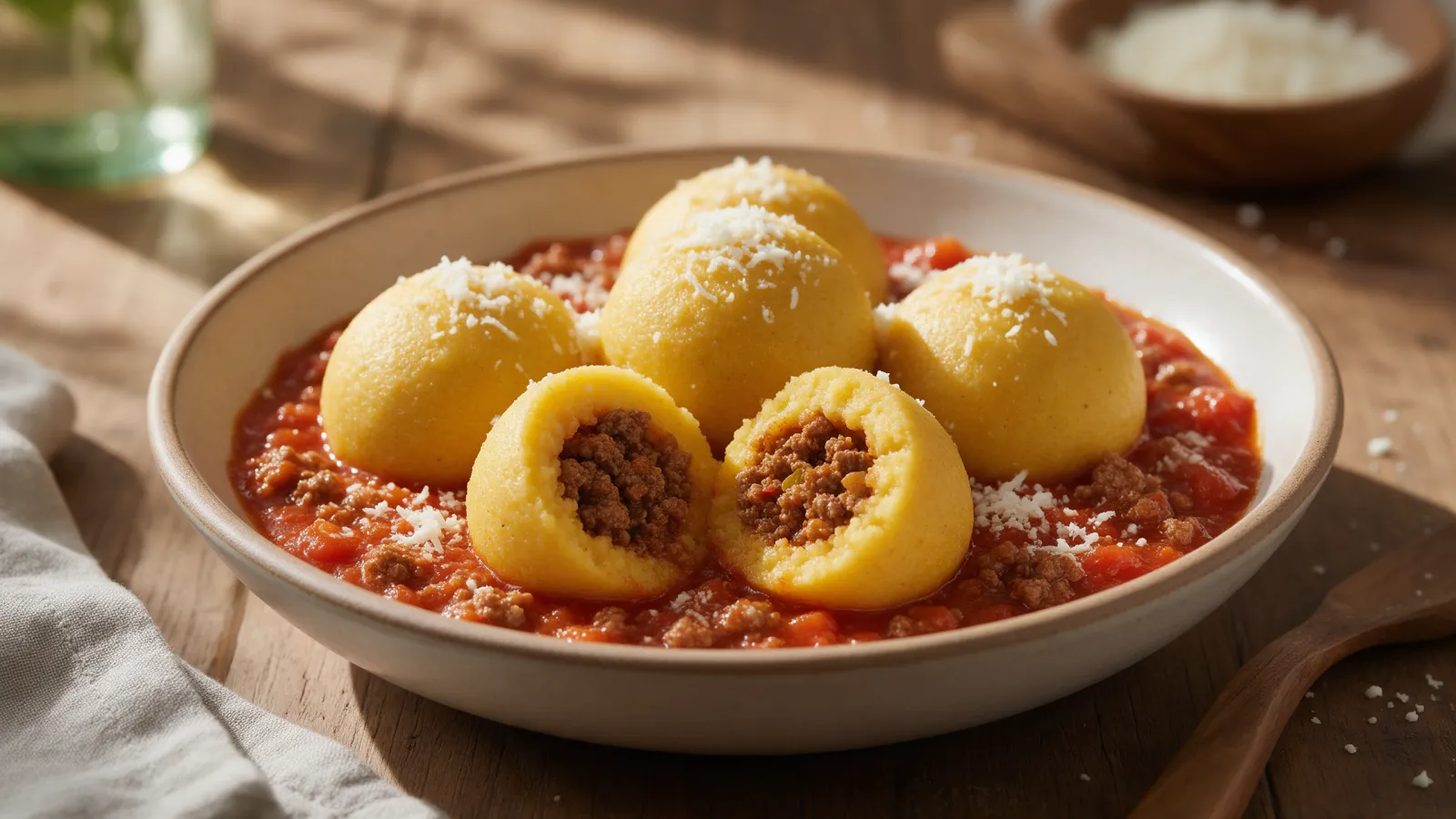

Picture a Venezuelan arepa turned inside out and dropped into a pot of tomato sauce. That is close to what bollitos pelones (boh-YEE-tohs peh-LOH-nehs) are: Venezuelan dumplings made from the same precooked corn dough as arepas, stuffed with a beef filling cooked until dry, simmered for 22 minutes in tomato sauce and finished with crumbly salty cheese. Pelones means bald, and it fits: unlike Venezuelan hallacas, these go into the pot with no leaf wrapper, so the dough itself has to hold. This recipe is built around that one problem, with exact water ratios, a filling you can make the day before and two cooking methods to choose from.
What are bollitos pelones, and are they worth making?
How do you make bollitos pelones? Cook ground beef with onion, pepper, garlic and tomato until the pan is dry, then let it cool. Mix precooked corn flour with an equal volume of warm water and salt, shape 24 balls of 50 g (1¾ oz), fill each with 20 g of beef, seal, and simmer covered in tomato sauce for 22 minutes. Serve with grated salty cheese. Ready in 105 minutes for 6 servings.
They are worth it if you like dumplings, meatballs in sauce or arepas, and want a one-pot lunch you can mostly prepare ahead. Four dumplings with sauce make a full plate at about 665 kcal.
Why they’re special. The outside of each dumpling picks up the tomato while the inside stays soft, like a fresh arepa, around a pocket of savoury beef. Starch from the dough thickens the sauce on its own, so there is no flour or cornstarch to add.
Best for. A weekend lunch for 6, a freezer batch for busy weeknights, or cooking with kids, who are usually happy to roll balls of dough. Scaled up and boiled first, they work for 20 people.
Maybe not for you if you want dinner in 30 minutes, since shaping 24 dumplings takes 25 minutes alone, or if you can’t find precooked corn flour. Masa harina gives you something else, as explained below.
Real time. 105 minutes total, roughly 70 hands-on. If the filling and sauce are made the day before, you need 60 minutes on the day.
Honest difficulty, medium. Nothing here is technically hard. Sealing improves after the third or fourth dumpling, and the hardest part is not stirring the pot too early.
What to buy, with US and UK substitutes
Quantities are in the recipe card: 480 g (3 cups) precooked corn flour, 720 ml (3 cups) warm water, 500 g (1.1 lb) ground beef and 1 kg (2.2 lb) tomatoes for 24 dumplings. The flour is the one ingredient you cannot fudge.
Precooked corn flour versus masa harina
Bollitos pelones need precooked corn flour, sold as Harina P.A.N. or labelled masarepa. The corn has been cooked and then ground, so it absorbs warm water and becomes a smooth, shapeable dough in 5 minutes. White and yellow both work; yellow gives a golden dumpling with almost the same taste. In the US, Harina P.A.N. is stocked by chains such as H-E-B, Giant, Stop & Shop, Food Lion and Costco, in 1 kg and 5 lb bags. In the UK, look online or in Latin American shops.
Masa harina (Maseca and similar) is a different product: corn nixtamalized, meaning cooked with lime (calcium hydroxide) before grinding. It tastes like tortillas, and in my kitchen it cracks when I close the balls and breaks down sooner in the sauce. In an emergency, use it with 2-3 extra tablespoons of water and accept the flavour change. Plain cornmeal and polenta are raw and won’t form a dough with warm water.
The rest of the shopping list, translated
| Recipe calls for | US store | UK store | What changes |
|---|---|---|---|
| Carne molida | Ground beef, 90% lean | Beef mince, 10% fat or less | Fattier beef leaks fat that pushes the seam open |
| Pimentón | Red bell pepper | Red pepper | Nothing |
| Ají dulce (optional) | Latin markets, frozen | Hard to find; skip | A floral note, no heat |
| Queso duro or llanero | Cotija or queso seco | Feta patted dry, or pecorino | Feta is tangier; pecorino sharper |
| Tomate | Plum tomatoes or canned crushed, 2 × 14 oz | Chopped tinned tomatoes, 2 × 400 g | Canned is more consistent than winter tomatoes |
Equipment, and workarounds
A wide 11-12 inch (28-30 cm) lidded pot so all 24 dumplings fit in one layer, a skillet, a tray and a mixing bowl. No wide pot? Split the sauce between two medium pots, or use the boil-first method in any stockpot.
A make-ahead plan, and how to tell each stage is right
105 minutes on the clock, about 70 of them hands-on. The sauce simmers by itself while you cook the filling, and the dough is mixed while the filling cools.
Make ahead. Cook the filling and the sauce the day before and refrigerate them in covered containers. Fridge-cold filling is the easiest to stuff with, because it doesn’t drip. Don’t make the dough ahead: in my experience it dries and cracks within 30 minutes, even covered.
How to tell it’s right.
- Filling → when you push the beef aside, the bottom of the skillet looks dry and glossy, with no liquid running back. Leftover Venezuelan pisillo, the dry-fried shredded beef of the plains, already meets that test and can go straight into the dough.
- Dough → a ball squeezed between your palms has smooth edges, and your hands come away almost clean.
- Shaped dumpling → round, smooth, no visible seam. If filling peeks out, patch it with a pinch of damp dough.
- Sauce → small bubbles at the edge, never a boil that jostles the dumplings.
- Doneness → at 22 minutes, a halved dumpling shows even dough with no pale, floury ring next to the filling.
Shaping dumplings that hold together
One cup of warm water per cup of flour (480 g flour to 720 ml water). That’s a little firmer than the arepa dough on the bag, on purpose, because these spend 22 minutes in liquid. Warm water, around 104°F (40°C), hydrates the flour faster than cold, and the 5-minute rest finishes the job. Freshly mixed dough looks fine and then cracks as you shape it. The salt goes in the dough, 1 tsp, since the sauce only seasons the surface.
Seal with damp hands: press a 3-inch (8 cm) disc, add the filling, lift the edges, pinch, then roll the ball between your palms for 10 seconds. The rolling erases the seam; skip it and the seam is exactly where sauce gets in.
Simmering in the sauce without losing any
Keep the sauce at a gentle simmer with the lid on, so steam cooks the tops of the dumplings that sit above the sauce. For the first 10 minutes the dough is still soft and a spoon will tear it; swirl the pot instead. After 10 minutes, once they firm up, turn each one over. If the sauce gets too thick early, pour ½ cup (120 ml) of hot water down the side.
Scaling up for 12 or 20
- 12 people → double everything: 960 g (6 cups) flour, 1.44 litres (6 cups) water, 1 kg (2.2 lb) beef, 2 kg (4.4 lb) tomatoes, 48 dumplings. Use two wide pots.
- 18-20 people → triple it: 1.44 kg (9 cups) flour, 2.16 litres (9 cups) water, 1.5 kg (3.3 lb) beef, 3 kg (6.6 lb) tomatoes, 72 dumplings. Boil them in batches of 15-20 and finish them all together in the hot sauce for 5 minutes.
- Mix dough in batches of no more than 480 g (3 cups) flour, so it doesn’t dry out before you shape the last ball.
Before you cook, food safety, mistakes, spice and allergens
The two critical points: a cold, dry filling and no spoon in the pot for the first 10 minutes. The rest is food safety and a few fixable mistakes.
Food safety. USDA FSIS sets 160°F (71°C) as the safe minimum for ground beef. Fifteen minutes in the skillet with no pink left gets you there easily; check the centre of the pan if you own a thermometer. Don’t leave the filling out for more than 2 hours at room temperature. If it needs longer to cool, finish cooling it in the fridge.
Common mistakes.
- Dumplings split in the sauce → warm or wet filling, dry dough or a hard boil. Cool the filling, add 2 tbsp water to cracking dough and lower the heat to small bubbles.
- The outside turns mushy → boiling sauce or early stirring. Low heat, lid on, turn only after 10 minutes.
- Raw in the middle → balls bigger than 50 g (1¾ oz) or sauce not simmering. Keep the size and add 5 minutes.
- Dough sticks to your hands → too much water or not enough rest. Add 2 tbsp flour and rest 5 more minutes.
- They taste floury → no salt in the dough. 1 tsp per 480 g (3 cups) flour.
Spice level, 0 out of 5. Not spicy. Even ají dulce is a sweet pepper with no heat; serve hot sauce on the side if you want it.
Kids. Usually a hit, since it’s corn dough with beef and tomato. For small children, make 30 g (1 oz) balls with 12 g of filling; they cook in 15 minutes.
Allergens. Dairy, from the cheese on top; leave it off and the dish is dairy-free. Precooked corn flour is naturally gluten-free and Harina P.A.N. is labelled gluten-free, but check the olives, tomato paste and any stock cube if you cook for someone with coeliac disease.
Which version should you make?
For 6 at home, simmer the dumplings directly in the sauce: more flavour and a sauce that thickens itself. Cooking for a crowd, or making them for the first time? Boil them in salted water until they float (12-15 minutes) and only then move them into the sauce for a short 5-minute finish. They are far less likely to split and you can work in batches.
- Short on time → make the filling and sauce the night before. Or use 1 litre (4 cups) of good jarred passata thinned with 1 cup (240 ml) water.
- Party snack → 30 g (1 oz) dumplings, boiled, served in a dish of hot sauce with the cheese on the side; you’ll get about 40 from the 6-serving quantities.
- Lighter → 95% lean beef or ground chicken, half the cheese and ½ tsp salt in the sauce, which cuts about 370 mg sodium per serving.
- Vegetarian → a filling of mashed black beans fried dry with the same vegetables, or small cubes of firm white cheese; cheese melts and can leak if the seal isn’t perfect.
- Festive → add capers, raisins and a splash of wine cooked off to the filling, closer to the stew inside an hallaca.
What it costs, and what makes it expensive
Using US Bureau of Labor Statistics average retail prices for August 2026, the two biggest items, 1.1 lb ground beef at $6.92/lb and 2.5 lb tomatoes at $1.98/lb, come to about $12.50, or roughly $2.10 per serving before corn flour, onion, pepper, olives and cheese. BLS doesn’t track masarepa, bell peppers or cotija, so add your local shelf price for those. The beef is the expensive part everywhere: in Colombian wholesale markets it’s half the total cost of the dish, while the bag of corn flour behind every dumpling costs under a tenth. To spend less, cut the beef to 400 g (14 oz) and add more vegetables to the filling, not less dough.
Serving, storing and freezing bollitos pelones
What to expect. A soft, tomato-tinted surface, tender arepa-like dough inside and a juicy but not wet beef centre. The sauce turns thick and slightly sweet, and the cheese adds the salt.
How to serve them. In shallow bowls, 4 per person with lots of sauce and the cheese grated over at the table, so it doesn’t melt away. Sliced avocado or a plain green salad is all they need. If you like the corn dough and beef combination, try fried Venezuelan empanadas or a reina pepiada arepa; for more ground beef in tomato sauce, there’s Venezuelan pasticho and Mexican picadillo. Leftover Colombian shredded beef, chopped fine, makes a quick filling, and for a bigger Venezuelan spread, pabellón criollo is the national plate.
Fridge. USDA FSIS guidance: no more than 2 hours at room temperature, then 3-4 days in the fridge at 40°F (4°C) or below, in shallow containers.
Freezer, raw is best. Freeze freshly shaped dumplings spaced out on a tray for 1 hour, then bag them. I use mine within 2 months. Cook them from frozen in already simmering sauce, adding about 10 minutes. Cooked dumplings in sauce also freeze; FSIS gives 2-6 months for cooked meat leftovers, though the dough comes out softer.
Reheating. In a covered pot over low heat with ½ cup (120 ml) water for every 2 cups of sauce, since the sauce thickens in the fridge, until the centre reaches 165°F (74°C). In the microwave, covered, in 1-minute bursts. High heat scorches the sauce and splits the dough.
Frequently asked questions
What are bollitos pelones in English? Venezuelan corn dumplings: balls of precooked corn dough stuffed with seasoned ground beef and cooked in tomato sauce. Pelones (bald) refers to their lack of a leaf wrapper.
Can I use masa harina instead of masarepa? Only in a pinch, and add a little extra water (two or three tablespoons). Masa harina is nixtamalized, so it tastes like tortillas and cracks more when shaped. Look for corn flour labelled precooked.
Why do my corn dumplings fall apart? Dry dough, warm or wet filling, or a hard boil. Use 1 cup warm water per cup of flour with a 5-minute rest, a cold and dry filling, and a covered pot at a gentle simmer.
Do you boil bollitos pelones or cook them in the sauce? Either works. Simmering them in the sauce gives more flavour (22 minutes, covered). Boiling first is safer and suits big batches: salted water until they float, then a short finish in the sauce.
Can you freeze bollitos pelones? Yes, ideally raw. Freeze on a tray for 1 hour, bag, use within about 2 months, and cook from frozen in simmering sauce for about 10 minutes longer.
Are bollitos pelones gluten-free? The dough is, since precooked corn flour contains no wheat and Harina P.A.N. is labelled gluten-free. Check the olives, tomato paste and any stock cube.
Nutrition per serving
Calculated ingredient by ingredient from USDA FoodData Central (SR Legacy), using this recipe’s quantities and all the salt, for one serving of four dumplings with their sauce and a sixth of the cheese:
- Calories: 665 kcal
- Protein: 30 g
- Carbohydrates: 80 g (mostly corn flour)
- Fat: 25 g, of which 8 g saturated
- Fibre: 7 g
- Sugars: 10 g (tomato and onion)
- Sodium: 1590 mg
That’s a full meal. About 1,065 mg of the sodium comes from salt you add to the dough, filling and sauce, and the cheese adds about 360 mg; with ½ tsp salt in the sauce and half the cheese it drops to around 1,220 mg.
I have pulled more than one pot of sauce full of loose dough off the stove, and every time the culprit was the same: filling that went in still warm. Now I cook it the night before and let the fridge do the waiting. Cold filling, quiet pot, whole dumplings. Josnaisis.