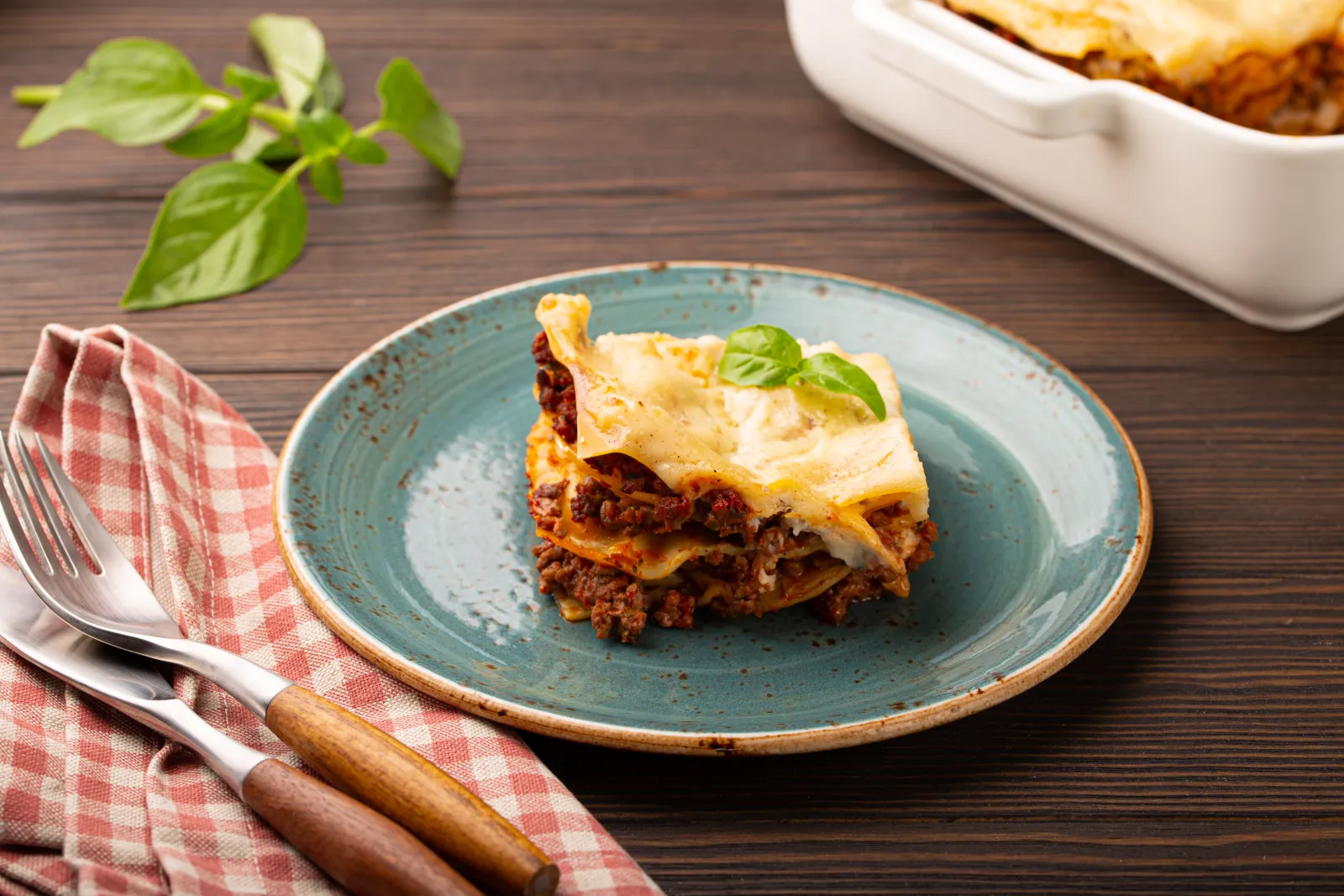

Picture a Bolognese lasagna, then add a slice of ham and a slice of Gouda to every layer and roughly double the béchamel. That is pasticho (pahs-TEE-cho), the lasagna Venezuelan families bake for Sunday lunch, birthdays and New Year’s. It is creamier, saltier and taller than the Italian dish, and it slices best the day after it’s baked.
What is pasticho, and how is it different from lasagna?
How do you make Venezuelan pasticho? Simmer a beef and pork meat sauce with onion, bell pepper and tomatoes for 35 minutes while you make a béchamel from 1.2 liters (5 cups) milk, 90 g butter and 90 g flour. Build four layers of noodles with meat sauce, béchamel, ham and sliced cheese, top with béchamel, mozzarella and Parmesan, and bake 45 minutes at 350°F (180°C). Rest 30 minutes before slicing. Ready in 160 minutes for 10 servings.
Pasticho is the Venezuelan name for lasagna, and in a Venezuelan kitchen the two words mean the same dish. The name resembles the Italian pasticcio, a word Italians use for baked pies of pasta and filling. Three things set the Venezuelan version apart from a lasagna alla bolognese:
- More béchamel. In pasticho the white sauce is close to half the filling, not a thin film. 1.2 liters (5 cups) of milk go into one pan.
- Ham in every layer. Thin slices of cooked deli ham, about 100 g (3.5 oz) per layer.
- “Queso amarillo”. Literally “yellow cheese”, a mild sliced cheese in the Gouda family that melts between the layers. There’s no ricotta.
The result is richer and saltier than most lasagnas, with more distinct layers when you cut it.
Is it worth making, and how much work is it?
Yes, if you’re feeding 8 to 10 people or want a freezer full of lunches. One pan gives 10 main-course servings, and half of it can go straight into the freezer for the same amount of work. It’s a poor choice for two people on a weeknight.
- Total time → 160 minutes, about 65 of them hands-on. The rest is simmering, baking and resting.
- Difficulty → medium. Nothing is technically hard; the risk is liquid. Too dry a sauce leaves no-boil noodles hard, too wet a sauce floods the pan.
- Who it’s not for → anyone after something light. One serving is about 780 kcal and 1,400 mg sodium.
- Spice level → 0 out of 5. Ají dulce is a sweet pepper with no heat, and kids almost always like it.
- Allergens → gluten (noodles, flour, some Worcestershire sauces), milk (béchamel and cheese) and pork. No egg unless your noodles are egg pasta.
Ingredients, with US and UK swaps
The recipe card has every quantity. This is where the shopping decisions are.
| Venezuelan ingredient | US supermarket | UK supermarket | What changes |
|---|---|---|---|
| Queso amarillo, sliced | Gouda or Muenster from the deli counter | Gouda or Edam slices | Muenster melts softer; Edam a little firmer. Cheddar works but turns greasier and sharper |
| Ají dulce | Frozen at some Latin grocers | Rarely sold | Use an extra 40 g (1.4 oz) red bell pepper; you lose a floral note, not the dish |
| Pasta para pasticho | No-boil or “oven-ready” lasagna noodles | ”No pre-cook” lasagne sheets | Absorb liquid in the oven, so the sauce needs ½ cup (120 ml) more water |
| Jamón | Thin-sliced cooked deli ham | Thin-sliced cooked ham | Avoid prosciutto or other cured ham: it toughens and over-salts |
| Mozzarella for the top | Low-moisture shredded mozzarella | Grated mozzarella (the block kind) | Fresh mozzarella balls release whey and make the pan watery |
Choosing the noodles
I use no-boil noodles. They skip the pot of boiling water, they don’t tear, and they soak up the spare liquid that would otherwise pool at the bottom, so the pasticho cuts firmer. The two rules: add 120 ml (½ cup) water to the meat sauce, and make sure every edge is buried under sauce or béchamel.
If you only have regular noodles, boil them 8 minutes in salted water, rinse in cold water and lay them flat on a clean towel. Skip the extra water in the sauce. Fresh pasta sheets go in raw with no extra water; the slices come out softer.
Equipment
A deep 9 x 13 in (23 x 33 cm) pan, at least 2¾ in (7 cm) tall, about 5 quarts (5 liters). A standard 2-inch (5 cm) glass dish overflows with this much filling: make three layers instead of four and bake the leftovers in a small dish. You also need a wide pot, a heavy saucepan, a whisk and foil.
Mistakes that make pasticho watery or messy
- Slicing it hot. Hot béchamel is a thick liquid; it only sets as it cools. Give it 30 minutes. At 10 to 15 minutes the pieces come out but the ham and sauce slide off each other.
- Wet ingredients. Under-reduced sauce, boiled noodles that weren’t drained, fresh mozzarella, or water-added ham. Pat ham dry with paper towels if it’s slick.
- Hard noodle edges. A corner of no-boil pasta left uncovered bakes into a cracker. Béchamel over everything, foil for the first 30 minutes.
- Lumpy béchamel. The milk went in all at once. Add it in four batches, whisking each smooth; if lumps form anyway, strain it or blitz with a stick blender.
- Too salty. Ham, three cheeses and Worcestershire all bring salt, which is why the sauce gets only 1 tsp and the béchamel ½ tsp. Taste before adding more.
- Burnt top, cold middle. The oven was too hot or the foil came off early. 350°F (180°C), covered for 30 minutes.
How to plan it, from a family pan to a party of 20
The béchamel fits inside the meat sauce’s 35-minute simmer, and that overlap is what keeps the day to 160 minutes.
Make-ahead plan
- Up to 3 days ahead → make the meat sauce and refrigerate it. On the day, make the béchamel, layer and bake.
- The night before → assemble the whole pan, cover tightly and refrigerate. With no-boil noodles this is the best option, because the pasta hydrates overnight. Bake straight from the fridge, 45 minutes covered and 15 uncovered, until the center reads 165°F (74°C).
- For neat party squares → bake a day ahead, cool, refrigerate, slice cold into 10 pieces and reheat covered at 325°F (160°C) for about 30 minutes.
Scaling for 6, 15 or 20 people
For 15 people, make the recipe 1.5 times: one deep 9 x 13 in (23 x 33 cm) pan and one 8 x 11 in (20 x 28 cm) pan give 16 servings. The bake times for the 6 and 20-serving versions are my own oven’s; the reliable test is 165°F (74°C) in the center or a knife that slides through without meeting firm pasta.
Which version to make
- Short on time → meat sauce the day before plus no-boil noodles. On the day, 20 minutes of béchamel, 20 of layering, then the oven.
- Individual portions → foil loaf pans or small dishes that go straight into the freezer; about 30 minutes in the oven.
- No pork → use 750 g (1.65 lb) of 80/20 ground beef and skip the ham. It loses the salty contrast but still tastes like pasticho.
- Lighter → 2% milk in the béchamel, 90/10 beef with no pork, half the ham and no cheese between layers, only mozzarella on top.
- Chicken → 750 g (1.65 lb) cooked, shredded chicken breast in place of the ground meat, same tomato sauce.
- Vegetarian → 1 kg (2.2 lb) diced eggplant, zucchini and mushrooms cooked 15 minutes with the same tomatoes, no ham.
- Plantain → fried slices of ripe plantain instead of noodles. Sweeter and heavier; a home variation rather than the party version.
What it costs
I couldn’t find a reliable public consumer price series for Venezuela, so this uses US average prices. The ingredients tracked by the US Bureau of Labor Statistics (BLS, August 2026) add up to $23.74, about $2.37 a serving.
Meat, cheese and ham are 87% of the cost. The BLS only publishes a price for cheddar, so cheese here is priced as block cheddar; sliced Gouda from the deli counter costs more. Canned tomatoes, fresh vegetables and oil aren’t tracked and are left out. To save money, cut the Parmesan to 30 g (1 oz) and slice a block of Gouda yourself.
Serving, storing and reheating
Serve one square per plate, on its own or with a green salad. For a Venezuelan spread, start with tequeños, set out Venezuelan chicken salad at Christmas, pour papelón con limón to drink, and finish with Venezuelan quesillo. At the holidays it shares the table with hallacas and Venezuelan ham bread.
- Fridge → according to the USDA FSIS, cooked leftovers shouldn’t sit out more than 2 hours and keep 3 to 4 days at 40°F (4°C) or below.
- Freezer → FoodSafety.gov lists 2 to 6 months for cooked meat leftovers, for quality only; food kept at 0°F (−18°C) stays safe. I freeze baked, chilled squares wrapped one by one in plastic and then bagged, and use them within 2 months, after which the béchamel turns grainy. Thaw overnight in the fridge.
- Reheat → covered with foil at 325°F (160°C), about 20 minutes for one piece, until the center reaches 165°F (74°C). A spoonful of milk over each piece keeps the béchamel from drying. In the microwave, use medium power in 1-minute bursts; full power makes the cheese rubbery.
Frequently asked questions
Is pasticho the same as lasagna? It’s the Venezuelan name for lasagna, made with more béchamel, a layer of ham and sliced mild cheese such as Gouda, and no ricotta.
Do I need to boil the noodles for pasticho? Not with no-boil noodles. Add ½ cup (120 ml) water to the meat sauce and cover every edge. Regular noodles need 8 minutes in boiling water and careful draining.
Why is my pasticho watery? Under-reduced sauce, wet noodles, fresh mozzarella, water-added ham, or slicing before it rested. Fix them in that order.
How long should pasticho rest before cutting? At least 30 minutes. For the cleanest squares, chill it overnight and slice cold.
Can I assemble pasticho the night before? Yes. Cover and refrigerate, then bake from cold 45 minutes covered and 15 uncovered, until the center hits 165°F (74°C).
Can you freeze pasticho? Yes, baked and in portions. Use within about 2 months for the best béchamel texture and reheat to 165°F (74°C).
What cheese is in Venezuelan pasticho? Queso amarillo between the layers, a mild sliced cheese like Gouda, plus mozzarella and Parmesan on top. Muenster or Edam work outside Venezuela.
Nutrition
Per serving (one tenth of the pan), calculated ingredient by ingredient from USDA FoodData Central (SR Legacy) values per 100 g, with noodles counted dry and the sliced cheese as Gouda:
- Calories: 782 kcal
- Protein: 45 g
- Carbohydrates: 52 g
- Fat: 44 g (22 g saturated)
- Fiber: 4 g
- Sugars: 14 g
- Sodium: 1,405 mg
About seven in ten calories come from the meat, cheeses and butter, and the ham alone adds roughly 450 mg sodium per serving. The lighter version above trims the most.
At home in Venezuela, pasticho was made so there would be leftovers, and I still cook it that way in Colombia, sauce on Saturday and the rest on Sunday, with half the pan going into the freezer in squares. Tomorrow’s pasticho always cuts better than today’s. Josnaisis.