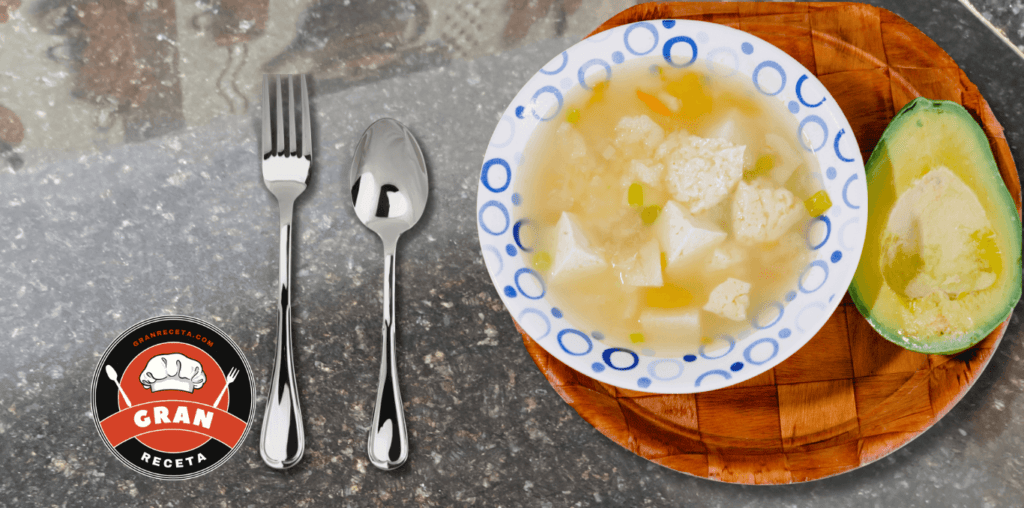

Mote de queso, the lunchtime soup of Sucre and Córdoba, is a 2-ingredient soup that thickens itself, and it is the best argument I know for tracking down a real yam. White yam, boiled hard for 35 minutes, releases enough starch to turn 8½ cups of water creamy with no flour, roux or cream anywhere, and into that goes salty white cheese in cubes that soften without melting. It is the everyday lunch soup of Sucre and Córdoba, on Colombia’s Caribbean coast, and it is vegetarian by accident rather than design. Six bowls, about 455 calories each.
How do you make mote de queso? Soak cubed salty white cheese for 30 minutes. Cook onion and garlic, then boil white yam for 35 minutes until half of it dissolves and the broth binds. Add the cheese and soured cream for the last 10 minutes over low heat and finish with lime. 70 minutes for 6 servings.
The yam problem, and it is a real one
In a US supermarket, the label yam is almost always on a sweet potato. What this soup needs is the tropical white yam, a rough, bark-skinned root the size of a forearm with dense white flesh, sold as ñame in Latin markets, name or igname in Caribbean ones, and yam in African ones.
It matters because of what each root does in the pot. True yam breaks down into starch and binds the broth while tasting of almost nothing; sweet potato turns the whole thing sweet and orange. If the only option is potato, the soup will be thinner and you will need to crush some pieces against the pot to get any body at all.
Two yams, and only one of them thickens
On the Colombian coast two varieties are sold side by side. Ñame espino, the thorny one, falls apart as it cooks and is the one that thickens; ñame diamante holds its pieces and gives a soup with chunks, which is a different, also legitimate dish. According to the DANE’s SIPSA bulletin for the week of September 12 to 18, 2026, espino sold for 5,217 pesos a kilo in Montería against 4,942 for diamante, a gap of 275 pesos for a large difference in outcome.
Outside Colombia you rarely get a choice of variety, so treat whatever you find as diamante: crush a few pieces against the side of the pot at the 30-minute mark and the broth will bind anyway.
Why the yam is not soaked
Peeled yam is slippery, and plenty of recipes deal with that by soaking it. The problem is that the starch leaves with the slime, and that starch is the only thickener this soup has.
A 30-second rinse under the tap takes off what needs taking off. If the slipperiness bothers your hands, rub them with lime rather than putting the yam in a bowl of water.
The 35 minutes that matter
The mark is not tender yam but half-dissolved yam. At 20 minutes the pieces are whole and the broth is thin; at the 35-minute mark the soup binds with pieces still visible on the spoon; by the one-hour point it is a paste you have to thin with hot water.
Stirring helps, since the friction wears down the edges of the pieces and releases more starch. What you should not do is cover the pot completely: part of the thickening is the 8½ cups reducing.
Which cheese, and what to do with it
Queso costeño is a pressed fresh cheese preserved by salt rather than refrigeration, which is why it is so salty and why it holds its shape in a hot pot. The closest thing in most Western supermarkets is halloumi, which is built for exactly this and needs a 20-minute soak.
Paneer is the option if you would rather control the salt yourself, since it carries none and never melts. Firm block feta works with a 30-minute soak and one change of water. What does not work is anything that melts cleanly, mozzarella or cotija, because it vanishes into the broth and takes the dish’s best bite with it.
Who this recipe is for
- If you only find one kind of yam → crush a few pieces against the pot at 30 minutes to force the starch out
- If your cheese is unsalted, like paneer → skip the soak and salt the broth instead, about 1 tsp
- If you have no suero costeño → sour cream thinned with lime juice plays the same acid role
- If you want it lighter → drop the cheese to 10 oz and add more yam; the bowl goes from about 455 to about 390 calories
- If it sits and thickens → reheat with ½ cup of hot water per bowl over low heat, stirring
How the 70 minutes break down
Thirty-five of the 70 minutes are the yam boiling and 30 are the cheese soaking in parallel, which leaves about 20 minutes of actual work: peeling, cutting and the onion base. For a soup this substantial, it asks very little attention.
The order follows heat tolerance. Everything that can take a boil goes first, and the cheese, which cannot, goes last. The lime goes in off the heat, because hot acid splits the soured cream.
Make ahead, storage and reheating
Mote keeps 3 days in the fridge, within the 3 to 4 day window the USDA gives cooked dishes, and it sets almost solid as it cools, which is a good sign rather than a bad one. Thin it with hot water, ½ cup per bowl, over low heat.
Do not freeze it. The cheese turns rubbery and the yam separates from the broth on thawing, leaving grainy water and squeaky cubes. If you want to get ahead, cook the yam base and keep it without the cheese, adding fresh cubes when you reheat.
What goes wrong
Soaked yam. The starch leaves and the soup never binds, and then people reach for flour, which makes it something else.
Unsoaked salty cheese. The broth becomes inedible and there is no way to take salt back out once it has spread.
Boiling the cheese. It melts, disappears into the broth and the dish loses its best part. Lowest heat for the last 10 minutes.
Sweet potato instead of yam. A sweet orange soup that is not this dish at all.
Variations
With eggplant. Half an eggplant in cubes with the yam, a Sincelejo habit that adds body without changing the flavor.
With pork ribs. 7 oz browned before the onion turns it into a main course and adds about 90 calories a bowl.
With ají dulce. Three or four of the mild Caribbean peppers in the base, aromatic without heat, very much the Córdoba way.
Without soured cream. More lime at the end and a spoon of raw oil; cleaner tasting and lower in fat.
What to serve with it
Mote is served on its own at midday, in a deep bowl of about 14 oz, with white rice on the side for anyone who wants to stir it in, and sliced avocado. More soured cream goes on the table so people can add their own.
For a full coastal lunch, Colombian patacones with hogao or Colombian carimañolas work as a starter before the soup, and cold Colombian aguapanela with lime is what gets drunk with it. If you want the region’s other great soup, Colombian sancocho plays the same role with hen and root vegetables.
Frequently asked questions
Why is my mote watery? Either the yam soaked before cooking, or it had too few minutes in the pot, or it was a variety that holds its shape. Crushing pieces against the pot fixes it.
Can I use sweet potato? No. US supermarkets label sweet potato as yam, but it is a different root with a sweet flavor that does not belong here.
What cheese substitutes for queso costeño? Halloumi is the closest in behavior. Paneer if you want no salt, firm feta if you soak it 30 minutes.
What is suero costeño? A tart cultured cream from the Colombian coast. Sour cream loosened with lime juice is a fair stand-in.
Is it vegetarian? Yes, as written, and it carries 17 g of protein a bowl from the cheese alone.
Nutrition
Per bowl, one sixth of the pot, calculated with the USDA database for the yam, the cheese and the soured cream:
- Calories: 455 kcal
- Protein: 17 g
- Carbohydrates: 49 g
- Fat: 22 g, of which 11 g saturated
- Fiber: 7 g
- Sodium: 680 mg
Nearly all the fat and protein come from the cheese, which according to the USDA carries 20.38 g of protein and 24.31 g of fat per 100 g; the yam brings the carbohydrate and nearly all the fiber, at 4.1 g per 100 g. It is a vegetarian soup with more protein than plenty of meat ones, and soaking the cheese first takes a real bite out of the sodium.
The first time I had mote de queso in Sincelejo I assumed there was cream in it, because I could not accept that a soup with two ingredients came out that silky. Someone explained it was the yam and that the trick was not washing it too much. In Venezuela we used yam in sancocho, in chunks meant to survive the pot, and it had never occurred to me to let it fall apart on purpose. Josnaisis.