
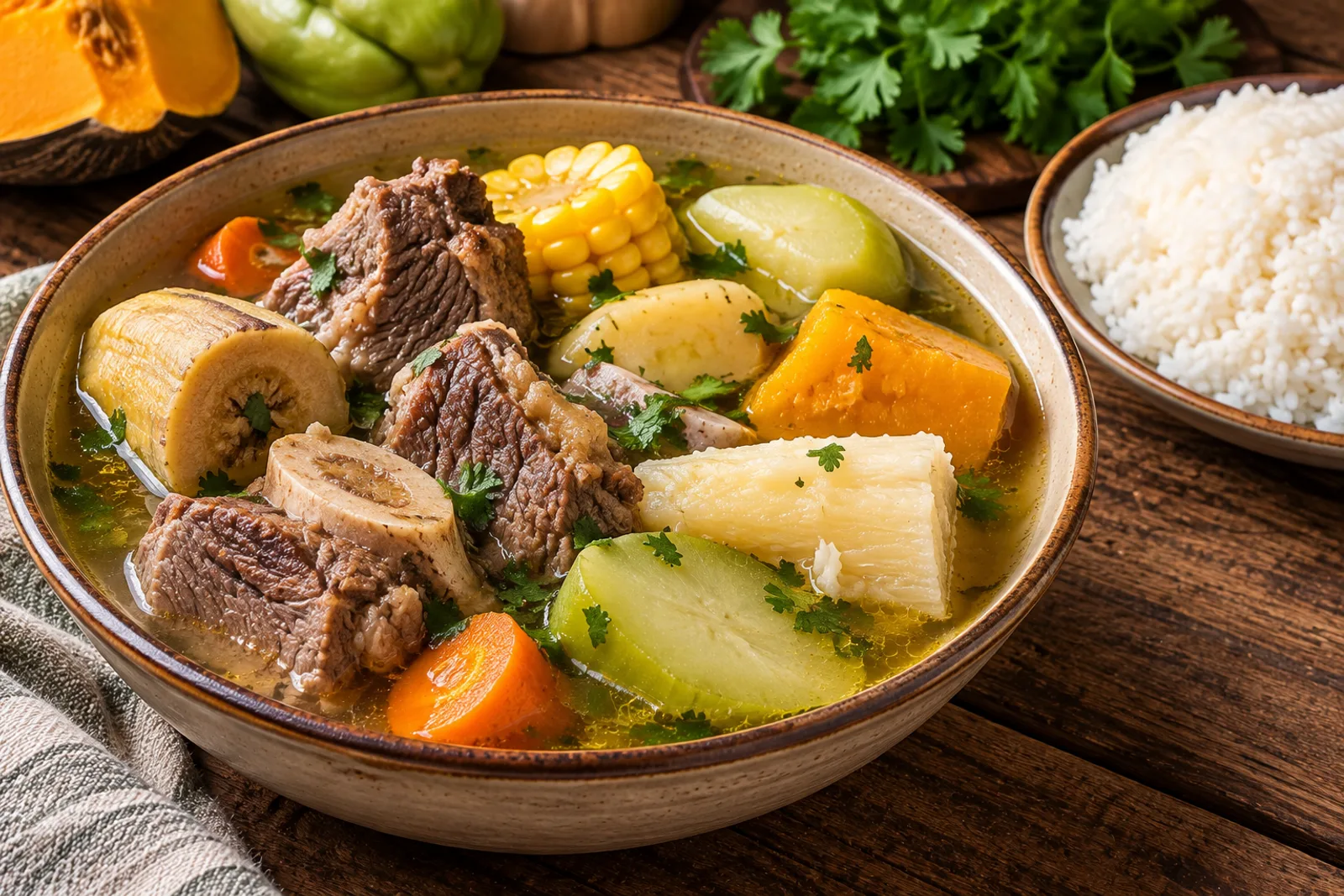

Olla de carne is Costa Rica’s Sunday soup: big pieces of bone-in beef and nine kinds of vegetable in a clear broth, eaten from a wide bowl with white rice on the side. The name means “pot of meat,” and that’s what it is. The whole trick is timing. The beef simmers alone for 105 minutes, then the vegetables go in three rounds so the cassava softens just as the squash and chayote turn tender, and nothing ends up mushy.
What olla de carne tastes like, and how it compares
How do you make Costa Rican olla de carne? Simmer 1 kg (2.2 lb) of short ribs and 800 g (1¾ lb) of brisket in 4 liters (4.2 quarts) of cold water, skimming for 15 minutes, then 90 minutes on low with onion, bell pepper, garlic, celery and cilantro. Skim the fat, add cassava, corn, green plantain and tiquizque; 20 minutes later carrot, potato and sweet potato; 10 minutes after that chayote and squash. Finish with cilantro. 175 minutes for 8 servings.
Think of an American beef and vegetable soup, but with the vegetables in whole, fist-sized pieces instead of diced, and the broth kept light and clear rather than tomato-based. The squash, sweet potato and corn make it gently sweet; the cassava and tiquizque make it filling. It’s a full meal on its own, not a starter.
If you know other Latin beef soups, here’s where it sits. Venezuelan beef hervido uses similar roots but lets some squash melt into an orange broth and is eaten with arepas. Mexican caldo de res swaps the roots for zucchini, cabbage and green beans, with chiles and lime at the table. Dominican sancocho piles in seven meats and cooks down thick, almost a stew. Chilean cazuela uses beef shank with squash, corn and green beans, and cooks the rice right in the pot. The Costa Rican pot is beef only, with chayote, sweet potato, tiquizque and cilantro, and a broth you can see through.
Time and effort. 175 minutes start to finish, about 60 of them hands-on, most of it peeling while the beef simmers. Difficulty, medium: nothing is technically hard, but the three rounds need a timer.
Shopping for olla de carne in the US and UK
The beef
You want bone-in meat with some fat. Short ribs give the broth its flavor; brisket or flank gives chunks you can pull apart with a spoon. Bone-in beef shank works too and adds body. In the UK, ask for beef short ribs or Jacob’s ladder and brisket. To spend less, use more short ribs and less brisket: the beef is what makes this pot expensive, the vegetables cost little.
The vegetables, and what to buy when you can’t find them
Most of the list is easy: cassava, corn, carrots, potatoes, sweet potato and squash are in any big supermarket, and frozen peeled cassava is a perfectly good shortcut. The three that send people searching are tiquizque, ñampí and ayote.
- Tiquizque. A hairy brown root with white or lilac flesh that turns creamy in soup. Latin grocers in the US sell it as malanga or yautia. Ñampí is its smaller cousin, sold as taro or eddo in Asian and Caribbean stores. Both are irritating raw, so cook them until soft right through. My hands itch when I peel them, so I wear gloves.
- Ayote. The one used here is ripe ayote, with orange, sweet flesh. Butternut is the closest match; kabocha works and stays firmer. Some Costa Rican cooks use young green ayote instead, which behaves more like zucchini.
- Chayote. A pale green, pear-shaped squash, sold as chayote in most US stores and as christophene in Caribbean shops in the UK. If there’s none, zucchini or courgette in big chunks, added only for the last 8 minutes; it’s softer and milder.
- Sweet potato. Pale-fleshed boniato from a Latin market holds its shape best. Orange sweet potatoes work, but they’re sweeter and soften sooner.
- Green plantain. It must be green and hard. A yellow one sweetens the broth and falls apart.
- Cilantro and bell pepper. Costa Ricans call cilantro culantro, and the mild red pepper chile dulce. A regular red bell pepper is fine.
- Salsa Lizano. Costa Rica’s tangy, slightly sweet brown table sauce. It’s sold online and in some Latin grocers; the same bottle goes on Costa Rican gallo pinto.
Equipment. A 10-liter (10½-quart) pot, a ladle for skimming, a big knife for the cassava and a cutting board. With an 8-quart pot, start with 3 liters (3.2 quarts) of water and add 1 liter (4 cups) of hot water with the first round of vegetables.
The plan and the three rounds of vegetables
Counting from when the beef hits cold water: at minute 105, cassava, corn, green plantain and tiquizque or taro; at 125, carrots, potatoes and sweet potato; at 135, chayote and squash; at 150, cilantro leaves and the last of the salt. Everything is ready together at 155.
The beef goes into cold water and you skim for the first 15 minutes, before it boils hard, so the foam rises in one layer you can lift off. After that the surface should only tremble, with small bubbles at one edge. A rolling boil churns the fat into the broth and it won’t clear again.
How to tell it’s going right.
- Beef at minute 105 → a fork goes in with slight resistance. It finishes softening with the vegetables.
- Cassava → splits open in the center and looks translucent. If it’s still closed and chalky white, it isn’t done.
- Tiquizque and taro → a knife slides to the center with no push.
- Potato, chayote, squash → tender and whole. If they break when you poke them, turn off the heat.
- Salt → at the end, because the broth reduces for nearly 3 hours.
Instant Pot and make-ahead versions
Pressure cooker or Instant Pot. In a 6-quart pressure cooker, put the beef in 2.5 liters (10½ cups) of cold water, never more than two-thirds full, and skim with the lid off for 15 minutes. Add the aromatics, lock the lid and cook 40 minutes at high pressure, then let the pressure come down naturally for 10 minutes. Move the beef and broth to a big pot, add 1.5 liters (6⅓ cups) of hot water, skim the fat and cook the vegetables uncovered on the stove with the same timing as above. Never pressure-cook the vegetables; potato and chayote turn to mush in minutes. The total is about 145 minutes.
Slow cooker. Fine for the beef and aromatics, 6 to 8 hours on low. Do the vegetables on the stove in their rounds; left all day in a slow cooker, chayote, potato and squash disintegrate.
A day ahead. Cook the beef with the aromatics to minute 105, divide it with its broth into shallow containers and refrigerate within 2 hours. Next day the fat has set on top and lifts off in one piece. Bring it back to a boil and carry on with the vegetables: about 55 minutes on the day you eat. Peel the vegetables the same day.
Half batch for 4. Halve the beef and vegetables but use 2.5 liters (2.6 quarts) of water in a 6-liter (6-quart) pot, since a small pot loses proportionally more to evaporation. Start with 1 teaspoon of salt. The cooking times stay the same.
Mistakes to avoid, and who it suits
- Mushy potato and squash, hard cassava → everything went in at once. Use three rounds; the cassava goes in 30 minutes before the squash.
- Cloudy, greasy broth → it boiled hard or wasn’t skimmed at the start. Turn off the heat, let it settle 10 minutes and ladle the fat off the top.
- Cassava that won’t soften → old or fibrous root, not too little time. If it’s still hard after 40 minutes, give it 10 to 15 more; if it still won’t give, the root is the problem, and don’t serve it until a knife slides into the center. Good cassava is bright white with no dark streaks when peeled.
- Your mouth tingles eating the taro or tiquizque → it wasn’t cooked through. Test it before you turn off the heat.
- Too salty → all the salt went in at the start. Add it in two stages and taste before the second.
Heat level, zero. Nothing in the pot is spicy; hot sauce goes on the table for anyone who wants it. Kids usually like it, because the squash, sweet potato and corn make it sweet; check for bone splinters. Allergens: no gluten, dairy, egg or nuts. Celery is a declarable allergen in the UK, so leave it out if needed. Salsa Lizano and flour tortillas may contain gluten; check the label.
How to serve, store and reheat it
Serving. In a wide, deep bowl: a piece of beef, one piece of each vegetable and broth to cover. The white rice goes on a small plate alongside; some people spoon it into the bottom of the bowl first. Put tortillas, lime wedges and Salsa Lizano on the table, plus an empty plate for bones and corn cobs.
Fridge. Into shallow containers and into the fridge within 2 hours of coming off the heat; it keeps 3 to 4 days at 40 °F (4 °C) or below.
Freezer. 2 to 3 months. The beef, broth, cassava and corn freeze well; the potato turns grainy and the chayote watery. If you plan to freeze, pull those out and add fresh potato and chayote when reheating, 15 minutes.
Reheating. Covered, over medium-low heat, until it simmers and reaches 165 °F (74 °C) in the center. On high heat the squash catches on the bottom and the cassava breaks. If it thickened in the fridge, add ½ cup of water for every 2 cups of soup.
For a beef pot with three meats instead of one, try the Colombian three-meat sancocho, or the Venezuelan cruzado with beef and hen.
Olla de carne questions
Is olla de carne a soup or a stew? A soup with a thin, clear broth, but with pieces big enough that it eats like a full meal. Costa Ricans serve it as the main course.
Do you cook the rice in the soup? No. White rice is cooked separately and served on the side, and each person adds it to the bowl or not.
What’s the difference between tiquizque and taro? They’re related roots. Tiquizque is the one sold as malanga or yautia; ñampí is taro or eddo, smaller and a little denser. Either works here, and if you can’t find them, extra cassava and potato do the job with less creaminess.
Can I make it without beef? Use the same vegetables, in the same order, with 3 liters (3.2 quarts) of vegetable stock. It’s no longer olla de carne, but it’s a hearty vegetable soup.
Nutrition per bowl
Per bowl (one-eighth of the pot, without rice or tortillas), calculated ingredient by ingredient from the quantities above. I count 600 g (1⅓ lb) of meat in the 1 kg of bone-in short ribs and use lean values for the ribs and brisket, because the fat is skimmed before the vegetables go in; tiquizque is counted as yautia and ayote as butternut:
- Calories: 665 kcal
- Protein: 42 g
- Carbohydrates: 90 g
- Fat: 16 g, of which 6 g saturated
- Fiber: 10 g
- Sugars: 12 g
- Sodium: 943 mg
The beef accounts for about 290 kcal per bowl and cassava is the biggest vegetable contributor, about 100 kcal. Skip the skimming and the numbers rise. Half a cup of cooked white rice adds about 100 kcal.
I grew up with Venezuelan hervido, so the first time I made olla de carne most of it felt familiar. Chayote was the new part, and it taught me something: it goes from tender to watery in a few minutes, which is why it waits for the last round with the squash. Since I started doing it that way, every piece reaches the bowl whole. Josnaisis.