
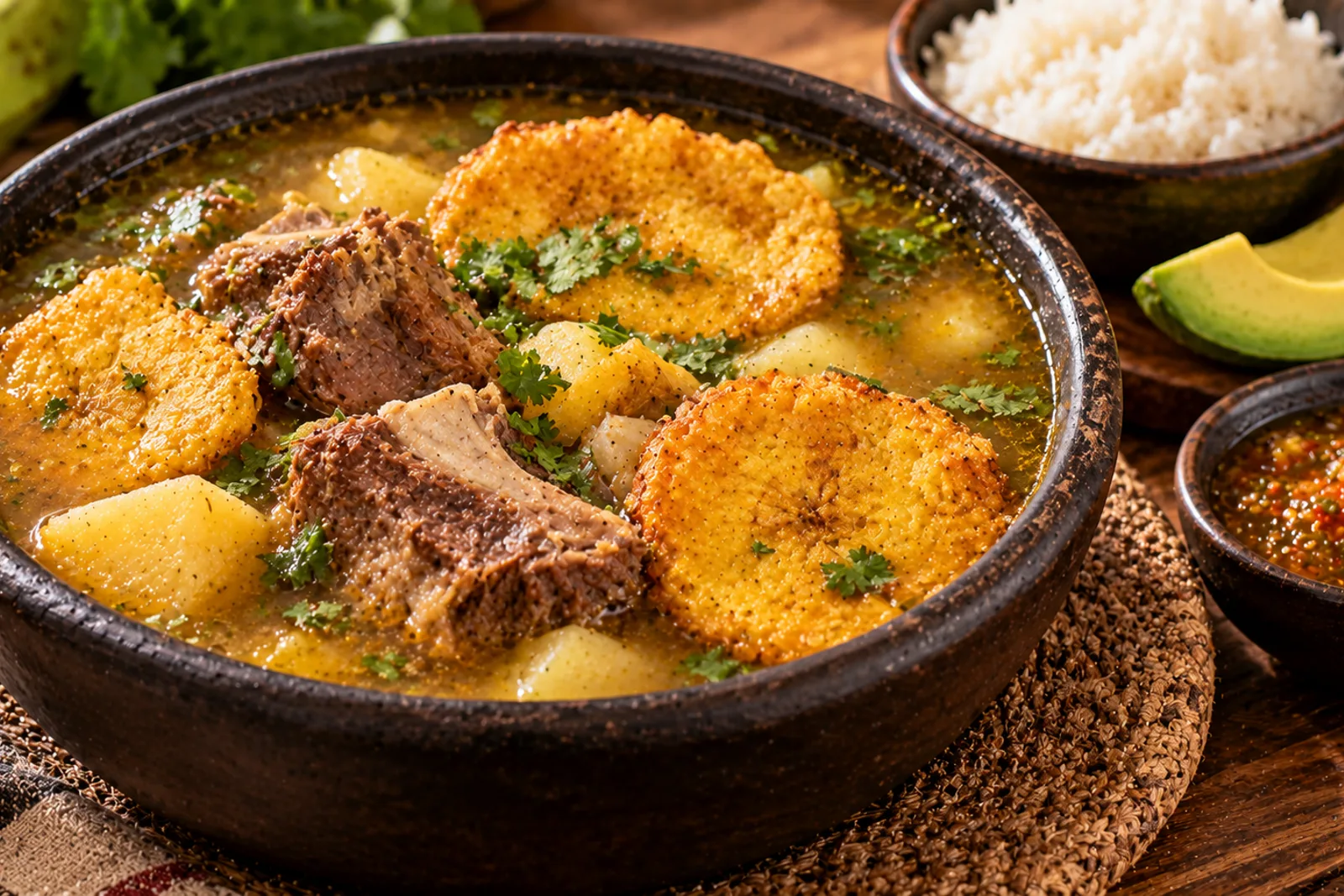

Sopa de patacón (SOH-pah deh pah-tah-KOHN) is a Colombian beef soup that gets its character from patacones, the green plantain rounds that are fried, smashed flat and fried again, the same thing Puerto Ricans and Cubans call tostones. They go into a short rib and potato broth for the last 10 minutes, soften at the edges and stay whole in the middle. This recipe makes 6 big bowls, and below is how to fry the plantains so they hold up, when to add them, and what makes them fall apart.
What patacon soup is, and how it differs from plantain soup
How do you make Colombian patacon soup? Simmer 2.2 lb (1 kg) of beef short ribs in 12½ cups (3 liters) of water, skimming for 15 minutes and then cooking 70 minutes on low with green onion, garlic and cilantro stems. Add a tomato and onion sofrito and 1.1 lb (500 g) of potatoes and cook 20 minutes. Slide in 18 twice-fried plantain patties and cook 10 minutes over low heat without stirring. Finish with cilantro. 120 minutes for 6 bowls.
In Colombia it’s an everyday lunch soup, served with white rice and sliced avocado on the side, and a common way to use up leftover patacones. The meat varies from house to house: short ribs, cubed beef or chicken.
If you searched “green plantain soup,” there are two different Colombian soups behind that phrase. In Colombian plantain soup the plantain goes in raw, one grated and two broken by hand, and cooks 30 minutes until it thickens the broth. Here it goes in fried, at the end, so the broth stays clearer and the plantain is something you bite into, with a toasted flavor the other soup doesn’t have.
Time. 120 minutes start to finish, about 70 of them hands-on, most of that while the ribs simmer on their own. Difficulty, medium. The soup itself is simple; frying 18 plantain rounds in two batches and smashing them while hot takes some attention.
Ingredients, and what to buy in the US and UK
Green plantains
Plantains look like oversized bananas but are starchy and barely sweet when green, and they’re never eaten raw. You need them fully green and hard, with no yellow. A plantain that has started to ripen has more sugar: it browns in the first fry before the center cooks and then falls apart in the broth.
- US. Green plantains sit next to the bananas in most supermarkets and in every Latin grocery. Pick the greenest, firmest ones.
- UK. African and Caribbean grocers, market stalls and the world food section of some big supermarkets. Green bananas are not a substitute: they’re smaller and less starchy.
- Shortcut. Latin grocers in the US sell frozen tostones, already smashed. Fry or heat them as the package says and add them for the last 10 minutes, exactly like homemade ones.
To peel a green plantain, cut off both ends, slit the skin lengthwise without cutting into the flesh, and pry it off with your thumb. The sap stains, so a little oil on your fingers helps.
Beef, potatoes and sofrito
| Ingredient | Metric | US | Notes and swaps |
|---|---|---|---|
| Bone-in short ribs | 1 kg | 2.2 lb | English cut, sawn into 2 in pieces. Cheaper: meaty beef soup bones |
| Floury potatoes | 500 g | 1.1 lb | Russet in the US, Maris Piper or King Edward in the UK |
| Green onions | 120 g | 4 oz | Colombian cebolla larga is a thick green onion; scallions are the closest |
| Roma tomatoes | 250 g | 9 oz | Any ripe plum tomato |
| Annatto (achiote) | ½ tsp | ½ tsp | Only adds golden color. Leave it out and the soup is paler, same taste |
The sofrito, called guiso or hogao in Colombia, is green onion and tomato cooked down with garlic and cumin. If you already have some made, use about 6 tbsp.
Equipment. A 6-quart (6-liter) pot, an 11 in (28 cm) deep skillet for frying, a skimmer, paper towels, and something flat to smash the plantains with: the bottom of a glass or a small saucepan, with the plantain between two pieces of plastic wrap. A thermometer for the oil helps.
Making the patacones for soup
These are the same twice-fried Colombian patacones served as a side dish, with one change: for soup, don’t smash them thinner than 1 cm (⅜ in). A thin one is crisper on a plate, but in broth it soaks through and splits.
Smash them straight out of the first fry. If they cool, they crack; give them 30 seconds back in the oil and try again. Don’t salt them, because the soup is already seasoned.
Some Colombian cooks add a few rounds fried only once, so they break down and thicken the broth. It works, but those ones won’t stay whole.
When to add the patacones so they don’t fall apart
When the potato is nearly cooked, over low heat, for 10 minutes. Taste for salt before they go in, because you won’t want to stir much afterward. Added with raw potato, they’d spend 30 minutes in the pot and arrive broken. In my kitchen, at 5 minutes the edge is soft and the center still hard; at 10 they cut with a spoon and stay whole; from 15, sooner at a hard boil, they start to split, and by 20 they fall apart and thicken the broth.
If your family likes them crisp, skip the pot entirely: put the patacones in the bowls and ladle the boiling broth over them at the table.
Timeline, and what to make the night before
The ribs go first because they need 85 minutes; the sofrito and the frying fit inside that time.
Night before, in three separate containers:
- The ribs in their strained broth, split into shallow containers so it cools fast, and refrigerated within 2 hours. Next day the fat has set on top and lifts off in one piece.
- The sofrito, covered, in the fridge.
- The patacones after the first fry, already smashed, in a sealed bag in the fridge. They also freeze for up to 2 months and go straight into the hot oil from frozen.
On the day: reheat the broth, potatoes and sofrito for 20 minutes, second fry in the meantime, patacones for 10 minutes, then rest. About 45 minutes.
Scaling up
| Servings | Short ribs | Water | Plantains | Potatoes | Pot |
|---|---|---|---|---|---|
| 6 | 1 kg (2.2 lb) | 3 L (12½ cups) | 3 | 500 g (1.1 lb) | 6 qt |
| 12 | 2 kg (4.4 lb) | 6 L (6¼ qt) | 6 | 1 kg (2.2 lb) | 10 to 12 qt |
| 20 | 3.4 kg (7½ lb) | 10 L (10½ qt) | 10 | 1.7 kg (3¾ lb) | 16 qt, or two 8 qt |
For 20 you’re frying about 60 patacones, so do the first fry the day before. A big pot takes longer to come back to a simmer: give the ribs an extra 10 to 15 minutes and add the patacones in two batches, letting the broth bubble again in between. Tomatoes scale the same way: 500 g (1.1 lb) for 12, 850 g (1.9 lb) for 20.
Mistakes to avoid
- Patacones fall apart → too thin, a hard boil, or more than 15 minutes in the pot. Keep them 1 cm (⅜ in) thick, low heat, no spoon.
- Hard in the middle → the first fry was too short or too hot, so they browned before cooking through. First fry until soft when pierced, no color.
- Sweet and dark → the plantains had started to ripen. Fully green only.
- Greasy broth → it wasn’t skimmed or degreased. Skim from cold water and ladle off the fat before the potatoes go in; the patacones also release a little oil.
- Flat-tasting broth → not enough salt or a watery sofrito. Give the sofrito its 10 minutes and taste before the patacones go in.
Heat level, 0 out of 5. Colombians put ají picante, the fresh Colombian hot sauce, on the table. Kids usually like it; check for bone chips. Allergens: no gluten, dairy, egg or nuts. If you boost the broth with a bouillon cube, check the label.
Variations
- Pressure cooker or Instant Pot → skim for 15 minutes with the lid off, add the aromatics, then cook 30 minutes at pressure with 10 minutes of natural release. Finish the potatoes and patacones with the lid off. About 95 minutes in all.
- Chicken → bone-in chicken pieces instead of ribs, 35 minutes of simmering instead of 70. A lighter soup.
- Cubed beef → boneless chuck or brisket in 3 cm (1¼ in) cubes, same timing as the ribs and more meat per bowl.
- Thicker → 3 rounds fried only once, mashed into the pot with the potatoes.
- More vegetables → sliced carrot with the potatoes and peas with the patacones.
- Meatless → vegetable stock, a stronger sofrito and an extra teaspoon of cumin. Good, though flatter.
Serving and storing
In a deep bowl with a piece of rib, 3 patacones and cilantro on top, with Colombian white rice and sliced avocado on the side. The ribs are what make the pot expensive; plantains and potatoes are cheap, and soup bones bring the cost down a lot.
Fridge. No more than 2 hours at room temperature, then 3 to 4 days at 40°F (4°C) or below, in shallow containers. Patacones left overnight in the broth go soft all the way through and start to break up. It still tastes good, but it’s a different soup. If you expect leftovers, store the broth separately and fry fresh patacones when you reheat.
Freezer. The broth with the ribs and sofrito keeps 2 to 3 months. Leave out the potatoes, which turn grainy, and the patacones; freeze first-fry patacones separately.
Reheating. Bring the broth to a boil over medium heat, add fresh potatoes for 20 minutes if you froze it without them, and the patacones for the last 10.
For a plain, clear short rib broth with only potatoes, the Bogotá breakfast version is Colombian caldo de costilla.
FAQ
Are patacones the same as tostones? Yes. Both are green plantain rounds fried, flattened and fried again. Colombians say patacones; in Puerto Rico, Cuba and Venezuela they are tostones.
How long do patacones cook in the soup? About 10 minutes at a gentle simmer, once the potatoes are nearly done. Past 15 minutes, especially at a hard boil, they start to split.
Can I use leftover or frozen patacones? Yes. First-fry patacones keep overnight in the fridge and up to 2 months frozen; give them the second fry and add them to the pot. Frozen store-bought tostones go in after you’ve heated them as the package says.
Can I make it without meat? Yes, with vegetable stock and a heavier sofrito. You lose the depth of the ribs, but the patacones still bring a toasted flavor.
Nutrition per serving
One bowl, a sixth of the pot, without rice or avocado, calculated from the quantities in this recipe. I count 600 g (1.3 lb) of meat in 2.2 lb of bone-in ribs, using lean values since the broth is skimmed, and the plantains as fried, including the oil they absorb (about 70 g / 2½ oz across the pot):
- Calories: 585 kcal
- Protein: 23 g
- Carbohydrates: 68 g
- Fat: 25 g, of which 8 g saturated
- Fiber: 6 g
- Sugars: 6 g
- Sodium: 855 mg
A little over half the calories come from the patacones. Half a cup of cooked white rice adds about 100 kcal.
Where I grew up in Venezuela, tostones went next to the plate, never into the broth, so with this soup the thing I watch is that they don’t fall apart. They only do if they’re smashed too thin or left to boil. At a finger’s width, over low heat for ten minutes, they reach the bowl whole. I do the first fry the night before, and then the soup is ready in the time it takes the potatoes to cook. Josnaisis.