
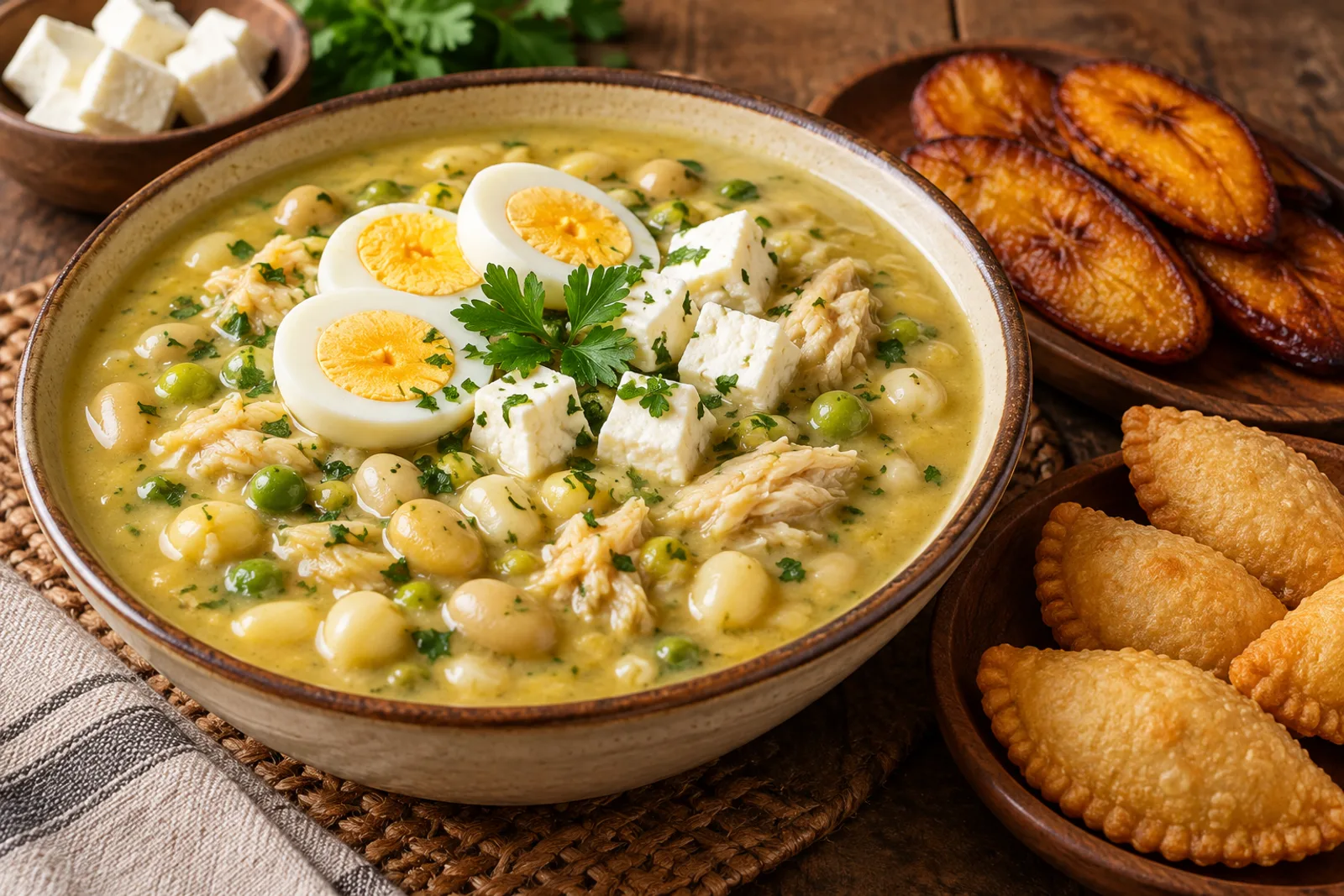

Beans and grains (twelve kinds, by tradition), two squashes, salt cod poached in milk and a spoonful of ground peanuts: fanesca (fah-NES-kah) is the thick soup Ecuadorian families cook once a year, during Holy Week. Nobody makes it on a whim. The cod needs a day or two in the fridge to lose its salt, every bean is cooked on its own, and on the day everything comes together in one big pot. This version feeds 12, uses frozen and canned beans from an ordinary US or UK supermarket, and splits the work so serving day is an hour and a half at the stove.
What is fanesca
How do you make Ecuadorian fanesca? Soak 500 g (1.1 lb) of salt cod in the fridge for 24 to 48 hours, changing the water. The day before, cook the beans and blend butternut squash and zucchini with a little rice into a purée. On the day, poach the cod in milk, build a base of butter, annatto and onion, then add the purée, the milk, blended peanuts and the beans, and finish with the cod and queso fresco. Ready in 150 minutes for 12 servings, plus soaking.
Fanesca comes from the Ecuadorian highlands and is eaten during Holy Week, above all at lunch on Good Friday, when many Catholic families skip meat. Tradition says the twelve grains stand for the apostles and the cod for Jesus, although real kitchens use anywhere from 8 to 12 and nobody counts at the table.
Think of it as a chowder thickened with squash instead of flour. It comes out orange from the annatto, sweet from the squash, salty from the cod and quietly nutty from the peanuts, with whole beans in every spoonful. A bowl of about 460 g (1 lb) is a full meal, which is why the toppings go on the soup and there is no main course after it. It isn’t spicy; hot sauce goes on the side.
Time and effort. 150 minutes of cooking split over two days, about 60 the day before and 90 on the day, plus 24 to 48 hours of soaking. Difficulty, medium: no tricky technique, just planning and a pot that sticks if you walk away. If you are planning meatless Fridays around it, our Latin American Lent recipes are sorted by time and type of dish.
Shopping for fanesca outside Ecuador
You only need to cook the lentils from dry. Everything else can come out of a bag or a can, and the soup is still recognizably fanesca. Per person, plan on 42 g (1½ oz) of dried cod, 125 ml (½ cup) of milk and about 140 g (5 oz) of beans and grains.
- Zambo is a young figleaf gourd, green outside with mild white flesh; it adds body without sweetness. Zucchini (courgette) is the practical swap. It is wetter and blander, so the base comes out paler; if the purée looks thin, simmer it uncovered 5 more minutes before blending. Mexican grocers in the US sell chilacayote, which is the same plant.
- Zapallo is a sweet, orange-fleshed winter squash. Butternut or kabocha is almost identical in the pot.
- Fava beans are sold frozen as broad beans in UK supermarkets and in Latin, Middle Eastern and Asian stores in the US. Peel them anyway: the skins stay tough and gray in the soup.
- Choclo is Andean corn with big, starchy, barely sweet kernels; Latin stores in the US carry it frozen, sometimes as Peruvian giant corn. Frozen sweetcorn works but makes the soup sweeter.
- Chochos are Andean lupini beans. Jarred lupini (in the Italian or pickle aisle) are larger and packed in brine: rinse them well and taste one before they go in.
- Queso fresco is easy in the US. In the UK, use a mild feta and hold back on the salt at the end, because feta is saltier.
- Salt cod is sold in Latin, Italian and Portuguese shops, sometimes frozen. If yours is already soaked and frozen, skip the soak and use about 560 g (1¼ lb), which is what 500 g of dry cod weighs once rehydrated and cleaned.
- Annatto (achiote) powder is in the Latin aisle. It adds color more than flavor; ½ teaspoon of sweet paprika gives the color, though not quite the same taste.
Equipment. An 8-liter (8½-quart) heavy pot, a blender, a wooden spoon and a 3-liter (3-quart) lidded container that fits in your fridge for the cod.
How to soak salt cod for fanesca
Soak it in cold water in the fridge, at 40°F (4°C) or below. That is one or two days of raw fish sitting in water, and on the counter it spoils. Use 4 liters of water per kilo (about 2 quarts per pound), skin side up so the salt leaves through the flesh.
- First change after 12 hours, then every 8. The water fills with salt and the cod stops releasing it unless you renew it.
- One day per centimeter (⅜ inch) of thickness. Pieces 1 cm thick or less and flakes need about 24 hours, ½-inch (1.5 cm) pieces about 36, and a ¾-inch (2 cm) loin needs 36 to 48.
- Taste before you trust it. Simmer a small piece from the thickest part in unsalted water until it is opaque and flakes, 2 to 3 minutes, and taste it then, never raw. If it tastes of brine, give it 8 more hours in fresh water.
I soak it in water rather than milk because the water can be changed and judged, and I save the milk for poaching. It is the same schedule I use for Mexican Christmas bacalao, where the cod goes in as whole loins.
Make-ahead plan for fanesca
Expect an hour of hands-on work the day before and 90 minutes on the day. Only the soaking can’t be rushed, so the calendar starts with the cod.
- Two days ahead, in the morning if you have a thick loin: cod into the fridge to soak. Thin pieces can start the morning before.
- The day before. Cook the lentils, boil and peel the fava beans, boil the corn and peas, rinse the cans and make the squash purée. Everything goes into the fridge, covered. Peeling the favas is the slowest job and the easiest one to hand to someone else.
- Serving day. Cod in milk, onion base, purée, peanut milk, beans, in that order. Boil the eggs for 12 minutes and fry the plantains while the pot simmers.
How to make fanesca step by step
The squash purée
Simmer the squashes and rice, covered, in 600 ml (2½ cups) of water for 25 to 30 minutes over medium heat. They are ready when the squash collapses as you press it against the side of the pot and the rice is falling apart. Blend with the cooking liquid until no strings are left; it should look like thick cream. The rice is what gives it body without flour.
Poaching the cod
Poach the drained cod in 1 liter (4¼ cups) of milk over low heat for 10 minutes, never at a rolling boil, until it flakes when you nudge it with a fork. Pull it out, remove skin and bones with your fingers and break it into ¾-inch (2 cm) flakes. Strain that milk and keep it: it carries the cod flavor through the whole pot.
Onions, purée and peanuts
Melt the butter with the annatto, soften both onions 6 to 8 minutes until translucent, and add garlic, cumin and oregano for the last minute. Then add the purée and the cod milk and simmer gently 10 minutes.
Blend the peanuts with 500 ml (2 cups) of milk until completely smooth. From the moment that goes in, keep the heat low and scrape the bottom every 2 minutes: the peanut settles, sticks and, if it scorches, turns the whole soup bitter.
Knowing when it’s done
The beans go in already cooked and just need 10 to 15 minutes to heat through. Then the cod, cream and cheese, 5 minutes without boiling. Fanesca is ready when it coats the back of a spoon and the beans sit whole on the surface. Too thick? Add hot milk, 100 ml (a scant ½ cup) at a time. Season last, tasting with a flake of cod on the spoon.
Making fanesca for a crowd
The recipe scales well because each part is cooked separately. Above 12 servings, use several 8-liter pots instead of one huge one: a 20-liter pot of milky, peanutty soup is impossible to stir to the bottom and it will catch.
- For 6. Halve everything; it fits a 4-liter (4-quart) pot.
- For 24. Double it: soak 1 kg (2.2 lb) of cod in 4 liters (4¼ quarts) of water and run two 8-liter pots side by side, splitting the onion base between them.
- For 36. Triple it in three pots, and blend the peanut milk in batches without filling the blender jar, so it stays smooth.
Fanesca mistakes and how to fix them
- Too salty. It was salted early, the cod was under-soaked or the lupini weren’t rinsed. Add milk and, if you have some, more squash purée, and don’t salt the toppings. Tasting the boiled test piece of cod prevents it.
- Scorched bottom. Peanut and milk settle and burn. If it catches, pour the soup into a clean pot without scraping: what stays on the bottom stays out of the flavor.
- Mushy beans. They were overcooked the day before or went in too early. Cooked just tender, they only need 10 to 15 minutes in the soup.
- Gray, chewy favas. The skins were left on. Peel them, frozen ones too.
- Stringy cheese or split milk. The soup boiled hard after the cheese and cream. From that point, gentle heat only.
Allergens and kids. Contains milk, peanuts, fish and lupini (lupin is one of the 14 allergens that must be declared in the UK and the EU). It’s gluten-free if you skip the wheat empanadas. There’s no chili in the pot, and the sweet squash makes it an easy sell for children; serve the cod on the side if they’re unsure.
Variations
- Without cod. Skip the poaching and use 1 liter (4¼ cups) of plain milk instead. Milder, sweeter and less salty; a little extra queso fresco brings back the savory edge.
- With fresh fish. 500 g (1.1 lb) of corvina, sea bass or cod fillet, no soaking, poached in the milk until opaque and flaky at 145°F (63°C) in the center. Clean white-fish flavor, without the cured taste.
- With canned tuna. The emergency swap when there is no salt cod: two 5-oz (160 g) cans, drained, stirred in at the end. Different flavor, same idea.
- Regional versions. Chimborazo adds quinoa; Cuenca adds hominy and achogchas; coastal fanescas use seafood, green plantain, yuca and peanuts.
- Peanut-free. Leave the peanuts out. The soup is paler and loses its toasty depth, but it still works.
What to serve with fanesca
Top each bowl with half a hard-boiled egg, slices of fried ripe plantain and queso fresco, plus parsley and a few cod flakes. A dozen bowls need 6 eggs and 2 ripe plantains, fried like Venezuelan fried sweet plantains but a little thinner. On the side go empanadas de viento, small fried pastries filled with cheese, or plain fried dough balls, and a bowl of hot sauce; a fresh Colombian ají picante with onion and cilantro is close to what Ecuadorian tables put out.
Many families follow the soup with molo, a mashed potato dish, and finish with figs and cheese. For more Ecuadorian food, llapingachos with peanut sauce share the peanut, and encebollado is the everyday fish soup. Another milky Lenten soup from the Andes is the Peruvian chupe de camarones, and if you like a soup that is a whole meal, Colombian ajiaco works the same way at the table.
Storing, freezing and reheating fanesca
Fridge. Cool it and refrigerate it, covered, within 2 hours of turning off the heat; it keeps 3 to 4 days. It sets almost into a purée when cold. That’s normal.
Reheating. Warm only what you’ll eat, in a pot over low heat with a splash of hot milk per bowl, scraping the bottom, until it steams and reaches 165°F (74°C). In the microwave, use medium power and stir every minute.
Freezer. 2 to 3 months in single-serving containers. Thawed, the milk can look grainy and the beans get softer; stirring in hot milk brings it back. If you know part of the pot is going to the freezer, set it aside before the cheese and cream go in, and add them when you reheat. Thaw overnight in the fridge.
Fanesca FAQ
How many grains are in fanesca? Twelve by tradition, linked to the apostles. In practice families use anywhere from eight to twelve and count them differently; this recipe has 7 beans and grains plus rice and peanuts, and welcomes mellocos, quinoa or hominy if you can get them.
Can I use a pressure cooker or Instant Pot? For cooking dried beans and chickpeas, yes. Not for the soup itself: with milk and peanuts it sticks to the bottom, and you can’t stir a sealed pot.
Can I make the whole soup a day ahead? Yes, and it tastes better. Cool it within 2 hours in shallow containers so it chills fast, then reheat with milk as above.
How much salt cod per person? About 42 g (1½ oz) of dried cod, roughly 47 g (1⅔ oz) once soaked and cleaned. That’s deliberate: in fanesca the cod seasons, and the beans are the meal.
Fanesca nutrition per serving
Per serving (about 460 g / 1 lb of soup, without egg, plantain, empanadas or extra cheese), calculated from the recipe quantities:
- Calories: 463 kcal
- Protein: 29 g
- Carbohydrates: 42 g
- Fat: 22 g, of which 10 g saturated
- Fiber: 8 g
- Sugars: 13 g
- Sodium: 1,023 mg
The protein comes almost equally from cod, milk and beans, and the fiber from the legumes. Sodium doesn’t include the salt you add at the end; the cod alone accounts for about 690 mg per bowl, and brined lupini add a little more.
Fanesca asks for more planning than any soup I cook, but it is also the easiest one to share out: give everyone in the house a bag of beans to peel and the day-before work is done in an hour. I only salt it once, at the very end, tasting with a flake of cod on the spoon. Josnaisis.