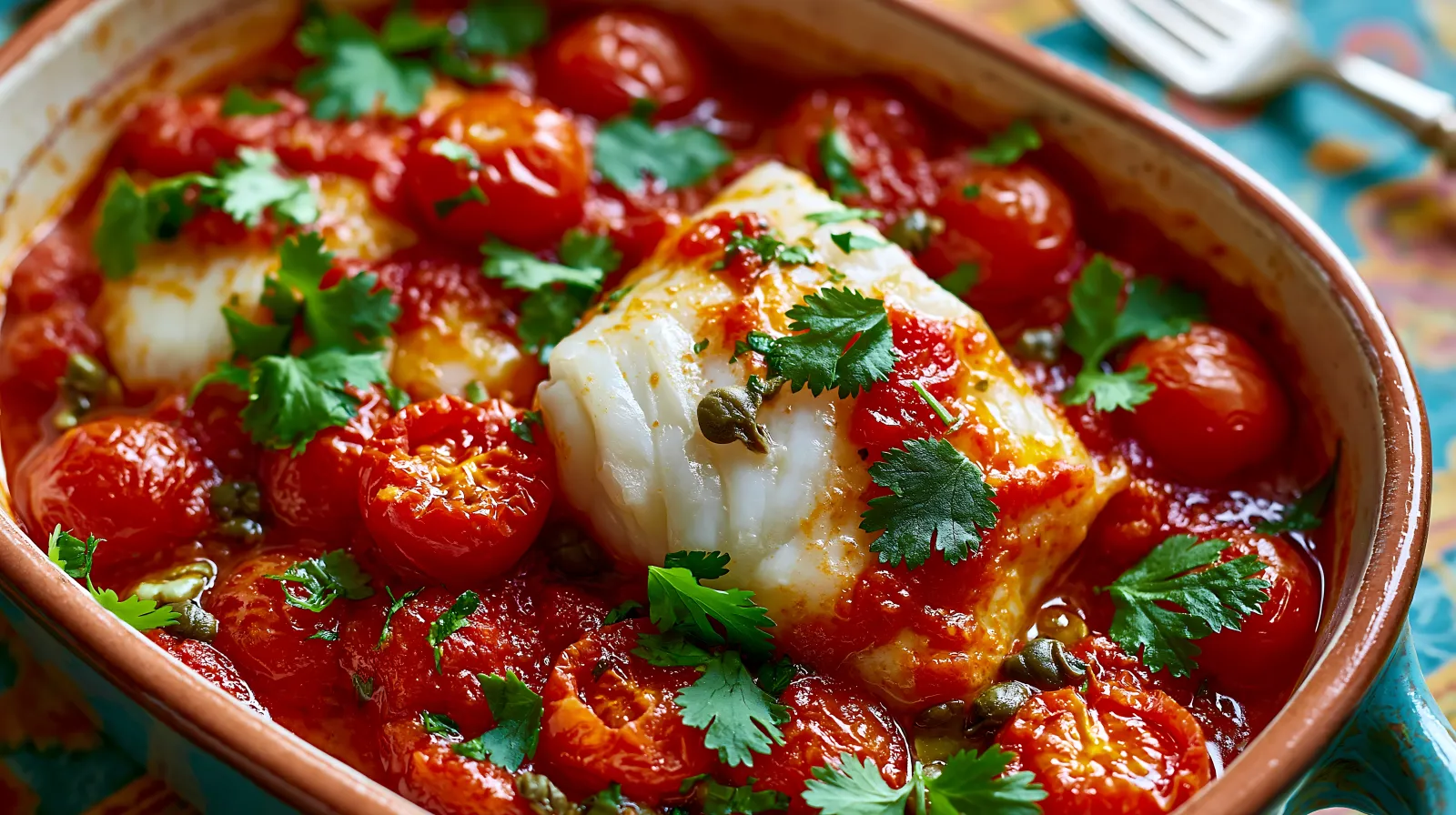

On Christmas Eve in much of Mexico, next to the turkey or the roast pork, there’s a pot of salt cod stewed with tomatoes, olives, capers, potatoes and whole pickled yellow peppers. It’s called bacalao a la vizcaína (bah-kah-LAH-oh ah lah viz-kah-EE-nah), “Biscay-style cod,” although the Basque dish it’s named after is something else. The cooking takes two hours. The planning starts two days earlier, because dried salt cod has to soak in the fridge before it’s edible, and that soak is where most first attempts go wrong.
What is Mexican Christmas bacalao?
How do you make Mexican bacalao? Soak dried salt cod in the fridge for 36 to 48 hours, changing the water every 8 hours, then flake it. Simmer it for 30 minutes with baby potatoes, green olives and capers in a tomato, onion and garlic sauce cooked down in olive oil; whole pickled güero peppers and parsley go in for the last 10. 120 minutes for 8 servings, plus the soak.
It’s a thick, oily tomato stew of flaked salt cod, eaten at the Christmas Eve dinner (Nochebuena) and on New Year’s Eve, and then again the next day stuffed into bread rolls. Cod isn’t fished in Mexican waters, so every piece of it is imported, most famously from Norway.
How it differs from the Basque original. In the Basque Country, salsa vizcaína is made from rehydrated choricero peppers and slowly cooked onion; its red color comes from the pepper, not from tomato, as the Spanish consumer guide Consumer (EROSKI) points out. The cod goes in as whole loin pieces. Saveur’s notes on the Mexican version sum up what changed: olives and almonds came in, and the cured ham, dried sweet red peppers and dried red chiles of the original went out. The Mexican cook also flakes the fish into 1 in (2 to 3 cm) pieces and builds the stew on tomato. If you were hoping for the Bilbao dish, this isn’t it.
Is it worth making? Yes, if you can give it two days of fridge space. The hands-on work is about 55 minutes on the day. It’s not for a last-minute dinner, and it’s not for anyone watching sodium closely: a serving lands around 2,890 mg even with a proper soak, more than the FDA’s 2,300 mg Daily Value. Honest difficulty: medium. The two ways it fails are a short soak, which leaves it salty, and too much stirring, which turns the flakes to mush.
Choosing the fish, salt cod or salted pollock
This is the most expensive ingredient and the one most likely to be something other than what the label says. In the Latin aisle of a US supermarket you’ll find two kinds of boxed “bacalao.” Read the species on the back.
- Salt cod (Gadus morhua), ideally Norwegian, is what the dish is built around: thick loins that soak into large, firm flakes. Buy a skin-on loin, not pre-shredded fish, so you can see what you’re paying for.
- Salted pollock is sold in the US as bacalao too. Goya’s 16 oz box, for example, is labelled Boned Salted Pollock, lists Alaska pollock and salt as ingredients, and carries 3,720 mg of sodium per 2 oz (56 g) before soaking; the box suggests soaking 1 lb in 6 cups of water for 24 hours with three water changes. It’s cheaper, with thinner flakes.
- Frozen desalted cod skips the soak. It’s common in Spanish supermarkets and harder to find in the US; thaw it for a day in the fridge and treat it as soaked fish.
- Fresh cod makes a pleasant tomato fish stew, but without the salt-cured texture it’s a different dish.
Mislabelling is real. Oceana Mexico’s DNA testing found that 31.5 % of the fish sold as bacalao in Mexico City supermarkets, fish markets and restaurants was another species, sharks and rays among them; at fish markets alone it was 55 %. The study covered 62 samples bought between December 2018 and January 2019. The Norwegian Seafood Council’s checklist: white or pearly flesh with no yellow or grey patches, firm to the touch, and a clean salty smell.
What 2.2 lb gives you. Soaking rehydrates the fish. In tests by the Norwegian food research institute Nofima, a traditional 24 to 48 hour soak gave a 33 to 34 % weight gain, so 1 kg (2.2 lb) of dry salt cod becomes roughly 1.33 kg (2.9 lb). In my kitchen, a skin-on loin loses about 200 g per kilo to skin and bones, which leaves about 1.1 kg (2.4 lb) of flaked fish, or 5 oz (140 g) per person for 8.
How to soak salt cod, and how to know it’s ready
The Norwegian Seafood Council’s method is the one I follow: rinse the fish, set it skin side up in 3 to 4 times its weight in cold water, refrigerate, change the water after 12 hours and then every 8 hours, and allow one day of soaking per centimeter (⅜ in) of thickness. That works out to 36 hours for thin pieces, 48 hours for a ¾ in (2 cm) loin and about 72 for a 1¼ in (3 cm) one.
It has to happen in the fridge. The council gives 4 to 6°C; I keep mine at 40°F (4°C) or below, which is the USDA’s limit for perishable food. Two days in water on the counter is how fish spoils. If 1 gallon (4 liters) of water won’t fit, split the fish between two containers.
Night-time water changes. If one falls at 3 a.m., do it before bed and when you get up. What matters is 5 or 6 changes over 48 hours.
The taste test. Don’t taste raw soaked fish. Cut a ¾ in (2 cm) piece from the middle of the thickest part, poach it in unsalted boiling water for 2 minutes and eat it. It should taste like well-seasoned fish, like a salted chip, not like seawater. If it stings, 8 more hours in fresh water.
What else you need, with US and UK swaps
Exact amounts are in the recipe card: 1.5 kg (3.3 lb) tomatoes, 600 g (1.3 lb) baby potatoes, 150 g (5 oz) olives and about 10 pickled peppers for 8.
| Ingredient | What it does | US | UK | What changes |
|---|---|---|---|---|
| Jitomate saladet | the sauce base | Roma tomatoes | plum tomatoes | nothing |
| Canned option | saves the blanching | 2 × 28 oz cans whole peeled | 4 × 400 g tins | a little more acidic |
| Papa cambray | soaks up the sauce | baby potatoes | baby new potatoes | nothing |
| Chiles güeros | sour, mild heat | canned güero peppers, Mexican aisle | pickled banana or Turkish green peppers | slightly sweeter or sharper |
| Aceitunas | brine and fat | pimiento-stuffed green olives | Manzanilla olives | nothing |
Some Mexican versions, Saveur’s among them, add almonds; some add raisins too. If you use them, stir in 50 g (⅓ cup) of each with the peppers at the end.
Equipment. A 5 quart (5 liter) lidded container that fits in your fridge, a wide 6 quart (6 liter) pot and a slotted spoon. In a narrow pot the tomatoes take about 10 minutes longer to reduce.
A Christmas Eve countdown
- December 22, morning → rinse and start the soak. Thin pieces can wait until that evening. First water change 12 hours in.
- December 23 → change the water every 8 hours. When the hours are up, do the taste test, drain and flake. If you want the 24th free, cook the whole stew today.
- December 24 → reheat a stew made the day before for 25 to 30 minutes over low heat, or cook it from scratch on the timeline below.
- December 25 → tortas de bacalao for lunch.
Signs it’s going right. The soaked loin is whiter, plumper and springs back when pressed. The onion is translucent at 8 minutes with no brown edges. At 25 minutes the tomato has lost its shape, the sauce has nearly halved and there’s a sheen of oil on top. After the simmer, a fork slides through the potatoes and the flakes are still whole. Served, it should be juicy, not soupy.
Flaking without shredding
Pull off the skin, run your fingers along the loin to find the bones and open the fish along its natural layers into 1 in (2 to 3 cm) flakes. Smaller pieces disappear after half an hour in the sauce. Once the cod is in the pot, swirl the pot rather than stirring with a spoon.
Mistakes, spice level, kids and allergens
- Too salty → short soak or too few changes. Once it’s cooked there’s no taking the salt out; potatoes won’t absorb a useful amount. Stretch it with another batch of sauce and potatoes and no extra fish, or serve it with unsalted rice.
- Watery → the tomatoes didn’t get their 25 minutes, or went in unblanched with all their juice. Uncover and cook 10 minutes more over medium heat, swirling.
- Mushy → flakes too small, or stirred. 1 in (2 to 3 cm) flakes, and a swirl instead of a spoon.
- Strong smell or slimy texture → it soaked outside the fridge. Throw it out.
- Sharp, acidic sauce → canned or underripe tomatoes. Ten more minutes of reduction softens it; taste before reaching for sugar.
Spice level, 1 out of 5. Whole pickled güero peppers add more aroma than heat. Split them and the stew gets warmer; for children, leave them whole and lift them out.
Kids. It’s an intense, salty fish dish with small bones, so check the flakes carefully. Mine prefer it the next day in a roll.
Allergens. Fish, throughout. No gluten, dairy or egg. Almonds add tree nuts. The bread for the tortas adds gluten.
Versions for different kitchens
- Short on time → frozen desalted cod, thawed for a day in the fridge. The pot still takes 120 minutes.
- For a crowd of 20 → 2.5 kg (5.5 lb) salt cod, 10 liters (2.6 gallons) of water per soak, and two 6 to 8 quart pots. Give the 3.75 kg (8.3 lb) of tomatoes about 15 extra minutes to reduce. Plan the fridge space before you plan anything else.
- As a side next to a roast → the recipe for 8 stretches to about 12, set out next to a Venezuelan pernil or a turkey.
- Lower sodium → 12 more hours of soaking, rinsed olives and capers, drained peppers. Leaving out olives, capers and peppers altogether brings a serving from 2,890 to about 2,060 mg.
- Smooth sauce → blend the tomatoes with the onion and garlic instead of chopping; it reduces in about 20 minutes.
What it costs
The fish is most of the bill. At the US city averages the Bureau of Labor Statistics published for August 2026, field-grown tomatoes were $1.977 per pound, so 3.3 lb cost $6.54, and white potatoes $0.976 per pound, $1.29 for 1.3 lb. The BLS doesn’t track salt cod. On Walmart.com in October, a 1 lb bag of salted skinless cod fillet was listed at $17.26, which puts 2.2 lb at about $38, roughly 83 % of what those three ingredients add up to. Salted pollock costs less; check the species before comparing prices.
In Mexico, the consumer agency Profeco put the floor at 365 pesos a kilo in its holiday price monitoring, as the newspaper El Imparcial reported in November 2024. That’s a minimum, not an average.
Yield. 8 main-course plates with about 5 oz (140 g) of fish each, or about 12 servings as a side on a full holiday table.
Serving it, tortas the next day, and leftovers
At the table. A pot in the middle, bread rolls for mopping up, and the rest of the Mexican Christmas Eve spread: romeritos in mole, a warm pot of Mexican Christmas punch, and later in the holidays the Three Kings bread on January 6. If your New Year’s Eve pot is pozole rojo, freeze the bacalao you want to keep until then: it won’t last that long in the fridge.
Tortas de bacalao. The best leftover of the season. Split a bolillo or a crusty white roll, pull out a little of the crumb, and fill it with hot bacalao, a pickled pepper and not too much liquid so the bread doesn’t go soggy. One 98 g (3.5 oz) bolillo adds 318 kcal and 496 mg of sodium by the USDA’s numbers.
Fridge. Two hours out at most, per the USDA. The FoodSafety.gov storage chart gives 3 to 4 days at 40°F (4°C) for stews; store it in shallow containers so it chills fast.
Freezer. 2 to 3 months for best quality, from the same chart. Potatoes turn mealy once frozen, so lift them out first and add freshly boiled ones when you reheat. Thaw in the fridge.
Reheating. Covered, over low heat, with 2 to 3 tablespoons of water per 4 servings, swirling, to 165°F (74°C) in the center. In the microwave, 1-minute bursts. High heat scorches the bottom and breaks up the fish.
Salted fish turns up on the Colombian coast too: the mullet in Colombian mullet rice arrives salted and also gets rinsed before cooking.
Frequently asked questions
How long do you soak salt cod? One day per centimeter (⅜ in) of thickness, by the Norwegian Seafood Council’s rule: 36 hours for thin pieces, 48 for a ¾ in (2 cm) loin, about 72 for 1¼ in (3 cm). Keep it refrigerated and change the water every 8 hours after the first 12.
How do I know the salt cod is soaked enough? Poach a small piece from the thickest part in unsalted water for 2 minutes and taste it. Seasoned is right; briny means 8 more hours.
Can I soak salt cod at room temperature? No. It’s 36 to 48 hours of fish in water; keep it at 40°F (4°C) or below the whole time.
Is bacalao a la vizcaína Mexican or Spanish? Both, as two different dishes. The Basque one uses choricero pepper sauce and whole loins. The Mexican Christmas one uses tomato, olives, capers, potatoes and pickled güero peppers with flaked cod.
Can I use salted pollock instead of cod? Yes. It soaks faster, about 24 hours by the Goya box, and gives thinner, softer flakes.
How much salt cod per person? 125 g (4.4 oz) of dry salt cod per person for a main course: 1 kg (2.2 lb) for 8, 2.5 kg (5.5 lb) for 20.
Can I make it ahead or freeze it? Yes. Make it the day before and reheat; it keeps 3 to 4 days in the fridge and 2 to 3 months frozen, potatoes removed.
Nutrition
Counting 1.1 kg of flaked fish and dividing the pot by 8, ingredient by ingredient: the soaked cod uses Portugal’s INSA food composition table (dried salted cod, soaked, raw, which lists 80 kcal and 3.7 g of salt per 100 g), and everything else USDA SR Legacy. Canned jalapeños stand in for pickled güero peppers, as the closest entry in the database.
- Calories: 415 kcal
- Protein: 31 g
- Carbohydrates: 29 g
- Fat: 22 g, of which 3 g saturated
- Fiber: 6 g
- Sugars: 10 g
- Sodium: 2,890 mg
Almost all the fat is the ⅔ cup (150 ml) of olive oil, and almost all the sodium is the fish and the jars, with no salt added at all.
I grew up eating salt cod at Easter in Venezuela, where we also soaked it in the fridge, but the Mexican version with tomatoes and pickled peppers came much later, and it took me a couple of Christmases to stop stirring it. Now the cod goes into the water on the morning of the 22nd and the water changes are written on a sticky note on the fridge door. Two days of patience, two hours of cooking. Josnaisis.