
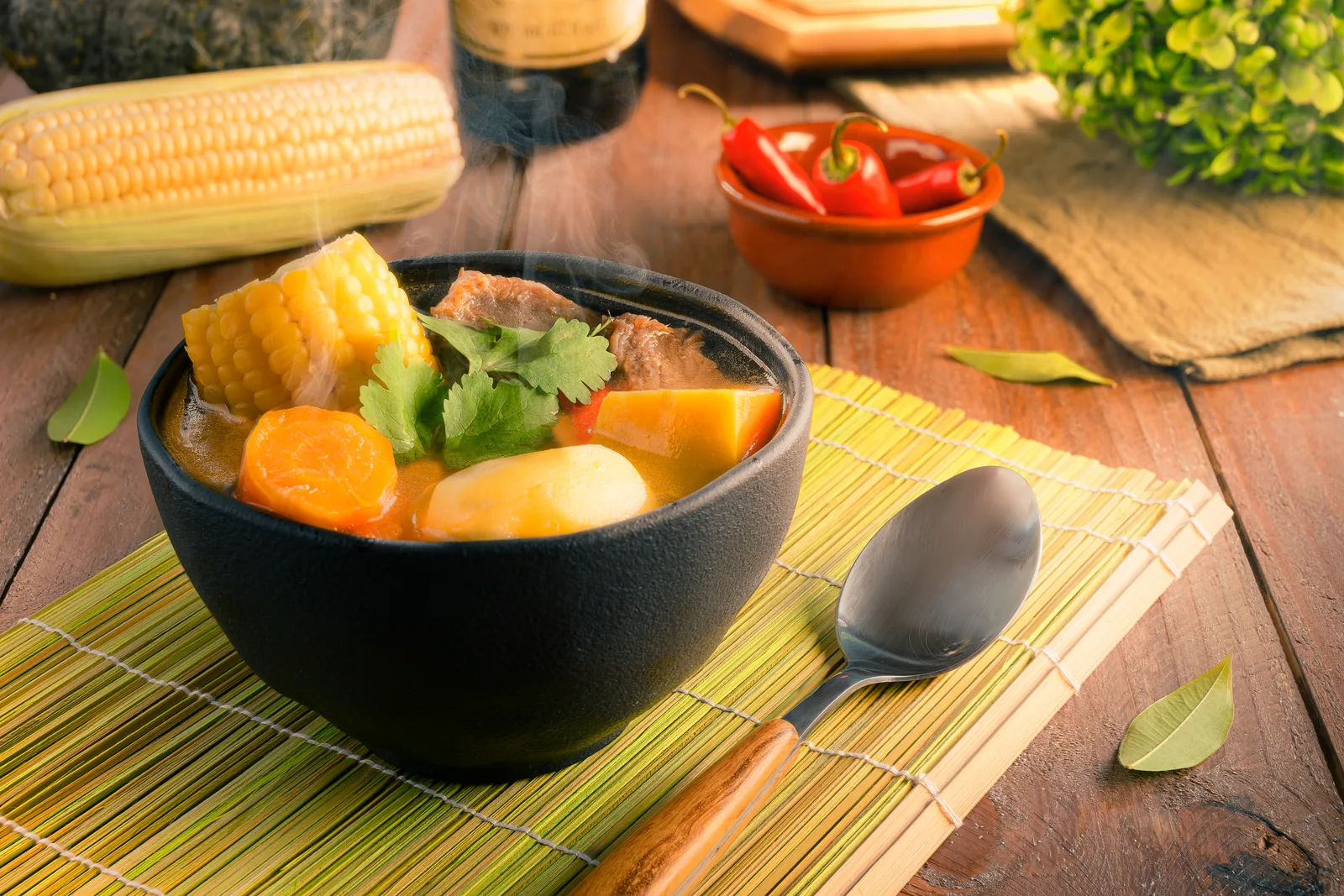

Cazuela (kah-SWAY-lah) is Chile’s everyday soup: a clear, golden beef broth served with one of everything in each bowl, a piece of meat on the bone, a whole potato, a chunk of squash and half an ear of corn, plus green beans and a little rice. It isn’t hard, but it rewards order. Bone-in beef shank needs 1½ hours alone at a gentle simmer, and only then do the vegetables go in, in three turns, so the potato and squash come out whole instead of dissolving into the broth. Below: which cut to ask for in a US or UK store, how to time the pot, a quicker chicken cazuela, and how Chileans serve it.
What Chilean cazuela is, and how long it takes
How do you make Chilean cazuela? Brown 2⅔ lb (1.2 kg) of cross-cut beef shank, soften onion, grated carrot and bell pepper, add 10½ cups (2.5 liters) of hot water, skim, and simmer covered for 1½ hours. Then add 6 whole potatoes; 10 minutes later the rice, corn and squash; 15 minutes after that the green beans, for 5 minutes. 170 minutes for 6 servings.
Total time 2 hours 50 minutes, of which about an hour is hands-on, spread out; the rest is the beef simmering on its own. Easy. The two things to watch are the order the vegetables go in and not stirring once the squash is in.
If you know Latin American beef soups, this one sits close to Mexican caldo de res, which uses the same cut but more vegetables, all chopped, with lime and tortillas at the table, and to Venezuelan beef hervido, built on taro, yam and cassava. Cazuela keeps everything whole and in the same bowl. It’s also made with chicken, pork, turkey or lamb; beef and chicken are the two most cooked at home.
Ingredients and US or UK swaps
Plan on one 7 oz (200 g) slice of bone-in shank per person.
| Ingredient | Metric | US | Notes |
|---|---|---|---|
| Beef shank, cross-cut | 1.2 kg | 2⅔ lb | 6 slices, 1¼ to 1½ in thick |
| Hot water | 2.5 liters | 10½ cups | Top up if it drops below the meat |
| Waxy potatoes | 6 × 150 g | 6 medium | Yukon Gold or red; UK Charlotte |
| Butternut or kabocha squash | 600 g | 1⅓ lb | 6 chunks of 3½ oz |
| Corn on the cob | 3 ears | 3 ears | Halved; frozen cobs work |
| Green beans | 150 g | 5 oz | 1¼ in lengths |
| Short- or medium-grain rice | 50 g | ¼ cup | Not long-grain |
The beef, and what to ask the butcher for
The meat has to survive 1½ hours of simmering and leave gelatin in the broth, so you want a tough cut full of connective tissue, ideally on the bone.
- Beef shank, as written. Cross-cut slices of the leg with the marrow bone in the middle. They give the fullest broth and meltingly soft meat. In the US they’re in the meat case of most supermarkets and at Latin butchers; ask for slices 1¼ to 1½ in (3 to 4 cm) thick, since thinner ones fall apart before the potatoes are done. In the UK, ask for beef shin on the bone, often sold as an “osso buco” cut.
- Brisket. Boneless and fattier. The meat shreds into long strands and the broth is lighter; if you can, add a marrow bone or one slice of shank and lift it out before serving.
- Short ribs. Flanken-style, cut across the bones (UK Jacob’s ladder cut the same way). Lots of flavor and more fat in the broth, which you’ll want to ladle off before the potatoes go in.
Squash, corn and potatoes
- Squash. The Chilean zapallo is a firm winter squash. Butternut or kabocha are the closest in a US or UK store. Cut big chunks, about 3½ oz (100 g), so they hold together for 20 minutes.
- Corn. Chilean choclo is less sweet than supermarket sweet corn, so your cazuela will taste a little sweeter; the timing doesn’t change. Frozen corn cobs go in straight from the freezer.
- Potatoes. Pick a waxy or all-purpose variety. Russets are floury and split on the outside before the center is cooked.
Rice, or chuchoca
The rice goes in raw and thickens the broth just slightly; ¼ cup for 6 keeps it a soup. Double it and you’re close to a porridge. Short- or medium-grain holds up better in broth than long-grain.
Chuchoca is dried, cracked, coarsely ground corn, used in Chile instead of rice: 1 tbsp per bowl, stirred in for the last 5 minutes. Coarse polenta or coarse cornmeal gives a similar result.
Equipment. An 8 liter (8 qt) pot with a lid, a slotted spoon and a ladle.
Game plan and make-ahead
You don’t need everything prepped before you start: the 1½ hours the beef spends alone is when you peel the potatoes (keep them in cold water so they don’t darken) and cut the rest.
Make ahead. Cook the beef in its broth (steps 1 to 4) the day before and refrigerate the pot as soon as it stops steaming, within 2 hours. Next day the fat sets on top and lifts off in one piece. Bring it back to a boil and carry on from the potatoes: dinner in about 45 minutes.
For 12. Double everything and use a 15 to 16 liter (16 qt) stockpot or two 8 liter pots. It takes longer to come to a boil, but the beef and vegetable times stay the same.
How to make cazuela, step by step
Brown the beef and build the broth. Dry slices, one layer, 4 minutes per side. That color, plus the browned bits you scrape up while the onion, carrot and pepper soften, is much of the broth’s color. Add the hot water, bring to a boil, and skim the gray foam for about 5 minutes until only a little white foam rises. Then low heat, lid on.
Check the beef at 1½ hours. A fork should slide in with no resistance and the meat should pull off the bone when nudged. If it’s still springy, give it 15 to 30 minutes more; thick slices and meat from older animals take longer. Don’t add the potatoes until the beef is tender, because once they’re in, the clock is set by them. If the broth has dropped below the meat, top up with hot water.
The order the vegetables go in
From hardest to softest, so everything is ready at the same moment:
- Whole potatoes, with 30 minutes to go. Whole, they don’t split or cloud the broth with starch.
- Rice, corn and squash, with 20 to go. Rice first, one stir along the bottom; corn and squash laid on top, and from now on no spoon in the pot.
- Green beans, for the last 5 minutes, so they stay green with a little bite.
Keep it at a gentle simmer the whole time: small bubbles. A rolling boil knocks the potatoes and squash against the pot and breaks them.
How to tell it’s ready. A knife slides into the center of a potato without breaking it, the squash gives when pierced but keeps its edges, the rice is soft and the green beans are bright green. Rest it covered for 5 minutes.
Chicken cazuela and a pressure-cooker version
- Chicken cazuela (cazuela de ave). Swap the beef for 6 bone-in, skin-on chicken drumsticks. Brown them 3 minutes per side, make the same base, add 2 liters (8½ cups) of hot water, and when it boils put the chicken and potatoes in together. At 10 minutes add the rice, corn and squash; at 25, the green beans; at 30, turn it off. The chicken is well past the 165°F (74°C) it needs. Lighter, clearer broth, on the table in 1½ hours: there is no long beef stage to peel and chop during, so prep all the vegetables first.
- Pressure cooker or Instant Pot. Browned beef, the softened base and the water go in; cook 30 minutes at high pressure on a stovetop cooker (36 in an electric one), then let the pressure drop naturally, about 15 minutes. Open it and finish the vegetables uncovered, exactly as above. About 2 hours in all. Don’t pressure-cook the vegetables; they turn to mush.
- With an old hen. A stewing hen needs 90 to 120 minutes alone before the vegetables, like the beef, and gives a richer, yellower broth.
- With chuchoca or polenta. No rice; 6 tbsp stirred in for the last 5 minutes. Thicker, yellower broth.
Why the squash fell apart, and other fixes
- Squash dissolved. It went in with the potatoes, the chunks were small, or the pot boiled hard. Use 3½ oz (100 g) chunks, add them with 20 minutes to go, simmer gently. If your squash is soft-fleshed, leave the skin on; I do, and the piece holds together and gets peeled at the table.
- Potatoes broken outside, hard inside. Floury potatoes, or a rolling boil.
- Mushy rice, thick broth. Too much rice, or it went in too early. If you plan to reheat, cook the rice separately and add it to each bowl.
- Tough beef. It needs more time, not less: another 15 to 30 minutes before the vegetables. A lean cut with no connective tissue, like a steak, stays dry however long it simmers.
- Greasy broth. Ladle the fat off before the potatoes, or cook the beef the day before and lift the fat off cold.
- Cloudy broth. It boiled hard or wasn’t skimmed.
Allergens, heat and kids. No gluten, dairy or egg. Not spicy; chopped green chile goes on the table for whoever wants it. Kids usually like it because every piece is whole and recognizable; for little ones, shred the beef off the bone.
How to serve cazuela
In deep bowls, right after the 5-minute rest, with one of everything per person: the meat, a potato, a chunk of squash, half an ear of corn, green beans and rice, and broth to cover. Cilantro on top; green chile, pebre or bread at the table. Pebre, the fresh Chilean salsa of tomato, onion and cilantro, is the one that comes with Chilean pumpkin sopaipillas.
Most people drink the broth first, then eat the meat and vegetables with a knife and fork, often mashing the potato and squash into what’s left of the broth. It’s a full meal on its own; for a Chilean spread, start with baked empanadas de pino.
Cost. The beef is most of the bill; everything else is everyday produce. The chicken version is the cheaper one.
Storing, freezing and reheating
- Fridge. Into a sealed container within 2 hours, then 3 to 4 days at 40°F (4°C) or below. The rice keeps drinking broth, so it’s thicker the next day.
- Freezer. 2 to 3 months, ideally without the potatoes, which turn watery and grainy when thawed. Freeze the beef, broth and squash, and cook fresh potatoes when you reheat. Thaw overnight in the fridge.
- Reheating. In a pot with about ½ cup (120 ml) of water for every 2 bowls, over medium heat, shaking the pot rather than stirring, until the broth boils.
Frequently asked questions
Is cazuela the same as a beef stew? No. Stew is thickened and the vegetables are chopped; cazuela is a brothy soup with the meat and vegetables in large whole pieces, eaten with a spoon and then a knife and fork.
Can I use boneless stew beef? Yes, but the broth will be lighter. A marrow bone or one slice of shank in the pot during the 1½ hours makes up for it.
Can I make it in a slow cooker? I haven’t tested timings for a slow cooker, so I don’t give them here. The pressure-cooker version above is the tested shortcut.
Why is my broth cloudy? A hard boil emulsifies the fat into the broth and breaks the potatoes, and unskimmed foam clouds it too. Keep it at a gentle simmer from the first boil.
Can I use stock instead of water? You can, but you don’t need to: the bone-in beef makes its own broth over the 1½ hours. Store-bought stock or bouillon is already salted, so hold back the second teaspoon of salt until you’ve tasted the broth, just before the potatoes go in.
Nutrition
Per bowl (one shank slice, a potato, a chunk of squash, half an ear of corn, green beans, rice and broth), worked out ingredient by ingredient from the quantities above:
- Calories: 490 kcal
- Protein: 39 g
- Carbohydrates: 67 g
- Fat: 9 g, of which 2 g saturated
- Fiber: 9 g
- Sugars: 12 g
- Sodium: 910 mg
The beef brings about 180 kcal a bowl and the potato about 115; corn and squash together, about 105. The figures use the lean meat of the shank without the bone, so the marrow and fat left in the broth add a little if you don’t skim it.
At home cazuela is a Sunday pot: I cook the beef on Saturday night, and on Sunday I just lift off the cold fat and add the vegetables. I always leave the skin on the squash and cook one extra potato in case one breaks. Josnaisis.