
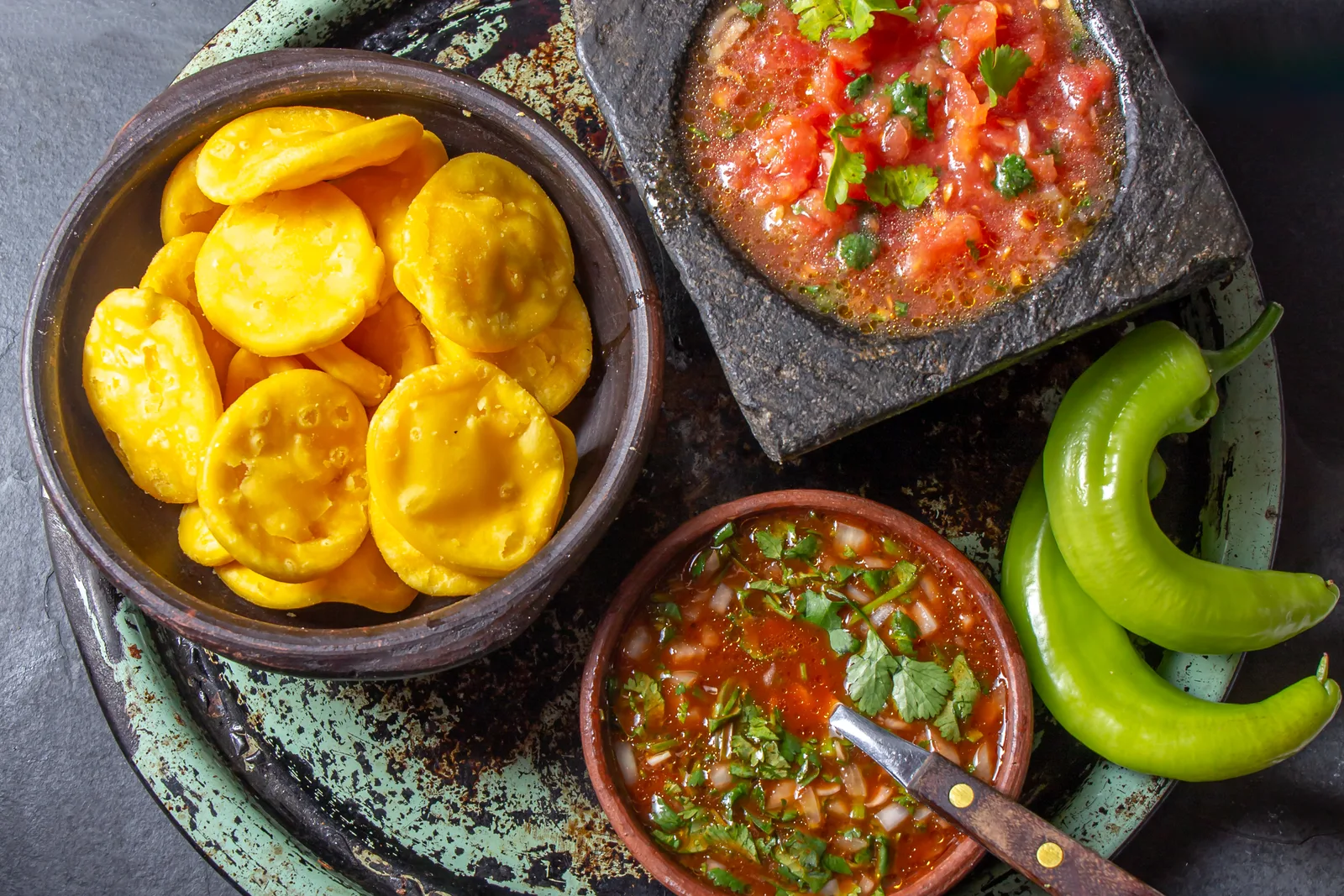

A Chilean sopaipilla (soh-pie-PEE-yah) is a flat, savory round of fried dough made with mashed squash, about 4 inches across and ¼ inch thick, pricked with a fork so it stays flat. It comes out golden with a crisp edge, an orange, tender crumb and only a hint of sweetness. In Chile it’s the snack for cold, rainy afternoons, spread with pebre, a fresh tomato and cilantro salsa, or with mustard, or soaked in a dark cane-sugar syrup with cinnamon and orange. Below is the recipe for 24 using canned pumpkin or fresh squash, how to fix a sticky dough, a quick pebre and the syrup, and how to freeze them.
Chilean sopaipillas vs New Mexico sopapillas
How do you make Chilean sopaipillas? Whisk 4 cups (500 g) of flour with 2 tsp baking powder and 1¾ tsp salt, add 15 oz (425 g) of cold pumpkin puree and 6 tbsp (80 g) of melted lard or shortening, and knead just until smooth. Rest 20 minutes, roll to ¼ in (5 mm), cut 4 in (10 cm) rounds, prick them and fry at 350°F (180°C) for 2 to 3 minutes per side. 125 minutes for 8 servings.
If you searched “sopaipillas” from the US, most results are the New Mexico sopapilla: a plain flour dough fried unpricked so it puffs into a hollow pillow, served with honey. The Chilean one is a different thing:
| Chilean sopaipilla | New Mexico sopapilla | |
|---|---|---|
| Dough | Flour, mashed squash, lard, baking powder | Flour, fat, leavening, water or milk |
| Shape | Flat round, pricked with a fork | Puffed, hollow square or triangle |
| Eaten with | Pebre, mustard, avocado, or soaked in syrup | Honey, or with savory meals |
| Color | Orange-gold | Pale gold |
If you’re cooking your way through Chile, pair them with Chilean empanadas de pino or the Chilean pastel de choclo.
Time. About 2 hours with fresh squash, not counting the pebre or the syrup, 40 minutes of which is cooking and cooling it. With canned puree it’s about 85 minutes. Easy: no yeast, no mixer. The only thing that needs your attention is the oil.
Ingredients and the pumpkin question
The recipe makes 24 rounds of 4 in (10 cm), 3 per person. For a crowd of 12 to 16, double everything and mix it in two bowls.
Canned pumpkin or fresh squash
In Chile the dough uses zapallo camote, a dense, sweet, deep-orange squash. Outside Chile:
- US. A 15 oz can of 100% pure pumpkin is the easiest option and the amount matches the recipe exactly. Check the label: pumpkin pie filling has sugar and spices and won’t work. Fresh butternut or kabocha are the closest to the Chilean squash.
- UK. Butternut squash from any supermarket. Canned pumpkin puree is sold in some larger supermarkets and online.
What matters is that the puree is cold and not watery. Warm puree melts the fat and makes the dough sticky; wet puree soaks up a lot more flour and the sopaipillas come out tougher. Canned puree goes in as it is. Fresh squash varies, so weigh the mash after draining and use 15 oz (425 g): how much 1 lb 2 oz (500 g) of peeled squash yields depends on the squash and the water it holds, so if you come up short, cook another chunk, and freeze any extra.
Fat and baking powder
- Lard or vegetable shortening is traditional and gives the most tender crumb. In the UK, Trex is the shortening.
- Margarine or butter work at the same weight. Butter adds a dairy flavor and means the sopaipillas are no longer dairy-free.
- Fresh baking powder. Drop ½ tsp into hot water: if it doesn’t fizz right away, it’s past its best and the rounds will be tough.
Equipment
A deep 10 to 11 in (26 to 28 cm) skillet or wide pot that holds 4 rounds without touching, a rolling pin, a 4 in (10 cm) round cutter or a wide glass, a fork and, ideally, a deep-fry or candy thermometer. Without one, drop in a scrap of dough: when the oil is ready it rises at once, ringed with bubbles. If it sits on the bottom the oil is too cool; if it darkens in seconds, too hot.
How to make sopaipillas, step by step
Cool, dry puree
Cook 1¼ in (3 cm) cubes from cold water for 15 to 20 minutes after boiling, until a fork goes through easily. Let them drain 5 minutes, mash and spread thin on a plate: it’s cool in about 20 minutes. Keep half a cup of the cooking water in case the dough needs it.
A short knead
Mix the dry ingredients first so the baking powder is evenly spread, then add the puree and the melted fat, warm but not hot. Knead 2 or 3 minutes, until the dough is smooth, evenly orange and no longer sticky. Keep going and the dough turns elastic, shrinks back when you roll it and fries up tough.
Because squash never holds the same amount of water twice, adjust as you go:
- Sticky dough. Add flour 1 tbsp at a time until it stops sticking.
- Cracking, crumbly dough. Add cooking water 1 tbsp at a time.
Cover it and rest 20 minutes. The rest relaxes the dough so it rolls out without springing back.
Roll, cut, prick
Work with half the dough at a time on a floured counter. Roll it to ¼ in (5 mm), cut 4 in (10 cm) rounds and prick each one 3 or 4 times right through. The holes let steam out; without them a sopaipilla balloons and cooks unevenly. Press the scraps together without kneading, roll once and cut; a third rolling makes them tough.
For thinner, crackly sopaipillas, roll to ⅛ in (2 to 3 mm) and fry 1 to 2 minutes per side. You’ll get more rounds, and they snap instead of bend.
Fry at 350°F (180°C)
1.5 liters (6⅓ cups) of oil in a 10 to 11 in skillet gives about 1 in (2.5 cm) of depth, plenty for them to float. Fry 4 at a time, 2 to 3 minutes per side, turning with tongs or a slotted spoon once the underside is golden. They puff a little in the middle; that’s normal.
They’re done when both sides are evenly golden, the edge crackles when you press it and the inside is soft and dry when you tear one open. Move each batch to a rack or paper towels and wait for the oil to come back to 350°F (180°C). All 24 take 6 batches, about 35 minutes.
Why sopaipillas turn out hard, greasy or raw
- Hard. Over-kneaded dough, scraps rolled out several times, or old baking powder. Knead only until smooth and test the baking powder first.
- Greasy and heavy. The oil dropped below 340°F (170°C), usually from crowding the pan. Four at a time in a 10 to 11 in skillet lets it recover quickly.
- Brown outside, raw inside. Oil too hot or dough thicker than ¼ in (5 mm). Lower the heat and roll thinner.
- Ballooned. Not enough pricking. Prick right through, 3 or 4 times.
- Dough won’t roll out. The puree was warm or watery. Cool it first and correct with flour.
Allergens. Contains wheat (gluten). No eggs; made with margarine or vegetable shortening, it’s also dairy-free and vegan. There’s no heat in the dough; any spice is in the pebre.
Sopaipillas pasadas, soaked in chancaca syrup
For the sweet version, fry the rounds as above and simmer them for a few minutes in hot syrup until they’re soaked through, soft and glossy. Eat them warm, with a spoon or plenty of napkins.
Syrup for all 24:
- 400 g (14 oz) chancaca, piloncillo or panela, chopped
- 750 ml (3 cups) water
- 1 cinnamon stick
- Peel of ½ orange, without the white pith
- 2 whole cloves (optional)
- 1 tbsp (8 g) cornstarch (UK cornflour) mixed with 2 tbsp cold water (optional, for a thicker syrup)
Put the chancaca, water, cinnamon, orange peel and cloves in a wide pot over medium heat and cook 10 minutes, stirring, until the sugar has dissolved completely. Stir in the cornstarch mixture and boil 1 minute, until slightly thickened. Fish out the spices and peel, turn the heat to low and add the freshly fried sopaipillas 6 at a time for 5 to 8 minutes, turning them, until soaked but still in one piece. Spoon a little extra syrup over to serve.
What to use instead of chancaca
Chancaca is unrefined cane sugar sold in hard blocks, the same product as Mexican piloncillo and Latin American panela, and they swap at the same weight. In the US, piloncillo cones are in the Latin aisle of most large supermarkets; in the UK, look for panela in Latin shops and online. The same dark syrup soaks the Latin torrejas, fried bread in piloncillo syrup, and a fig-and-orange version goes over Peruvian picarones, yeasted rings that also use squash.
If you can’t find any of them, dissolve ½ cup (170 g) of dark molasses (UK black treacle) in the water and sweeten with dark brown sugar to taste. The color and the cane depth come close, with a more bitter edge. With brown sugar alone, the syrup is lighter and flatter.
What to serve with sopaipillas, and a 10-minute pebre
Chileans spread, bite and spread again. The usual toppings:
- Pebre, Chile’s fresh salsa of tomato, onion and cilantro.
- Mustard, plain or mixed with chili paste.
- Mashed avocado with salt.
- Pasadas, with the syrup above.
Pebre for 4. Seed and finely dice 2 ripe tomatoes (300 g / 10½ oz). Finely chop ½ onion (75 g / 2½ oz), soak it 5 minutes in cold water and drain, which takes the bite out. Mix with 4 tbsp chopped cilantro (UK coriander), 1 green chili or jalapeño, seeded and minced, 2 tbsp lime or lemon juice or vinegar, 1 tbsp oil and salt, starting with ½ tsp. Let it sit 30 minutes so it releases its juices. It’s a cousin of Argentinian chimichurri, but with tomato and no oregano.
Variations for a crowd, without pumpkin or thinner
- Without pumpkin, as in southern Chile. Replace the puree with about 330 ml (1⅓ cups) of warm water, added gradually until the dough is smooth and not sticky. They come out paler and more like plain fried bread, with a slightly firmer crumb.
- Party size. Cut 2½ in (6 cm) rounds at the same ¼ in thickness and fry to the same golden color. The recipe gives about 60, good with a bowl of pebre in the middle.
- Sweet potato. Some Chilean cooks use cooked, mashed sweet potato instead of squash. Adjust the dough with flour or water exactly as above.
If you like Latin fried doughs, Venezuela’s mandocas, rings of corn dough, ripe plantain, cane sugar and cheese are the sweet-dough cousin, and the churros guide covers frying at the same temperature.
How to freeze and reheat sopaipillas
Raw, the way I recommend. Cut and prick the rounds, layer them on a tray with parchment between layers, freeze for 2 hours until firm, then bag them. Fry them straight from frozen at 340 to 350°F (170 to 180°C), turning until golden on both sides. They take a little longer than fresh ones. Brush off any loose frost first and don’t fry rounds with ice stuck to them, because the water makes the oil spit; lower them in carefully, one at a time. I use them within 3 months, the same as frozen squash puree.
Fried. Once completely cool, bag and freeze, or keep up to 2 days in a sealed container at room temperature; after that they harden. Reheat in a hot oven or air fryer for a few minutes, until the edge crisps again. The microwave makes them soft.
Pasadas. Best the same day. Refrigerate leftovers covered and warm them for a few minutes in a little syrup over low heat.
Puree. Cooked extra squash? Freeze it in 15 oz (425 g) portions for up to 3 months and the next batch takes 85 minutes.
Sopaipillas FAQ
Can I make the dough a day ahead? Make the puree up to 3 days ahead and keep it in the fridge. Dough with baking powder is best fried the day you mix it; to get ahead, freeze the cut rounds raw.
Why was my dough sticky even though I followed the amounts? Your squash held more water. It happens with freshly boiled squash that wasn’t drained long enough. Work in flour 1 tbsp at a time; next time drain it 5 minutes longer, or roast the squash in chunks instead of boiling it for a drier mash.
Are they sweet? Not on their own. The squash adds color and a faint sweetness, but they’re savory bread, meant for salsa or mustard. The sweet version is the syrup-soaked pasadas.
Nutrition per serving
Per serving (3 sopaipillas of 4 in / 10 cm, without pebre or syrup), calculated from the recipe amounts plus the oil they absorb while frying:
- Calories: 445 kcal
- Protein: 7 g
- Carbohydrates: 52 g
- Fat: 23 g, of which 4 g saturated
- Fiber: 3 g
- Sugars: 2 g
- Sodium: 580 mg
Each sopaipilla is about 148 kcal. More than half the fat comes from the frying oil, another reason to keep it at 350°F (180°C): cooler oil means more of it ends up inside. The syrup in the pasadas adds sugar on top.
With auyama, the orange squash sold in Colombia, the mash never comes out the same twice, so keep extra flour and the cooking water within reach. The pasadas are cousins of what we do in Venezuela with papelón, and to make a batch stretch, send half to the pebre bowl and give only half the syrup. Josnaisis.