
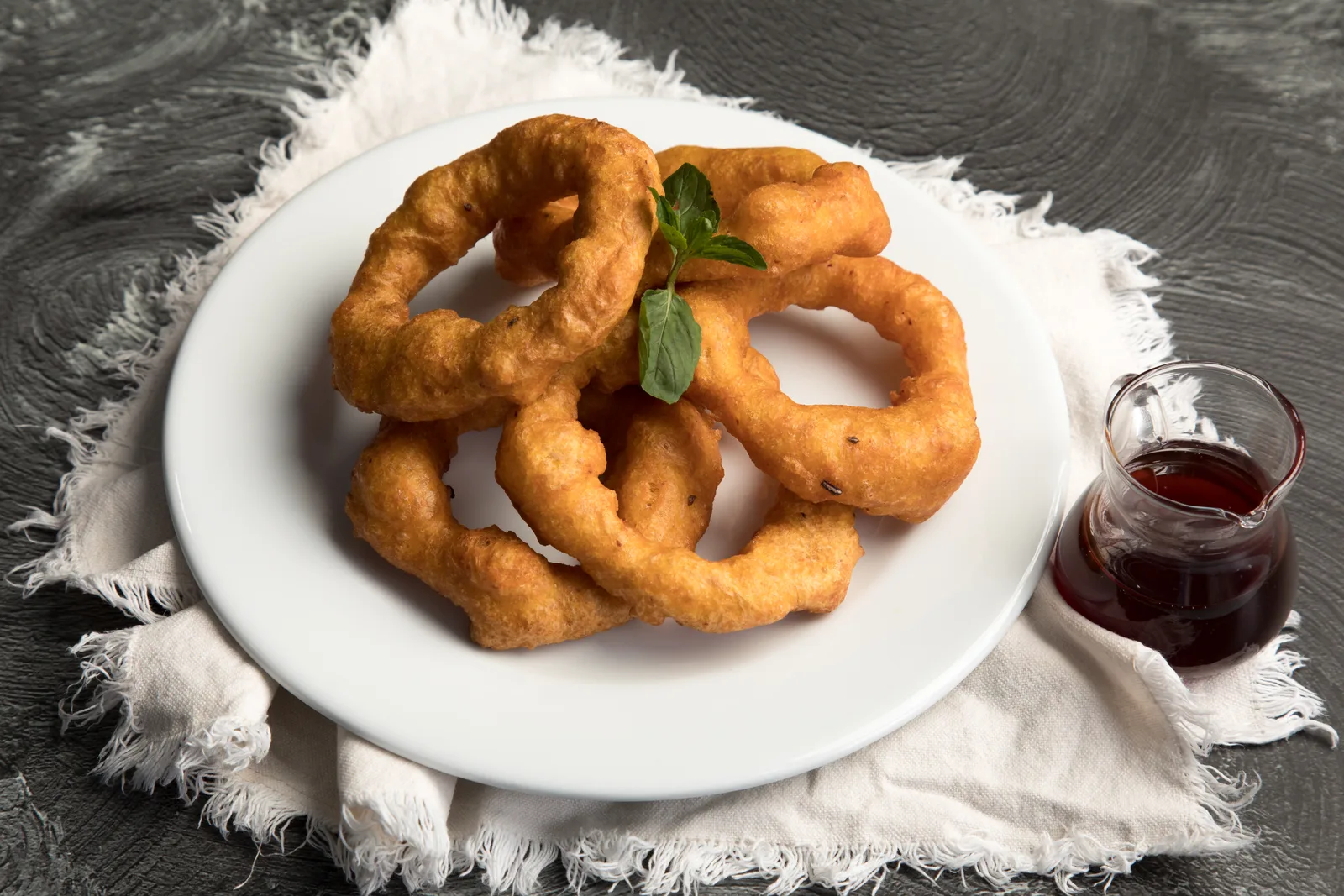

Half the dough for Peruvian picarones (pee-kah-ROH-nes) is mashed squash and sweet potato, 9 oz of each, raised with yeast, stretched by hand into rough rings, fried until crisp and hollow, and soaked in a dark syrup of unrefined cane sugar, orange and spice. They’re a Lima street-cart dessert, often fried to order, and nothing like a cake doughnut: the outside shatters, the inside is airy and a little chewy, and the syrup does the sweetening. The hard part isn’t the recipe, it’s trusting a dough so sticky you can’t knead it. Here’s how to get it right in an American or British kitchen.
What picarones are, and what makes them work
How do you make Peruvian picarones? Boil 9 oz (250 g) each of squash and sweet potato with aniseed, mash them and mix with 4 cups (500 g) of flour, yeast and the cooking water into a very soft, sticky dough. Let it rise for 2 hours, shape rings with a wet hand and fry at 350-355°F (175-180°C) for about 2 minutes a side, then pour chancaca syrup over them. 210 minutes for 6 servings.
Three things decide the result, and all three are in this article:
- A wet, sticky dough. Half of it is vegetable purée, so it behaves more like a thick batter than a bread dough. That moisture is what turns to steam in the oil and leaves the rings hollow.
- A wet hand. It’s the only way to shape a dough this loose.
- Oil at 350-355°F (175-180°C). Fried cooler, they’re greasy; hotter, they’re dark outside and doughy inside.
Since 2025, Peru has marked a National Picarones Day on the third Friday of October.
Time and effort. About 3½ hours, of which a little over an hour is work: 40 minutes making the dough, a 2-hour rise during which you make the syrup, and half an hour at the stove. Medium difficulty, only because shaping takes 5 or 6 practice rings.
How they differ from other Latin fritters
| Picarones (Peru) | Mandocas (Venezuela) | Colombian buñuelos | Mexican buñuelos | |
|---|---|---|---|---|
| Dough | Wheat flour, squash, sweet potato | Corn flour, ripe plantain, cheese | Cheese, cornstarch, tapioca | Wheat flour, egg, butter |
| Leavening | Yeast, 2-hour rise | None | None | Baking powder |
| Shape | Hand-stretched ring | Ring | Ball | Thin disk |
| Texture | Hollow, crisp, chewy | Dense, soft | Puffy, cheesy | Glass-crisp |
| Sweetened by | Spiced syrup poured over | Cane sugar in the dough | Not sweet | Cinnamon sugar or syrup |
Ingredients and US and UK swaps
This makes about 30 rings of 1½ oz (40 g) of dough each, five per person for six people. Full quantities are in the recipe card above.
The squash
Peruvians use zapallo macre, a big squash with dense, sweet, orange flesh. You won’t find it outside Latin markets, and you don’t need it:
- Kabocha is the closest match: dry, sweet and deeply orange. US supermarkets and Asian grocers carry it, mostly in fall.
- Butternut squash is in every US and UK supermarket year-round. Its purée is a little wetter, so you may need less of the cooking water.
- Canned pumpkin works for a shortcut version (see Variations). It must be 100% pumpkin, never pumpkin pie filling, which is already sweetened and spiced.
- Skip carving pumpkins and spaghetti squash: watery, stringy and bland.
The sweet potato
Any sweet potato works. In the US, the orange-fleshed kind is often labeled “yam”, but it’s the same sweet potato; true yams are a different, starchier tuber. Orange flesh gives a more golden ring, pale flesh a paler one, with the same flavor underneath. In the UK, ordinary supermarket sweet potatoes are fine.
Chancaca, and what to use instead
Chancaca is unrefined cane sugar, the cane juice boiled down and set into blocks. Mexican piloncillo and Colombian panela are the same product, and any of them makes the same dark syrup.
- US. Piloncillo cones are in the Hispanic aisle of most large supermarkets. Peruvian chancaca turns up in Latin grocery stores and online.
- UK. Panela is sold online and in Latin American shops. Dark muscovado sugar is the easiest supermarket swap and comes very close.
- Dark brown sugar, same weight, gives a lighter, less complex syrup. Still good.
- Molasses on its own is too bitter and thick; if you use some, mix it with brown sugar.
Fig leaves give the syrup a green, fruity note. If you have a fig tree, use two; otherwise two dried figs add something similar. Without either, orange, cinnamon and cloves still make a proper syrup.
Equipment
A heavy pot about 7 in (18 cm) wide and at least 5 in (12 cm) tall, where 1.5 liters (6 cups) of oil comes about 2½ in (6 cm) up the side and no more than halfway, leaving room for it to bubble up when the dough goes in. A deep-fry or candy thermometer, a large bowl, a wooden chopstick or skewer for turning, and a wire rack. No thermometer? Drop in a pea-sized bit of dough: it should rise to the surface at once and float in a ring of bubbles, never sink.
Game plan
| When | What |
|---|---|
| Up to 1 week ahead | Make the syrup and keep it in a jar in the fridge |
| 3½ hours before serving | Boil the squash and sweet potato (15-20 min), cool the purée (15 min) |
| 3 hours before | Mix the dough (10 min of slapping by hand) |
| During the 1½-2 hour rise | Make the syrup if you didn’t make it ahead |
| 30 minutes before | Heat the oil (about 10 min), then shape and fry in batches |
How to make picarones
Mixing and rising the dough
Boil the vegetables until they collapse, 15 to 20 minutes, and keep that anise-flavored water: it goes into the dough. The yeast water should be 104-113°F (40-45°C); if it feels hot on your finger, it’s hot enough to kill the yeast.
Don’t expect a smooth ball. Use one hand like a paddle, lifting the dough and slapping it back into the bowl for 10 minutes. It’s ready to rise when:
- It’s sticky on your fingers but pulls away from the bowl in one mass.
- It stretches into long strands when you lift it.
- It’s glossy, with no dry flour or lumps of purée.
After 1½ to 2 hours somewhere warm, it should have doubled and be full of bubbles on top and along the sides. In a cold kitchen it takes longer, so go by the volume rather than the clock.
The syrup
Simmer the chancaca with 2 cups (500 ml) of water and the spices for 25 to 30 minutes, until it has lost about a third of its volume and coats a spoon in a slow, even layer. It thickens a lot as it cools, so stop before it looks like thick syrup in the pan, or it will set hard.
Shaping with wet fingers
- Dip your whole hand in the bowl of salted water and shake off the excess.
- Scoop a walnut-sized piece of dough, about 1½ oz (40 g), with your fingers curled like a hook.
- Push your thumb through the center and stretch the dough around it into a 3 to 4 in (8 to 10 cm) ring, keeping the rim no thinner than about ⅜ in (1 cm).
- Lower your hand close to the oil and let the ring go.
- If the hole closes up, stick the chopstick in and swirl it to open the ring again.
- Wet your hand before every ring. A dry hand sticks, and the ring tears.
Your first few will be lopsided. That’s normal: homemade picarones are never perfect circles.
Frying
Fry 3 or 4 at a time. Each ring cools the oil, and a crowded pot drops below 340°F (170°C), which is when they turn greasy. Give them about 2 minutes per side, flipping with the chopstick, until deep golden and crisp when tapped. Let the oil come back to 350°F (175°C) between batches.
Troubleshooting
- Heavy, dense rings. The dough was too stiff, from too little water or extra flour. Keep it sticky and let the wet hand do the work.
- The dough didn’t rise. The water was too hot, the yeast was old, or the kitchen is cold. If the yeast didn’t foam after 10 minutes, start that step again with a fresh packet. If it did, give the dough more time somewhere warm.
- Greasy picarones. Oil below 340°F (170°C) or too many in the pot.
- Dark outside, raw inside. Oil above 365°F (185°C) or rings that are too thick. Turn the heat down and stretch them thinner.
- The hole closed up. Open it with the chopstick during the first few seconds in the oil.
- Syrup set hard or crystallized. It was reduced too far. Warm it with 3 or 4 tbsp of water until it flows.
- Thin, runny syrup. Simmer it another 5 to 10 minutes.
Allergens and diets. Contains wheat gluten. The classic recipe has no eggs or dairy, so it’s vegan. No chile, no heat.
Variations and scaling
- Squash only. Use 500 g (1.1 lb) of squash and no sweet potato. Just as hollow, a little less sweet.
- Canned pumpkin. Use 500 g (about 2 cups) of 100% pumpkin purée. It’s wetter than homemade, so start the dough with 100 ml (scant ½ cup) of warm water with ground aniseed and add more only if it won’t stretch into strands.
- With beer. Some cooks swap part of the cooking water for warm beer. The dough handles the same and you look for the same signs.
- For a crowd of 12 to 20. Double everything, with 1 kg (about 8 cups) of flour, for around 60 picarones. If you can, run two pots with two people shaping. Picarones soften as soon as they cool, so fry and serve in waves rather than all at once.
Cost. The oil is the biggest expense. Once it’s cool, strain it and keep it covered for another sweet fry, such as homemade churros.
Serving and leftovers
Serve 4 or 5 per plate, straight from the oil, with 3 or 4 tablespoons of warm syrup poured over and more on the table. They’re good with coffee, or with a mug of Peruvian hot chocolate on a cold afternoon. If you’re planning a Peruvian dinner, pick either these or a suspiro a la limeña for dessert; both together is a lot of sugar.
- Eat them fresh. As they cool they go from crisp to chewy, faster once they’re in syrup. Pour the syrup on at the table.
- Syrup. Keeps up to 1 week in a closed jar in the fridge. Warm just what you need.
- Dough. Fry all of it the same day, once it has doubled. Over-risen dough tastes yeasty and goes flat.
- Leftover rings. Store them without syrup, covered, until the next day. I reheat them in a 350°F (180°C) oven for 4 to 5 minutes to bring back some crunch; the microwave leaves them soft.
Picarones FAQ
Can I make picarones in an air fryer? No. The dough is almost a batter and won’t hold a ring shape on a basket; it slumps through the gaps and bakes into flat bread. It needs hot oil to set the outside in seconds.
Can I mix the dough in a stand mixer? Yes, with the paddle rather than the dough hook, which just spins a dough this loose around. Look for the same signs as by hand: it pulls away from the bowl in one mass and stretches into strands. A hand mixer’s beaters clog.
Are picarones the same as doughnuts? They’re a yeast-raised fried ring, so they’re related, but there’s no egg, butter or milk, and 500 g (1.1 lb) of the dough is vegetable purée, and they’re never glazed. The sweetness comes entirely from the syrup poured on at serving.
Nutrition per serving
Per serving of 5 picarones (one sixth of the batch) with all the syrup shared out, worked out ingredient by ingredient from the recipe quantities, using brown sugar as a stand-in for chancaca and butternut for zapallo, and allowing about 100 g (3½ oz) of oil absorbed across the whole batch:
- Calories: 676 kcal (about 135 per picarón with its syrup)
- Protein: 10 g
- Carbohydrates: 120 g
- Fat: 18 g, of which 1 g saturated
- Fiber: 5 g
- Sugars: 45 g, mostly from the syrup
- Sodium: 232 mg
Absorbed oil is the number that moves most: fry below 340°F (170°C) and the fat climbs quickly. With half the syrup, a serving drops to about 600 kcal.
What I had to unlearn with picarones is the urge to fix a sticky dough with more flour. Every instinct says to firm it up so it behaves, and every time it costs you the hollow, crackly ring. So the bowl of salted water goes next to the pot before I light the burner, my hand gets dunked before every single ring, and the first one out of each batch is mine, as a test of the oil. Josnaisis.