
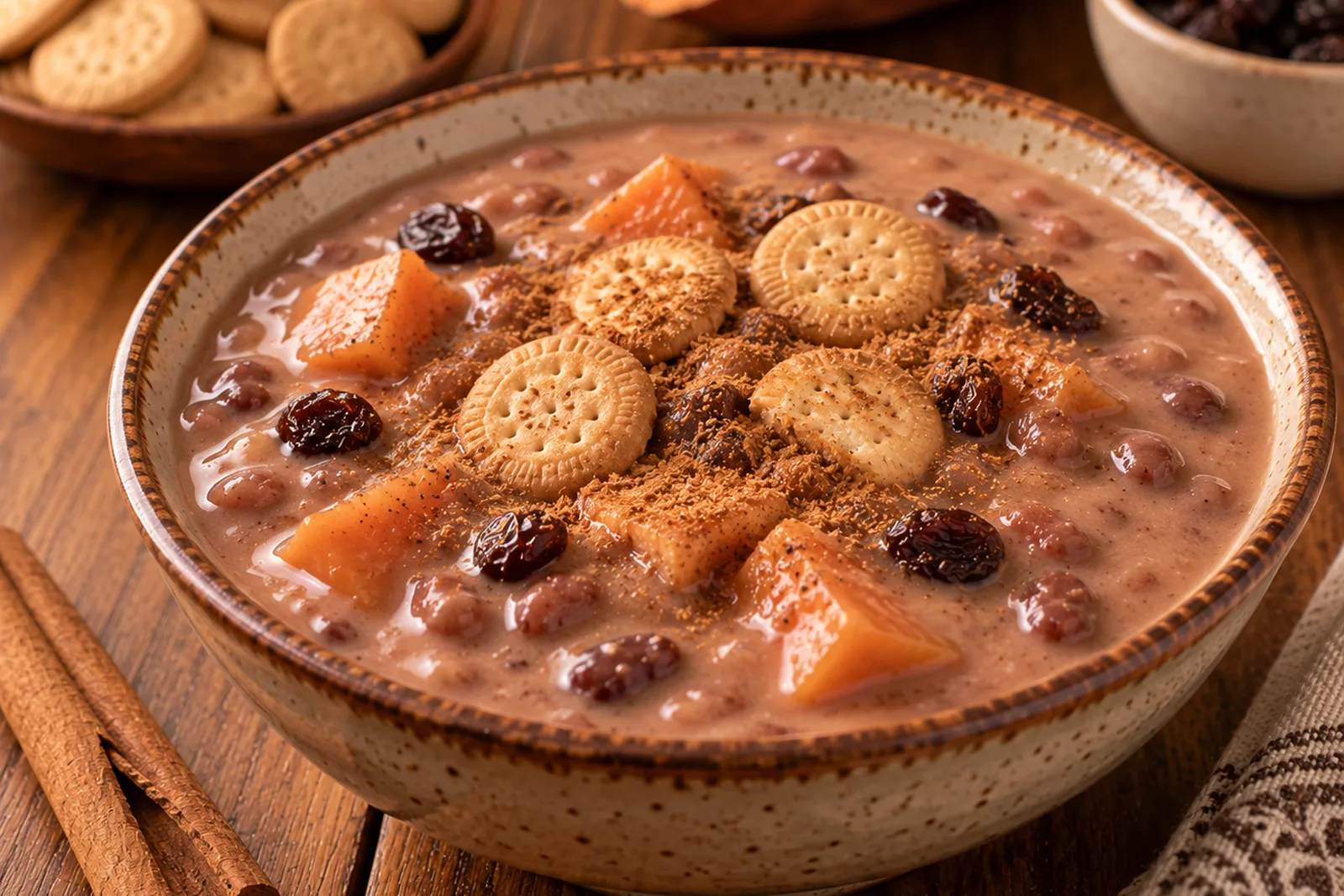

Habichuelas con dulce (ah-bee-CHWEH-lahs kohn DOOL-seh), “beans with sweetness,” is what the Dominican Republic eats during Lent and Holy Week: red beans blended until smooth, strained, and simmered with evaporated milk, coconut milk, cinnamon and cloves, with soft cubes of sweet potato and raisins. It’s served in a bowl and eaten with a spoon, warm or cold, with crisp milk cookies on top. If “sweet beans” sounds odd, think of it the way you’d think of pumpkin pie: the beans give body and an earthy color, and the cream and spices do the rest.
What habichuelas con dulce tastes like
How do you make habichuelas con dulce? Blend 3 cups (500 g) of cooked red kidney beans with 4 cups (960 ml) of water and strain out the skins. Simmer the liquid over medium heat with evaporated milk, coconut milk, sugar, cinnamon and cloves, add diced sweet potato for 20 minutes and raisins for 10 more, scraping the bottom constantly, until it coats a spoon like cream soup. 55 minutes for 8 bowls.
The texture is a pourable cream, somewhere between a thick milkshake and a cream soup, never a paste. It tastes of milk, coconut and warm spices, with only a faint bean flavor in the background. Families make it in big pots and carry containers of it to relatives and neighbors over Holy Week, so it’s one of the best desserts in this collection for feeding a crowd.
Time and effort. 55 minutes with canned beans: 15 to blend, strain and dice, 40 at the stove, most of it stirring. Dried beans add an overnight soak and 1 to 1¼ hours of cooking. It’s easy; the only real skill is not walking away from the pot.
Don’t confuse it with savory Puerto Rican habichuelas guisadas, stewed beans eaten over rice. Same word for beans, completely different dish.
Ingredients, and what to buy in the US and UK
The recipe makes 8 bowls of a generous cup each.
Canned or dried beans
- Canned, as in the recipe card: two 15.5 oz (439 g) cans of red kidney beans give about 3 cups (500 g) drained. Rinse off the salty canning liquid. UK 400 g tins hold about 240 g of beans once drained, so two tins plus a few spoonfuls from a third get you there.
- Dried: ½ lb (225 g) gives the same 3 cups cooked. Blend them with their cooking liquid instead of tap water for a darker color and more flavor.
- Which bean. Red kidney beans are the easiest to find. Pinto beans work and make it a little paler. Black beans change both color and flavor.
The milks
- Evaporated milk is the unsweetened kind in a can, not sweetened condensed milk. Both are on the baking aisle in the US and next to the custard and tinned milks in the UK.
- Canned full-fat coconut milk, not the coconut drink in a carton, which is mostly water and leaves it thin. To skip coconut, use another 400 ml (1⅔ cups) of evaporated milk or whole milk: it’s less rich and loses the coconut note.
Sweet potato, spices and cookies
- Sweet potato. The Dominican batata has purple skin and firm white flesh. Latin and Caribbean grocers sell it as batata or boniato. The orange sweet potato from any supermarket works, but it softens faster and adds more sweetness and an orange tint: cut it into ⅝ in (1.5 cm) cubes and start checking at 15 minutes.
- Spices. Whole cinnamon sticks and whole cloves. Count the cloves in (there are 6) so you can count them out, or tie them in a tea infuser. Nutmeg goes in at the end because its aroma fades with long boiling.
- The cookies. Dominican galletitas de leche are small, plain, lightly sweet milk cookies, sold in the Latin aisle of many US supermarkets. Animal crackers are the closest stand-in in the US; in the UK, Marie or Rich Tea biscuits. Some families serve toasted casabe (cassava flatbread) instead.
Cooking dried beans for this recipe
- The night before. Cover ½ lb (225 g) of dried kidney beans with water by about 3 in (7 cm) and soak at least 5 hours, ideally overnight.
- Cook. Drain, cover with 6 cups (1.4 liters) of fresh water and bring to a full boil. Lower to medium-low and keep at a steady, visible boil, uncovered, for 1 to 1¼ hours, until a bean squashes easily between two fingers. Top up with hot water if the beans poke out.
- Measure. Drain, saving the liquid, and top it up with water to 4 cups (960 ml). Then follow the recipe card.
Raw or undercooked red kidney beans contain a natural toxin that causes vomiting and diarrhea, and only real boiling destroys it. Never cook dried kidney beans in a slow cooker unless they’ve been boiled for at least 30 minutes first; slow cookers don’t get hot enough. In a pressure cooker, use the time your manual gives for soaked red kidney beans and check that they squash easily before blending.
How thick it should be, and what goes wrong
The right consistency. After 40 minutes it coats the back of a spoon in a thin layer, and a finger drawn through it leaves a line that holds for a moment. In the pot it still looks runny, like cream of tomato soup. That’s correct: it thickens a lot in the fridge. If you cook it until it looks thick while hot, it sets into a pudding-like paste once cold.
Common problems
- Gritty. Not blended or strained enough. Blend until no pieces remain and press the sieve until only skins are left.
- Tastes burnt. Milk caught on the bottom. Scrape the bottom with a wooden spoon every 2 or 3 minutes and stay at medium or below. If it does catch, pour it into a clean pot without scraping up the scorched layer.
- Too thick once cold. Stir in ½ cup (120 ml) of cold milk. Next time, take it off the heat sooner.
- Thin even when cold. It needed more time, or the coconut milk was the carton kind. Simmer 10 minutes more, uncovered, stirring.
- Sweetness. ¾ cup (150 g) of sugar gives a medium-sweet result. Taste after the raisins go in, since they add sweetness too, and go up to 1 cup (200 g) if you like it sweet the way many Dominican homes do.
Allergens and who it suits. Contains milk and coconut, and the cookies contain wheat. Not spicy. Kids usually like it, especially cold. Leave out the raisins for picky eaters.
Variations and scaling up for a crowd
- With sweetened condensed milk. A common Dominican variation. Cut the sugar in half and stir in condensed milk a little at a time at the end, tasting: it gets sweeter, thicker and more caramel-like.
- With ginger or star anise. A 1½ in (4 cm) piece of bruised ginger or 3 star anise pods go in with the cinnamon and come out at the end. They make it more aromatic.
- No sweet potato. Smoother and lighter. Nothing else changes.
- Dairy-free. Use a second 400 ml (13.5 fl oz) can of coconut milk instead of the evaporated milk. It comes out paler and tastes strongly of coconut. Carton plant milks make it watery.
- For 12. Multiply by 1½: 3 cans of beans, 6 cups (1.4 liters) of water, 1½ cans of each milk and a 13 oz (375 g) sweet potato.
- For 24. Triple it: 6 cans of beans, 12 cups (2.9 liters) of water, 3 cans of each milk and 1⅔ lb (750 g) of sweet potato. Use a 12 qt (12 liter) stockpot or two medium pots: a crowded pot scorches more easily. It takes much longer to come to a simmer, so keep stirring; once it bubbles, the times are the same.
For an Easter table, make it the day before: it’s at its best cold and all that’s left is the cookies. If you want a second Lenten dessert, Mexican capirotada with piloncillo syrup is also baked a day ahead, and Venezuelan majarete, a set coconut and corn pudding, shares the same cinnamon and clove. There are more meatless ideas in our Lent recipes.
Serving, storing and reheating
Serving. In bowls or cups, with 2 or 3 cookies on top or casabe on the side. Cold from the fridge, warm or hot are all traditional; to serve it cold, give it a few hours in the fridge.
Cooling safely. It’s a milk-based dish, so don’t leave it out at room temperature for more than 2 hours. A full pot takes a long time to cool in the middle: divide it into shallow containers before refrigerating.
Fridge. Covered, up to 3 days. If it smells sour, fizzes or tastes tangy, throw it out.
Freezer. 2 to 3 months in airtight containers. Thawed, the coconut milk may separate and the sweet potato softens further: whisk it or give it a few seconds in the blender. Poured into ice-pop molds, it also makes creamy popsicles.
Reheating. In a pot over medium-low, stirring, with a splash of milk if it has thickened, until steaming throughout (165°F / 74°C). In the microwave, in 1-minute bursts, stirring between each.
Habichuelas con dulce FAQ
Why is it eaten at Easter? It’s the Dominican Lenten sweet, made for Ash Wednesday, some Lenten Fridays and above all Holy Week, when many families skip meat. The oldest written mention usually cited is from 1798, when a French traveler described sugared beans being made in Santo Domingo for Holy Week.
Can I skip straining it? You can, but it’ll be grainy with bits of skin, and it loses the smooth, creamy texture that defines it. No fine sieve? Line a regular one with a clean cloth.
Can I use leftover savory beans? No. Beans cooked with onion, garlic or a stock cube carry those flavors into the dessert. Use plain canned beans or beans cooked in water only.
Is it like Asian sweet red bean desserts? Only loosely. Those usually use small adzuki beans, often left whole or as a paste. This uses kidney beans, strained to a liquid, with dairy, coconut and baking spices.
Habichuelas con dulce nutrition
Per bowl (1 of 8), without cookies or casabe, worked out from the recipe card quantities:
- Calories: 361 kcal
- Protein: 10 g
- Carbohydrates: 51 g
- Fat: 14 g, of which 11 g saturated
- Fiber: 5 g
- Sugars: 31 g
- Sodium: 242 mg
About a quarter of the calories come from the coconut milk and a fifth from the sugar. With 1 cup (200 g) of sugar instead of ¾, it’s around 385 kcal a bowl.
The hardest part for me was learning to take it off the heat while it still looks too thin. Every instinct says to keep going until it thickens, and that’s exactly how you end up with a pudding in the fridge. I make it the night before, taste it cold before deciding whether it needs more sugar, and add the cookies at the table, when they still crunch. Josnaisis.