
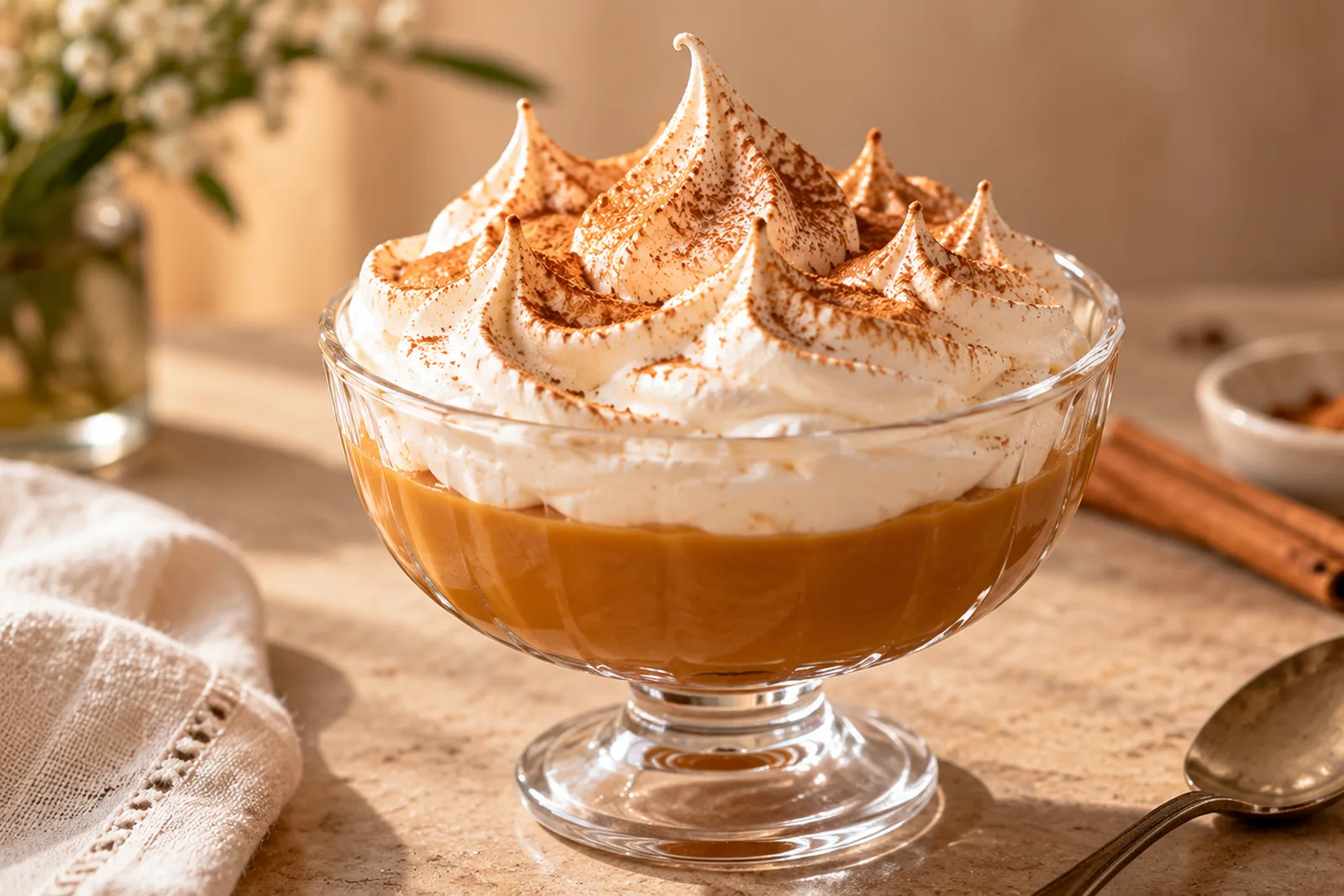

Suspiro a la limeña (soos-PEE-roh ah lah lee-MAY-nyah, “the sigh of a woman from Lima”) is a classic Peruvian dessert served in a glass: a thick, sweet milk caramel called manjar blanco under a cloud of meringue made with port syrup, finished with cinnamon. It starts with two pantry cans, condensed and evaporated milk, which you stir over low heat for about 40 minutes. Get that base to the right point and the rest is a technique any baker can learn. Below: the cue that tells you it’s ready, how to make it without alcohol, what to do about raw egg whites, and how to have it waiting in the fridge the night before.
What suspiro a la limeña is, and how long it takes
How do you make suspiro a la limeña? Stir a 14 oz (397 g) can of condensed milk and a 12 fl oz (354 ml) can of evaporated milk over medium-low heat for about 40 minutes, until you can see the bottom of the pan; add 3 tempered yolks and vanilla, cook 3 minutes and spoon into glasses. Whip 3 egg whites with a syrup of 150 g (¾ cup) sugar and 80 ml (⅓ cup) port boiled to 240°F (116°C), cover the chilled base and dust with cinnamon. 75 minutes for 6 servings, plus an hour of chilling.
Think of it as a cousin of dulce de leche, softer and paler, because egg yolks enrich it and it isn’t cooked as far. The meringue is an Italian meringue: whites whipped with hot sugar syrup, so it stays stiff and glossy instead of weeping. The name is usually credited to the Peruvian poet José Gálvez.
Time. 40 of the 75 minutes are stirring, and the glasses then need at least an hour in the fridge. Skill level: medium. The base only asks for patience; the meringue needs an electric mixer and either a thermometer or a glass of cold water.
Not the same as suspiros. The Latin meringue kisses called suspiros are crisp baked cookies. Colombia’s manjar blanco is a firm milk sweet set with rice, and arequipe, Colombian dulce de leche, is milk and sugar reduced to a spread with no egg. Suspiro is soft, eggy and eaten with a spoon from the glass.
Ingredients, with US and UK shopping notes
| Ingredient | Metric | US | Notes |
|---|---|---|---|
| Sweetened condensed milk | 397 g | one 14 oz can | Same can size in the UK |
| Evaporated milk | 354 ml (about 380 g) | one 12 fl oz can | UK cans are often 410 g; weigh out 380 g |
| Egg yolks | 3 large | 3 large | |
| Vanilla extract | 5 ml | 1 tsp | |
| Egg whites | 3 large (about 100 g) | 3 large | Or pasteurized whites, see below |
| Granulated sugar | 150 g | ¾ cup | |
| Port | 80 ml | ⅓ cup | Ruby or any everyday port |
| Ground cinnamon | about 1 g | ½ tsp | For dusting |
Leftover evaporated milk is the base of the sauce in Peruvian aji de gallina, and the same two cans soak a tres leches cake if you’re buying in bulk.
Swapping the port
- Sweet red wine or ordinary red wine. Same amount. Less rounded, still good.
- Pisco. Some Peruvian cooks use it instead of port. Drier and stronger.
- No alcohol. Use 80 ml (⅓ cup) water and add ½ tsp vanilla to the meringue. You lose the wine aroma, but the method is the same. This is the one to make when kids are eating.
The syrup boils for about 6 minutes, which drives off some of the alcohol but not all of it. If anyone needs to avoid alcohol completely, make the water version.
Equipment
- A heavy-bottomed saucepan, 2 to 3 quarts (2 to 3 liters). Thin pans scorch condensed milk long before it’s ready.
- A stand mixer is easiest, since your hands are free to pour the syrup. A hand mixer works with a second person pouring.
- A candy or instant-read thermometer for the syrup, or a glass of cold water.
- A piping bag with a star tip, or a spoon.
Make-ahead plan
| When | What |
|---|---|
| Day before | Cook the base, fill the glasses halfway, press plastic wrap on top, refrigerate |
| Day of, 30 minutes before serving | Make the syrup and meringue, pipe it on |
| Just before serving | Dust with cinnamon |
You can also top the glasses the day before: Italian meringue holds its shape in the fridge, though it’s tallest and shiniest the day it’s made.
Making the milk caramel base
Bring both milks to a boil over medium heat, stirring, about 5 minutes. Then lower to medium-low and stir without stopping for 35 to 40 minutes, scraping the corners. Condensed milk catches and burns within a minute if you walk away.
It starts thin and cream-colored, then thickens and slowly darkens. It’s ready when it’s light caramel, as thick as pastry cream, and a spoon dragged across the bottom shows the pan for a moment before the mixture closes over.
It thickens a lot more as it cools, so don’t wait for it to look set in the pan. Quick versions cook it for only 10 to 12 minutes instead of 35 to 40; the result is paler and runnier, and the meringue tends to sink into it. Push well past the “see the bottom” stage and it turns dark and gets stiff in the fridge, closer to fudge-like dulce de leche.
Tempering the yolks
Yolks added straight to the hot pan scramble into threads. Beat them with a fork, whisk in 3 tbsp of the hot base one spoonful at a time, then pour everything back with the vanilla. Cook 3 minutes over low heat, stirring, until slow bubbles rise again. Those bubbles mean the yolks are fully cooked. If you see lumps, push the base through a fine sieve.
Fill 6 glasses halfway, press plastic wrap onto the surface so no skin forms, cool, and chill at least 1 hour.
The port meringue, step by step
- Syrup. Sugar and port in a small saucepan over medium-high heat, no stirring, about 6 minutes, to 240 to 244°F (116 to 118°C). No thermometer? The bubbles turn thick and slow, and a drop in cold water forms a soft ball you can squash between your fingers. If it dissolves, keep going; if it’s hard like candy, it went too far.
- Whites. When the syrup is near 230°F (110°C), start whipping the whites in a spotless bowl, with no trace of yolk or grease, to soft peaks that flop over.
- Stream. Mixer on medium-high, pour the syrup in a thin stream down the side of the bowl. On the beaters, it spins into hard sugar threads.
- Whip until cool. Keep going until the meringue has tripled, is stiff and glossy, and the outside of the bowl no longer feels warm.
Pipe a swirl that reaches the rim of each glass, or spoon it on, and dust ½ tsp cinnamon over all 6 through a small sieve.
Is the meringue safe? Raw whites and pasteurized options
The yolks are cooked in the boiling base and easily pass the 160°F (71°C) that egg dishes need. The whites are the question. A 240°F (116°C) syrup heats them a lot, but it doesn’t guarantee every bit of the meringue reaches 160°F (71°C), especially with only 3 whites in a cold bowl that pulls heat away.
For most healthy adults, an Italian meringue made with fresh, properly refrigerated eggs is how this dessert is always made. If you’re serving pregnant women, young children, older adults or anyone with a weakened immune system, pick one of these:
- Pasteurized whites. Carton whites or in-shell pasteurized eggs, both sold in US supermarkets. Check the label says they whip, because some cartons contain thickeners and never rise. They can take about twice as long to reach soft peaks, so be patient before adding the syrup.
- Swiss meringue. Set the 3 whites and the 150 g (¾ cup) sugar in a bowl over barely simmering water and stir constantly until the mixture reads 160°F (71°C) on a thermometer, then whip off the heat until stiff and cool. You lose the port flavor, but you can use fresh eggs safely.
When it goes wrong
- Scorched base or brown flecks. Heat too high, or the stirring stopped. Don’t scrape the bottom; pour the top into a clean pan and carry on.
- Runny base in the glass. It came off before you could see the bottom. Return it to the pan for 5 to 10 minutes more before topping.
- Base too stiff after chilling. Over-reduced. Warm it with 2 to 3 tbsp (30 to 45 ml) evaporated milk, stirring until it loosens.
- Egg threads. The yolks weren’t tempered, or the heat was high. Strain.
- Whites won’t whip. Yolk or grease in the bowl, or carton whites not meant for whipping.
- Soft, weeping meringue. The syrup didn’t reach 240°F (116°C), or you stopped whipping while the bowl was still hot. Whip a few minutes more; if it won’t firm up, start again with properly cooked syrup.
- Meringue sinking into the base. The base was warm or under-cooked. Always top it fridge-cold.
Allergens. Contains egg and milk, and alcohol if you use port. Gluten-free if your vanilla is; check the label. Very sweet, which children love; use the water version for them.
Bigger batches and variations
- For 12. Double everything: 2 cans of each milk, 6 yolks, 6 whites, 300 g (1½ cups) sugar and 160 ml (⅔ cup) port. Use a wider 4 quart (4 liter) pan and go by the bottom-of-the-pan cue, not the clock.
- One dish. Spread the base in a glass dish about 8 in (20 cm) across and serve with a spoon. In large dessert glasses you’ll get 3 or 4 servings instead of six.
- Cherimoya suspiro. Stir 1 cup (240 ml) of cherimoya purée into the yolks before tempering and cook up to 7 minutes more without boiling. Frozen pulp is sold in Latin shops.
- Lucuma or passion fruit. Both are common Peruvian variations. Lucuma comes as frozen pulp or powder in Latin shops and online; add a little, taste, then add more.
- Shortcut with jarred dulce de leche. It saves the 40 minutes but gives a different dessert: darker, thicker and more caramel-flavored. Loosen it with a few spoonfuls of evaporated milk to a pastry-cream texture. A can of condensed milk cooked in a pressure cooker turns out the same way.
What drives the cost. The two cans and the port. A bottle of port covers several batches, and the water version costs less.
Serving and storing
Serving. Chilled or at room temperature, in small glasses, since it’s rich. Black coffee or tea cuts the sweetness. It’s the natural ending to a Peruvian dinner of lomo saltado. For a hot, fried Peruvian dessert instead of a chilled one, try picarones, squash and sweet potato rings in spiced syrup.
Fridge. Covered, 3 to 4 days at 40°F (4°C) or below. Don’t leave it out more than 2 hours (1 hour above 90°F / 32°C), since it contains milk and eggs.
Freezer. I don’t freeze it: the meringue deflates and turns watery as it thaws.
Frequently asked questions
Why is it called suspiro a la limeña? The name is credited to the Peruvian poet José Gálvez, who is said to have described it as soft and sweet like a woman’s sigh. That’s the best-known story, though nothing documents it.
Can I make it without an electric mixer? The base, yes. A hot-syrup meringue by hand is very hard, because you have to pour and whisk at the same time for several minutes. Without a mixer, top it with lightly sweetened whipped cream and cinnamon. Different, still very good.
Is it served hot or cold? Cold or at room temperature, never warm. The base needs at least 1 hour in the fridge to firm up before the meringue goes on.
Nutrition
Per glass (one-sixth of the recipe), worked out ingredient by ingredient from the quantities above:
- Calories: 440 kcal
- Protein: 13 g
- Carbohydrates: 70 g
- Fat: 13 g, of which 7 g saturated
- Fiber: 0 g
- Sugars: 69 g
- Sodium: 184 mg
Condensed milk supplies nearly half the calories, and the meringue sugar about 97 per glass. Eight smaller glasses come to about 330 kcal each.
I serve this in little glasses, because one spoonful too many and it’s too sweet, and I dust the cinnamon only as it goes to the table so it doesn’t turn damp. For Dylan, the syrup gets water and vanilla instead of port. Josnaisis.