
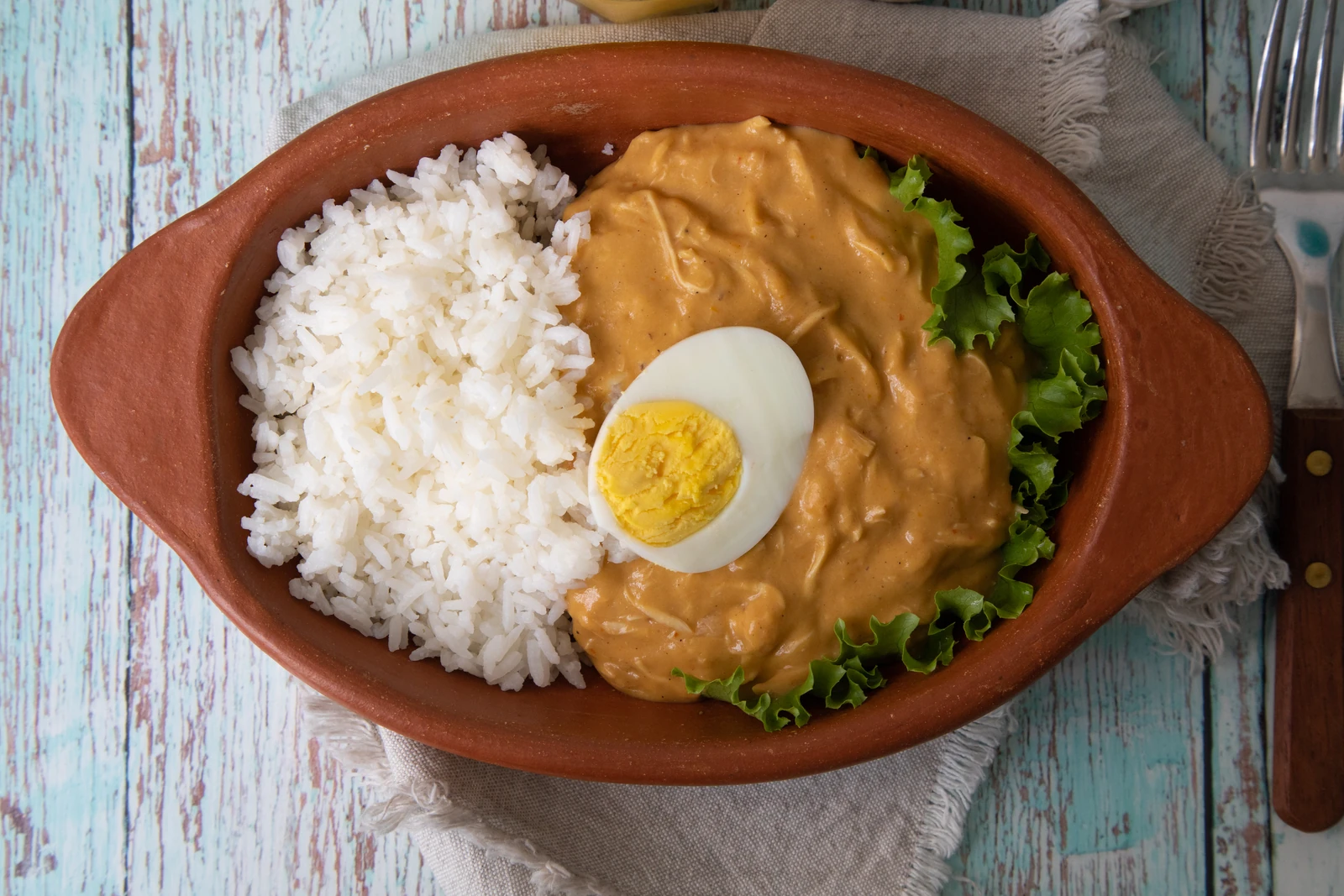

Aji de gallina (ah-HEE deh gah-YEE-nah) is shredded chicken in a thick, golden sauce made from Peru’s yellow chile, aji amarillo, cooked onion and bread soaked in evaporated milk, blended smooth with pecans and finished with Parmesan. It tastes mild, creamy and faintly sweet, with a fruity heat that arrives at the end, and it’s served over boiled potatoes with white rice, a hard-boiled egg and a black olive. The name means “hen in chile”: it used to be made with a stewing hen, and today most home cooks use chicken. The one ingredient you’ll need to hunt for is the chile paste, and below there’s a clear plan B if you can’t find it.
What aji de gallina is, and how long it takes
How do you make aji de gallina? Poach 1⅓ lb (600 g) of chicken breast for 20 minutes and shred it. Soften onion and garlic, add 3 tbsp of aji amarillo paste, then blend that with 4 slices of bread soaked in 1 cup (240 ml) of evaporated milk, 40 g of pecans and some of the stock. Simmer the sauce 10 minutes, fold in the chicken, loosen with stock and stir in ½ cup (50 g) of Parmesan. 70 minutes for 4 servings.
Total time 70 minutes: 15 of prep and 55 at the stove, with the chicken, potatoes and eggs cooking at the same time. Medium difficulty: nothing is tricky, but you have four things going and the sauce needs watching at the end.
Think of it as a cousin of chicken à la king or a mild korma, thickened with bread instead of flour or cream. It isn’t related to the Colombian aji picante, which is a raw chile and vinegar salsa for empanadas; in Peru “aji” simply means chile. If you like shredded chicken baked under pastry, the Venezuelan polvorosa de pollo is the one to try, and for chicken in a tangy, cream-free sauce there’s Mexican chicken in salsa verde. The cream of poblano soup with corn is a different thing again: a chile soup, not a stew. And for Peru’s other famous chicken, roasted whole rather than shredded, see Peruvian chicken (pollo a la brasa) with green sauce, marinated in soy sauce and aji panca instead of aji amarillo.
Ingredients, and what to buy in the US and UK
The recipe allows about 5 oz (150 g) of raw chicken per person, with plenty of sauce for the rice. Chicken is the main cost, then the nuts and Parmesan; thighs and walnuts bring it down, and a jar of paste covers about four batches.
Aji amarillo paste, and what to use if you can’t find it
| Option | Where to find it | How much | What changes |
|---|---|---|---|
| Jarred paste (the recipe) | US: the Hispanic aisle of large supermarkets and Latin grocers, usually 7.5 oz (213 g) jars. UK: Latin American grocers and online specialist food shops, 225 to 230 g jars | 3 tbsp (45 g) | Nothing. Heat varies by brand, so taste ½ tsp on its own first |
| Frozen whole aji amarillo | Freezer section of Peruvian and Latin grocers | Make paste (below) and measure 3 tbsp | The freshest, fruitiest flavor |
| Dried aji mirasol | Peruvian grocers, online | Stem and seed them, toast a couple of minutes in a dry pan, simmer in water until soft, blend and measure 3 tbsp | It’s dried aji amarillo: the sauce turns toasted orange and tastes of dried chile |
| Yellow bell pepper plus a hot chile | Any supermarket | 1 roasted, peeled yellow bell pepper (7 oz / 200 g) plus ½ yellow habanero (UK: scotch bonnet) or 1 serrano, blended | Similar color and heat, but without the fruity aji flavor. Good, just not quite the same dish |
An opened jar won’t go to waste: the same paste is the base of Peruvian papa a la huancaína, potatoes in a spicy cheese sauce.
Some recipes add turmeric. It only adds color: ¼ tsp brightens the sauce if you use mirasol or bell pepper, but it doesn’t replace the chile.
Homemade paste from frozen or fresh peppers. Wearing gloves, cut off the stems, split the peppers and scrape out the seeds and white veins, which hold most of the heat. Put them in cold water, and as soon as it boils, drain and change the water: 2 or 3 boils leave a pleasant warmth, 4 or 5 take it away almost entirely. Peel off the skins and blend with a splash of oil and water to a smooth cream. Freeze leftovers in an ice cube tray; I use them within 3 months.
How spicy is aji de gallina?
Raw aji amarillo with its veins is a good deal hotter than a jalapeño, but jarred paste and blanched homemade paste are much tamer. For the sauce in this recipe:
| Aji amarillo paste | Heat |
|---|---|
| 1½ tbsp | Barely warm; you taste the chile, not the burn. Kid-friendly |
| 3 tbsp (the recipe) | Mild to medium, noticeable at the end |
| 5 tbsp | Properly hot |
Cooking for mixed tastes? Use two-thirds of the paste in the pan, and stir the rest into the blended sauce near the end once you’ve tasted it.
Chicken breast, thighs, rotisserie chicken or a stewing hen
- Breast, as in the recipe, shreds into long strands and poaches in 20 minutes. Keep the water at a bare tremble and let it rest in the hot stock: a rolling boil turns it stringy.
- Boneless thighs are juicier and more forgiving, with shorter strands. 25 minutes.
- Rotisserie chicken works: 1⅓ lb (600 g) of skinless shredded meat and low-sodium boxed chicken broth instead of the poaching stock. About 35 minutes from the onion step. You lose some depth from the homemade stock.
- A stewing hen (sold as a boiling fowl in the UK) is the original. It gives a richer stock and firmer, tastier meat, but needs 1½ to 2 hours at a low simmer until the meat comes off the bone, the same as a Colombian stewed hen. Skim the fat off the stock and use 600 g of the shredded meat.
White sandwich bread or saltines
- Crustless white sandwich bread gives the smoothest sauce. A day-old French baguette, crusts removed, also works.
- Saltines (UK: cream crackers): about 1½ oz (45 g) in place of the bread, soaked the same way. They thicken just as well but make the sauce saltier and a little less silky, so taste before salting.
- Gluten-free: the same weight of gluten-free sandwich bread.
Pecans or walnuts, Parmesan and evaporated milk
- Pecans are the usual choice in Peru and give a sweet, toasty depth. Walnuts work and are a touch more bitter; toasting them 5 minutes in a dry pan softens that. With no nuts at all, the sauce is less rounded but still good.
- Parmesan, finely grated so it melts without lumps. Grana Padano is fine.
- Evaporated milk comes in cans in the baking aisle in the US and in tins in any UK supermarket. Don’t confuse it with sweetened condensed milk. With whole milk instead, the sauce is lighter and less creamy, and you’ll need less stock at the end.
Potatoes, eggs and olives
Peruvian yellow potatoes are floury and buttery-yellow, and Latin grocers sell them frozen. Yukon Gold is the closest in the US; in the UK, a floury variety such as Maris Piper works, though the flesh is paler. Little Colombian papas criollas are another good match. Peruvian botija olives are purple and meaty; Kalamata olives are the easiest stand-in.
Equipment. A heavy 3-quart (about 3-liter) pot, because the sauce catches on the bottom, and a blender.
How to make aji de gallina, step by step
Running everything at once
- Start the chicken water, and put the potatoes on in a second pot of cold water. Drop the eggs in with the potatoes toward the end, for their last 10 minutes or so.
- While the chicken poaches, soak the bread and chop the onion and garlic.
- Start the onion while the chicken rests in its stock; the 15-minute rest is exactly how long it takes.
- Shred, blend and finish the sauce. The potatoes and eggs can wait.
The onion and chile base
Give the onion the full 8 minutes over medium heat, until it’s translucent and squashes under the spoon, without browning. Undercooked onion makes the sauce harsh. Once the paste goes in, keep stirring for about 5 minutes. You’re looking for a glossy base with oil showing at the edge. If it starts to stick, lower the heat and add 2 tbsp of stock.
How thick the sauce should be
Freshly made, it should fall from the spoon in a thick ribbon that sinks slowly back into the pot, and a line drawn across the bottom of the pot should close up slowly, not instantly. If it sits on the spoon like mashed potatoes, add hot stock ¼ cup (60 ml) at a time, waiting a minute between additions. If it pours like gravy, cook it 3 or 4 minutes more, stirring; if it still won’t thicken, blend another slice of bread with ¼ cup (60 ml) of milk and stir that in.
Cheese goes in last, off the heat, and salt only after tasting: the stock, chile paste and Parmesan are all salty.
Make it the day before
Aji de gallina is a good make-ahead dish for guests because the sauce settles overnight.
| When | What to do |
|---|---|
| The day before | Poach and shred the chicken, make the sauce without the cheese, mix them, cool and refrigerate within 2 hours |
| 1 hour before serving | Boil the potatoes and eggs, cook the rice |
| 15 minutes before | Reheat the sauce gently with ½ to 1 cup (120 to 240 ml) of stock, stir in the Parmesan off the heat |
Let it cool uncovered until it stops steaming before you put the lid on. It will be much thicker cold, which is normal.
For 8 or 12 people
| Servings | Chicken | Crustless bread | Evaporated milk | Aji paste | Nuts | Parmesan | Stock |
|---|---|---|---|---|---|---|---|
| 4 | 1⅓ lb (600 g) | 4 slices | 1 cup (240 ml) | 3 tbsp | 50 g (½ cup) | 50 g (½ cup) | 1½ to 2 cups |
| 8 | 2⅔ lb (1.2 kg) | 8 slices | 2 cups (480 ml) | 6 tbsp | 100 g (1 cup) | 100 g (1 cup) | 3 to 4 cups |
| 12 | 4 lb (1.8 kg) | 12 slices | 3 cups (720 ml) | 9 tbsp | 150 g (1½ cups) | 150 g (1½ cups) | 4½ to 6 cups |
Blend in batches no more than half full, and use a wide pot of 6 quarts (about 6 liters) or more: in a tall narrow pot the bottom scorches before the top is hot. For 12, poach the chicken in two pots or in one 8-quart pot with 4 liters (about 4 quarts) of water. Add the chile paste in two stages and taste.
Troubleshooting
- Thick and gluey. Too much bread, or it reduced too far. Thin it with hot stock, a little at a time. Don’t fix it with more bread.
- Grainy, with pools of oil. It boiled hard with the cheese in, or was reheated on high. Take it off the heat, add 2 tbsp of hot stock and whisk hard.
- Scorched on the bottom. High heat or a thin pot. Pour it into a clean pot without scraping the bottom.
- Dry, stringy chicken. It boiled rather than poached, or cooked too long. Keep the water barely trembling and let it rest in the stock.
- Gritty sauce. Not blended long enough, or the bread still had crusts. Blend a full minute.
- Too hot. Blend 1 slice of bread with ½ cup (120 ml) of evaporated milk and stir it in. It stretches the sauce and tames the heat.
Allergens. Contains gluten (bread), milk (evaporated milk and Parmesan), tree nuts (pecans or walnuts) and egg on the plate.
Storing, freezing and reheating
Fridge. In a sealed container, 3 to 4 days. Keep the potatoes, rice and eggs separate.
Freezer. Only the chicken and sauce, for 2 to 3 months at best quality. It can look a little grainy once thawed; whisking in stock as it heats brings it back. Don’t freeze the potatoes or the hard-boiled eggs: potatoes turn watery and egg whites go rubbery. Thaw overnight in the fridge.
Reheating. In a pot over low heat with 2 to 4 tbsp of stock or milk per serving, stirring from the bottom for 5 to 8 minutes, until it steams and reaches 165°F (74°C) in the center. In the microwave, covered, at medium power in 1-minute bursts, stirring between each: on full power the edges boil, the cheese separates and the sauce splits. If that happens, whisk in a splash of hot stock.
Serving. Thick potato slices underneath, the chicken on top, fluffy white rice on the side and half an egg, an olive and some chopped nuts on each plate. Allow 1 potato and 1 cup of rice per person.
FAQ
Can I make it with leftover roast chicken or turkey? Yes. Use 1⅓ lb (600 g) of skinless shredded meat and boxed low-sodium broth, and simmer it in the sauce for just 5 minutes so it doesn’t dry out.
Do I need a blender? It’s smoother with one. Without, mash the soaked bread to a paste with a fork, chop the nuts very finely and stir everything into the onion base in the pot. The result is more rustic, with small bits of bread.
What should I do with the leftover stock? About 1 liter (4 cups) is left over. Refrigerate it for up to 4 days, or freeze it in 1-cup portions for reheating the aji de gallina or cooking the rice.
Nutrition
Per serving (a quarter of the recipe, with half an egg and 2 olives, without potatoes or rice), calculated ingredient by ingredient from the recipe amounts:
- Calories: 615 kcal
- Protein: 49 g
- Carbohydrates: 26 g
- Fat: 36 g, including 9 g saturated
- Fiber: 3 g
- Sugars: 11 g
- Sodium: 1150 mg
The chicken accounts for about 180 kcal per serving; the oil, nuts, evaporated milk and Parmesan add about 310 between them. A 5 oz (150 g) potato adds roughly 130 kcal and a cup of cooked rice about 205. Sodium depends heavily on the brand of chile paste and cheese.
I make the sauce the night before, with thighs, because the aji amarillo tastes rounder the next day and all that’s left is boiling the potatoes. For the kids I set aside some sauce before the last spoonful of paste goes in, and the only difference anyone notices is the heat. Josnaisis.