
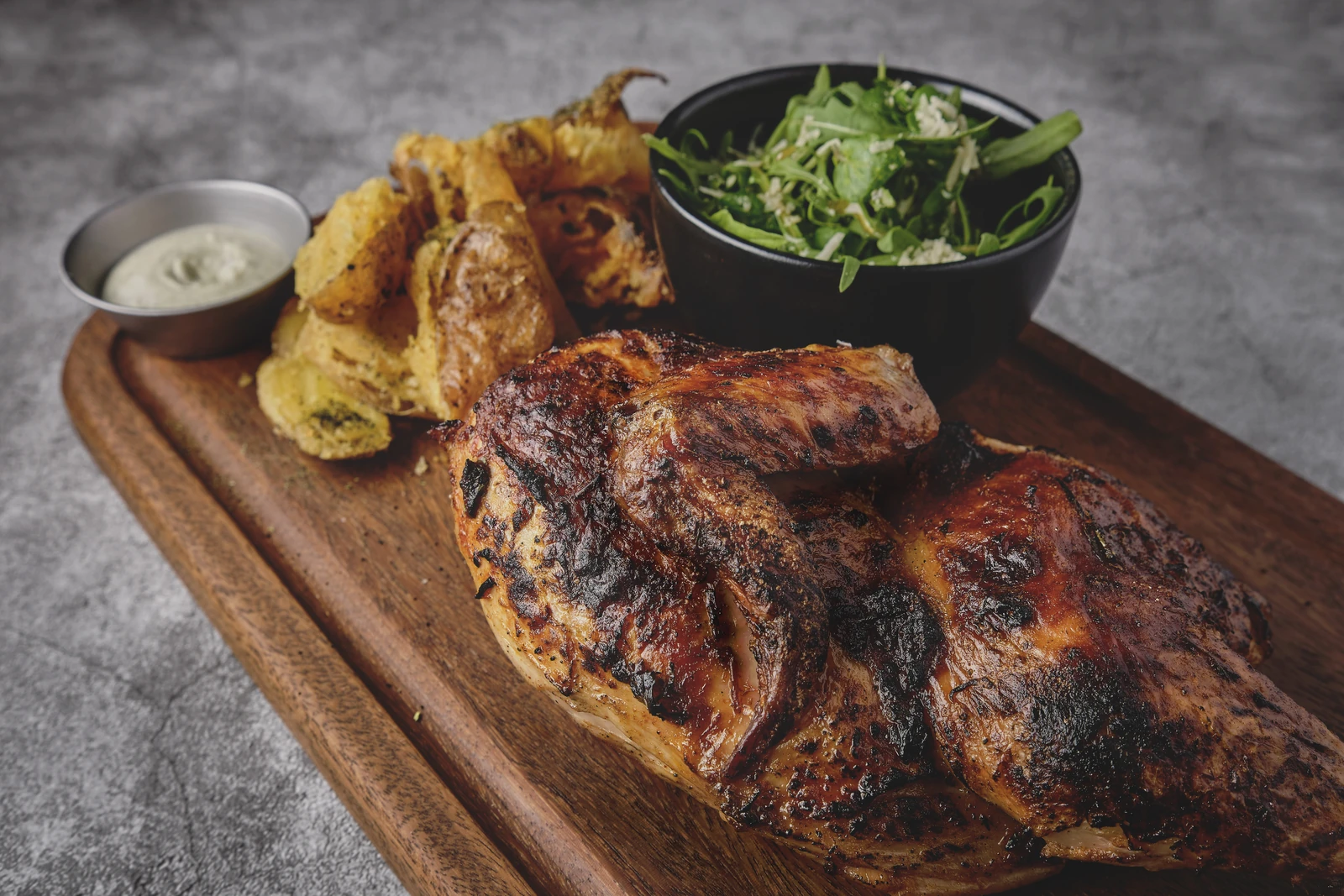

Pollo a la brasa (POH-yoh ah lah BRAH-sah) is Peruvian rotisserie chicken: a whole bird marinated in soy sauce, garlic, cumin and aji panca, a mild, dark red Peruvian chile, then roasted until the skin turns deep mahogany. In Peru it’s sold by the quarter in restaurants called pollerías, with fries, a simple salad and a line-up of sauces; in the US it’s the chicken behind the famous green sauce. You don’t need a rotisserie. An overnight marinade and a rack in a 400°F (200°C) oven get you very close, and this recipe walks you through it, along with the aji verde, what to buy if you can’t find aji panca or huacatay, and how to get the fries on the table at the same time.
What Peruvian chicken is, and how long it takes
How do you make Peruvian chicken in the oven? Rub a 4 lb (1.8 kg) chicken under and over the skin with a blended marinade of soy sauce, aji panca paste, dark beer, vinegar, garlic, lime, cumin, paprika, oregano and rosemary, and refrigerate it for 12 hours. Roast it on a rack at 400°F (200°C), with water in the pan underneath, until the thigh and breast read 165°F (74°C), about 85 minutes. Rest 10 minutes, quarter it and serve with fries, salad and green sauce. 850 minutes (30 hands-on and 12 hours in the fridge) for 4 servings.
The skin comes out very dark, from mahogany to almost black on the wing tips, roasted and lightly crisp, and the meat tastes of garlic, cumin and soy right to the bone. The chicken itself isn’t spicy: aji panca adds color and a sweet, slightly smoky depth, not heat. The heat is in the sauce, served on the side. The dish was created in Chaclacayo, just outside Lima, in the middle of the last century.
It isn’t a plain supermarket rotisserie chicken, or a Latin roast chicken with a mojo-style marinade, where the citrus marinade goes under the skin only so the skin roasts golden and pale. Here the marinade goes on the outside on purpose, because the soy and sugar are what darken and roast the skin, and the bird sits on a rack, above its juices.
Time. About 30 minutes hands-on: 15 the night before and 15 on the day, plus 12 hours in the fridge, 75 to 90 minutes in the oven and 10 of resting. Easy. The only thing to watch is that the skin doesn’t burn before the meat is done.
Ingredients, and what to buy in the US and UK
The recipe is for one 4 lb (1.8 kg) chicken, which gives 4 quarters, the standard pollería portion. The marinade makes about 1 cup (240 ml), enough for a bird of up to 5 lb (2.2 kg).
Aji panca paste, and what to use instead
Aji panca (ah-HEE PAHN-kah) is a dark red Peruvian chile used dried or as a paste. It’s barely hot, with a fruity, slightly smoky flavor and a deep maroon color, and it’s what makes this marinade taste Peruvian.
- Paste, as in the recipe. In the US, in Peruvian and Latin grocers and online; in the UK, in Latin American shops and online. One jar covers several chickens and keeps in the fridge once opened.
- Dried aji panca. Stem and seed it, soak it in hot water for 20 minutes and blend with a splash of the soaking water. Measure 2 tbsp.
- Dried ancho or guajillo chiles, easy to find in US supermarkets and online in the UK. Prepare them the same way: 1 ancho or 2 guajillos make about 2 tbsp of paste. This is the closest swap. Ancho is earthier and guajillo a little tangier, but the color and low heat are similar.
- Paprika, as a last resort. 2 tsp sweet paprika plus a pinch of cayenne instead of the paste. It gives color, but the flavor is flatter and the chicken comes out redder rather than dark.
Soy sauce, dark beer and vinegar
In Peru soy sauce is called sillao, and any regular soy sauce works. Dark beer, a stout or any dark, roasty beer, adds a bitter, malty background. It’s optional: without it the chicken is just as dark and a little less complex. Don’t replace it with more vinegar, or the marinade gets too sharp for 12 hours.
The chicken and equipment
Use a 3½ to 4½ lb (1.6 to 2 kg) chicken, which fits a normal roasting pan and cooks evenly. For a bigger bird, see the times by weight below.
- A rack. An oven rack over a roasting pan, or an ovenproof wire cooling rack. Without a rack the underside poaches in its juices and comes out pale and soft. If you have neither, set the chicken on 2 onions sliced thickly.
- An instant-read thermometer. It’s what tells you when to take the bird out.
- A blender for the marinade and the sauce.
Peruvian green sauce (aji verde)
The creamy green sauce that comes with Peruvian chicken in the US is blended mayonnaise, green chile, cilantro, a little cheese and lime. In Peru the pollería table usually has mayonnaise, ketchup, mustard and an aji sauce, sometimes yellow; the bright green, cilantro-heavy version is the one that took off in Peruvian chicken restaurants in the US. This recipe makes about 9½ oz (270 g), a little over 1 cup, so roughly 4 tbsp per person.
- The chile. Peru uses fresh green aji; outside Peru, jalapeños are the standard, and serranos if you want it hotter. With 2 seeded jalapeños it’s medium hot. For more heat, blend in some of the seeds.
- The cheese. Cotija or queso fresco adds body and salt. In the UK, a little crumbled feta does the same job.
- Consistency. Add the oil in a thin stream with the blender running; poured in all at once, the sauce stays thin. It thickens a little more in the fridge.
Huacatay, and what to use without it
Huacatay (wah-kah-TIE), also called Peruvian black mint, is an Andean herb that smells somewhere between mint, basil and anise. Fresh, it’s almost impossible to find outside Peru; it’s sold as a paste in jars in Latin grocers and online. Without it, add 10 g (⅓ oz) more cilantro and, for that fresh note, 3 or 4 mint leaves. You’ll get a more cilantro-forward sauce, still very good, just without the huacatay perfume.
Roasting it, the plan for the day
The marinade and sauce can be done ahead; what needs timing on the day is the oven and the fries, so that everything reaches the table hot. The fries are double-fried, like the ones in Colombian salchipapa with double-fried potatoes: 6 to 8 minutes at 320°F (160°C) while the chicken finishes and 3 to 4 minutes at 350°F (175°C) while it rests.
How long to roast Peruvian chicken by weight
At 400°F (200°C), without a fan, allow 20 to 23 minutes per pound (45 to 50 minutes per kilo), and start checking 15 minutes before the shorter time:
| Chicken weight | Time at 400°F (200°C) | Start checking at |
|---|---|---|
| 3 lb (1.4 kg) | 65 to 70 minutes | 50 minutes |
| 4 lb (1.8 kg), the recipe | 80 to 90 minutes | 65 minutes |
| 5 lb (2.2 kg) | 100 to 110 minutes | 85 minutes |
With a fan (UK fan oven), the same times at 180°C. These are for planning: the chicken is done when it hits temperature, not when the timer goes off.
How to tell it’s done
- 165°F (74°C) in the inner thigh, close to the body, and in the thickest part of the breast, without touching bone. The thigh is always the last to get there; if one spot is short, give it 10 more minutes and check again.
- The leg wiggles loosely and the juice from a poked thigh runs clear, not pink. That’s a hint, not proof: the thigh bone can look pink in a fully cooked bird. The thermometer is what counts.
- The skin is dark mahogany, taut, with the wing tips almost black.
Dark, crisp skin
- Rack, with water below. The rack lets hot air reach the underside; the cup of water in the pan stops the dripping fat from burning and smoking out the kitchen. Top it up if it dries.
- Let it drip first. With pools of marinade on top, the skin steams instead of roasting.
- If it darkens too early, loose foil over the breast, without lowering the oven. The sugar and soy brown before the meat is cooked. That’s normal for this chicken, but it shouldn’t get to burnt.
- Rest it uncovered. Under foil the steam softens the skin you worked for.
What goes wrong, and how to avoid it
- Black, bitter skin and undercooked meat. The oven was too hot or the chicken too close to the top. Middle shelf, 400°F (200°C), and foil over the breast once it’s dark.
- Pale, soft underside. Roasted straight in the pan or not drained. Use a rack and let the marinade drip off.
- Too salty. Soy sauce is already salty, so the recipe only adds ½ tsp salt. With dark soy sauce, or a marinade longer than 48 hours, leave the salt out.
- Dry breast. It went past 165°F (74°C) while you waited for the thigh. Check both from 65 minutes and pull it as soon as the thigh is there.
- Thin green sauce. The oil went in all at once or the jalapeños were wet. Drizzle it in with the motor running.
Heat, kids and allergens. The chicken isn’t hot, and most kids like it; the heat is only in the sauce. It contains soy, gluten (soy sauce usually contains wheat, and beer is brewed from barley), egg (mayonnaise) and milk (cheese). For gluten-free, use a tamari labeled gluten-free, leave out the beer and check the label on the chile paste too.
Thighs, air fryer, grill or a crowd
- Chicken pieces. 3½ lb (1.6 kg) bone-in, skin-on thighs and drumsticks with the same marinade, on a rack at 425°F (220°C) for about 40 to 45 minutes, until 165°F (74°C). The quickest option, and the skin gets even darker.
- Air fryer. A bird of up to 4 lb (1.8 kg) usually fits a 6 qt (5.5 liter) basket or larger; check first, because it needs room around it and must not touch the heating element, and if it’s a tight squeeze make the pieces version instead: 360°F (180°C) for 30 minutes breast side down, flip, then 20 to 30 minutes more, until the thigh reads 165°F (74°C). The sugar darkens the skin fast, so keep an eye on it.
- On the grill. Best with pieces over indirect heat, as in this Mexican adobo chicken with a two-zone grill, then a few minutes over the coals at the end to char the skin.
- For 8 or 12 people. 2 or 3 chickens of 4 lb (1.8 kg) and double or triple the marinade. The time is per chicken, by its weight, not added up, as long as they fit with air around them; on two shelves, swap the pans halfway. Scale the sauce the same way.
What to serve with Peruvian chicken, and leftovers
Serving. A quarter per person with thick fries and a salad of lettuce, tomato and cucumber dressed with lime and oil, the green sauce in bowls on the side. Other ideas: crispy fried yuca instead of fries, Colombian white rice for a heartier plate, or a Peruvian starter of papa a la huancaina, potatoes in a creamy yellow chile and cheese sauce. Leftover chicken, shredded and stir-fried with day-old rice, turns into Peruvian arroz chaufa.
Cost. The chicken is most of it; a jar of aji panca or huacatay paste lasts several batches.
Fridge. Cooked chicken, no more than 2 hours at room temperature, then 3 to 4 days at 40°F (4°C) or below in a covered container. The green sauce, covered, 3 to 4 days: the fresh cheese and raw cilantro are the first things to turn.
Freezer. Cooked chicken keeps its quality for 2 to 6 months in a freezer bag or airtight box; thaw it in the fridge. Don’t freeze the sauce: the mayonnaise separates.
Reheating. In a 350°F (180°C) oven, in a dish with 2 tbsp water, covered with foil, for 15 to 20 minutes, until it’s 165°F (74°C) in the middle; uncover for the last 5 minutes to dry the skin. The microwave heats it fine, but the skin goes soft.
Peruvian chicken FAQ
Is Peruvian chicken spicy? No. Aji panca is a mild chile and the chicken has almost no heat. The spice is in the green sauce, which you add at the table.
Can I marinate it for just a few hours? Yes, for at least 4 hours. The skin will be just as dark, but the breast meat tastes less of garlic and cumin than after 12 hours. Not more than 48 hours, which is the limit for raw poultry in a marinade in the fridge, and the meat gets saltier.
Can I use a frozen chicken? Thaw it first in the fridge, still in its wrapping: a 4 lb (1.8 kg) bird needs a full day. Frozen, it won’t take the marinade and the center lags far behind the skin.
Why isn’t my chicken as dark as the restaurant’s? Not enough marinade left on the outside, or you patted it dry before roasting. The color comes from the marinade that clings to the skin; with enough of it, it’s mahogany by 60 minutes. The last 10 minutes at 425°F (220°C) help.
Nutrition per serving
Per serving: a quarter of the chicken with skin (about 9⅔ oz / 274 g raw meat and skin), all the marinade and a quarter of the green sauce, without fries or salad:
- Calories: 931 kcal
- Protein: 54 g
- Carbohydrates: 8 g
- Fat: 75 g, of which 17 g saturated
- Fiber: 2 g
- Sugars: 3 g
- Sodium: 1506 mg
The green sauce is about 246 kcal of each serving, nearly all from the mayonnaise. Without the chicken skin, a serving drops by about 356 kcal and 35 g of fat. The figures count all the marinade and all the fat in the skin; some of both stays in the bag and in the pan, so the plate you eat has a little less sodium and fat.
The first time I made this at home I put it straight in the pan, the way I make my everyday roast chicken, and the underside came out poached, pale and soft. Since I started roasting it up on a rack, with a little water underneath so it doesn’t smoke, the skin comes out dark all the way round. I make the green sauce while the chicken is in the oven, and whatever is left goes on potatoes and sandwiches over the next few days. Josnaisis.