
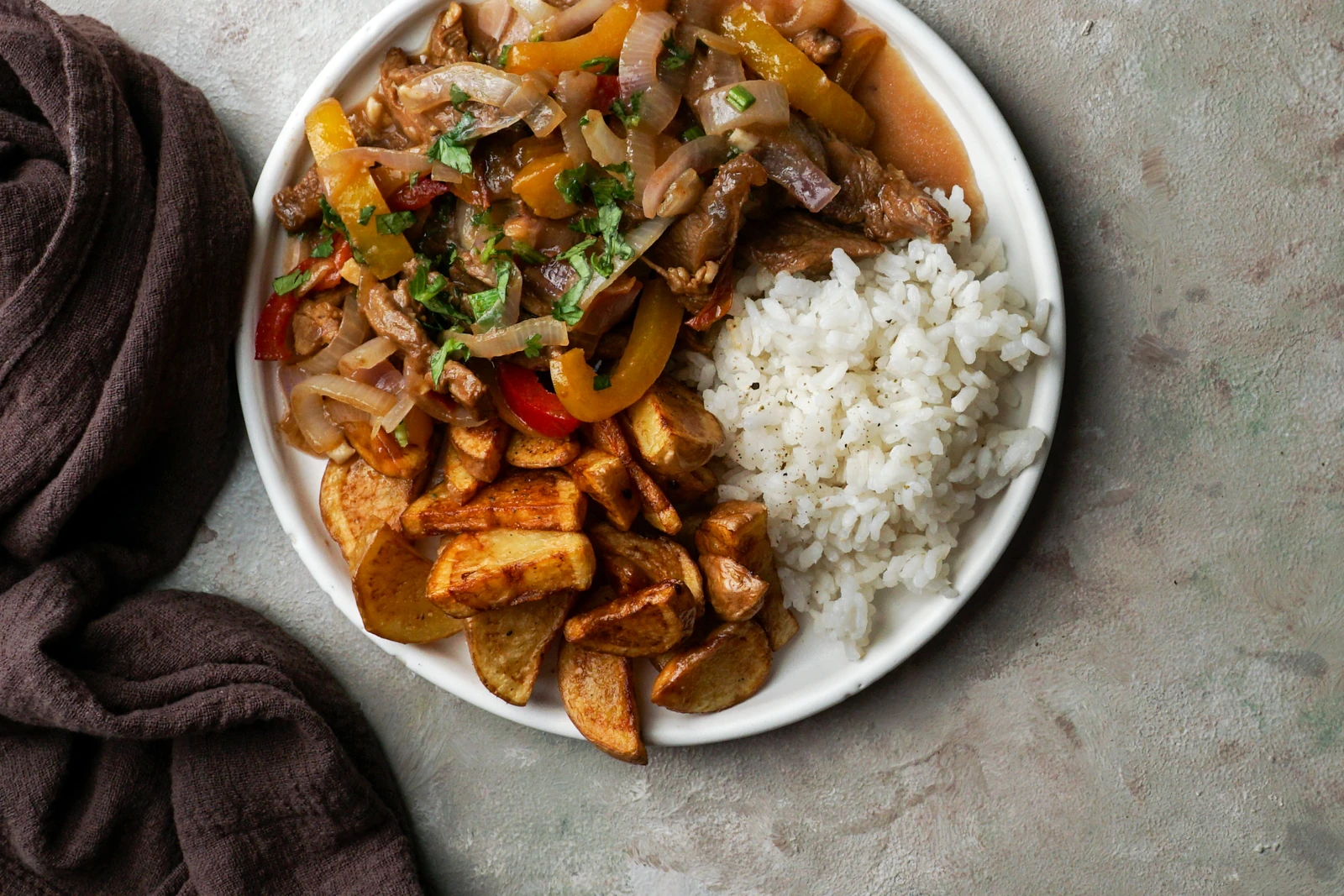

Lomo saltado (LOH-moh sahl-TAH-doh, roughly “tossed beef”) is what Peru does with a hot wok: strips of beef tenderloin seared hard with red onion, tomato and aji amarillo, Peru’s fruity orange chile, then splashed with soy sauce and red wine vinegar. It comes with french fries and white rice on the same plate, which surprises most people the first time and makes perfect sense once the fries soak up the sauce. It belongs to chifa, Peru’s Chinese-Peruvian cooking. Everything depends on 4 minutes of searing, so this recipe spends most of its time on that, on the steak to buy in a US or UK store, and on what to do without fresh aji amarillo.
What lomo saltado is and how long it takes
How do you make lomo saltado? Sear 1⅓ lb (600 g) of beef tenderloin strips in two batches in a smoking-hot pan, about 2 minutes each, and set aside. Stir-fry red onion and aji amarillo for 1 to 2 minutes and garlic for 30 seconds, add 3 tbsp soy sauce and 1 tbsp red wine vinegar, return the beef for 1 minute and finish with tomato wedges for 30 seconds. Serve with fries and white rice. 65 minutes for 4 servings.
Time. 65 minutes in all: 20 to prep, about 35 to fry the potatoes twice, and 10 for the stir fry itself, which is the only part you can’t step away from. Difficulty, medium: nothing is hard, but once the pan is hot there’s no time to chop.
What you get: juicy beef with a sticky, salty, tangy sauce, onion and tomato that still hold their shape, and fries that turn savory where they touch the juices. Unlike Mexican bistec a la mexicana, where the beef finishes in a tomato sauce, nothing here simmers: it all happens over the highest heat in a few minutes.
Ingredients at a glance
About 5 oz (150 g) of raw beef per person, plus fries and rice.
| Ingredient | Metric | US | Notes and swaps |
|---|---|---|---|
| Beef tenderloin | 600 g | 1⅓ lb | UK fillet; cheaper options below |
| Red onion | 250 g | 1 large | In thick wedges, not thin slices |
| Plum tomatoes | 300 g | 2 | Firm, seeds removed |
| Aji amarillo | 1 pepper or 1 tbsp paste | 1 pepper or 1 tbsp paste | Swaps below |
| Soy sauce | 45 ml | 3 tbsp | Regular, not dark or sweet |
| Red wine vinegar | 15 ml | 1 tbsp | White or rice vinegar work |
| Floury potatoes | 700 g | 1½ lb | Russet; UK Maris Piper or King Edward |
Which steak to buy
- Tenderloin (UK fillet). The traditional choice and the most forgiving: 2 minutes at full heat and it’s still tender. It’s also what makes the dish expensive.
- Top sirloin, strip steak, flank or skirt in the US; rump in the UK. Cheaper and a little chewier. Always slice against the grain: find the direction the muscle fibers run and cut across them.
- Skip stewing beef (chuck, brisket). It needs an hour or more of slow cooking and turns tough in a 2-minute sear.
Strips should be ⅝ in (1.5 cm) thick and about 2 in (5 cm) long. Thinner and they overcook before browning; thicker and the center stays raw.
Aji amarillo, and what to use instead
Aji amarillo is a Peruvian chile, orange when ripe, fruity and medium-hot; most of the heat goes when you remove the seeds and veins.
- US. Whole frozen peppers turn up in Peruvian and Latin grocers, and jars of aji amarillo paste sit in the Hispanic aisle of many supermarkets.
- UK. Mainly online or in Latin American shops, usually as paste.
- The best swap: 1 tbsp of paste for 1 fresh pepper, stirred into the soy and vinegar. Brands vary in heat, so taste first.
- Orange or yellow bell pepper plus half a jalapeño or a red Fresno. You get the color and some heat, but not the fruity flavor. Still a good dinner, just less Peruvian.
Soy sauce is called sillao in Peru and it’s ordinary soy sauce. It brings most of the salt, which is why the beef gets so little. Pan: a 12 in (30 cm) carbon steel, cast iron or stainless skillet, or a wok. Thin nonstick pans don’t hold heat well and don’t like this temperature.
How to make lomo saltado
Set up before the heat goes on
Line up next to the stove, in order: the dry, seasoned beef; onion and aji; garlic; the cup of soy and vinegar; tomato; cilantro; the fries; and an empty bowl for the beef. Turn on the extractor fan or open a window: a pan this hot will smoke.
Fries, fried twice
The first fry, 6 to 8 minutes at 320°F (160°C), cooks the inside; they come out soft and pale. The second, 3 to 4 minutes at 350°F (175°C), makes the golden crust. Use a pot of at least 5 quarts (5 liters) so the 2 liters of oil stay below the halfway mark: the oil rises and bubbles hard when the potatoes go in, more so if they’re wet, so dry them well and lower them with a spider. Two batches each time keep the oil from cooling too much. For the full method, the double-fried fries in Colombian salchipapa use the same temperatures.
No deep pot? Bake the sticks in one layer with 1 tbsp oil at 400°F (200°C) for about 25 minutes, or use frozen fries and follow the bag. Both come out less crisp.
Why the beef goes in batches
A home burner can’t keep a pan hot under 1⅓ lb of cold, wet beef. The pan temperature drops, the meat releases its juices and ends up simmering in them: gray, tough and sitting in liquid. Half the beef in a 12 in pan or a wok, one layer with gaps, stays hot enough to brown. In a 10 in (24 cm) pan, do three batches of about 7 oz (200 g).
Give the beef a full minute untouched to build a crust, then toss it for another 60 seconds. The strips leave the pan pink inside and finish in the sauce, reaching the table juicy and just pink in the center. If you prefer it more done, give it 1 more minute in the sauce before the tomato; it will be a little firmer.
Sauce, tomato and the finish
| Step | Time | What you should see |
|---|---|---|
| Onion and aji amarillo | 1 to 2 min | Browned edges, firm centers |
| Garlic | 30 sec | Fragrant, not brown |
| Soy and vinegar, down the sides | 30 sec | Bubbles hard straight away |
| Beef back in | 1 min | Glossy, coated |
| Tomato | 30 sec | Shiny, starting to weep, still whole |
You want a thin layer of sauce in the bottom of the pan after those 4 minutes of sauce work, enough to wet the rice.
Fries mixed in or on the side
Both are traditional. Folded in off the heat, they soak up the sauce and taste better, but go soft within minutes. On top or alongside, they stay crisp. Mix them in only if everyone is at the table.
Common mistakes
- Watery, gray beef. The pan wasn’t hot enough, the beef was wet, or there was too much at once.
- Chewy beef. A stewing cut, slicing with the grain, or more than 2 minutes per batch.
- Limp onion, mushy tomato. They went in too early or over lower heat.
- Soggy fries. Mixed in long before serving, or fried once at a low temperature.
- Too salty. Soy sauces differ. Taste the sauce; with a strong one, start with 2 tbsp.
Heat, kids and allergens. With the seeds and veins removed, the aji gives mild heat that most kids are fine with. Contains soy and wheat (soy sauce); use tamari and check the label for gluten-free. No dairy or eggs.
Variations and cooking for a crowd
- Pollo saltado (chicken). Swap in 1⅓ lb (600 g) chicken breast or thigh strips and sear each batch 3 to 4 minutes, until no pink remains and it reaches 165°F (74°C). The rest is the same.
- With oyster sauce. 1 tbsp alongside the soy sauce makes a darker, slightly sweet sauce. Common, not essential.
- Tallarín saltado. Toss cooked spaghetti-style noodles with the sauce at the end instead of fries. Pasta drinks more sauce, so taste and adjust the soy before serving.
- For 8. Don’t double it in one pan. Cook two full rounds of the 10-minute stir fry, or run two pans side by side. Double the fries and fry them in 4 batches, with the first fry done ahead.
What you can do ahead
- Slice the beef, cut the onion and aji, mix the sauce: up to 4 hours ahead, covered in the fridge. Cut the tomato at the last minute.
- First fry of the potatoes: hours ahead or the day before, refrigerated; do the second fry just before serving.
- Rice: it holds well covered. The Colombian white rice recipe has the ratios for fluffy, separate grains.
Serving and leftovers
Serve each plate with about 1 cup of cooked rice, the stir fry beside it and the fries on top. Garlic rice works too. For a Peruvian starter, papa a la huancaina, potatoes in a creamy aji amarillo and cheese sauce, uses the same chile, and so does causa limeña, a chilled layered potato and chicken dish you can assemble the night before. If soy sauce and a smoking pan are your thing, arroz chaufa, Peru’s chifa-style chicken fried rice, comes from the same kitchen, and Colombian fried rice is another Latin dish built the same way, and for a slow-cooked contrast, Colombian carne en bistec braises its steak with onion and tomato. To open the meal with something cold and sharp, serve a Peruvian ceviche with leche de tigre first, made at the last minute.
Storing. Lomo saltado is meant to be eaten fresh. Refrigerate leftovers within 2 hours, keeping the fries in a separate container, and eat within 3 to 4 days. I don’t freeze it: the tomato and onion turn to mush when thawed.
Reheating. It won’t be quite the same, since the beef cooks further and the fries lose their crunch. The best way: the stir fry in a hot skillet with 1 tbsp water for 2 to 3 minutes, until steaming hot (165°F / 74°C); the fries separately in a 400°F (200°C) oven or an air fryer for about 5 minutes. The microwave toughens the beef and softens the fries.
Lomo saltado FAQ
Is lomo saltado spicy? Not very. Aji amarillo is medium-hot, and with seeds and veins removed, most people find the dish mild. Add more paste if you want heat.
Should I marinate the beef? There’s no need, since the sauce goes in at the end. If you do marinate it in soy sauce, keep it under 20 minutes and pat the strips dry before searing, because wet beef won’t brown.
How is it different from a Chinese beef stir fry? The wok, the soy sauce and the batch searing are Chinese. The red wine vinegar, the aji amarillo, the tomato wedges added in the last 30 seconds and the fries and rice on the same plate are Peruvian.
Nutrition per serving
Per serving (5 oz / 150 g raw beef with vegetables, sauce and fries, without rice), worked out ingredient by ingredient from the amounts above:
- Calories: 595 kcal
- Protein: 38 g
- Carbohydrates: 43 g
- Fat: 31 g, including 6 g saturated
- Fiber: 5 g
- Sugars: 5 g
- Sodium: 1,180 mg
The fries account for most of the fat and carbs, the soy sauce for nearly half the sodium. A cup of cooked white rice adds about 200 kcal.
I’d rather wash a bowl for a second batch of beef than eat steamed steak, so the empty pan always heats until it smokes before anything touches it. When tenderloin is too expensive, I buy top sirloin and take my time slicing it across the grain; with a properly hot pan, the difference is small. And the fries go on the side at my table, so whoever sits down last still gets them crisp. Josnaisis.