
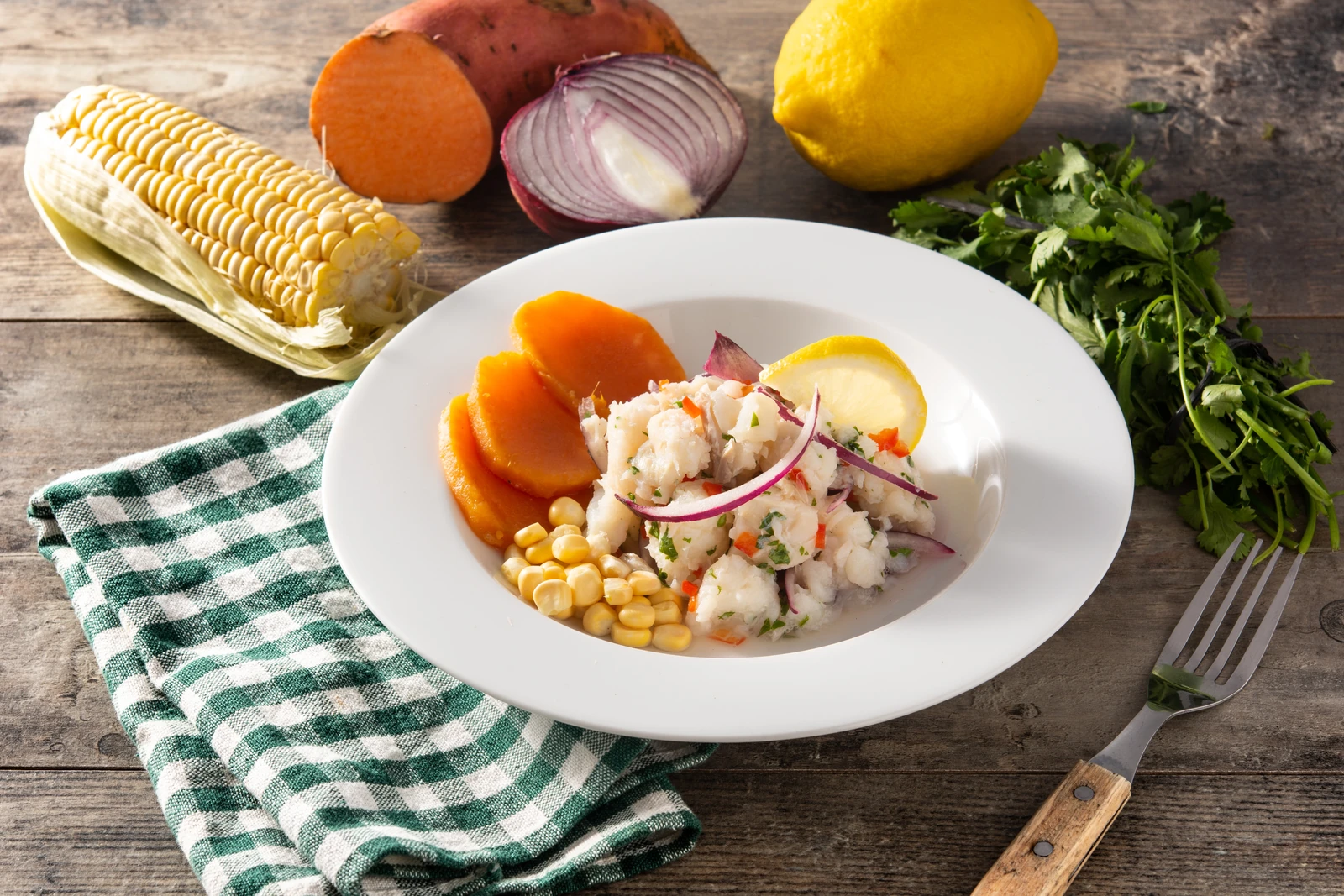

In Lima, ceviche is not left to soak. Cubes of raw white fish meet freshly squeezed lime, salt, chile and red onion for a couple of minutes, just long enough to turn white on the outside while the center stays silky and pearly, and they go to the table in their own sharp, spicy juice. That juice, boosted with a little blended fish, is leche de tigre (LEH-cheh deh TEE-greh), “tiger’s milk,” and it’s half the point of the dish. Sweet potato and big-kernel Andean corn sit alongside to cool the heat. Below: the recipe for 4, which fish you can safely eat raw and how to ask for it at a US or UK fish counter, what to use instead of Peruvian chiles, and why it can’t be made ahead.
What Peruvian ceviche is and how long it takes
How do you make Peruvian ceviche? Cut 1 lb 3 oz (540 g) of sushi-safe white fish into ¾-inch (2 cm) cubes, salt it, add chopped aji limo and ½ cup plus 1 tbsp (140 ml) of fresh lime juice with 2 ice cubes, and stir for 1 to 2 minutes until the fish whitens outside. Remove the ice, stir in strained leche de tigre, thinly sliced red onion and cilantro, and serve at once with sweet potato and corn. 60 minutes for 4 servings.
Total time 60 minutes, but most of that is the sweet potato simmering on its own. The ceviche itself is about 15 minutes of cutting and blending and 3 minutes of assembly. Easy, as long as you buy the right fish.
If you’ve had ceviche in the US, it was probably the Mexican style, and the two are made quite differently:
| Peruvian ceviche | Mexican fish ceviche | |
|---|---|---|
| Fish cut | ¾ in (2 cm) cubes | ½ in (1.5 cm) cubes |
| Time in lime | 1 to 2 minutes, at the table | 20 to 30 minutes in the fridge |
| The juice | kept and drunk as leche de tigre | half is drained off |
| Mixed with | red onion, aji limo, cilantro | tomato, cucumber, serrano, avocado |
| Served with | sweet potato and corn | tostadas or crackers |
The Mexican fish ceviche with tomato and avocado has its own timings and fish guide. For shrimp, there’s Mexican shrimp ceviche and the bright green shrimp aguachile.
Buying the fish, and keeping it safe
This is the part that matters most. Lime juice does not cook fish in any food safety sense. It turns the flesh white and firm the way heat does, but it doesn’t kill parasites and only knocks back some bacteria. Leaving the fish in lime longer doesn’t make it safer; it just makes it tough.
What “safe to eat raw” means
- Previously frozen. Freezing is what kills parasites. Fish meant for raw eating is frozen commercially at -4°F (-20°C) for 7 days or -31°F (-35°C) for 15 hours. A home freezer runs at about 0°F (-18°C) and can’t be relied on to do the same job, so the safest buy is fillet that was frozen by the supplier, thawed overnight in your fridge. If the shop can’t confirm how it was frozen, make the poached version below.
- “Sushi grade” or “sashimi grade.” It’s a marketing label, not a regulated grade. Ask the fish counter directly whether that fish was frozen for raw consumption.
- Fresh and cold. It should smell faintly of the sea, never fishy or of ammonia, with firm, glossy flesh. Straight home and into the fridge.
Who shouldn’t eat it raw. Pregnant women, young children, older adults and anyone with a weakened immune system. The poached version further down gives them a very close plate.
Out of the fridge, ceviche should sit no more than 2 hours, or 1 hour above 90°F (32°C).
Which fish to ask for
Peru’s classic is corvina, a firm, lean white fish; sole (lenguado) is the more delicate luxury option. Away from Peru:
| Where | Good choices | Notes |
|---|---|---|
| US | fluke or flounder, black sea bass, halibut, red snapper | Fluke is a flatfish, like Peruvian sole |
| UK | sea bass, sea bream, lemon sole, halibut | Farmed bass and bream are the easiest buys |
| Avoid | salmon, mackerel, swai or basa | Oily fish change the dish; swai and basa go mushy |
Tilapia works but comes out softer and blander. Each person gets about 4¾ oz (135 g) of trimmed fish, which with the sides is a full lunch; as a starter, the recipe serves 6.
Cost. The fish is almost the whole bill, and corvina and sole are the priciest. Flounder in the US or farmed sea bass in the UK give an excellent ceviche for less.
Limes, Peruvian chiles and the sides
- Limes. Peru uses the small, very sour limón sutil, close to a key lime. Regular (Persian) limes are slightly less aromatic and work well. Don’t use lemons, which taste different, or bottled juice.
- Aji limo. A small, fruity, quite hot Peruvian chile in red, yellow or green. Latin and Peruvian shops sometimes carry it fresh, frozen or as a paste. The closest swap is habanero in the US or Scotch bonnet in the UK, the same species with the same fruity smell but hotter: use half a habanero for each aji limo, seeded. Jalapeño or serrano is milder and loses the fruitiness.
- Rocoto. A round red Andean chile with black seeds and serious heat, sold frozen or as paste in Latin shops. It’s used in the rocoto variation below.
- Red onion, sliced paper-thin and soaked 5 minutes in ice water so it stays crisp and loses its harsh edge.
- Sweet potato. The orange-fleshed kind, called a sweet potato in the UK and sometimes labeled “yam” in US stores.
- Choclo. Peruvian corn has huge, pale, starchy kernels and isn’t very sweet. Latin shops in the US sell it frozen, on the cob or as kernels; in the UK, look online. Supermarket sweet corn works but adds a sweetness choclo doesn’t have.
- Cancha. Toasted, salted Andean corn kernels, crunchy and optional.
Equipment. A very sharp knife (a dull one crushes the fish), a glass or ceramic bowl set over ice, a blender, and a fine sieve. Skip aluminum, which reacts with acid.
Making it, step by step
What to do ahead
| When | What |
|---|---|
| Up to a day before | Cook the sweet potato (30 to 40 min) and corn (15 to 20 min); chill, covered |
| Up to a few hours before | Cut the fish into ¾ in (2 cm) cubes; keep covered over ice in the fridge |
| Up to 2 hours before | Slice and soak the onion, drain, chill |
| Up to 1 hour before | Blend and strain the leche de tigre; chill |
| Last 15 minutes | Squeeze the limes |
| At the table | Salt, chile, lime, 1 to 2 minutes, then leche de tigre and onion |
The one thing you can’t do ahead is put the fish in the lime.
Cutting the fish
Pat the fillet dry and remove skin, pin bones and the dark strip of bloodline, which tastes strong and doesn’t whiten. Cut ¾ in (2 cm) strips, then cubes, all the same size so they all reach the same point in the same 2 minutes. Odd-shaped trimmings go into the leche de tigre.
Leche de tigre
It’s the ceviche juice made stronger: lime blended with a little raw fish, which gives it body and a cloudy look, plus onion, chile, garlic and cilantro stems. 30 seconds in the blender, then strain, pressing with a spoon. The ice chills it and takes the edge off the acidity.
You want something milky, sour, salty and hot. If it’s too sharp, add another ice cube; if it’s flat, a pinch of salt. A ½ in (1 cm) slice of ginger or a little celery in the blender are both common additions.
The 3-minute assembly
- Salt first. 1 tsp over the cold cubes, toss, wait 1 minute, so the salt gets in before the acid firms the surface.
- Chile. Toss in the chopped aji limo.
- Lime and ice. Add the lime juice and 2 ice cubes, stirring for 1 to 2 minutes.
- Finish. Lift out the ice, stir in the leche de tigre, onion and cilantro, taste, serve.
How to tell it’s right
- Outside, each cube is opaque white.
- Inside, cut one open: the center is still pearly and slightly translucent. That’s the goal.
- Texture is tender and silky, not rubbery.
- The juice turns cloudy and pale.
If you’d like it firmer, give the fish 5 minutes in the lime before the leche de tigre goes in. Leave it 20 minutes and you’ve made a different dish.
Common mistakes
- Fish chalky and white right through. It sat in the lime too long, or was “made ahead.” Two minutes, at the table.
- Cubes falling apart. Soft fish or a dull knife.
- Bitter. The limes were squeezed hard against the peel, or hours early.
- Watery and lukewarm. The fish wasn’t dried, or the bowl wasn’t kept on ice.
- Too sour. One more ice cube in the leche de tigre and a pinch of salt balance it.
- Onion takes over. Slice it thinner and give it the ice-water soak.
- A strong smell when you open the pack. More lime won’t fix it. That fish isn’t for eating raw.
Allergens and heat. Contains fish. Free of gluten and dairy; check the label on store-bought cancha. With 2 seeded aji limo it’s properly hot; with half a chile, or chile only in the leche de tigre, it’s mild.
Variations
- Poached, for pregnancy, kids or older guests. Bring 2 quarts (2 liters) of salted water to a gentle simmer, add the cubes for 2 to 3 minutes until opaque and 145°F (63°C) in the center, chill 2 minutes in ice water, pat dry, and continue with just 1 minute of lime. Poach the 60 g (2 oz) of trimmings along with the cubes and use them, cooled, in the leche de tigre, because the regular one is made with raw fish (or blend it without fish), and wash the board, knife and bowl after handling the raw fillet. Firmer, but the juice tastes the same.
- Rocoto ceviche. Swap the chopped aji limo for 1 tbsp finely chopped rocoto, seeded. Hotter and redder; start with half.
- Yellow leche de tigre. Blend in 1 tbsp aji amarillo paste for a golden, fruitier, milder juice. It’s the same chile that goes into papa a la huancaina with creamy huancaina sauce.
- Mixed seafood. Replace 7 oz (200 g) of the fish with cooked, chilled octopus or shrimp, added at the end.
- For 8 or 12. Prep everything in one go, but assemble the ceviche in batches of 4 servings at the last minute; in one huge bowl the first cubes overcook while you’re plating the last.
Serving and leftovers
Serve in shallow bowls, fish and onion on top, juice around it, with 2 or 3 rounds of sweet potato and a wheel of corn per person, plus a lettuce leaf and a handful of cancha if you have them. Spoon up the juice at the end or pour it into a small glass.
For a Peruvian meal, ceviche comes first, followed by something hot such as lomo saltado, Peru’s beef stir fry with fries or aji de gallina, the creamy chicken with pecans. At a cevichería the usual hot dish is arroz con mariscos, Peruvian seafood rice with aji panca, which you can cook while the fish waits in the fridge.
For guests who don’t eat raw fish, causa limeña, layered potato with chicken is Peru’s other cold starter, and it’s assembled the night before. If you’d rather have the fish cooked, encebollado, Ecuador’s tuna and yuca soup brings the same lime and red onion bite to a hot bowl.
Leftovers. Best not to have any: in the fridge the lime keeps working, the fish turns tough within hours and the onion goes limp. If some is left, drain off the juice, refrigerate it covered within 2 hours and eat it by the next day. Don’t freeze or reheat it. The cooked sweet potato and corn keep 3 to 4 days in the fridge.
Frequently asked questions
How long do you marinate Peruvian ceviche? Only 1 to 2 minutes for ¾-inch (2 cm) cubes, stirring, until the outside turns white. Up to 5 minutes if you like it firmer; much longer and it toughens.
Is leche de tigre safe to drink? It contains raw fish, so it carries the same precautions as the ceviche: fine for healthy adults when the fish is right, not for pregnant women, young children or anyone immunocompromised. For them, make it with poached trimmings or with no fish at all.
Can I use frozen fish from the supermarket? Yes, and away from a fishmonger you trust it’s the safer choice, as long as the pack says it’s suitable for raw eating or the counter confirms it. Thaw it overnight in the fridge and pat it very dry.
Can I make it with lemons? It works in a pinch, but lemon juice is less sharp and tastes different, so the ceviche comes out flatter. Limes are worth the trip.
Nutrition
Per serving (4¾ oz / 135 g fish with its leche de tigre, 4½ oz / 125 g sweet potato and 2 oz / 60 g corn), worked out ingredient by ingredient from the recipe, using croaker for the corvina and sweet corn for the choclo:
- Calories: 352 kcal
- Protein: 32 g
- Carbohydrates: 46 g
- Fat: 6 g, of which 2 g saturated
- Fiber: 6 g
- Sugars: 11 g
- Sodium: 884 mg
The ceviche alone is about 187 kcal; the sweet potato adds about 108 and the corn about 58. Almost all the sodium is the salt, counted in full because the leche de tigre gets drunk.
The first Peruvian ceviche I made, I kept the fish in the lime “a little longer, just in case,” and it came out like the Mexican one I already knew. Now I set the bowl over ice, wait until everyone is sitting down, and pour the leche de tigre into small glasses before I bring the plates. Josnaisis.