
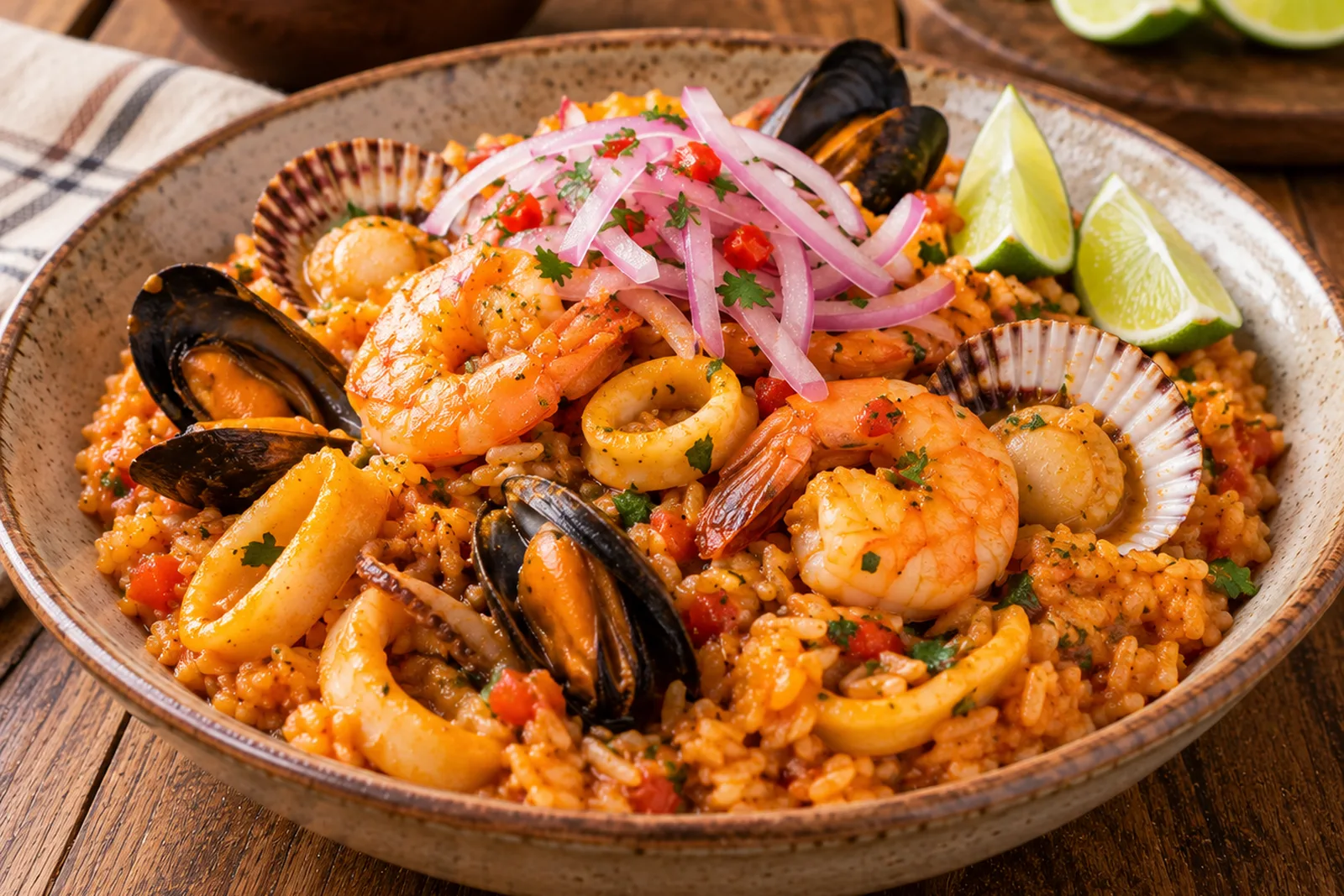

Arroz con mariscos (ah-ROHS kohn mah-REES-kohs) means “rice with seafood,” and in Peru it’s the hot dish of the cevichería, the seafood restaurant: long-grain rice cooked in a garlicky base of two Peruvian chiles, white wine and fish stock, with squid, shrimp and mussels folded through and a tangle of lime-dressed red onion on top. Think of it as somewhere between paella and a seafood jambalaya, with fruity chile instead of saffron or Cajun spice. This recipe serves 4 and is built for a US or UK kitchen: a bag of frozen seafood, chile pastes from a jar or a supermarket swap, and a method that keeps the seafood tender.
What arroz con mariscos is, and how long it takes
How do you make Peruvian arroz con mariscos? Sear 1 lb 5 oz (600 g) of seafood for 2 minutes and set it aside with its juices. Soften onion and garlic, fry 2 tbsp aji amarillo and 1 tbsp aji panca paste with tomato, reduce ½ cup (120 ml) white wine, then toast 2 cups (400 g) of rice and cook it covered in 2½ cups (600 ml) of stock for about 20 minutes. Fold the seafood back in with a splash of stock for 3 minutes and serve with salsa criolla and lime. 65 minutes for 4 servings.
Total time 65 minutes, about 30 of them hands-on; the rest is rice simmering under a lid. Medium difficulty, only because the seafood timing and the texture of the rice need your attention.
The finished dish is moist, not soupy and not dry: grains that stay whole and separate but glisten, and no liquid pooling in the pot. Heat is mild to medium. Aji amarillo is a yellow-orange chile with a fruity flavor and moderate heat; aji panca is a dark red one with almost no heat, used mostly for color and a sweet, smoky depth.
How it differs from paella and Peruvian fried rice
| Arroz con mariscos | Spanish paella | Arroz chaufa | |
|---|---|---|---|
| Rice | Long-grain | Short-grain (bomba) | Long-grain, cooked the day before |
| Flavor base | Aji amarillo, aji panca, wine | Saffron, paprika | Soy sauce, ginger, scallions |
| Texture | Moist, stirred together | Dry, thin layer, crisp bottom | Dry, stir-fried at high heat |
Peruvian arroz chaufa is the fried rice of Peru’s Chinese-Peruvian restaurants, with no chile and no stock. If you want seafood you eat with a spoon, the Colombian seafood stew in coconut milk is a creamy cazuela served with rice on the side, and for shrimp alone there’s Colombian shrimp rice made with a shell stock.
Ingredients, with US and UK shopping notes
Each person gets roughly 5 oz (150 g) of seafood and ½ cup (100 g) of uncooked rice, a generous one-dish meal.
| Ingredient | Metric | US | Notes and swaps |
|---|---|---|---|
| Mixed seafood | 600 g | 1 lb 5 oz | Frozen seafood mix is fine, see below |
| Long-grain white rice | 400 g | 2 cups | Not parboiled, not arborio |
| Fish or seafood stock | 840 ml | 3½ cups | Low-sodium if from a carton or cube |
| Dry white wine | 120 ml | ½ cup | Or more stock, see FAQ |
| Aji amarillo paste | 30 g | 2 tbsp | Swaps in the next section |
| Aji panca paste | 15 g | 1 tbsp | Swaps in the next section |
| Red onion | 150 g + 150 g | 2 medium | One for the rice, one for the relish |
| Tomato | 150 g | 1 large | Grated on a box grater, skin discarded |
| Red bell pepper, frozen peas | 75 g, 70 g | ½ pepper, ½ cup |
Which rice to buy
Use regular long-grain white rice. Rinsing it until the water runs almost clear washes off loose starch that makes it sticky. Short-grain rice like bomba or arborio drinks more stock and turns creamy, closer to risotto, so the liquid amounts here won’t work for it. Parboiled (converted) rice stays too separate and doesn’t take on the color and flavor in the same way.
Aji panca and aji amarillo, and what to use instead
Both are sold as pastes in jars. In the US, look in the Hispanic or international aisle of larger supermarkets, Latin grocers, or online. In the UK they’re easiest to find online or in Latin American shops.
| If you can’t find | Use | What changes |
|---|---|---|
| Aji panca paste, 1 tbsp | ½ dried ancho or 1 dried guajillo chile, stemmed and seeded, soaked 20 minutes in hot water and blended with a splash of the water | Ancho is earthier and guajillo tangier; similar color and low heat |
| Aji amarillo paste, 2 tbsp | Frozen aji amarillo or dried aji mirasol, blended to a paste | Same flavor; mirasol gives a more toasted orange |
| Aji amarillo paste, 2 tbsp | ½ roasted, peeled yellow bell pepper plus ¼ yellow habanero (UK: scotch bonnet) or ½ serrano, blended | Similar color and heat, without the fruity aji flavor. Tasty, but a different rice |
These are the same swaps that work in the marinade for Peruvian chicken with aji panca and the sauce for aji de gallina. Paprika adds color but doesn’t stand in for aji panca.
Frozen seafood mix, and how to thaw and drain it
A bag of frozen mixed seafood is the easy route, and it works well. In the US it’s often sold as seafood medley or seafood blend; in UK supermarkets look for seafood selection or mixed seafood. Read the label. If it says cooked, don’t sear it: add it at the end just to heat through. If it’s raw, sear it for 2 minutes as in the recipe card.
Thawing. The night before, in the fridge, in a colander set over a bowl so the water drains away. In a hurry, keep it in its sealed bag and submerge it in cold water, changing the water every 30 minutes; 1 lb (450 g) takes about an hour. Never thaw it on the counter.
Draining. Frozen seafood, especially squid, sheds a lot of water. Drain it and pat it dry. Wet seafood cools the pan, steams instead of searing, and that water ends up thinning out the rice.
Fresh seafood. Peeled raw shrimp or prawns, squid rings and mussels. Cook about 1 lb 2 oz (500 g) of fresh mussels in their shells, covered, with ½ cup (120 ml) water until they open; throw away any that stay shut. Pick out the meat and strain the liquid into your stock. Scallops get a separate 1-minute sear and go in at the very end.
Stock and wine
Carton or cube fish stock is fine; if it’s salted, use half the salt in the recipe and taste. If you buy shell-on shrimp, fry the shells in 1 tbsp oil, cover with 1 quart (1 liter) of water, simmer 15 minutes and strain: that’s the best stock for this rice. Use a dry white wine; a sweet one makes the rice cloying.
Step by step, with what to look for
Work in this order: the onion relish first (it soaks while you do everything else), then the seafood, seared and set aside, then the rice, which needs no attention for its 15 minutes under the lid. Warm the stock in a saucepan while you make the base; cold stock slows the boil and the bottom layer of rice cooks before the top.
- The sear. High heat, oil just smoking, shrimp and squid in a single layer for 2 minutes. Shrimp pink outside and still translucent inside, squid opaque white. Work in two batches if your pan is small.
- The chile base. Onion 4 minutes, garlic 1 minute, chile pastes and cumin 3 minutes, until the oil turns orange and shows at the edge and the raw chile smell is gone. Then tomato for 5 minutes, until there are no pieces left.
- The rice. After the boil, when the liquid has dropped to the surface and small craters appear, the lid goes on and the heat goes to its lowest for 15 minutes. Don’t stir and don’t peek.
- Done. After the seafood goes back in with ½ cup (120 ml) of stock for 3 minutes, shrimp should be opaque through and the rice tender, glossy and moist, with no liquid at the bottom of the pot. Seafood is safe when shrimp are firm and pearly-opaque and mussels have opened; the target for seafood is 145°F (63°C).
Fixing the texture
- Dry or still hard: add ½ cup (120 ml) reserved stock and cook 3 to 5 minutes more, covered. Common with loose lids or burners that don’t turn down low enough.
- Soupy: uncover over medium heat for 2 or 3 minutes, stirring gently, until the bottom dries. Rest it uncovered.
- Mushy: it was stirred while cooking or the rice wasn’t rinsed. Next time, hands off for the full 15 minutes.
With a different rice the liquid will change, so go by the grain and the bottom of the pot, not just the clock.
Mistakes to avoid
- Rubbery squid. It cooked too long. Two minutes in the pan, then back in at the end; never 20 minutes with the rice.
- Watery, bland rice. Frozen seafood that wasn’t drained. Thaw in a colander and pat dry.
- Raw-tasting chile. The tomato went in right after the paste. Give the chiles their full 3 minutes in the oil.
- Too salty. Store-bought stock and mussels are already salty. Taste the liquid before salting the rice.
- Scorched bottom. The heat was too high under the lid. Use the lowest setting, and on a strong burner set a heat diffuser under the pot.
Heat, kids and allergens. With 2 tbsp aji amarillo paste it’s mild to medium. For children, use 1 tbsp and let adults add heat with the relish. It contains shellfish (shrimp) and mollusks (squid, mussels). It’s gluten-free if your stock is; check the label on cubes.
Variations and cooking for a crowd
- Quick, with cooked rice. The way many cevicherías do it. Make the chile base and reduce the wine as above, add 1 cup (240 ml) stock and simmer 3 minutes, fold in 5 to 6 cups of cooked white rice (what 2 cups of uncooked rice makes) for 3 minutes, then the seafood for 2 to 3 minutes. About 30 minutes. The rice is looser and less infused.
- With Parmesan and cream. Stir in 2 tbsp heavy cream (UK double cream) and 1½ oz (40 g) grated Parmesan with the cilantro. Richer and creamier, closer to the Lima restaurant style.
- Green, northern Peruvian style. Blend a bunch of cilantro with a little stock to get ½ cup of green paste and add it with the aji amarillo; replace the wine with ½ cup (120 ml) lager. The rice turns green.
- Shrimp only. 1 lb 5 oz (600 g) peeled raw shrimp, seared the same 2 minutes.
- For 8. Double everything, use a 13 in (32 cm) wide pot or two pots, and sear the seafood in three or four batches.
- For 12 or more. Use the cooked-rice method: cook the rice the day before, spread it on a shallow tray, refrigerate it within 1 hour and reheat it only once; on the day it’s just base, mix and seafood.
Make ahead. The chile base, up to and including the tomato, keeps covered in the fridge overnight. Set the seafood to thaw the same night, and you’re about 45 minutes from dinner the next day.
Cost. Scallops and large prawns are what push the price up; a bag of frozen seafood mix keeps it affordable and gives a good result.
Serving, leftovers and reheating
Serving. Straight from the pot, with the salsa criolla on top or alongside and a lime wedge to squeeze. In Peru a ceviche often comes first; Peruvian ceviche with leche de tigre and this rice make a full cevichería meal at home.
Fridge. Cool leftovers fast: spread them in a shallow container and refrigerate within 2 hours, ideally within 1. Cooked rice and seafood keep 3 to 4 days at most, but I eat it within 1 or 2 days, because reheated seafood gets tougher each time. Eat the relish the same day; by the next day the onion goes limp.
Freezer. You can freeze it, but squid and shrimp come back tougher. If you do, I’d keep it no longer than 1 month, and thaw it overnight in the fridge.
Reheating. Once only, just the portion you’ll eat. In a covered skillet over medium-low heat with 2 or 3 tbsp stock or water, 5 to 7 minutes, stirring gently, until steaming in the center and 165°F (74°C). In the microwave, covered, at medium power, stirring every minute.
Frequently asked questions
Can I make arroz con mariscos without wine? Yes. Replace the ½ cup (120 ml) of wine with the same amount of stock. You lose a little acidity and aroma; a squeeze of lime at the table makes up for it.
Can I add octopus? Only cooked octopus: raw octopus needs far longer than the rice. Slice 5 to 7 oz (150 to 200 g) cooked octopus and add it with the other seafood in the final 3 minutes, just to heat through.
Why is my rice pale? Too little chile paste, or it wasn’t fried long enough. Most of the color comes from aji panca fried for 3 minutes until the oil turns orange. If you’re using the bell pepper swap, add ½ tsp sweet paprika for color.
What is salsa criolla? Peru’s everyday relish: thinly sliced red onion, soaked to tame it, then dressed with lime, fresh chile, cilantro and salt. It goes on rice dishes, stews and sandwiches, and its acidity cuts through the richness of this one.
Nutrition
Per serving (a quarter of the pot with its share of salsa criolla, no other sides), calculated ingredient by ingredient from the recipe card:
- Calories: 715 kcal
- Protein: 38 g
- Carbohydrates: 100 g
- Fat: 15 g, of which 2 g saturated
- Fiber: 5 g
- Sugars: 8 g
- Sodium: 1410 mg
The rice provides about 365 kcal per serving, the oil about 95 and the seafood about 130. Sodium is high because of the stock, mussels and salt; low-sodium stock and half the salt bring it down a lot. Jarred chile pastes usually contain salt too, so check the label.
At home I make it with a bag of frozen seafood mix, because I can find it all year, and I leave it thawing in a colander in the fridge overnight. The step I never skip is pulling the seafood out after 2 minutes: the first few times I let it cook with the rice, and the squid came out like rubber bands. Josnaisis.