
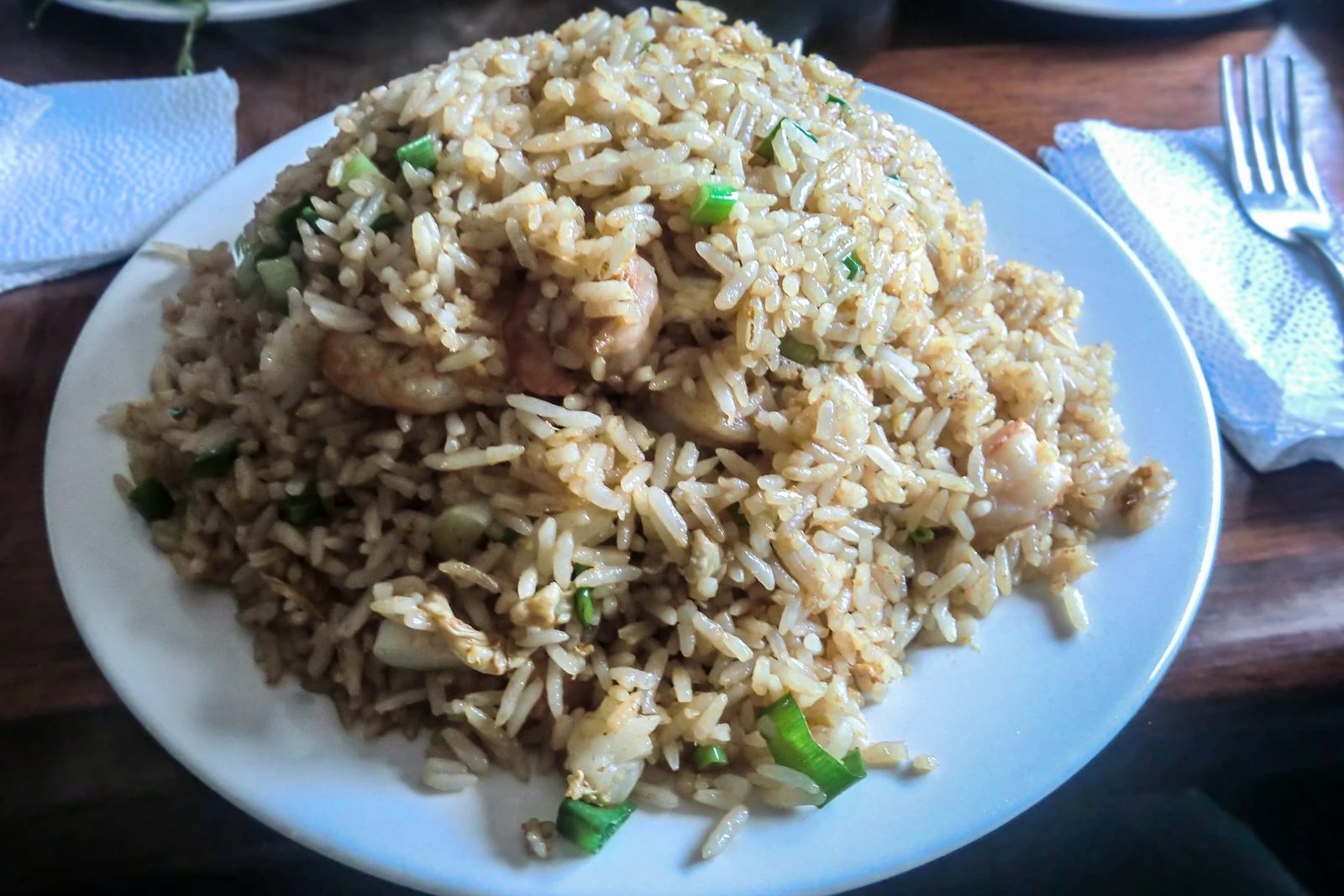

Arroz chaufa (ah-ROHS CHOW-fah) is the fried rice of Peru’s chifa restaurants, the Chinese-Peruvian kitchens found all over Lima, and it’s built on just a few things: day-old rice, a thin egg omelet cut into strips, plenty of scallions, fresh ginger, soy sauce and a last splash of toasted sesame oil. Chicken is the most common version. The difference between a loose, toasty chaufa and a soggy one comes down to two habits: rice that has spent the night in the fridge, and letting it sit untouched over the highest heat until it crackles. This recipe serves 4, works in a regular 12 inch skillet, and covers how much soy sauce to use, what to do without leftover rice, and the beef, seafood and aeropuerto versions.
What arroz chaufa is and how it differs from takeout fried rice
How do you make arroz chaufa? Cook 3 beaten eggs into a thin omelet and cut it into strips. Stir-fry 14 oz (400 g) of cubed chicken over the highest heat for 5 to 6 minutes and set it aside. In the same pan, add 4 cups (600 g) of cold cooked rice to scallion whites, garlic and ginger that have sizzled for 1 minute, and let it toast for about 5 minutes, pressing and flipping instead of stirring constantly. Finish with 3 tbsp soy sauce poured around the edge, the chicken, the egg, the scallion greens and sesame oil. 35 minutes for 4 servings.
“Chaufa” comes from the Chinese chaofan, fried rice. In Peru it’s a full meal on its own, light brown rather than dark, with scallion and ginger up front and the egg in visible strips instead of scrambled into the grains. It isn’t spicy: chili sauce and lime go on the table.
Time. 35 minutes with the rice already cooked: 20 at the stove after 15 minutes of chopping. Difficulty, easy, as long as everything is chopped before the pan goes on, because the stir fry doesn’t wait.
Two close relatives. From the same chifa kitchen comes lomo saltado, the Peruvian beef stir fry with soy and vinegar, seared the same way, fast and hot. And if you know Colombian fried rice, that one is darker, loaded with several meats and hot dogs, and served with fries; chaufa is simpler, with one protein and the ginger and scallion up front.
Ingredients at a glance
About 3½ oz (100 g) of raw chicken and 1 cup of cooked rice per person, plus the egg.
| Ingredient | Metric | US | Notes and swaps |
|---|---|---|---|
| Long-grain rice, uncooked | 185 g | 1 cup | Cooked the day before; jasmine works too |
| Chicken breast or thighs | 400 g | 14 oz | Thighs stay juicier |
| Eggs | 3 large | 3 large | Made into a thin omelet |
| Scallions | 90 g | 6 | UK spring onions |
| Fresh ginger, grated | 6 g | 1 tbsp | Ground ginger is not a swap |
| Garlic | 9 g | 3 cloves | Finely minced |
| Soy sauce | 60 ml | 4 tbsp | Regular, not sweet or dark |
| Neutral oil | 42 g | 3 tbsp | Vegetable, canola or sunflower |
| Toasted sesame oil | 14 g | 1 tbsp | Added at the end |
Day-old rice, and the shortcut
Freshly cooked rice is moist and soft on the surface. In a hot pan that moisture turns to steam, the grains glue together and the result tastes like rice stew. After a night in the fridge, the grains are firm and dry outside, separate easily and toast instead of steaming.
Cook long-grain rice with 2 cups of water per cup of rice and no salt, the way you’d make plain fluffy white rice; the soy sauce brings almost all the salt. Once it’s cooked, spread it on a clean, shallow tray so it cools fast and get it into the fridge within 1 hour; cover it once it’s cold. Short-grain or sushi rice stays sticky.
No leftover rice? Cook it, spread it hot on a sheet pan so the steam escapes, and refrigerate it uncovered for 1 hour. It’s a little softer but fries fine.
Scallions, ginger, soy sauce and sesame oil in a US or UK store
- Scallions. In Peru it’s cebollita china, the same green onion sold as scallions in the US and spring onions in the UK. Whites go in early with the garlic; greens go in at the end, barely cooked.
- Ginger. Called kion in Peru. Peel it with the edge of a spoon and grate it on a fine grater. Ground ginger gives a dry heat with none of the fresh aroma.
- Soy sauce. Peruvians call it sillao. Use regular soy sauce from any supermarket. For a darker color without more salt, add 1 tsp dark soy sauce from an Asian grocery.
- Sesame oil. The toasted, amber kind. It goes in at the very end, because high heat drives off its aroma. 1 tbsp is plenty; more drowns the ginger.
How much soy sauce
Use 1 tbsp on the chicken and 3 tbsp in the rice for 4 cups (600 g) of cooked rice. That gives an evenly seasoned, light-brown rice. Some Peruvian home cooks use as much as 8 tbsp for the same amount of rice, which makes it much darker and saltier. I’d rather keep it lighter and put the bottle on the table, because there’s no fixing rice that’s too salty.
Wok or skillet
A wok or a 12 in (30 cm) cast-iron, carbon-steel or stainless skillet that can handle the highest heat. In a 12 in pan, all 4 cups of rice fit in one batch; in a 10 in (24 to 26 cm) pan, fry the rice in 2 batches, each with half the aromatics. Have a wide spatula and a bowl ready for the chicken.
How to make arroz chaufa
Set up before the heat goes on
Line up next to the stove, in order: the omelet strips (made first), the marinated chicken, the scallion whites with the garlic and ginger, the crumbled rice, the soy sauce measured in a cup, the scallion greens and the sesame oil. From the moment the chicken goes in until you serve, it’s about 15 minutes without a break.
A thin omelet, in strips
Beat the eggs with the salt and cook them as one thin omelet: medium heat, 2 minutes without touching it, then 1 minute on the other side. Cut it into ⅜ in (1 cm) strips or squares. That way the egg shows up in pieces through the rice instead of disappearing into it. If you’d rather scramble, cook the eggs in the hot pan, stirring, for 1 minute and lift them out.
Chicken in one layer
Heat the empty pan over the highest heat for 2 minutes, until it smokes. Add the drained chicken in a single layer: 1 minute untouched to brown the bottom, then 4 to 5 minutes of stir-frying, until the largest cubes have no pink in the middle, 165°F (74°C) on a thermometer. In a 10 in pan, do it in 2 batches: piled up, chicken leaks juice and simmers in it instead of browning.
Toast the rice, don’t just stir it
This is the step that makes the dish. Once the aromatics have had 1 minute, add all the rice and toss it through. Then, instead of stirring nonstop:
- Spread it across the pan and press it down with the flat of the spatula.
- Leave it alone for 1 minute, until it crackles and smells toasty.
- Flip it in sections, scraping the bottom, and press it down again.
- Repeat 3 times. After about 5 minutes the rice is hot, separate and golden in spots.
Soy sauce at the edge, then the finish
Pour the soy sauce around the edge of the pan, where the metal is hottest: it sizzles on contact, toasts slightly and coats the rice in 30 seconds without soaking it. Pour it into the middle and one patch goes dark and wet while the rest stays white.
Then add the chicken and its juices, the egg, the scallion greens and the sesame oil, and toss for a minute or two.
It’s ready when the grains separate as you toss them, the color is an even light brown, there’s no liquid in the bottom of the pan and a few grains crunch.
Common mistakes
- Sticky, clumpy rice. Freshly cooked rice, or cold rice that wasn’t broken up. Crumble it by hand before you start.
- Pale, soft rice. Heat too low, pan too small or too much rice at once. Highest heat, batches in a 10 in pan, and let it sit until it crackles.
- Dark patches and white patches. The soy sauce went into the middle. Pour it around the hot edge and toss right away.
- Too salty. Too much soy sauce or a strong brand. Start with 2 tbsp in the rice, taste, then add the third.
- Bitter taste. The garlic browned in very hot oil. Give it 1 minute, just until fragrant, and add the rice straight away.
- Dry chicken. Cubes cut too small, or breast cooked too long. Take it out as soon as the pink is gone; it reheats with the rice.
Heat, kids and allergens. Not spicy, and most kids like it; go easy on the scallion greens for picky eaters. It contains soy and wheat (soy sauce), egg and sesame. For gluten-free, use tamari and check the label.
Variations and cooking for a crowd
- Beef chaufa. Swap the chicken for 14 oz (400 g) of steak sliced thin against the grain, seared 2 minutes in 2 batches.
- Seafood chaufa. 14 oz (400 g) peeled shrimp or prawns, stir-fried 2 to 3 minutes until pink and firm; add them back at the end with the egg so they don’t toughen. For seafood rice simmered in stock and Peruvian chiles rather than stir-fried with soy sauce, see arroz con mariscos, Peru’s one-pot seafood rice.
- Aeropuerto. Chaufa served on the same plate as tallarín saltado, a chifa noodle stir fry, often with bean sprouts. A plate for a big appetite.
- Chaufa amazónico. Made with cecina, a salted, smoked meat from Peru’s Amazon, instead of chicken, and served with fried ripe plantains.
- Vegetarian. Skip the chicken and stir-fry 10 oz (300 g) sliced mushrooms over the highest heat for 5 minutes, with diced carrot and red bell pepper.
- With rotisserie chicken. Shred cooked chicken and add it with the egg: it only needs 2 minutes to heat through.
- For 8. Don’t double it in one pan. Make the omelet and chicken in 2 batches each, and the rice in 2 rounds of 4 cups, each with half the aromatics, soy sauce and sesame oil. Every 4 people need about 1 cup of uncooked rice.
A 35-minute weeknight dinner
With rice cooked the day before, it’s 35 minutes on the clock, and closer to 25 if you slice the scallions, garlic and ginger in the morning. Without cooked rice, add 1 hour of chilling on a sheet pan and 30 minutes to cook the rice, so about 2 hours in all. Whenever I cook rice for lunch, I make an extra cup for tomorrow’s chaufa.
Serving and leftovers
Serving. In Peru it’s eaten on its own as a full meal, with soy sauce, a chili sauce and sometimes a lime wedge on the side. The creamy aji amarillo sauce from papa a la huancaina is a great spoonful on top. For a Peruvian spread, start with a chilled causa limeña, layered potato and chicken, or make aji de gallina, the creamy chicken stew, another main that goes with plain rice, as does seco de res, Peru’s cilantro beef stew with canary beans.
Fridge. Refrigerate leftovers in a shallow container within 1 hour. General leftover guidance allows 3 to 4 days at 40°F (4°C) or below, but the strictest advice for cooked rice is 24 hours. Since the rice already spent a night in the fridge before it was fried, I eat leftovers the next day at the latest.
Freezer. Up to 3 months in a flat, well-sealed bag. Thaw overnight in the fridge.
Reheating. Once only, in a hot skillet with 1 tbsp water, 3 to 4 minutes, tossing, until steaming all the way through, 165°F (74°C). In the microwave, cover it, add a spoonful of water and heat in 1-minute bursts, stirring in between. Don’t reheat what you won’t eat.
Why the fuss about rice? Raw rice can carry bacterial spores that survive cooking. If cooked rice sits for hours at room temperature, they multiply and make a toxin that reheating doesn’t destroy. Cooling it fast and keeping it in the fridge prevents that.
Arroz chaufa FAQ
Is arroz chaufa the same as Chinese fried rice? It’s the same family, since it came out of Peru’s chifa kitchens. What makes it Peruvian is how it’s eaten, with chili sauce and lime at the table, and versions like aeropuerto or the Amazon-style chaufa with cecina.
Does it use oyster sauce? It’s optional. 1 tbsp with the soy sauce adds gloss and a sweet-salty depth. If you use it, cut the soy sauce in the rice to 2 tbsp.
Can I add peas or bell pepper? Many versions leave them out; others add diced red bell pepper. Stir-fry it for 2 minutes with the scallion whites; thawed frozen peas go in with the rice.
Can I make it with quinoa? Yes, quinoa chaufa is a thing in Peru: use 4 cups of cooked quinoa, chilled overnight, and follow the same steps.
Nutrition per serving
Per serving (a quarter of the recipe, made with chicken breast), worked out ingredient by ingredient from the amounts above:
- Calories: 485 kcal
- Protein: 32 g
- Carbohydrates: 41 g
- Fat: 20 g, including 4 g saturated
- Fiber: 1 g
- Sugars: 1 g
- Sodium: 1,130 mg
Soy sauce accounts for nearly 80% of the sodium. With reduced-sodium soy sauce and no salt in the omelet, it drops to about 680 mg per serving.
Leftover rice rarely gets thrown out in my kitchen, and chaufa is one of my favorite ways to use it, because it asks for very little and you can taste every part: the ginger, the scallions, the sesame. The only discipline it demands is patience, leaving the rice alone in a hot pan until it crackles before touching it. Josnaisis.