
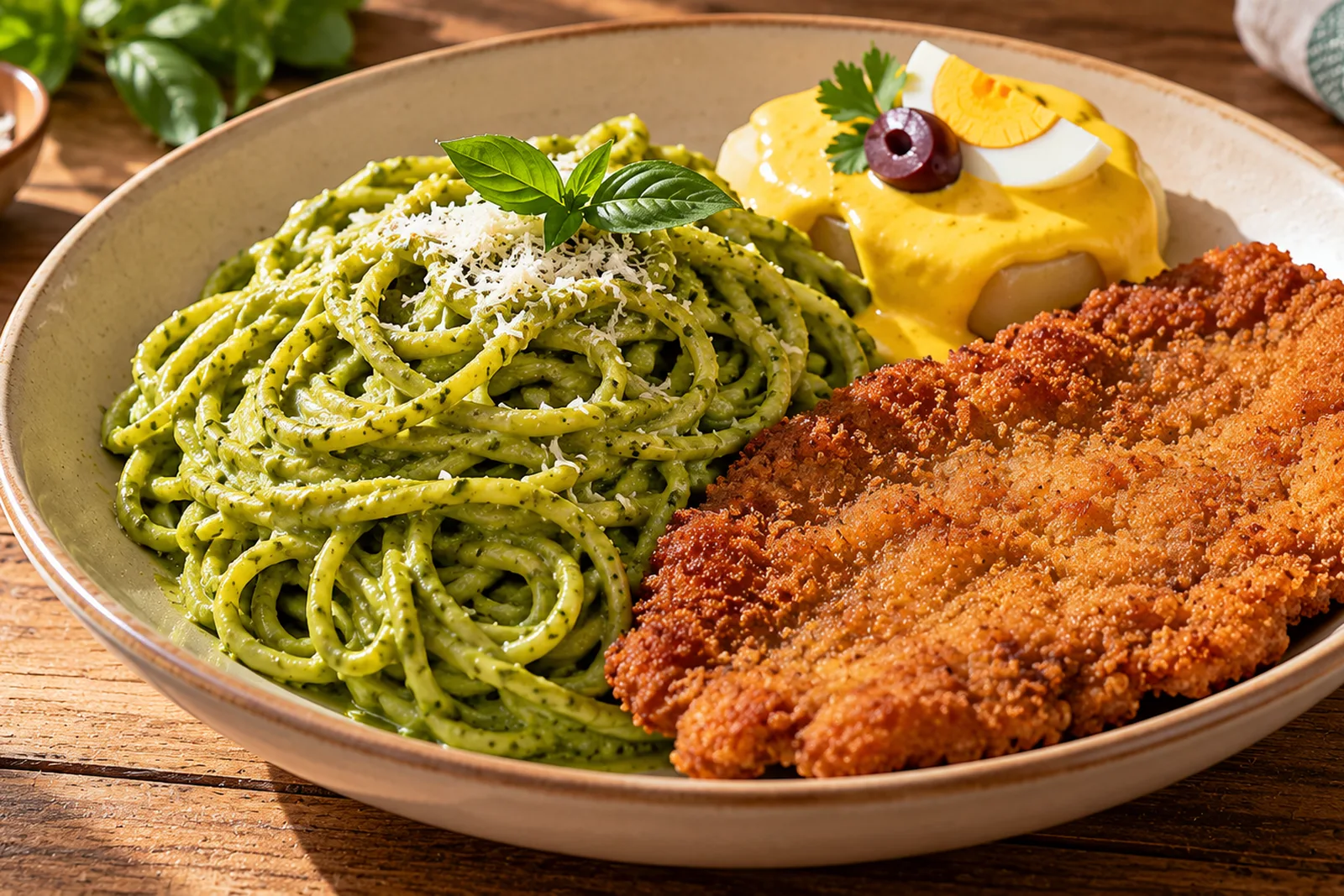

Tallarines verdes (tah-yah-REE-nehs VEHR-dehs) means “green noodles,” and in Peru it’s an everyday dinner: spaghetti tossed in a smooth sauce of spinach, basil, fresh cheese, evaporated milk and pecans, usually with a thin breaded steak on the side. Think of it as a creamy cousin of pesto. It’s mild, it’s on the table in 30 minutes, and the only real trick is keeping the sauce a vivid green instead of a dull olive, which takes one 30-second step.
What tallarines verdes is, and how it differs from pesto
How do you make tallarines verdes? Blanch 5 oz (150 g) spinach and 1¾ oz (50 g) basil in boiling water for 30 seconds, chill them in ice water and squeeze them dry. Cook 14 oz (400 g) spaghetti in that same water while you blend the greens with softened onion and garlic, 5 oz (150 g) queso fresco, ¾ cup (180 ml) evaporated milk and 1 oz (30 g) pecans. Toss the sauce with the pasta over the lowest heat just until hot, without boiling. 30 minutes for 4 servings.
| Italian pesto | Tallarines verdes | |
|---|---|---|
| Greens | Raw basil only | Spinach and basil, usually blanched |
| Cheese | Parmesan or pecorino | Queso fresco, a salty, crumbly fresh cheese |
| Nuts | Pine nuts | Pecans or walnuts |
| Liquid | Olive oil | Evaporated milk and a little oil |
| Texture | Oily, coarse | Creamy, smooth |
| Served | Uncooked, tossed with pasta | Warmed briefly with the pasta |
It isn’t spicy at all. The evaporated milk gives a faint sweetness and the cheese does the salting, so taste before you add any.
Two other pastas on this site look similar on paper. Mexican white spaghetti is a holiday side in a crema and cream cheese sauce with no greens, and Mexican red spaghetti is blended tomato with cream.
Easy, and done in the time it takes to boil water and cook a box of spaghetti.
Ingredients and US and UK swaps
The recipe allows 3½ oz (100 g) dried pasta per person, a generous main if there’s steak alongside. A 1 lb (450 g) box with the same amount of sauce also works for 4, just a little less saucy.
| Ingredient | Amount | US | UK |
|---|---|---|---|
| Queso fresco | 150 g (5 oz) | Dairy aisle or Latin section | Feta; taste before salting |
| Evaporated milk | 180 ml (¾ cup) | Any supermarket, by the condensed milk | Same, sold in small tins |
| Pecans | 30 g (1 oz) | Baking aisle | Baking aisle; walnuts are fine |
| Spinach | 150 g (5 oz) | Baby spinach bag | Baby spinach bag |
| Basil | 50 g (1¾ oz) leaves | 2 or 3 clamshells or a large bunch | 2 or 3 supermarket packs or a potted plant |
The cheese is the one that matters
Peruvian queso fresco is white, salty and crumbly. It doesn’t melt or go stringy, which is why the sauce turns out velvety rather than gooey.
- Mexican or Latin American queso fresco from a US supermarket is the closest match. Queso blanco or farmer’s cheese also works.
- Feta, in the US or the UK, is saltier and tangier. Leave out the ¼ tsp salt until you’ve tasted the blended sauce.
- Ricotta makes a milder, less salty sauce. Add 2 tbsp grated Parmesan to the blender and season more.
- Not cheddar or mozzarella. Melting cheeses turn stringy or greasy when warmed with the pasta.
If you’re missing something
- No evaporated milk. Whole milk works but the sauce is thinner and less rich; start with ⅔ cup (150 ml). All heavy cream (UK double cream) is too heavy; half cream and half whole milk comes closer.
- No pecans. Walnuts taste slightly more bitter, which the cheese mostly covers. For a nut allergy, leave them out and add 1 oz (30 g) more cheese for body.
- Frozen spinach. It’s already blanched, so thaw it, squeeze it hard and blend it without boiling. The sauce comes out a shade darker.
- Dried basil. Doesn’t work here. Fresh leaves only.
Equipment. A 5-quart (5-litre) or larger pot, a slotted spoon or spider, a bowl of ice water, a small skillet and a blender. A stick blender in a tall jug works but needs an extra minute to get smooth.
How to make tallarines verdes
One pot of water, three jobs
Everything runs off a single pot. Soften the onion while the water comes to a boil. Blanch the greens in it. Then cook the pasta in the same water, and blend the sauce during those 9 to 11 minutes. By the time the pasta is al dente, the sauce is waiting.
Blanch, chill, squeeze
The greens go into the boiling water for 30 seconds, then straight into ice water for 1 minute. They come out a brighter green than they went in, which is how you know it worked.
Then squeeze them, hard. A wet clump of spinach waters down the sauce and makes it paler.
Blend until smooth
Give it a minute or two on high, until there are no flecks of pecan or leaf. The sauce should coat the back of a spoon and fall off in a thick ribbon. If it’s more like a purée, add 2 tbsp of pasta water and blend again.
Toss on the lowest heat
The hot pasta does most of the work. Over the lowest heat, toss with tongs for a minute or two until the sauce is hot and clinging. Loosen with pasta water 2 tbsp at a time; the starch in it makes the sauce glossy without thinning the flavor. Plate it right away.
Why the sauce turns olive, and how to keep it green
Basil and spinach contain an enzyme that starts browning the leaves as soon as they’re cut or blended. A 30-second blanch switches it off, and the ice bath stops the leaves from cooking further. That’s why blanched sauce holds its color much better in the fridge.
Long heat does its own damage: boiled or reheated over and over, the green slides toward khaki even if you blanched. So the sauce never simmers on its own here; it only warms through with the pasta.
Can you skip blanching? Yes. Raw leaves give a slightly stronger basil flavor, and if you’re eating it the moment it’s made, the color holds well enough. If you want leftovers or to make the sauce ahead, blanch.
Other things that go wrong
- Watery, pale sauce. The greens weren’t squeezed.
- Gritty sauce. Not blended long enough, or a weak blender with whole pecans. Blend another minute or chop the nuts first.
- Too salty. Queso fresco and feta are both salty, and Parmesan on top adds more. Taste before seasoning.
- Pasta dries out on the plate. Not enough sauce, or it sat. Serve as soon as it’s tossed and keep some pasta water to loosen it.
- Tastes only of spinach. Too little basil, or too much stem. It’s 1¾ oz (50 g) of leaves.
Allergens. Contains milk (cheese and evaporated milk), tree nuts (pecans) and gluten (wheat pasta). No chiles, so no heat.
What to serve with tallarines verdes
- Bistec apanado, the classic partner. It’s a thin steak, about ¼ in (6 mm), dredged in flour, egg and breadcrumbs and pan-fried, much like a schnitzel. The method is the same as for crispy Mexican beef milanesa: oil at 350 to 355°F (175 to 180°C), 2 to 3 minutes per side. Fry it while the pasta boils.
- Papa a la huancaína. A plate with green noodles on one side and potatoes under a yellow chile and cheese sauce on the other is a Peruvian favorite. Papa a la huancaína can be made the day before.
- Breaded or grilled chicken. Colombian breaded chicken cutlets use the same dredge.
- To drink. A glass of homemade chicha morada with pineapple and cinnamon, Peru’s non-alcoholic purple corn drink, which kids like too.
- A fried egg on top, the meat-free way to eat it.
For 8, double everything, cook the pasta in two pots or two batches, and blend the sauce in two goes if your blender jar is under 6 cups (1.5 litres). For 12, triple it: 2⅔ lb (1.2 kg) pasta and three batches of sauce. The sauce can be made a few hours ahead and chilled; cook the pasta last.
If you’re building a Peruvian dinner, aji de gallina runs on the same pantry, evaporated milk and pecans, with yellow chile and shredded chicken.
Make ahead, storing and reheating
- Sauce in the fridge. In a sealed jar, up to 3 days. Blanched greens hold their color much better. It thickens when cold; loosen it with a splash of milk.
- Sauce in the freezer. Up to 3 months, in a container or flat freezer bag. Thaw overnight in the fridge. If it looks separated, whisk it or blend it again with 2 tbsp milk.
- Tossed pasta. Refrigerate within 2 hours and eat within 3 days. Don’t freeze it; the pasta goes soft.
- Reheating. In a skillet over low heat with 2 to 3 tbsp milk or water, stirring, until steaming hot, 165°F (74°C). In the microwave, use medium power and stir every minute. The green dulls a little each time.
The cheese and pecans are what make this cost more outside Peru; walnuts and a block of supermarket queso fresco bring it down.
Frequently asked questions
Is tallarines verdes the same as Peruvian pesto? People often call it that in English, and it’s the closest comparison. It’s creamier and milder than Italian pesto, though, because of the spinach, fresh cheese and evaporated milk.
Can I make it with only basil? You can replace the spinach with more basil, but the sauce tastes much stronger, closer to pesto, and costs more. Spinach gives body and color without drowning out the basil.
Should the Parmesan go in the sauce? Some cooks blend it in. I only sprinkle it on top. If you blend it in, 2 tbsp is enough, and skip the fine salt.
What other pasta shapes work? Fettuccine, linguine or short shapes like penne all hold the sauce. Keep it to 3½ oz (100 g) per person.
Nutrition
Per serving, without the steak or the Parmesan on top, worked out ingredient by ingredient from the quantities above:
- Calories: 711 kcal
- Protein: 26 g
- Carbohydrates: 86 g
- Fat: 30 g, of which 9 g saturated
- Fiber: 5 g
- Sugars: 10 g
- Sodium: 515 mg, not counting the salt in the pasta water
The pasta is about 371 kcal of that, the oil about 90, the queso fresco about 112 and the pecans about 52. The greens barely register.
I blanch every time, even when it’s going straight to the table, because sauce rarely survives dinner in my house, but when it does I want it still green the next day. Dylan gets his with a fried egg and the Parmesan passed around; mine comes with the steak. Josnaisis.