
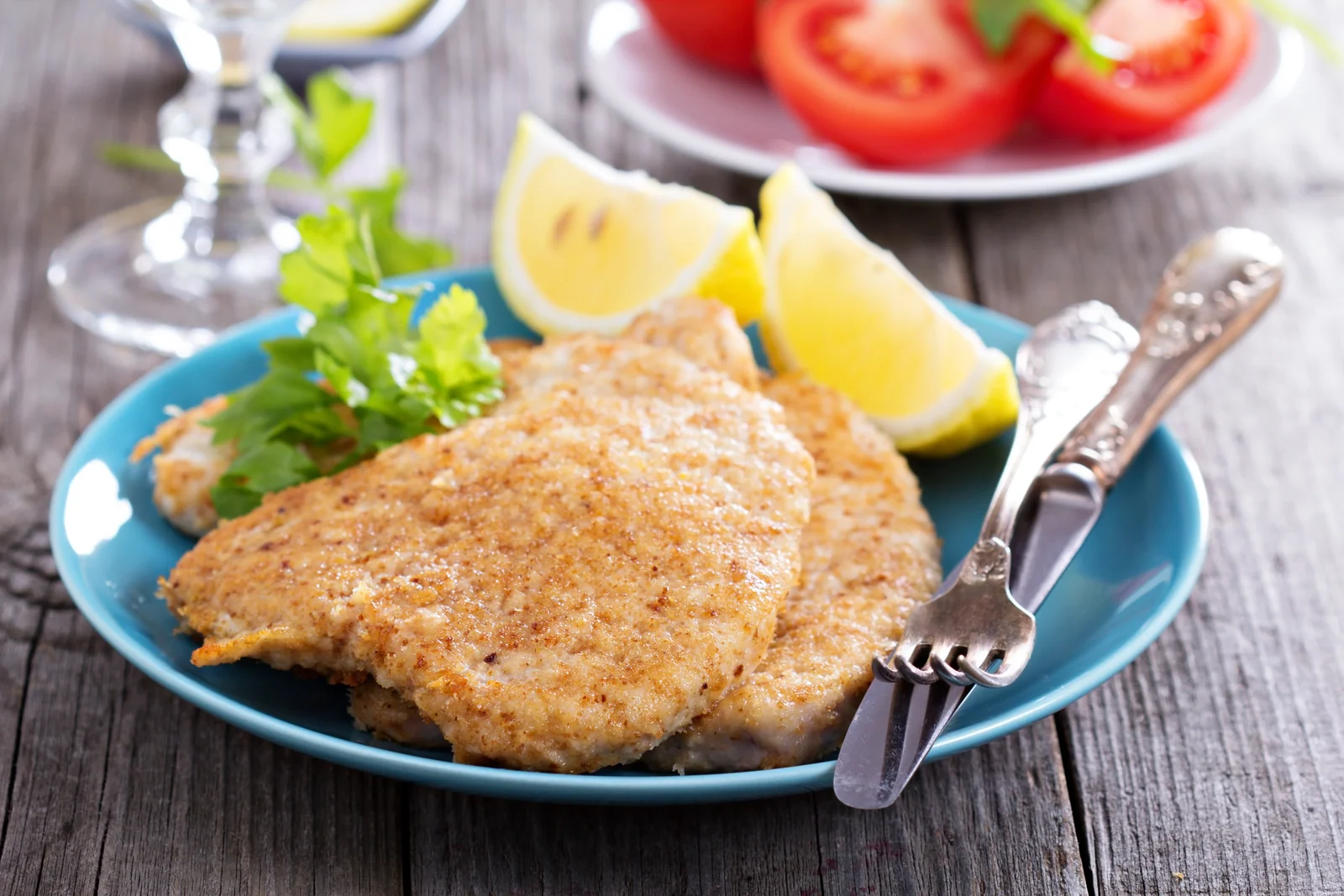

Milanesa is Mexico’s everyday breaded steak: a slice of beef pounded thin, coated in breadcrumbs and pan-fried until it crackles, then served with a squeeze of lime. If you know Wiener schnitzel or Italian cotoletta alla milanese, you already know the method. It’s a staple of Mexican fondas, the small family-run lunch spots, where it comes with rice, beans and salad, or tucked into a crusty roll as a torta. Here’s what to ask for at the meat counter, how thin to pound it, how to keep the crust from sliding off, and how to reheat leftovers so they’re still crisp.
What Mexican milanesa is, and how it differs from schnitzel and chicken fried steak
How do you make beef milanesa? Pound 600 g (1⅓ lb) of top round to ¼ inch (6 mm), pat it dry and season it. Coat it in flour, beaten egg and breadcrumbs, pressing them on, and chill for 15 minutes. Pan-fry in 1 cup (250 ml) of oil at 350–360°F (175–180°C) for 2 to 3 minutes per side and drain on a rack. 55 minutes for 4 servings.
The finished milanesa has a thin, smooth, golden crust that stays fused to the meat, and the beef inside is cooked through but still tender. It isn’t spicy; the heat comes from whatever salsa or pickled jalapeños you put next to it.
- Versus Wiener schnitzel → same flour, egg and crumb coating. Classic schnitzel is veal and is fried in deeper fat so the crust puffs away from the meat. A milanesa is usually beef, fried in a shallower layer of oil, and the crust is meant to stay flat and attached.
- Versus chicken fried steak → the American dish uses tenderized cube steak coated in seasoned flour (often flour, egg and flour again), not breadcrumbs, and it’s smothered in cream gravy. Milanesa has a finer, crunchier crumb crust and no sauce, just lime.
Difficulty is honestly easy. There’s no tricky technique, only an order to follow. One pound of beef makes about 3 milanesas; the 1⅓ lb in this recipe makes 4 large ones.
What to ask for at the meat counter
You want a lean cut with long fibers that turns tender after a few minutes in hot oil once it’s pounded thin. About 150 g (5 oz) per person.
- In the US → look for thin-sliced top round, often labeled “milanesa” or “for milanesa”. Many large supermarkets carry it, and Latin carnicerías almost always have it, usually already sliced into large thin sheets. Bottom round works too. Packs sold as minute steaks, breakfast steaks or sandwich steaks are fine if they’re from the round.
- In the UK → topside or silverside minute steaks. Topside is the closest to top round. Or ask the butcher to slice topside about 6 mm (¼ inch) thick.
- If you can only find thick steaks → buy top round and pound it yourself, or butterfly it first: slice it horizontally almost all the way through and open it like a book.
Skip cube steak. It has already been run through a tenderizer and the surface is shredded, so the crust tears and the meat goes stringy. Stewing cuts like chuck or shank turn chewy when fried for 5 minutes.
Breadcrumbs, swaps and what they change
Plain, fine, dry breadcrumbs are the classic: they give the smooth, even crust Mexican cooks expect. UK readers, that’s dried breadcrumbs, not fresh.
- Panko → a thicker, shaggier crust that’s crunchier and soaks up a bit more oil. Crush it slightly in a bag for something closer to the original.
- Crushed saltine crackers → saltier and they brown faster. Leave the salt off the meat and watch the second side.
- Crushed unsweetened corn flakes → very crunchy but they darken quickly, so keep the oil at 350°F (175°C) and watch the color.
- Gluten-free → rice flour or cornstarch instead of wheat flour, and gluten-free crumbs or crushed corn flakes. Check the corn flakes label, since many contain barley malt.
Equipment. A heavy 11 to 12 inch (28 to 30 cm) skillet, a meat mallet with a flat face (or a heavy pan), tongs, a slotted spoon and, ideally, a wire rack set over a baking sheet. An instant-read thermometer takes the guesswork out of the oil, but you can manage without one.
How to pound the beef so the milanesa is tender, not tough
Tough milanesa nearly always comes down to one of four things:
- Uneven thickness → if one end is ½ inch and the other ⅛ inch, the thin end dries out before the thick end is done. Pound to an even ¼ inch (6 mm) across the whole steak.
- Too much pounding, or with the spiked side → the spikes shred the meat and make it spongy. Use firm strokes with the flat side, center outward, and stop once it’s even. If the beef is already sliced very thin, 2 to 3 mm (about ⅛ inch), don’t pound it further; just even out the edges.
- Too long in the oil → at ¼ inch, 2 to 3 minutes per side cooks the beef through. Longer just dries it out. Thinner steaks need less time; go by the color of the crust.
- Wrong cut or gristle on the edge → gristle shrinks as it fries and bends the steak. Trim it, or nick it in 2 or 3 places.
Do you need to marinate it? Not for tenderness. Thickness and timing do that. Many Mexican cooks soak the beef in beaten egg with garlic and parsley for 20 minutes or longer for flavor; if you do, still pat it dry before the flour.
How to keep the breading from falling off
Breading lifts off when moisture is trapped between the crust and the meat. In the oil, that moisture turns to steam and pushes the coating away. Five habits prevent it:
- Dry meat → blot it before seasoning, and again if it has released juice.
- A whisper of flour → it soaks up surface moisture and gives the egg something to cling to. Clumps of flour peel off in sheets, so shake hard.
- Drained egg → hold each steak over the dish for a few seconds. Excess egg sets into a rubbery layer that separates.
- Crumbs pressed on with your palm → both sides, until no meat shows through.
- A 15-minute rest in the fridge, in one layer → the coating sets. Stacked steaks stick together and tear the crust when you pull them apart.
In the pan, flip only once, with tongs, never a fork, and don’t nudge them for the first minute.
Oil temperature and the signs it’s right
Aim for 350–360°F (175–180°C). One cup (250 ml) in an 11 to 12 inch skillet gives a layer about ¼ inch deep, which is plenty for a ¼ inch steak you turn once.
- No thermometer → a pinch of crumbs should sizzle on contact and stay golden. If it sinks and barely bubbles, the oil is too cool; if it browns in seconds, it’s too hot.
- Oil too cool → a pale, greasy crust that goes soft and slips off.
- Oil too hot → the crust is dark before 2 minutes are up and tastes bitter, so lower the heat and wait a minute.
- One or two at a time → every steak drops the oil temperature. Two is the most a 12 inch pan can take without them touching.
- Between batches → skim loose crumbs, or they burn and speckle the next one. Top up the oil if it gets low and let it reheat.
Signs it’s done. Strong, steady bubbling all around the steak from the moment it goes in, an even golden brown after 2 to 3 minutes a side, and when you cut it, no pink in the beef and the crust still attached.
Drain on a rack rather than paper towels: on paper, the underside steams in its own heat. Never cover them, because a lid or foil softens the crust within minutes.
What to serve with beef milanesa
The fonda plate is Mexican red rice, refried beans and a simple lettuce, tomato and onion salad, with lime wedges to squeeze over the crust. Other good partners are fries or mashed potatoes, a bowl of fresh pico de gallo for some crunch and heat, or chunky homemade guacamole in place of the salad.
How to make a torta de milanesa
The torta is the other classic way to eat it, and the best use for leftovers. Split a crusty homemade bolillo roll or a telera (a ciabatta roll or a small French baguette is the nearest supermarket swap), pull out a little of the soft crumb and toast the cut sides on a dry skillet for 1 to 2 minutes. Spread refried beans on one half and mayonnaise or Mexican crema on the other. Add a hot milanesa, sliced avocado, tomato, onion and pickled jalapeños; some people add queso fresco or shredded lettuce. One milanesa per torta; if it hangs far over the edges, cut it in half.
Milanesa gratinada, the cheesy version
Top a freshly fried milanesa with tomato sauce, a slice of ham and a melting cheese (Monterey Jack or low-moisture mozzarella), then slide it under the broiler (UK grill) until the cheese melts. Eat it straight away, as the sauce softens the crust.
Chicken, pork, air fryer and oven versions
- Chicken → butterflied chicken breast pounded to ¼ inch (6 mm), breaded the same way. Chicken has to reach 165°F (74°C) in the center, so give it about 3 minutes a side; the Colombian breaded chicken with ¼ inch cutlets walks through it.
- Pork → pork leg cutlets pounded to about ¼ inch; it’s the same idea as the breaded Colombian chuleta valluna.
- Air fryer → bread as usual, spray both sides with oil and cook at 400°F (200°C) for 8 to 10 minutes, flipping halfway. Crisp, but paler and a little drier than pan-fried.
- Oven → on a rack over a sheet pan, sprayed with oil on both sides, at 400°F (200°C) for about 20 minutes, flipping halfway. The least oil, with a lighter, drier crust.
- For 8 or more → double the recipe and run two skillets. Keep finished milanesas on a rack over a sheet pan in a 200°F (95°C) oven, uncovered, for no more than 20 minutes; longer and the crust softens.
What drives the cost. Almost all of it is the beef. Top round, or topside in the UK, is one of the cheaper steak cuts that works here, and pre-sliced milanesa packs cost a little more than buying a top round steak and pounding it at home.
Make ahead, storage and reheating so it stays crisp
- Breaded and raw, in the fridge → up to 1 day, in a single layer on a tray, covered with plastic wrap. Dinner is then 10 minutes of frying.
- Breaded and raw, in the freezer → freeze on a tray for 2 hours without touching, then bag them with parchment between each one. They keep for up to 3 months. Thaw overnight in the fridge on a rack and fry as usual.
- Cooked, in the fridge → cool uncovered on the rack, refrigerate within 2 hours in a container lined with paper towel, and eat within 3 to 4 days.
- Cooked, in the freezer → 2 to 3 months, separated with parchment. The crust comes back a little less crisp than fresh.
Reheating. An air fryer at 350–360°F (175–180°C) for 5 to 8 minutes, flipping halfway, or the oven at 350°F (180°C) for 10 to 15 minutes on a rack. Both bring the crunch back; heat until the center reaches 165°F (74°C). A skillet with a tablespoon of oil, 2 minutes per side over medium heat, also works. The microwave heats it but leaves the crust soft, which is fine only if it’s going into a torta.
Beef milanesa FAQ
Can I use cube steak for milanesa? You can, but it isn’t ideal. Cube steak has been mechanically tenderized, so the torn surface holds the breading poorly and the texture is stringy. Thin-sliced top round gives a cleaner bite.
Why is my milanesa greasy? The oil was too cool or the pan was crowded. Breading soaks up oil when it doesn’t set right away, so wait for 350–360°F (175–180°C) and fry one or two at a time.
Can I skip the flour? Yes, plenty of Mexican home cooks go straight to egg and crumbs. The flour helps the crust stay attached, so without it, dry the meat very well and press the crumbs on harder.
How many calories are in a beef milanesa? About 390 kcal per milanesa made from 150 g (5 oz) of raw beef, without sides: 37 g protein, 13 g carbohydrates, 20 g fat (6 g saturated), 1 g fiber, 1 g sugars and 880 mg sodium. I counted the beef, the flour, egg and crumbs that actually stick, and about 6 g of absorbed oil per steak, which is my own estimate for a thin cutlet shallow-fried.
I always bread two more milanesas than I need and freeze them raw, with parchment between each one. On a busy day they move from the freezer to the fridge the night before, and dinner is 10 minutes at the stove. Any cooked leftovers go into the air fryer the next day and then into a roll with beans and avocado; the microwave never gets them. Josnaisis.