
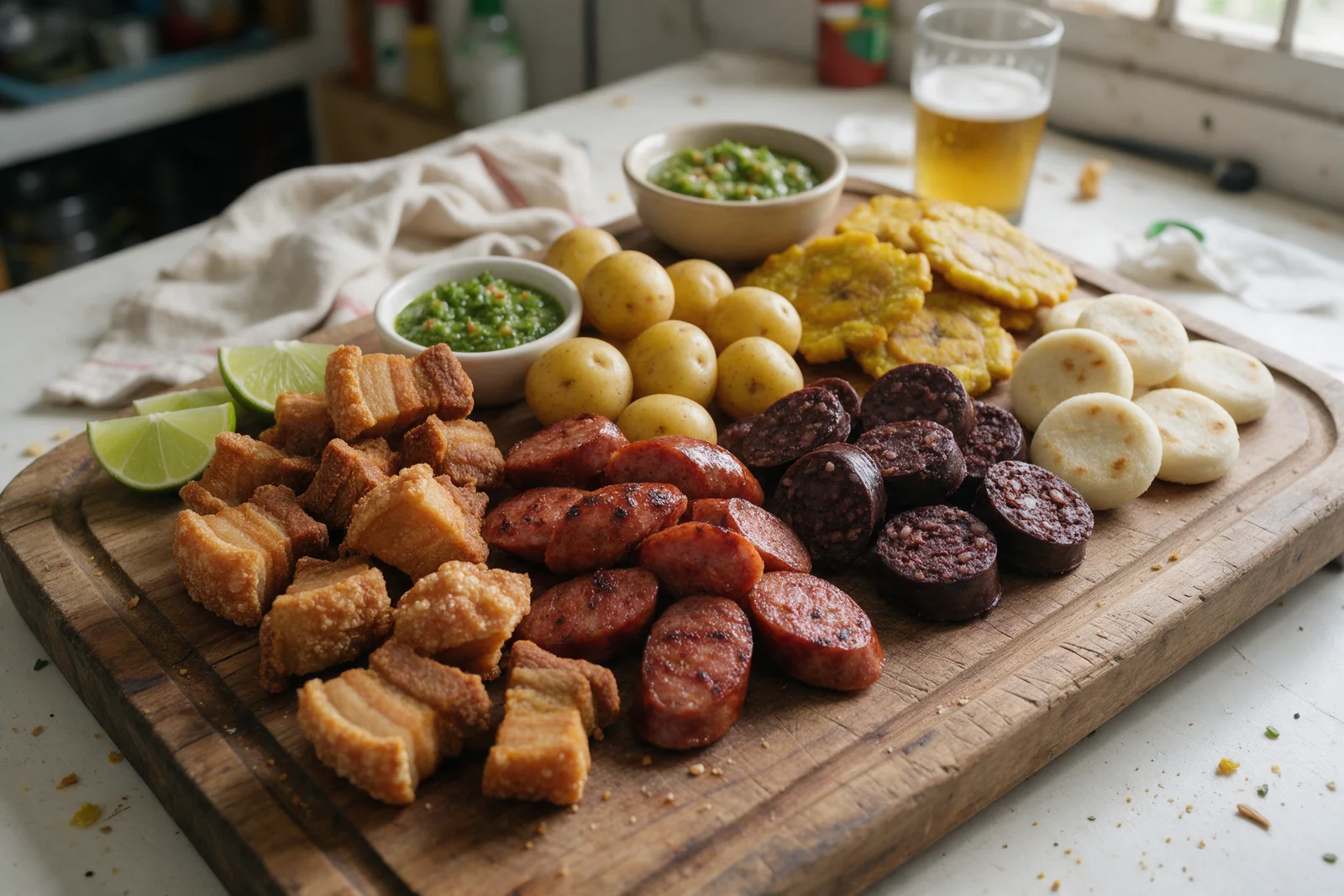

A Colombian picada is a shared platter of pork, sausages and fried starches, cut into bites and eaten with toothpicks, and the only hard part is getting six different things to the table hot and crisp at once. The fix is a plan, not a technique: do the boiling and seasoning the day before, then cook in an order where the first thing out of the oil is the one that holds best in a low oven. That gives you about 100 minutes of cooking on the day, three burners and an oven going, and a platter built in the last ten minutes.
What a Colombian picada is, and how it differs from fritanga
How do you make a Colombian picada? The day before, salt the pork belly, boil the cassava for 25 minutes and poach the chorizos. On the day, simmer the pork belly in water and then fry it in its own fat while the potatoes fry at 340°F (170°C) and the cassava and ripe plantain at 350-355°F (175-180°C), all held in a 200°F (90°C) oven. Brown the chorizo and morcilla in the pork fat and toast the mini arepas last. 150 minutes for 6 servings.
If you have never had one, picture a Colombian answer to nachos for a crowd: a big board in the middle of the table, everyone standing or sitting around it with a toothpick. The usual lineup is chicharrón (fried pork belly with puffed, crackling skin), chorizo, morcilla (a rice and herb blood sausage), papa criolla (small yellow potatoes fried whole), plantain, mini arepas (corn cakes) and yuca (cassava), with lime wedges, aji hot sauce and guacamole. There is no fixed list, and plenty of cooks add ribs, beef or chicken.
Picada or fritanga? Colombians often use the two words for the same platter, and restaurant menus list near-identical plates under either name. The practical difference is in the word: a picada is chopped into bites and can include grilled or griddled meats alongside the fried ones. My Colombian fritanga platter, fried in one pot in a fixed order is the all-fried version, with ribs and beef, about 3 hours for 8.
Picada or bandeja paisa? The bandeja paisa, with beans, rice and a fried egg is a single plate for one person. A picada has no beans or rice and is meant for sharing.
Time and effort. About 150 minutes of cooking: 50 the day before and 100 on the day. Nothing on the platter is hard on its own. The medium difficulty is juggling three pots and an oven, which is much easier with a second pair of hands.
Shopping list for 6, with US and UK finds
This feeds 6 adults as a meal. As a game-day snack with other food on the table, it stretches to about 10.
Pork belly for the chicharrón
14 oz (400 g) fresh, skin-on pork belly with a thick stripe of meat, in 2 or 3 pieces about 2 × 4 inches (5 × 10 cm), plus 1 level teaspoon (5 g) salt. It has to be fresh: bacon or cured belly turns salty and burns before the skin softens. In the US, Asian and Latin markets sell it with the skin on; regular supermarkets often trim it off, so ask at the counter. In the UK, pork belly with rind is in most supermarkets and every butcher. Cook it in big pieces and cut it at the end: small pieces dry out before the skin puffs. The full method, and why the water comes first, is in my Colombian chicharrón, simmered and fried in its own fat.
Chorizo
6 fresh Colombian chorizos, about 1 lb (450 g), one per person. These are fresh pork links seasoned with garlic, green onion and cumin, cooked before eating. In the US, Latin supermarkets carry them fresh or frozen, sometimes labeled antioqueño or santarrosano. Two swaps to avoid: Spanish cured chorizo is dried and sliced raw, a different product, and Mexican chorizo is loose, red with chile and vinegar, and falls apart in the pan. The UK “cooking chorizo” is heavy on smoked paprika and tastes nothing like it. If you can’t find Colombian chorizo, a good fresh garlicky pork sausage is the closer match. My Colombian chorizo, poached first so it doesn’t burst explains the poach-then-brown method used here.
Morcilla
10½ oz (300 g) Colombian morcilla, already cooked, which is how it is sold. It is filled with rice, peas and fresh mint and pennyroyal, so it tastes green and herby. In the US, look in Latin markets, chilled or frozen. In the UK, the closest is Spanish rice morcilla (de Burgos) from delis or online, which has the rice but not the herbs. British black pudding is oat-based and much richer, a different eat. No luck at all? Double the chorizo. If you’re curious, my Colombian blood sausage shows what goes inside.
Potatoes
1.1 lb (500 g) papa criolla, a small Andean potato with yellow, almost buttery flesh. US Latin markets sell it frozen, usually par-cooked: thaw it, dry it well and pull it from the oil as soon as it is golden and wrinkled, since it needs less time. Otherwise use baby yellow potatoes or small Yukon Golds in the US and baby new potatoes in the UK. Because they are bigger, boil them for 15 minutes first, dry them and fry about 5 minutes to brown. They come out less yellow and less creamy, but they work. To cook them on their own, see papas criollas fried, roasted or air fried, with timings for each.
Cassava, plantain and arepas
- Cassava (yuca): 1.1 lb (500 g) fresh, about 14 oz (400 g) peeled. Many US supermarkets stock it as yuca or cassava, and Latin freezer aisles sell it peeled in bags. In the UK, try Afro-Caribbean and Asian grocers, fresh or frozen. Frozen goes straight into boiling water and takes 20 to 30 minutes.
- Ripe plantains: 2 large, about 1 lb (470 g) peeled. They look like oversized bananas and are sold in most US supermarkets and in UK supermarkets and Afro-Caribbean shops. You want skins mostly black but fruit still firm; soft ones collapse in the oil.
- Mini arepas: 12 of about 1 oz (30 g) each, from the refrigerated or frozen Latin section in the US. In the UK you will likely make them from precooked white cornmeal (masarepa), sold in Latin shops and online.
For the table
3 limes in wedges, a batch of Colombian aji with green onion, tomato and cilantro (about 2 cups, 500 ml) and guacamole made with 3 Hass avocados. Plus 1.5 liters (about 6 cups) of neutral oil and ½ teaspoon (3 g) fine salt for the fried pieces.
The pork belly and the sausages are most of the bill. To stretch the platter, add more potatoes, cassava and arepas, which are filling and cheap, rather than cutting back on the lime and aji that make the richness work.
Equipment
- A heavy 8-inch (20-22 cm) pot with a lid and a splatter screen, for the pork belly.
- A heavy 8½-inch (22 cm) pot for frying: 1.5 liters of oil gives you about 1½ inches (4 cm) depth.
- A 10-11-inch (26-28 cm) skillet for the arepas.
- A wire rack set over a sheet pan, for the oven.
- A frying thermometer helps. Without one, a piece of potato should bubble hard the moment it touches the oil, without violent spitting.
The day before, 50 minutes that save an hour
- Salt the pork belly. Score the meat side every ¾ inch (2 cm), down to the skin but not through it, rub with salt and leave it uncovered on a rack in the fridge. The skin dries out and puffs better the next day.
- Boil the cassava. Peel it, cook it in salted water for about 25 minutes from the boil, until a knife slides in and the pieces start to split at the edges. Pull out the tough fiber running through the middle, cut into ¾-inch (2 cm) sticks and refrigerate. Cold cassava breaks less and fries crisper.
- Poach the chorizos. Cover with cold water, don’t prick them, and cook 10 minutes from the moment the water steams, never at a rolling boil, which splits the casings. That brings them to 160°F (71°C) inside. Pat dry and refrigerate; they keep 3 days this way and only need browning.
- Make the aji base, the blended chile with vinegar and salt. Chop the vegetables on the day so they stay crunchy.
Leave the guacamole, which darkens, and all the frying for serving day.
Serving-day timeline, minute by minute
- 0 to 10 minutes. Oven on at 200°F (90°C) with the rack over a sheet pan. Finish the aji.
- 10 minutes: pork belly into water. Skin side up, water halfway up the pieces. Once it boils, cover and simmer 20 minutes over medium, then uncover until the water evaporates, 20 to 25 minutes. No babysitting needed, which frees you for the fry pot.
- 10 to 38 minutes: potatoes. Oil at 340°F (170°C), whole potatoes in 2 batches of 12 minutes. To the rack, salted while hot.
- 38 to 52 minutes: cassava. Oil up to 350-355°F (175-180°C), cold sticks in 2 batches of 5 to 7 minutes.
- 52 to 66 minutes: plantain. Diagonal ⅜-inch (1 cm) slices at 350°F (175°C), 2 batches, 2 to 3 minutes a side, flipped once.
- 55 to 79 minutes: pork belly fries. When the water is gone the pot starts to sizzle. Turn every 4 to 5 minutes for 18 minutes, then skin down over medium-high for 4 to 6 minutes until it puffs. Make the guacamole while it fries; the oil pot is done by now.
- 79 to 90 minutes: sausages and arepas. Chorizos in the pork fat for 8 to 10 minutes, turning every 2; then morcilla slices for 3 minutes, flipped once with a spatula. Arepas in a dry skillet alongside, 3 to 4 minutes a side.
- 90 to 100 minutes: cut and plate. Pork into 1¼-inch (3 cm) bites, chorizo into ¾-inch (2 cm) rounds, everything onto the platter.
How to tell each piece is done
| Piece | Time | What you should see |
|---|---|---|
| Papa criolla | 12 min per batch | Skin wrinkled and starting to split, flesh soft to a skewer |
| Cassava | 5-7 min per batch | Golden all over, crust sounds hollow when tapped |
| Ripe plantain | 2-3 min a side | Mahogany edges, gives when pressed |
| Pork belly, water stage | 40-45 min | Water gone, sound changes from bubbling to dry sizzle |
| Pork belly, fat stage | 22-24 min | Meat golden, skin covered in blisters and puffed |
| Chorizo | 8-10 min | Evenly browned skin, hot in the center |
| Morcilla | 3 min | Crisp crust on both cut faces, still holding together |
| Mini arepas | 3-4 min a side | Golden spots, warm through |
Why this order
The pork belly is the longest job, around 70 minutes, and its water stage asks nothing of you, so that is when the oil pot runs. Whole potatoes go into the oil first because, protected by their skins, they hold best in the oven. Plantain goes last in the oil because its sugar darkens and leaves burnt bits behind. Morcilla is the very last thing in the pan for the same reason: it crumbles and stains the fat.
Keeping everything hot and crisp
- Oven at 200°F (90°C), on a rack, uncovered. Foil traps steam and turns crusts soft.
- Salt the moment things leave the oil. Salt won’t stick once they cool.
- One layer on the rack, pieces not touching.
- What holds worst comes last. Sausages and arepas go straight from the pan to the platter.
- If guests run late, the finished platter can go back in the 200°F (90°C) oven for 10 minutes. Any longer and the plantain and cassava dry out.
Scaling up for 4, 10 or 20 people
These amounts are for a meal. As a snack spread with other food, each column feeds noticeably more people.
| Ingredient | 4 people | 6 people | 10 people | 20 people |
|---|---|---|---|---|
| Skin-on pork belly | 10½ oz (300 g) | 14 oz (400 g) | 1½ lb (700 g) | 3 lb (1.4 kg) |
| Fresh chorizos | 4 | 6 | 10 | 20 |
| Morcilla | 7 oz (200 g) | 10½ oz (300 g) | 1.1 lb (500 g) | 2.2 lb (1 kg) |
| Small yellow potatoes | 12 oz (350 g) | 1.1 lb (500 g) | 1.9 lb (850 g) | 3¾ lb (1.7 kg) |
| Peeled cassava | 10½ oz (300 g) | 14 oz (400 g) | 1½ lb (700 g) | 3 lb (1.4 kg) |
| Ripe plantains | 1 large | 2 | 3 or 4 | 7 |
| Mini arepas | 8 | 12 | 20 | 40 |
| Avocados for guacamole | 2 | 3 | 5 | 10 |
| Limes | 2 | 3 | 5 | 10 |
With a bigger crowd the minutes per batch don’t change, but the logistics do:
- Oven-roast the pork belly. Beyond 1½ lb (700 g) it won’t sit in one layer in a pot. Boil the pieces 30 minutes, dry them 10 on a rack, then roast skin side up at 425°F (220°C) for 40 to 45 minutes. The skin crisps into a flat crackling rather than puffing.
- Two fry pots or an electric deep fryer for the potatoes, cassava and plantain, or the batches stretch past an hour.
- Grill the sausages if you have a grill: 20 pre-poached chorizos brown all at once.
Mistakes that make a picada soggy or greasy
- Frying raw cassava. It browns outside and stays hard inside. Always boil it first, about 25 minutes.
- Crowding the pot. Each cold batch drops the oil temperature, and a full pot ends up soaking rather than frying. Two batches per item, and let the oil recover in between.
- Pricking the chorizo. The juices run out and it dries.
- Searing the morcilla early. It crumbles and darkens the fat for everything after it.
- Covering the fried food to keep it warm. It steams itself soft.
- Cutting the pork belly before cooking. Small pieces dry out before the skin puffs.
- Plantains that are too soft. They break up in the oil and soak up fat.
Ways to change it up
Add beef or chicken. One of the most common additions. Beef in ¾-inch (2 cm) cubes, seared in batches over high heat for about 3 minutes until browned with no pink inside. Chicken thigh or breast pieces, 5 to 6 minutes per batch, to 165°F (74°C) in the center. Cook either in the arepa skillet before the arepas.
Swap the sweet plantain for patacones. Crisper and savory, but fried twice. Colombian patacones can get their first fry and smash a few hours ahead, with the second fry in the picada oil after the cassava.
Less oil. The potatoes and pre-boiled cassava do well in an air fryer at 400°F (200°C), and the pork belly can be oven-roasted as in the big-batch version. You lose some of the deep-fried contrast but free a burner and 6 cups of oil.
For kids or heat-shy guests. Nothing on the platter is spicy; all the heat is in the aji, which sits on the side. Set aside a little of the chopped vegetables and lime before adding the chile base.
Serving, leftovers and reheating
Set it in the middle of the table on a big platter or board, with toothpicks, napkins and the bowls of aji and guacamole. Squeeze lime over the pork and chorizo as you eat; in Colombia that is part of the dish, not a garnish. Cold beer or limeade is the usual drink.
- Fridge: in a sealed container, 3 to 4 days. Don’t leave it out more than 2 hours.
- Reheat: on a rack in a 425°F (220°C) oven for 8 to 10 minutes, or in an air fryer at 400°F (200°C) for 4 to 5 minutes, until hot through, 165°F (74°C). The microwave turns the pork skin chewy and the cassava limp.
- Freezer: skip it for anything fried; thawed potatoes, cassava and plantain go watery. What freezes well is the prep for next time: boiled cassava sticks and raw chorizos.
Picada questions people ask
Can I use Mexican or Spanish chorizo? Not as a straight swap. Mexican chorizo is loose and chile-red and crumbles in the pan; Spanish cured chorizo is a dried sausage that isn’t meant to be cooked this way. A fresh, mild, garlicky pork sausage is closer to the Colombian one.
Why does my morcilla fall apart in the pan? Colombian morcilla is mostly rice with very little fat holding it together. Give it a single flip with a spatula at the 3-minute mark, after slicing it straight from the fridge into thick ¾-inch (2 cm) rounds and laying it in fat that’s already hot.
How much oil do I need, and can I reuse it? 1.5 liters (about 6 cups) in an 8½-inch (22 cm) pot, so the pieces float. Strain and keep it after the potatoes and cassava; once the plantain has been through it, it’s full of burnt sugar and better discarded.
Nutrition per serving
One sixth of the platter with every piece, the aji and the guacamole, worked out ingredient by ingredient from the amounts in this recipe:
- Calories: 1280 kcal
- Protein: 30 g
- Carbohydrates: 110 g
- Fat: 83 g, including 24 g saturated
- Fiber: 13 g
- Sugars: 21 g, mostly from the plantain
- Sodium: 1990 mg
This is a heavy, once-in-a-while meal, and meant to be. Roughly 190 kcal of each serving comes from the chorizo and about 345 from the pork belly; the oil absorbed by the potatoes, cassava and plantain is an estimate, since it shifts with thickness and temperature. Each portion drops to about 770 kcal if ten people share the platter as a snack.
Back home in Venezuela, the closest thing at a get-together was a grill with cassava and fried plantain, and everything came off the same fire. The first picada I made here in Colombia taught me that the potatoes can’t go first if the pork isn’t already simmering, and now I plan the whole kitchen around the pork belly. Josnaisis.