
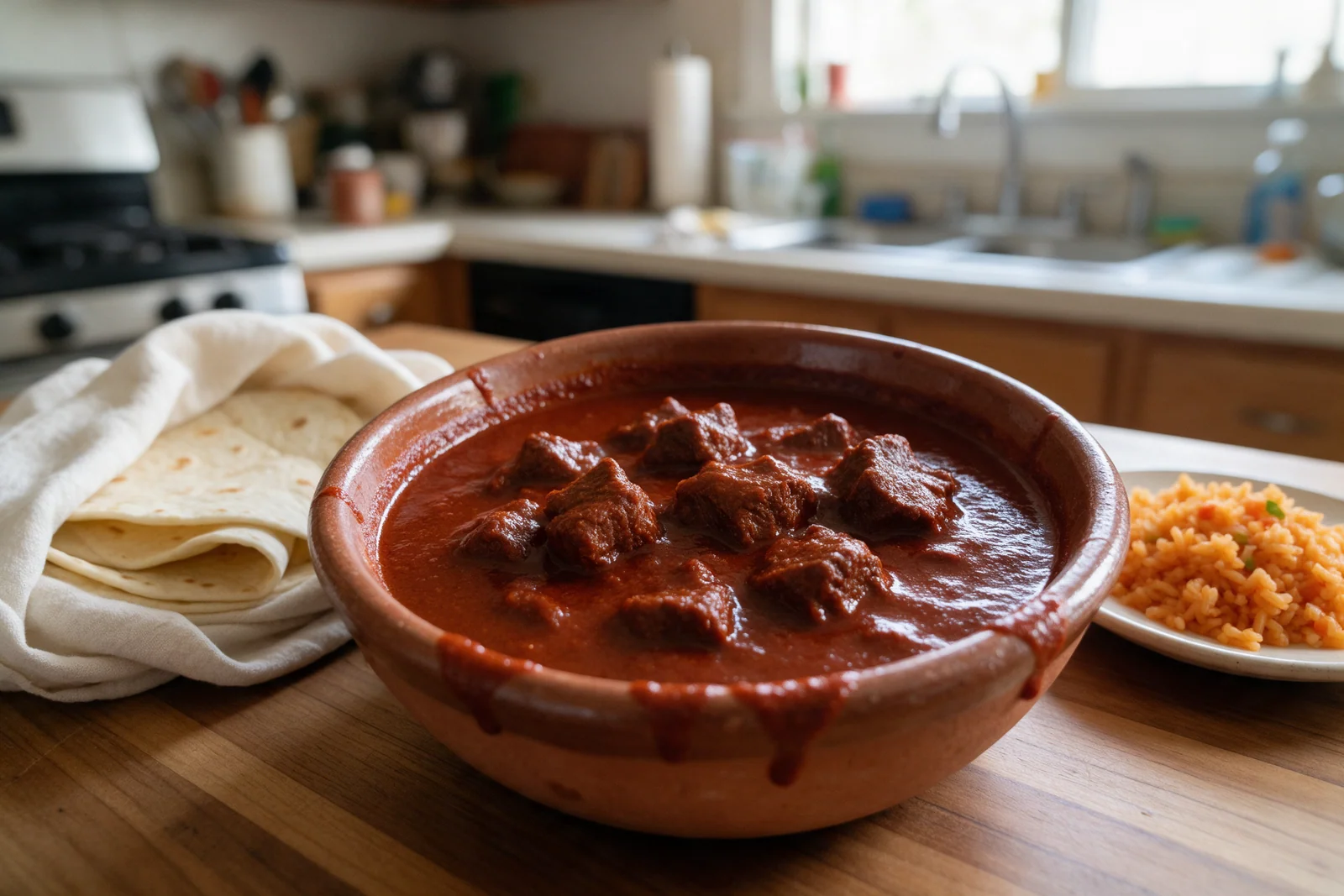

If you came here expecting a pot of ground beef, beans and chili powder, the chile colorado (CHEE-leh koh-loh-RAH-doh) of northern Mexico is a different dish. It is beef chuck in big bite-sized chunks, braised slowly in a smooth, brick-red sauce made from whole dried chiles that you toast, soak and blend yourself. “Colorado” is simply Spanish for red; the dish belongs to Chihuahua and Sonora, and it is a fixture of Mexican cooking across the US Southwest. This guide covers which dried chiles to buy in a US or UK shop, how to keep the sauce from turning bitter, stovetop, Instant Pot and slow cooker timings, and how to serve it in burritos or with rice and beans.
What is chile colorado, and how is it different from chili?
How do you make chile colorado? Toast 8 guajillo and 3 ancho chiles for 10 to 20 seconds a side, soak them for 20 minutes, then blend them with onion, garlic, cumin, oregano and fresh stock, leaving the soaking water behind. Strain, fry the sauce for 5 minutes, and simmer 2⅔ lb (1.2 kg) of browned beef chuck in it for 2 to 2½ hours. 210 minutes for 6 servings.
Think of it as a Mexican pot roast where the gravy is pure chile. The two dishes compare like this:
| Chile colorado | American chili con carne | |
|---|---|---|
| Meat | chuck in 1¼-1½ in (3-4 cm) chunks | usually ground beef |
| Chile | whole dried chiles, blended and strained | chili powder blend with cumin |
| Beans | served on the side, never in the pot | in the pot in most home versions (Texas chili skips them) |
| Tomato | none in this version, a little in some | usually plenty |
| Eaten with | flour tortillas, rice, beans | a spoon, crackers, cornbread |
In Chihuahua it is also made with dried beef, and plenty of families make it with pork. The method stays the same.
Which dried chiles to buy, and how hot it gets
There is nothing else in the sauce to hide behind, so the chiles decide the flavour. My mix is eight guajillos to three anchos.
| Chile | What it looks like | What it brings | Heat |
|---|---|---|---|
| Guajillo | long, smooth, shiny brick red | bright colour, fruity and slightly tart | mild to medium |
| Ancho (dried poblano) | wide, wrinkled, almost black | raisin-like sweetness and body | mild |
| New Mexico or California | long, smooth, red | the classic northern red chile; earthy and gentle | mild |
| Chile de árbol | small and skinny | heat, not much else | hot |
The finished dish is mild: you taste chile, not burn, and most children eat it happily. One or two árbol chiles toasted with the rest make it properly spicy.
Swaps that work. 10 to 12 New Mexico chiles instead of the guajillo and ancho give a lighter, earthier, less sweet sauce, closer to the red chile of New Mexico. All guajillo (12 of them) works too, a little sharper.
Watch the labels in the US. Some stores label anchos as “pasilla”. An ancho is broad and wrinkled; a true pasilla is long, narrow and nearly black.
Where to buy dried chiles in the US and UK
- US → bagged guajillo, ancho and New Mexico or California chiles hang in the Hispanic aisle of most big supermarkets, and Mexican grocers carry a wider range.
- UK → supermarket stock is patchy, so online Mexican grocers are the reliable route. Order before you plan the meal.
- Fresh enough? Good dried chiles bend without cracking. If they shatter like paper, they are old and taste dusty. In a sealed jar out of the light they keep for months.
The honest substitute, pure chile powder
If whole chiles are impossible, use about 7 tablespoons of pure ground ancho or New Mexico chile, the single-chile kind, not “chili powder”, which is already blended with cumin, garlic and salt. Skip the toasting and soaking, fry the powder in the oil over low heat for 1 minute, then whisk in the stock with the blended onion and garlic. Plenty of home cooks in northern Mexico do exactly this. The sauce comes out flatter and slightly gritty, but it is still recognisably chile colorado. Smoked paprika is not a substitute: it is all smoke and no fruit.
Which beef to buy
You want a braising cut with fat and connective tissue that melts over a long cook. In the US that is chuck roast; in the UK, chuck and blade or a pack labelled braising steak. Lean cuts like round or silverside go dry and stringy, and steak cuts toughen.
Allow 7 oz (200 g) raw beef per person and cut it into 1¼-1½ in (3-4 cm) cubes. Smaller pieces fall into shreds before the sauce has thickened; larger ones need an extra half hour.
Toasting and soaking without bitterness
This is the step that goes wrong, and it is measured in seconds, not minutes.
- Dry skillet, medium-low heat, no oil.
- 10 to 20 seconds a side, pressing the chile flat with a spatula.
- You’re there when the chile softens, smells toasty and darkens only a touch. Anchos are softer and burn sooner than guajillos, so keep an eye on them.
- You’ve gone too far when you see smoke or black patches, or smell something acrid. Throw that chile out; one burnt one can be tasted through the whole pot.
Soak in just-boiled water, off the heat, for 20 minutes. Then pour the soaking water away: it carries the bitterness out of the skins. Blend with fresh stock or water.
Should you strain the sauce?
I always do. Guajillo skins are tough, and even a good blender leaves fine threads that you feel on the tongue and that catch on the bottom of the pot. A fine-mesh sieve and a spoon take 2 minutes. With a high-powered blender, you can skip it if you don’t mind a more rustic texture.
How thick the sauce should be
When it’s done, the sauce coats the back of a spoon and a finger drawn through it leaves a clean line, like a thick gravy.
- Too thin → simmer uncovered for 10 to 15 minutes, stirring.
- Too thick or catching → add stock about 3 tablespoons (50 ml) at a time.
- For burritos → reduce it further, until it clings to the meat and barely runs on the plate. A wet filling soaks through the tortilla and tears it.
The flour on the beef thickens the sauce on its own and stops the fat from separating. To make it gluten-free, skip the flour and, once the beef is tender, stir in 2 tablespoons of masa harina loosened with a splash of stock and let it bubble until the sauce thickens.
Stovetop, Instant Pot or slow cooker
| Method | Time for 1¼-1½ in (3-4 cm) chuck cubes | Stock in the pot |
|---|---|---|
| Stovetop, low heat, lid ajar | 2 to 2½ hours | 2 cups (500 ml) |
| Instant Pot or pressure cooker, high pressure | 35 minutes + 15 minutes natural release | 1 cup (250 ml) |
| Slow cooker | 6 to 8 hours on low, or 3 to 4 on high | 1 cup (250 ml) |
Instant Pot. Use the Sauté function for browning and frying the sauce, then add the beef and only 1 cup (250 ml) of stock, because nothing evaporates under pressure. Scrape the bottom completely clean before you lock the lid: chile sauce is thick and is the classic trigger for the “Burn” warning. Cook 35 minutes at high pressure and let the pressure drop naturally for 15 minutes. If the beef still resists a fork, give it another 5 to 10 minutes at pressure. Finish on Sauté, uncovered, for 10 to 15 minutes to thicken the sauce. Start to finish, with toasting and browning, it’s about 1 hour 45 minutes.
Slow cooker. Brown the beef and fry the sauce in a skillet first, because the slow cooker can’t do either. Add 1 cup (250 ml) of stock. The sauce comes out thinner, so reduce it in a saucepan at the end.
Whichever you use, the test is the same: a cube breaks apart under a fork with no knife. If you have to push, it needs longer, whatever the timer says.
What goes wrong, and how to fix it
- Bitter sauce → burnt chiles, or the soaking water went into the blender. A splash more stock, 1 tsp brown sugar and a pinch of salt soften it but won’t fully rescue it. Toast less next time.
- Beef still tough after 2 hours → it needs more time, or the cut was too lean. Keep going and check every 20 minutes, loosening the sauce with stock if it gets too thick.
- Gritty or stringy sauce → it wasn’t strained, or it wasn’t blended long enough. Lift the beef out with a slotted spoon and push the sauce through a sieve now.
- Sauce catching on the bottom → heat too high or sauce too thick. Low heat, a stir every 20 to 30 minutes, and a splash of stock.
- Too hot → you can’t remove heat, only spread it: more rice, more beans and a spoonful of sour cream.
- Red fat on top → normal with chuck. Spoon it off, or chill the pot and lift it off once it sets.
How to serve chile colorado
- On a plate with Mexican red rice, frijoles de la olla or refried beans, and warm tortillas to scoop it up.
- As a burrito filling, with the sauce reduced right down, in 8-10 in (20-25 cm) homemade flour tortillas spread with Mexican refried beans. Counting about 3 oz (80 g) of cooked beef per burrito, this pot fills around 10, and the folding method in my homemade burritos guide keeps them from splitting.
- With potatoes, the way many northern families stretch it: 2 medium potatoes, peeled and cut into 1¼ in (3 cm) cubes, added for the last 40 to 45 minutes until a knife slides in.
- Toppings: chopped white onion, cilantro, crumbled queso fresco, or a melting cheese such as Monterey Jack.
For a crowd of 12, double everything and use a pot of at least 8 litres (8½ quarts). Brown the beef in more batches, because crowding makes it steam instead of crust, but keep the same simmering time. In a pressure cooker, never fill above the two-thirds line; cook two batches instead.
If you like this kind of dried-chile braise, beef birria uses a similar chile paste in a brothier stew, and Sinaloa chilorio is its pork cousin, shredded and fried in its adobo.
Make-ahead, storing and reheating
Chile colorado is better on day two, as the sauce settles and the beef soaks up the chile. Cook it the day before if you can.
- Fridge → in a sealed container, refrigerated within 2 hours of cooking, it keeps 3 to 4 days.
- Freezer → up to 3 months for best quality, flat in freezer bags or in tubs with ¾ in (2 cm) of headroom. Thaw overnight in the fridge.
- Reheating → in a saucepan over medium-low heat with a splash of stock or water, since it thickens a lot when cold. Stir until it bubbles gently or reaches 165°F (74°C) in the centre. In the microwave, covered, stirring every minute.
FAQ
Is chile colorado the same as chili con carne? No. Chile colorado is chunks of beef in a sauce made from whole dried chiles, with beans served alongside. American chili usually uses ground beef, chili powder, tomato and, outside Texas, beans in the pot.
Is chile colorado spicy? Made with guajillo and ancho, it’s mild: more flavour than heat. For real heat, toast one or two chiles de árbol along with the others.
Can I make it with pork? Yes. Use 2⅔ lb (1.2 kg) of pork shoulder in cubes with the same sauce. Pork usually turns tender sooner than beef, so start checking at 1½ hours.
How many calories are in a serving? There are 41 g of protein and about 596 kcal in the beef and sauce, without rice or tortillas, worked out with unsalted stock. Most of it comes from the fat in the chuck, so skimming the red fat off the top brings it down.
I learned to cook with dried chiles late. Back home in Venezuela, and now in Colombia, a stew gets its flavour from a fresh sofrito, not from a blender full of red paste. The first time I made this sauce I toasted the anchos the way I toast arepas, until they smoked, and the whole pot went in the bin. These days I count quietly to fifteen with every chile, and this is the filling my son Dylan asks for when we roll burritos. Josnaisis.